
AexoreX Systems LLC Advances Digital Labor-as-a-Service Model as Enterprises Rethink the Future of Work
A new enterprise approach to connecting AI intelligence, digital labor, knowledge, memory, automation, governance, and executive control
The company is developing an enterprise-oriented digital workforce model designed to extend organizational capacity across executive, technology, strategy, security, and operational functions—from emerging businesses to globally scaled enterprises.
Advertorial · Opinion · Analysis · AI-assisted, human edited
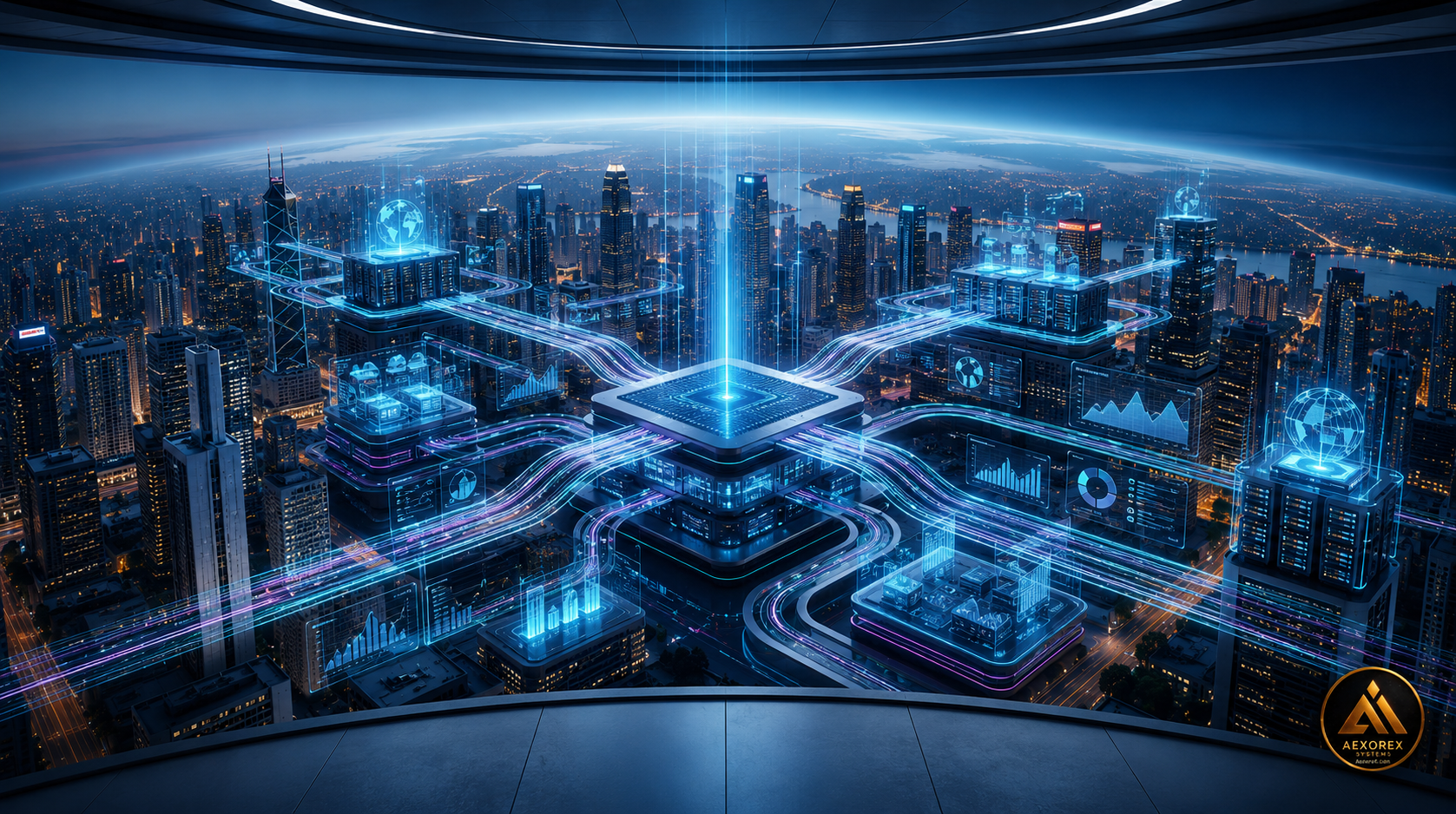
Global — August 20, 2026 — The rapid evolution of artificial intelligence is beginning to reshape a fundamental assumption of modern business: that organizational capacity must scale primarily through human headcount, conventional software, and increasingly complex operating structures.
A new generation of AI agents is creating the possibility of a different model—one in which software-based workers can perform defined roles, execute workflows, interact with enterprise systems, and operate continuously under established policies and human oversight.
AexoreX Systems LLC is currently developing an approach to this emerging category through Digital Labor-as-a-Service (LaaS), with the broader objective of enabling organizations to provision digital workforce capacity alongside their human workforce.
The initiative remains in its product development and platform-building stage. AexoreX Systems LLC is developing the underlying technology, architecture, governance model, and operating framework required to support enterprise-grade digital labor rather than presenting the concept as a fully deployed global workforce platform.
The development comes as enterprises increasingly move beyond experimental AI deployments toward agentic systems capable of executing multi-step processes. Deloitte's 2026 research describes the transition toward digital workforces and emphasizes that scaling agentic AI is increasingly a leadership, operating-model, and governance challenge—not simply a technology deployment exercise.
From AI Assistants to Digital Workers
Much of the first generation of enterprise AI focused on assistants, copilots, chat interfaces, and task-specific automation.
These systems generally remained subordinate to a human operator.
Digital Labor represents a broader concept.
A digital worker can be designed around a defined organizational role, equipped with access to approved knowledge and systems, assigned specific responsibilities, and governed by policies that determine what it may observe, recommend, approve, or execute.
The distinction is important.
A chatbot answers.
An automation executes a predefined sequence.
An AI assistant supports a human.
A digital worker is designed around a function of work.
That function may involve research, monitoring, coordination, analysis, customer operations, technology operations, reporting, or other digitally executable workflows.
The emerging enterprise model is therefore less about adding another AI application and more about introducing a new layer of organizational capacity.
Deloitte's current research similarly describes organizations moving toward operating models in which humans and AI agents work alongside one another, with agents increasingly able to make and execute decisions within defined environments.
---
The Emergence of Digital Executive Roles
As Digital Labor matures, its application may extend beyond individual tasks toward functional and managerial responsibilities.
AexoreX Systems LLC is developing this concept around a potential hierarchy of digital workforce capabilities.
Digital CEO
A Digital CEO is envisioned as a software-based executive intelligence worker supporting areas such as:
- enterprise intelligence;
- strategic monitoring;
- business performance analysis;
- executive reporting;
- opportunity identification;
- strategic planning support;
- cross-functional coordination; and
- decision-support workflows.
The role is not intended to replace the legal authority, fiduciary responsibility, accountability, or human judgment of an actual corporate CEO.
Instead, it represents an intelligent executive operating layer designed to expand the capacity of human leadership.
Digital CTO
A Digital CTO is envisioned around technology and infrastructure responsibilities, including:
- technology intelligence;
- architecture analysis;
- technology strategy support;
- infrastructure monitoring;
- engineering workflow coordination;
- technology evaluation;
- technical risk identification; and
- enterprise technology reporting.
The objective is to provide continuous technology intelligence and operational support without implying that software assumes the legal or organizational responsibilities of a human CTO.
Digital CSO
The Digital CSO concept can support strategic and security-oriented functions depending on the organization's defined mandate.
Potential capabilities include:
- strategic intelligence;
- risk monitoring;
- competitive intelligence;
- security intelligence;
- policy monitoring;
- organizational risk analysis;
- escalation management; and
- executive reporting.
The exact scope of a Digital CSO must be determined by the organization's governance framework and whether CSO refers to Chief Strategy Officer or Chief Security Officer.
This distinction is particularly important in enterprise environments where authority, accountability, and access controls must be explicit.
---
Digital Employees as a New Workforce Layer
The broader concept behind these roles is the development of Digital Employees.
A Digital Employee is a software-based worker designed to perform an assigned organizational function under defined policies, permissions, workflows, and governance controls.
Potential digital employees may eventually support:
- Digital Executive;
- Digital Operations;
- Digital Finance;
- Digital Sales;
- Digital Marketing;
- Digital Customer Support;
- Digital Research;
- Digital HR;
- Digital IT;
- Digital Security;
- Digital Data;
- Digital Compliance; and
- other enterprise functions.
The objective is not simply to automate isolated tasks.
It is to create a scalable digital workforce layer that can operate alongside human employees.
This distinction is increasingly relevant as enterprises experiment with agentic AI. Deloitte's 2026 research notes that the workforce impact of AI is moving toward new models of human-agent collaboration, with employees increasingly required to orchestrate, supervise, and assure digital labor.
---
Digital Labor-as-a-Service
The Labor-as-a-Service (LaaS) model introduces a different way of thinking about organizational capacity.
Traditionally, businesses acquire workforce capacity through:
- hiring;
- outsourcing;
- consulting;
- contractors; and
- software.
Digital Labor potentially introduces another layer:
«Organizations can provision software-based workforce capacity as a service.»
Under a LaaS model, a company could potentially provision a digital worker for a defined function, connect that worker to approved enterprise systems, establish permissions and policies, monitor performance, and scale the workforce according to operational demand.
For smaller companies, this could create access to capabilities that might otherwise require significant investment in specialized personnel or enterprise software.
For mid-sized organizations, Digital Labor could provide additional operational capacity without requiring proportional growth in organizational complexity.
For large enterprises, digital workers could eventually become part of a broader workforce architecture operating across departments, business units, geographies, and systems.
The underlying proposition is therefore not simply cheaper automation.
It is elastic organizational capacity.
---
From Software Applications to Workforce Infrastructure
The transition from AI assistant to Digital Labor introduces a significant architectural challenge.
A production-grade digital worker cannot rely solely on a foundation model.
It requires an infrastructure layer capable of controlling:
- identity;
- authentication;
- authorization;
- enterprise knowledge;
- memory;
- workflows;
- orchestration;
- system integrations;
- observability;
- security;
- governance;
- auditability;
- escalation; and
- human oversight.
This means the future of Digital Labor is closely connected to enterprise architecture.
The question is no longer simply:
«"Which AI model should the company use?"»
It increasingly becomes:
«"How should intelligence, people, digital workers, systems, and governance operate together?"»
Deloitte's 2026 work on scaling agentic AI similarly identifies technical, organizational, and governance elements as necessary to move agentic AI from experimentation toward enterprise-scale business value.
---
AexoreX Systems LLC and the Development of an Enterprise Intelligence Infrastructure
AexoreX Systems LLC is developing this broader vision through its Enterprise Intelligence Infrastructure strategy.
At the center of that strategy is AEOS QUANTUM™, an Enterprise Intelligence Operating Platform being developed to connect intelligence, knowledge, memory, workflows, orchestration, governance, security, and Digital Labor within an enterprise-oriented architecture.
The platform remains under active development.
The long-term objective is to establish an infrastructure in which human employees and Digital Labor can operate within the same organizational environment while maintaining clearly defined responsibilities, permissions, governance, and accountability.
In this model:
Human Workforce
+
Digital Workforce
+
Enterprise Intelligence Infrastructure
become complementary components of a modern enterprise operating model.
---
Designed for Organizations of Different Scales
One of the central principles behind the LaaS concept is accessibility across organizational scale.
A digital workforce architecture should not be limited exclusively to multinational corporations.
A small technology company may require a digital research worker.
A growing business may require digital customer operations.
A mid-market company may require digital finance, technology, or security support.
A large enterprise may require hundreds or thousands of specialized digital workers operating across multiple functions.
The architecture therefore needs to support a spectrum of organizational complexity rather than assume that every company has the resources of a Fortune Global enterprise.
This could make Digital Labor particularly relevant to businesses seeking enterprise-grade capabilities without building every function internally.
---
Governance Will Define the Enterprise-Grade Digital Workforce
The most important question surrounding Digital Labor may not be how autonomous a system can become.
It may be how safely and predictably that autonomy can be governed.
Enterprise digital workers must operate within clearly defined boundaries.
Questions include:
What information can the worker access?
Which systems can it interact with?
What decisions can it make?
Which actions can it execute?
Which actions require human approval?
How are actions recorded and audited?
How is responsibility assigned when an automated process fails?
These questions become increasingly important as AI agents receive greater operational authority.
Recent enterprise discussions have highlighted identity, authorization, governance, and human oversight as critical considerations for agentic systems operating inside corporate environments.
For AexoreX Systems LLC, governance is therefore not an optional layer added after automation.
It is intended to be part of the architecture from the beginning.
---
The Development Path Toward the Autonomous Enterprise
AexoreX Systems LLC's broader development vision follows an evolutionary path:
Manual Business
↓
Digital Business
↓
Intelligent Business
↓
AI-Powered Business
↓
Digital Labor Enterprise
↓
Autonomous Enterprise
The transition is not expected to happen simultaneously for every organization.
Different companies will move at different speeds depending on their technology maturity, workforce, regulatory environment, data architecture, and risk profile.
The underlying direction, however, is becoming increasingly visible: enterprises are beginning to experiment with systems capable of sensing, reasoning, planning, coordinating, and executing work across digital environments.
---
The Future Workforce May Be Human and Digital
The emerging Digital Labor model does not necessarily imply a binary choice between humans and machines.
A more likely enterprise model is a workforce composed of both.
Human employees bring:
- judgment;
- leadership;
- creativity;
- empathy;
- accountability;
- relationship management;
- ethical reasoning; and
- strategic decision-making.
Digital workers can provide:
- continuous monitoring;
- high-volume information processing;
- research;
- workflow execution;
- coordination;
- structured analysis;
- repetitive digital operations; and
- always-on operational capacity.
The organizational advantage may therefore come not from replacing one workforce with another, but from orchestrating both as a unified operating system for work.
---
From Digital Labor to Enterprise Intelligence
The long-term significance of Digital Labor extends beyond automation.
If digital workers can understand enterprise context, access authorized systems, retain relevant memory, coordinate workflows, and operate within governance boundaries, they become part of an organization's intelligence infrastructure.
This creates the possibility of a new enterprise architecture:
People
↓
Digital Workers
↓
Enterprise Intelligence
↓
Systems and Data
↓
Business Operations
↓
Governance and Control
Such an architecture could eventually enable organizations to operate with a higher degree of intelligence, responsiveness, and scalability.
For AexoreX Systems LLC, this is the broader strategic context in which Digital Labor-as-a-Service is being developed.
---
A Category Still Being Defined
Digital Labor-as-a-Service remains an emerging concept.
Its commercial models, governance standards, security frameworks, regulatory implications, workforce economics, and organizational practices will continue to evolve as enterprise adoption of agentic AI expands.
The technology is also moving faster than many organizations' operating models.
Deloitte's 2026 research indicates that enterprise AI adoption is advancing while many organizations continue to face gaps in infrastructure, data, risk management, talent, and governance.
The next phase of enterprise AI may therefore depend less on simply building more capable models and more on building the infrastructure required to deploy intelligence responsibly at organizational scale.
For AexoreX Systems LLC, the current development effort is focused on that broader challenge.
The company's long-term objective is to help define an architecture in which human intelligence, artificial intelligence, Digital Employees, and enterprise systems can operate together as a governed, scalable, and continuously improving organizational workforce.
The transition from AI assistant to Digital Labor may ultimately represent more than another stage in software development.
It may represent the emergence of a new organizational layer:
«Software-based labor operating alongside human talent as part of the enterprise itself.»
---
About AexoreX Systems LLC
AexoreX Systems LLC is a technology company developing Enterprise Intelligence Infrastructure for the evolution of modern organizations toward intelligent and autonomous operating models.
The company is currently in the development and build phase of its technology platform and related Digital Labor architecture.
Its primary platform initiative, AEOS QUANTUM™, is being developed as an Enterprise Intelligence Operating Platform for Autonomous Enterprises, with an architectural focus spanning enterprise intelligence, knowledge, memory, workflow orchestration, governance, security, and Digital Labor.
AexoreX Systems LLC's development vision is global in scope, with the long-term objective of supporting organizations ranging from emerging businesses and small-to-medium enterprises to large multinational and Fortune Global organizations.
---
AEXOREX NEWSROOM™
Global Technology, Business & Market Intelligence
News. Analysis. Markets. Intelligence.
Understand What Matters. Anticipate What's Next.
Sources and attribution
- Ahmad Barizi · statement link
About the author
AexoreX Technology Desk is the newsroom's editorial desk covering enterprise technology, artificial intelligence, digital labor, automation, and emerging enterprise systems.
More from AexoreX Technology Desk →