
AexoreX Systems Simplifies Its Newsroom Publishing Workflow
AexoreX Systems is simplifying the AexoreX Newsroom publishing workflow by moving technical publishing complexity into automation while preserving editorial governance and safe revision-based editing
Opinion · AI-assisted, human edited
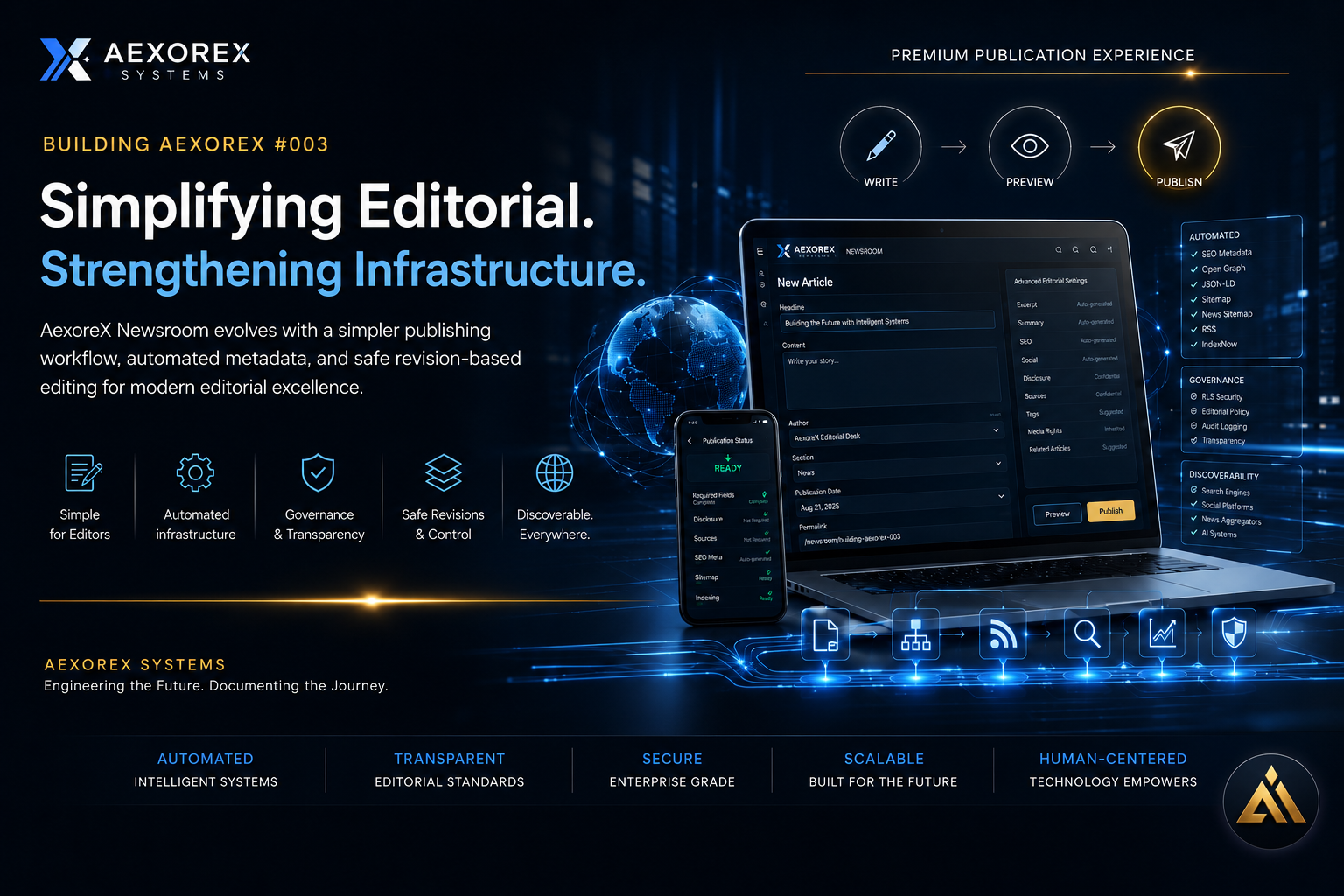
AexoreX Systems is advancing the development of its official corporate publication, AexoreX Newsroom. The focus is on simplifying the publishing process for human editors by shifting operational complexity to the underlying publishing infrastructure.
The latest development specifically targets the editorial workflow.
Streamlining Editorial Workflow
Instead of requiring editors to manually manage numerous metadata fields for each article, the Newsroom is adopting a simpler principle: "Complexity belongs in the system, not in the editor."
The objective is to enable article writing, review, and publication without editors needing to manually configure every technical publishing component.
From Manual Configuration to Automated Publishing
A modern digital publication involves significantly more than just the article body. Behind every published article are elements like metadata, structured data, canonical URLs, social sharing information, XML sitemaps, RSS feeds, and search discovery mechanisms.
Manually managing each of these components would create unnecessary editorial overhead. Therefore, AexoreX Systems is automating these functions.
Editors should primarily concentrate on the core substance of the publication, including:
- the headline;
- the article content;
- the author;
- the editorial section;
- the featured image;
- the publication date; and
- the permanent URL.
The publishing system then handles appropriate technical metadata and distribution mechanisms automatically in the background. This approach keeps the editorial interface relatively simple, while the underlying infrastructure maintains its enterprise-level capabilities.
Maintaining Editorial Governance
Simplification does not mean abandoning editorial controls. Some information is inherently dependent on an article's nature.
For instance, AI-assisted content may require disclosure, and sponsored content demands transparency. Certain editorial types might also require source attribution. These requirements are conditional, applied only when relevant, rather than universally imposed on every article.
This distinction is crucial: optional metadata should not impede publication, but genuine editorial requirements must still be enforced when applicable. This balances operational simplicity with essential editorial discipline.
Advanced Settings Without Editorial Overhead
The Newsroom's editorial interface is structured into a primary writing experience and a secondary layer for advanced settings. The primary editor focuses on the information necessary to create a publication.
Advanced settings can include additional controls for areas such as:
- excerpt and machine-readable summary;
- SEO metadata;
- social metadata;
- disclosure;
- sources;
- tags;
- media provenance; and
- related content.
This separation ensures technical configuration options are available without cluttering the main writing workflow. The goal is to make the Newsroom easier to operate while retaining the capabilities required by a modern corporate publication.
Editing Published Articles Safely
Another key development is the ability to edit an article after publication without immediately altering the live version. Published articles can now be opened for manual editing via the Newsroom's editorial interface.
When an existing published article is edited, the system creates a working revision linked to the original article. The workflow is:
Published Article → Edit → Save Revision → Preview → Publish Update
This means saving a revision does not instantly replace the live article. Editors can make changes, review the proposed version, and then decide if the revision should become the new published version. This provides a safer editing model for an evolving corporate publication.
Protecting the Published Version
The distinction between the live version and the working revision is particularly important for an institutional publication. A published article typically already has a canonical URL, search engine references, social shares, RSS distribution, and other discovery signals.
Editors should be able to update an article without inadvertently changing the public version simply by saving an intermediate edit. The Newsroom's working-revision model is designed around this separation. Only an explicit "Publish Update" action applies the revision to the live article.
Automation Behind the Scenes
Once an article is published or updated, the Newsroom continues to operate its existing technical publishing infrastructure. Depending on the publication state and workflow, this includes:
- canonical URL management;
- structured data;
- XML sitemap updates;
- News Sitemap updates;
- RSS updates;
- social metadata;
- IndexNow submission;
- indexing event logging; and
- related publication jobs.
The purpose is not to guarantee search engine indexing or ranking. Instead, the objective is to maintain a technically coherent publication environment where legitimate content can be discovered, processed, and evaluated by external systems.
A Simple Editorial Principle
This development reflects a broader principle AexoreX Systems applies to its technology architecture: the interface should remain simple even when the underlying infrastructure is sophisticated.
For the Newsroom, this means publishers should not need to understand every technical mechanism involved in publishing a modern web article. The system should automatically handle appropriate technical operations, while the human editor retains responsibility for editorial decisions.
Building the Publication While Building the Company
AexoreX Newsroom remains an integral part of the broader development of AexoreX Systems. The company is simultaneously building its corporate presence, technology infrastructure, products, operational systems, and institutional processes.
The Newsroom serves as both a distribution channel and a record of these developments. The "Building AexoreX" series documents this process incrementally. The objective is not to artificially create milestones but to record meaningful developments as they occur.
What Comes Next
Newsroom development will continue incrementally. Future work may include further refinement of editorial automation, publication workflows, discovery infrastructure, content organization, and documentation of the ongoing development of AexoreX Systems and AEOS QUANTUM™.
Each capability will be documented according to its actual development state. Completed functionality will be described as such. Work in development will remain identified as in progress. Future objectives will remain future objectives. This distinction is central to maintaining a reliable institutional record.
The Principle
AexoreX Systems is building its company and technology infrastructure one development at a time. The evolution of AexoreX Newsroom follows this same approach.
The goal is not to create a complicated publishing system for its own sake. The goal is to create a publication that is simple to operate, technically sound, transparent in its development, and capable of growing alongside the company.
"Building AexoreX #003" represents another step in that process.
Sources and attribution
- company-building documentation · statement
About the author
The editorial team behind AexoreX Newsroom, the official corporate publication of AexoreX Systems LLC.
More from AexoreX Systems Editorial Team →