
Enterprise AI Moves Beyond Chatbots as Companies Build Intelligence Infrastructure for Autonomous Operations
Enterprise AI is evolving beyond chatbots towards building intelligence infrastructure that connects reasoning, knowledge, workflows, and execution for autonomous operations.
Opinion · AI-assisted, human edited
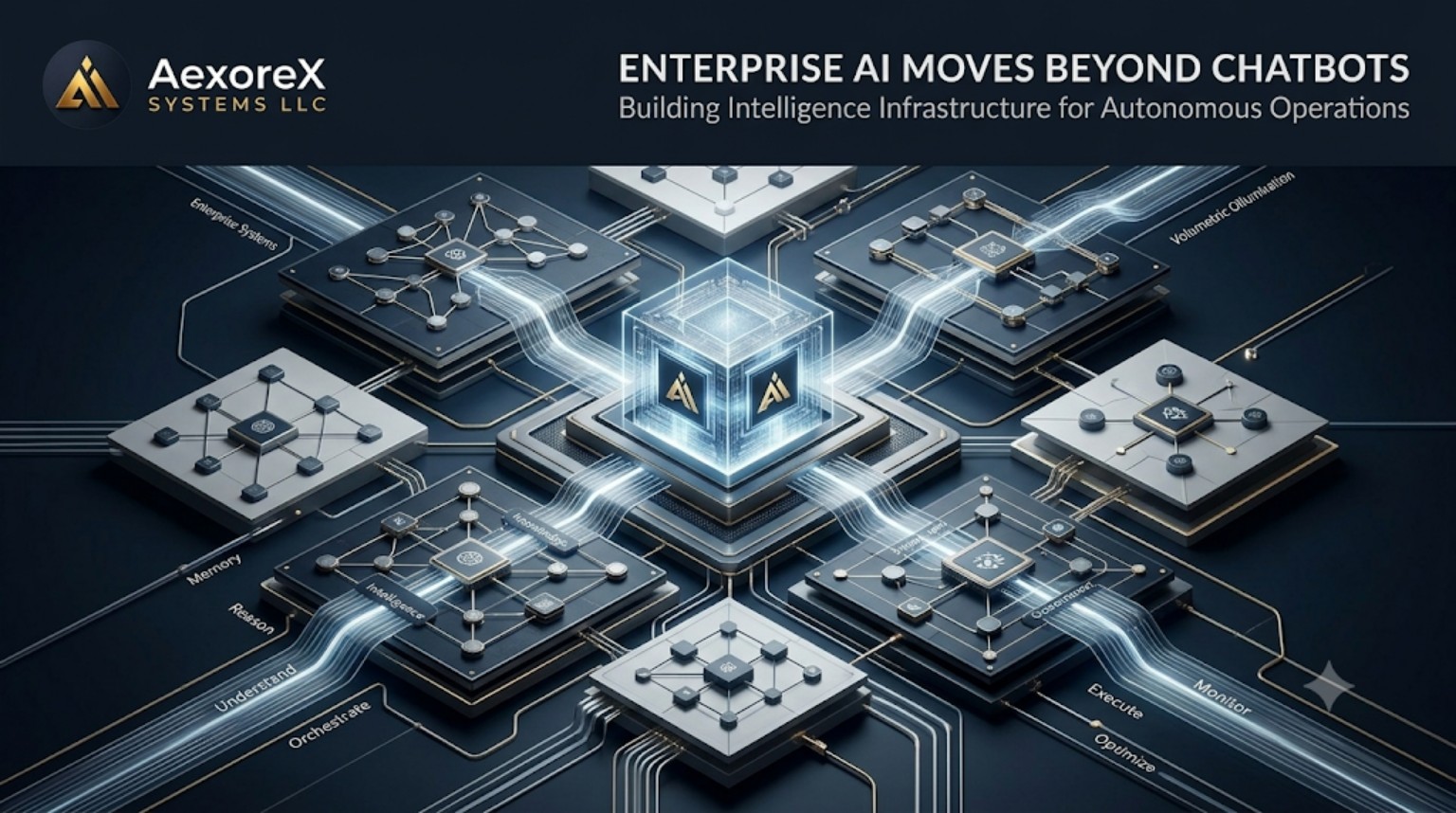
Enterprise AI Moves Beyond Chatbots
The enterprise AI market is entering a new phase. Organizations are moving beyond conversational assistants and beginning to explore infrastructure designed to connect intelligence with knowledge, workflows, systems, governance, and digital execution.
For much of the recent AI cycle, enterprise adoption centered on copilots, chat interfaces, document analysis, and individual productivity tools. While these applications established the value of generative AI inside organizations, they also exposed a larger challenge: intelligence alone does not execute an enterprise operation. The next stage is increasingly about connecting intelligence to the operating environment of the business.
From AI Assistance to Enterprise Execution
A conventional AI assistant primarily responds to a request. In contrast, an autonomous enterprise system must operate across a broader sequence: understand, retrieve knowledge, reason, decide, orchestrate, execute, monitor, learn, and optimize. This requires more than just a language model.
Enterprise operations depend on data sources, applications, business rules, permissions, approvals, human oversight, auditability, and continuously changing operational context. Therefore, an intelligence layer needs to interact with the systems where work actually occurs. This is creating demand for a broader category of infrastructure: platforms that coordinate intelligence, enterprise context, workflow execution, and digital labor within a controlled operating environment.
The Infrastructure Gap
Most enterprises already operate extensive technology stacks. CRM platforms manage customer relationships, ERP systems manage financial and operational processes, collaboration platforms manage communication, data platforms manage information, and automation platforms connect applications. AI introduces another capability: reasoning. The unresolved question is how these capabilities operate together.
Without an orchestration layer, organizations can end up with isolated AI deployments. Each deployment might understand a narrow slice of the enterprise but cannot reliably coordinate actions across systems. The resulting challenge is not simply an AI-model problem; it is an enterprise infrastructure problem.
A New Enterprise Intelligence Layer
This emerging architecture can be understood as an intelligence layer positioned between enterprise systems and operational execution. At its center is an intelligence capability capable of interpreting goals and context.
Around this core are several supporting layers: - **Knowledge** for organizational information and domain context - **Memory** for persistent operational context - **Connectors** for enterprise systems and external services - **Orchestration** for multi-step processes - **Digital Labor** for repeatable operational execution - **Governance** for policies, approvals, permissions, and accountability - **Control Towers** for monitoring and operational visibility - **Human Oversight** for decisions requiring review or intervention
The objective is not to replace every existing enterprise application. Instead, the objective is to make those systems increasingly accessible to an intelligent operating layer.
The Rise of Digital Labor
One of the most significant developments in this transition is the emergence of what can broadly be described as digital labor. Traditional automation executes predefined instructions. Digital labor, however, introduces systems capable of interpreting objectives, interacting with tools, handling structured and unstructured information, and coordinating multiple steps of work.
The distinction matters. A workflow might execute: "If X happens, then perform Y." A digital worker may instead receive: "Resolve this operational objective within these policies and constraints." This requires contextual reasoning, tool access, state management, escalation logic, and governance.
As these capabilities mature, enterprises may increasingly organize digital labor into different levels of responsibility—from task execution to coordination and, eventually, higher-level operational management.
Governance Becomes Infrastructure
Greater autonomy also increases the importance of governance. An enterprise cannot simply give an AI system access to critical applications and allow unrestricted execution. Autonomous operations require controls around identity, permissions, role-based access, approvals, action boundaries, audit trails, human escalation, policy enforcement, monitoring, and accountability.
This means governance cannot remain an afterthought; it becomes part of the infrastructure itself. The more capable an intelligent system becomes, the more important it is to understand not only what the system can do but also who authorized it, what information it used, which policies applied, what action it performed, and what happened afterward.
AexoreX Systems and the Enterprise Intelligence Infrastructure Thesis
AexoreX Systems LLC is developing AEOS QUANTUM™, which is positioned as an enterprise intelligence operating platform for autonomous enterprises. The company's architecture is centered on the idea that enterprise intelligence should operate as an infrastructure layer rather than as an isolated chatbot or standalone productivity application.
The platform concept brings together intelligence, knowledge, memory, orchestration, digital labor, governance, connectivity, and operational visibility. Its broader thesis is that enterprises will require an operating environment capable of coordinating increasingly autonomous digital work while maintaining organizational control.
This represents a different architectural perspective from simply deploying generative AI applications across individual departments. Instead of asking where an organization can add another AI assistant, the infrastructure question becomes: "How does intelligence become an operational capability of the enterprise itself?"
Why This Shift Matters
The implications extend beyond technology procurement. If enterprise intelligence becomes infrastructure, organizations may eventually reconsider how digital work is structured. Some processes currently divided between employees, software applications, workflow automation, and outsourced services could become coordinated through intelligent digital workers operating under defined policies.
That does not necessarily mean eliminating human involvement. In many environments, the more realistic model is a combination of human judgment, machine intelligence, and governed digital execution. Humans remain responsible for strategic decisions, exceptions, accountability, and activities requiring human judgment, while digital labor handles increasingly sophisticated operational workloads.
The Enterprise Operating Model Is Changing
The most important shift may, therefore, be conceptual. The first generation of enterprise AI asked: "How can employees use AI?" The next generation is asking: "How can an enterprise operate with intelligence embedded throughout its digital infrastructure?" That distinction is significant. The former treats AI as a tool available to employees, while the latter treats intelligence as an operational capability connected to the organization's systems, knowledge, workflows, policies, and digital workforce. If this direction continues, enterprise technology architecture may increasingly evolve from application-centric systems toward intelligence-centric operating environments.
What Comes Next
The transition will not happen uniformly. Enterprises will continue to require conventional software, deterministic automation, databases, human-operated workflows, and specialized applications. The emerging architecture is more likely to be additive: intelligence layers connecting and coordinating existing infrastructure while gradually assuming responsibility for selected categories of digital work.
The organizations best positioned for this transition may, therefore, not be those that deploy the largest number of AI tools. They may be those that build the strongest foundation for connecting intelligence, context, execution, and governance. That is the infrastructure challenge emerging beneath the current AI application wave, and it may ultimately define the next phase of enterprise software.
Sources and attribution
- AexoreX Systems · statement link
About the author
AexoreX Technology Desk is the newsroom's editorial desk covering enterprise technology, artificial intelligence, digital labor, automation, and emerging enterprise systems.
More from AexoreX Technology Desk →Related stories
- AexoreX Systems LLC Advances Digital Labor-as-a-Service Model as Enterprises Rethink the Future of Work
- Building AexoreX #004 — From AI Tools to Enterprise Intelligence Infrastructure
- AexoreX Newsroom #005 Building an Autonomous Search-Ready Publication Infrastructure
- AexoreX Systems Advances AEOS QUANTUM™ Toward a New Architecture for Autonomous Enterprise Operations