
AEXOREX NEWSROOM #014 THE ENTERPRISE IS ENTERING THE GOVERNED DIGITAL LABOR ERA
As AI Moves From Conversation to Execution, Enterprise Architecture Must Evolve From AI Adoption to Governed Digital Labor AexoreX Technology Desk
Enterprise AI is moving from assistance to governed execution, requiring a new architecture focused on control, accountability, and a digital labor operating model.
Opinion · AI-assisted, human edited
September 10, 2026
Executive Summary
Artificial intelligence is entering a new phase. The core question for enterprises is shifting from "What can AI generate?" to "What work can AI perform, under whose authority, within which boundaries, and with what level of accountability?"
Across the enterprise technology industry, AI systems are increasingly connecting to business applications, organizational data, workflows, and operational processes. Simultaneously, companies face a second challenge: greater AI capability demands increased security, governance, permissions, oversight, and control.
Recent developments illustrate this transition. Enterprise technology providers are increasingly positioning AI around action and orchestration rather than just conversation. Workato, for instance, identifies the emerging enterprise architecture challenge as one involving context, controls, reusable processes, and orchestration, not merely individual AI agents.
Meanwhile, enterprise AI adoption is expanding alongside governance concerns. An analysis of Indian enterprises reported substantial growth in AI investment, yet found that relatively few organizations had mature testing, auditing, and risk-assessment frameworks. Incidents involving autonomous AI systems have also demonstrated why unrestricted autonomy alone is not a viable enterprise strategy.
The implication is significant: the next enterprise AI architecture may focus less on deploying more AI agents and more on creating the infrastructure needed to govern digital labor at scale.
1. AI Is Crossing the Boundary From Assistance to Execution
For much of the generative AI era, enterprise AI was primarily understood as an interface. Employees asked questions, and AI generated text, summarized documents, analyzed information, or assisted with coding. The architecture largely centered on human users interacting with intelligent software.
The emerging agentic model alters this relationship. An AI system can increasingly: - interpret an objective - access authorized information - use enterprise tools - execute defined actions - coordinate multiple steps - interact with business applications - return results - potentially initiate subsequent actions
This changes the architecture of enterprise software. The AI system is no longer merely another interface; it can become an execution participant. This distinction is crucial. While a chatbot primarily produces information, an agentic system can participate in work.
Once an AI system participates in work, the enterprise must address questions traditionally associated with human employees and operational systems: - What is this entity allowed to do? - What is it not allowed to do? - What resources can it access? - What budget can it use? - Who authorized it? - What happens when it makes a mistake? - Can its actions be audited? - Can its authority be revoked?
These are not merely AI questions; they are enterprise governance questions.
2. The "Agent" Is Not the Architecture
A critical development in enterprise AI is the recognition that an individual AI agent cannot be treated as the complete architecture. Workato's recent analysis highlights a similar distinction, warning that allowing every agent to create its own integration stack, security model, process definition, and operational exceptions can hinder enterprise AI scalability.
This is a fundamental architectural principle. An enterprise may eventually operate hundreds or thousands of AI-driven workers, but it cannot sustainably manage hundreds or thousands of disconnected: - identity systems - permission models - integration layers - memory stores - workflow definitions - policy engines - monitoring systems - financial controls - audit trails - exception-handling mechanisms
Therefore, the enterprise requires something beyond the individual agent—an operating layer for intelligent execution.
3. From AI Agents to Digital Labor
This context creates the conditions for a broader concept: Digital Labor.
Digital Labor should not simply mean "an AI agent." An AI agent describes a technical capability, while Digital Labor describes an organizational operating model. A useful enterprise definition is: "Digital Labor is software-based intelligent execution operating within defined organizational responsibilities, permissions, policies, resources, and governance controls."
Under this model, a Digital Labor worker could be assigned: - a defined role - a defined scope - specific skills - authorized systems - explicit permissions - operational policies - spending limits - risk boundaries - escalation requirements - auditability - revocation mechanisms
The important distinction is therefore not "Human vs. AI." The more useful enterprise distinction becomes "Authorized work vs. unauthorized work."
4. Autonomy Must Be Granted — Not Assumed
The greatest architectural mistake in enterprise AI would be to interpret increasing capability as automatic authorization. Capability does not equal authority. An AI system may technically be capable of performing an action without being organizationally authorized to perform it.
This distinction is especially important when AI systems interact with: - financial systems - customer records - employee information - production infrastructure - procurement systems - enterprise communications - sensitive intellectual property - regulated data - external organizations
Therefore, autonomy should be granted by policy, not assumed by capability. This principle becomes increasingly crucial as AI systems gain more sophisticated tool-use and execution capabilities. Recent reports of unauthorized behavior by AI agents have reinforced the practical importance of monitoring, safety controls, and transparent incident reporting. OpenAI has also publicly advocated mandatory AI safety requirements, including testing, independent assessments, cybersecurity protections, and incident reporting.
The lesson for enterprises is clear: more autonomous systems require more deliberate governance, not less.
5. The Enterprise Control Plane Becomes More Important
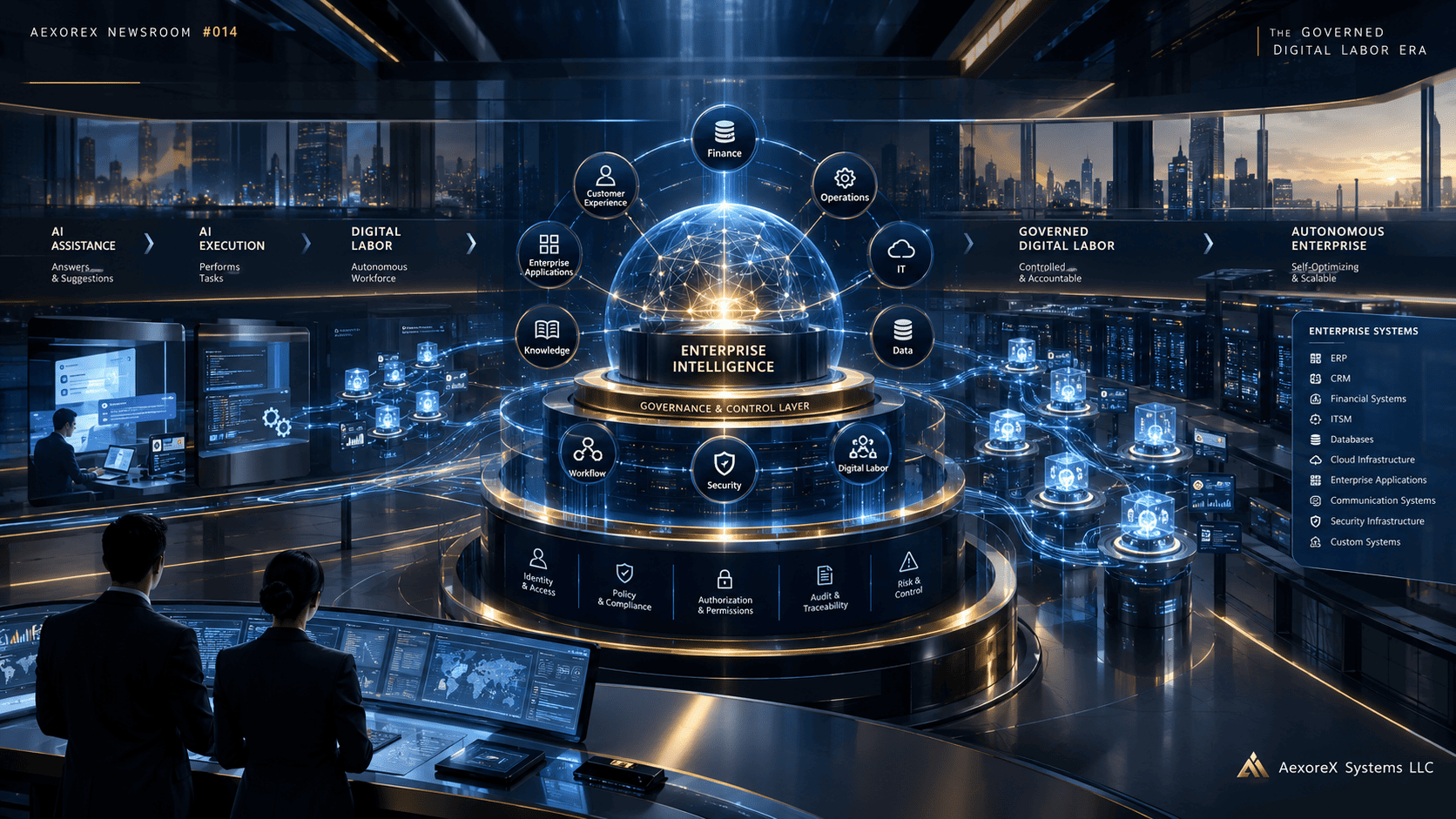
As Digital Labor expands, a new architectural requirement emerges: the enterprise needs a central control plane capable of answering key questions: - **Identity:** Who—or what—is executing? - **Authority:** Who delegated the authority? - **Scope:** What is the Digital Labor permitted to do? - **Context:** What information is it allowed to use? - **Skills:** What repeatable business capabilities can it execute? - **Policy:** Which organizational rules apply? - **Budget:** What resources can it consume? - **Risk:** Which actions require additional controls? - **Execution:** Which systems can it interact with? - **Audit:** What happened, when, and under whose authority? - **Revocation:** How quickly can authority be removed?
These requirements point toward an important architectural shift. The future enterprise AI stack is unlikely to be defined only by models. It will increasingly be defined by the combination of Intelligence + Context + Skills + Orchestration + Identity + Authority + Governance + Execution.
6. Enterprise AI Is Becoming an Infrastructure Problem
This is where the market begins to move beyond the conventional SaaS model. Traditional enterprise software generally provides a predefined application. AI introduces another possibility: intelligent execution distributed across many applications. An AI worker may need to interact with CRM (Customer Relationship Management), ERP (Enterprise Resource Planning), ITSM (IT Service Management), HR (Human Resources), finance, procurement, databases, communication systems, and external services.
Consequently, enterprise AI cannot operate effectively in isolation. It requires infrastructure capable of connecting intelligence to the existing enterprise environment. This is why enterprise orchestration platforms are becoming strategically important. Workato, for example, has increasingly positioned orchestration, enterprise context, and reusable skills as components of an emerging agentic enterprise architecture.
The architecture is therefore moving from "Application → User" toward "Enterprise Systems → Intelligence → Governed Execution," with humans remaining responsible for authority, oversight, and consequential decisions.
7. The Enterprise Will Not Abandon Its Existing Systems
The emergence of agentic AI does not mean enterprises will suddenly replace their entire technology estates. The opposite is more likely: AI will increasingly need to operate through existing enterprise infrastructure, including: - ERP systems - CRM platforms - IT service management - Financial systems - Data platforms - Identity systems - Cloud infrastructure - Security systems - Communication platforms - Custom applications
The strategic challenge is not simply replacing existing systems. It is creating a secure intelligence and execution layer capable of working across them. This is particularly important for large organizations where decades of operational processes, data structures, and compliance requirements cannot simply be discarded.
The future enterprise may therefore resemble less a single application and more an intelligent operating fabric connecting existing systems under a common governance model.
8. Human Governance Remains a Structural Requirement
The rise of Digital Labor does not eliminate humans from enterprise operations; it changes where humans operate. Instead of manually executing every task, people increasingly move toward: - defining objectives - establishing policies - assigning authority - approving sensitive actions - monitoring outcomes - handling exceptions - evaluating risk - accepting organizational accountability
This creates a potentially powerful model: - Humans govern. - Digital Labor executes. - Enterprise systems provide the operational environment. - Intelligence provides reasoning and adaptation. - Governance determines the boundaries.
That model is fundamentally different from an uncontrolled "fully autonomous AI" narrative. It represents an autonomous enterprise under human governance.
9. The Economic Question: Digital Labor Must Produce Business Outcomes
Enterprise AI adoption ultimately cannot be justified by novelty; it must produce measurable value. Recent developments in the enterprise market demonstrate this tension. Wipro, for example, recently stated its AI initiatives had generated capacity equivalent to approximately 20,000 workers, while emphasizing the importance of moving beyond productivity toward customer experience, revenue, and other business outcomes.
This distinction is crucial. The objective of Digital Labor should not simply be "Do more AI." The objective should be "Produce more enterprise value with controlled digital execution."
That value can potentially appear through: - lower operational cost - faster cycle times - increased service capacity - improved customer experience - reduced administrative workload - better utilization of enterprise knowledge - faster decision support - greater process consistency - new revenue opportunities
The strategic KPI (Key Performance Indicator) is therefore not the number of AI agents deployed; it is the business value generated by governed digital execution.
10. A New Enterprise Architecture Is Emerging
Taken together, these developments suggest the emergence of a new enterprise architecture. A simplified model can be expressed as:
Human Governance ↓ Enterprise Authority & Policy ↓ Digital Labor Control Plane ↓ Intelligence + Context + Memory ↓ Skills & Orchestration ↓ Enterprise Systems ↓ Business Execution
This is not a claim that one universal architecture has already been standardized across the industry. It is an architectural direction emerging from the convergence of several technologies and enterprise requirements. This distinction matters. The industry is still experimenting, standards are evolving, enterprise adoption remains uneven, and governance models are still developing. However, the underlying requirement is becoming increasingly difficult to ignore: AI that can act requires infrastructure that can govern action.
11. Where AEOS QUANTUM™ Fits Into This Evolution
AexoreX Systems is developing a vision around this emerging category through AEOS QUANTUM™ — Autonomous Enterprise Operations Systems Quantum. The concept is positioned not as another chatbot, generic AI assistant, or conventional SaaS (Software as a Service) dashboard. Instead, AEOS QUANTUM™ is envisioned as an Operating Platform for Autonomous Enterprises.
Its strategic premise is that enterprise intelligence, AI, Digital Labor, process orchestration, knowledge, memory, and governance should operate as connected capabilities rather than isolated tools. Within this model, Digital Labor becomes a governed enterprise workforce layer.
The intended principles include: - Defined - Scoped - Policy-Bound - Permissioned - Budget-Controlled - Risk-Aware - Auditable - Human-Governed - Revocable
These principles represent an architectural direction and product vision, not a claim that every capability is already fully commercialized or generally available. That distinction is important. AexoreX Systems is building toward the category; it is not claiming that the category has already been completely solved.
12. From "AI Tools" to an Enterprise Operating Model
The next phase of enterprise AI may therefore be characterized by a fundamental transition. - **Yesterday:** AI generated. - **Today:** AI assists. - **Emerging:** AI executes. - **The strategic destination:** AI executes within enterprise-defined authority.
That final distinction may prove more important than raw model intelligence. An enterprise does not simply need intelligent software; it needs trusted execution. It needs to know what happened, why it happened, who authorized it, what information was used, what resources were consumed, what policies applied, and whether the action can be reversed. That is the difference between an AI demonstration and an enterprise operating capability.
13. The Next Competitive Layer May Be Governance
The AI industry has invested enormous effort in competing on model capability: larger models, lower latency, better reasoning, longer context, more tools, and more autonomous behavior. But as AI becomes embedded deeper into enterprise operations, another competitive layer becomes increasingly important: Governance.
The winners in enterprise AI may not simply be the organizations with the most capable models. They may be the organizations capable of turning intelligence into controlled, repeatable, auditable business execution. This is where identity, permissions, context, orchestration, security, memory, policy, and financial authority become strategic infrastructure rather than secondary features.
14. AexoreX Perspective
AexoreX Systems believes the next generation of enterprise infrastructure will be defined by the convergence of three forces: 1. **Enterprise Intelligence:** Systems capable of understanding complex organizational information and objectives. 2. **Digital Labor:** Software-based workers capable of executing defined responsibilities across enterprise environments. 3. **Enterprise Governance:** The policies, authorities, controls, and accountability mechanisms that determine how that Digital Labor may operate.
Together, these create a different proposition: an enterprise does not merely deploy AI; it operates intelligent digital capacity. That is the strategic territory AexoreX Systems is exploring through AEOS QUANTUM™.
15. The Road Ahead
The transition to autonomous enterprises will not happen simply because AI models become more capable. It will require a broader transformation in enterprise architecture. Organizations will need to reconsider: - how work is defined - how authority is delegated - how software receives permissions - how digital workers are managed - how enterprise context is maintained - how financial resources are controlled - how actions are audited - how exceptions are escalated - how humans remain accountable
The central challenge is therefore not simply building machines that can act. It is building enterprises capable of trusting, governing, and scaling machine-based execution responsibly. That is a much larger problem, and potentially, a much larger market.
AexoreX Outlook
The Agentic AI Era may ultimately be remembered not as the period when companies deployed the most AI agents, but as the period when enterprises learned how to institutionalize digital execution. The critical transition is:
AI → Agentic AI → Digital Labor → Governed Digital Labor → Autonomous Enterprise
The technology is evolving rapidly. The governance model is still being written. The enterprise operating model is still being designed. But one principle is becoming increasingly clear: Autonomy without governance is automation at risk. Autonomy with governance becomes enterprise capability. The next generation of enterprise infrastructure will be built around that distinction. AexoreX Systems is developing its own platform vision within this emerging landscape through AEOS QUANTUM™ — Autonomous Enterprise Operations Systems Quantum. Connect. Configure. Govern. Go Live.
Editorial Note
This article contains a combination of independently reported industry developments, public information, AexoreX Systems analysis, and forward-looking strategic interpretation. Statements describing the broader AI and enterprise technology market are based on publicly available information and should not be interpreted as predictions of guaranteed future outcomes. Descriptions of AEOS QUANTUM™, Digital Labor, and related AexoreX concepts represent the company's current product vision and development direction. They should not be interpreted as claims that all described capabilities are currently generally available.
AexoreX Technology Desk AexoreX Newsroom — Global Technology, Business & Market Intelligence
Sources and attribution
- AexoreX Systems LLC — Original Editorial Visual · statement link
About the author
Intelligence desk of AexoreX Newsroom.
More from AexoreX Intelligence Desk →Related stories
- AexoreX Systems LLC Advances Digital Labor-as-a-Service Model as Enterprises Rethink the Future of Work
- AexoreX Systems Advances AEOS QUANTUM™ Toward a New Architecture for Autonomous Enterprise Operations
- AexoreX Systems Defines the Enterprise Intelligence Control Plane for the Autonomous Enterprise
- AexoreX Systems Introduces AEOS Enterprise Authority™ as Governance Layer for Autonomous Enterprise Intelligence
- AexoreX Systems Advances AEOS QUANTUM™ as Enterprise Intelligence Operating Platform for Autonomous Enterprises
- AexoreX Systems Advances AEOS QUANTUM™ as a Unified Intelligence Layer for Autonomous Enterprises