
AexoreX Systems Defines the Enterprise Intelligence Control Plane for the Autonomous Enterprise
Why the next generation of enterprise AI requires more than models and agents: a governed infrastructure layer connecting intelligence, knowledge, memory, orchestration, digital labor, enterprise systems, and human authority.
AexoreX Systems introduces the Enterprise Intelligence Control Plane, an architectural layer designed to govern and unify AI, digital labor, and enterprise systems for autonomous operations.
Opinion · AI-assisted, human edited
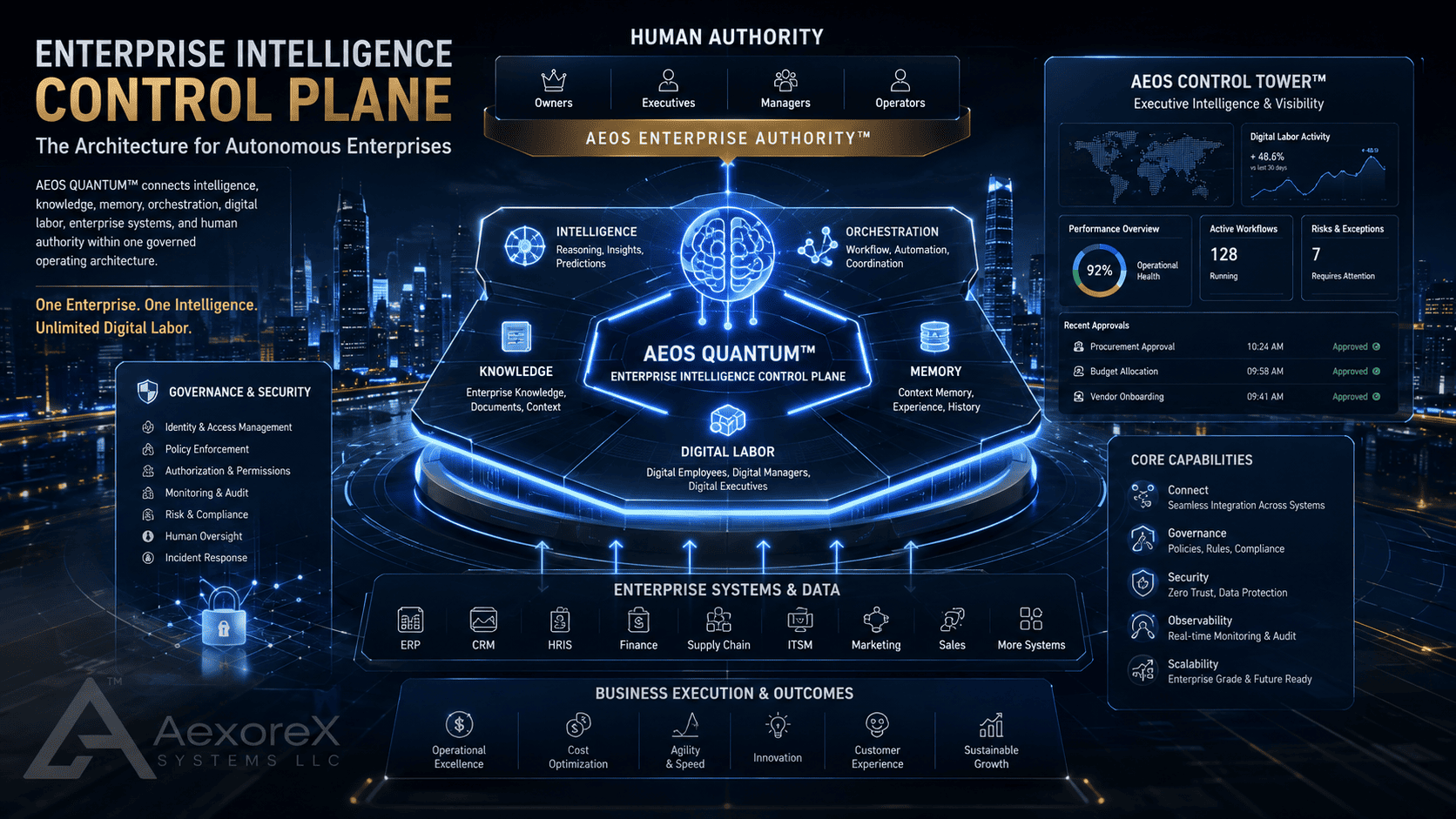
AexoreX Systems Defines the Enterprise Intelligence Control Plane for the Autonomous Enterprise
The company is developing an enterprise intelligence infrastructure designed to unify AI, digital labor, enterprise systems, knowledge, memory, orchestration, governance, security, and human authority within a single operating architecture.
The Enterprise AI Problem Is Becoming an Architecture Problem
Artificial intelligence is rapidly evolving from systems that primarily generate information to those capable of reasoning across contexts, coordinating tasks, interacting with software, and executing defined actions. For enterprises, this shift raises a critical architectural question. The challenge is no longer just how to introduce an AI model into an organization, but how to operate increasingly capable intelligence within the enterprise itself.
As organizations experiment with AI agents and autonomous workflows, new requirements emerge concerning identity, permissions, data access, knowledge, memory, orchestration, observability, governance, security, accountability, and human oversight. Recent enterprise discussions and research increasingly highlight these control requirements as central to transitioning from AI experimentation to production-scale agentic systems.
AexoreX Systems LLC is centering its technology strategy around this broader architectural problem. At its core is AEOS QUANTUM™, an Enterprise Intelligence Operating Platform under development for autonomous enterprises. The objective is not to build another AI assistant, but to create an infrastructure layer that enables enterprise intelligence to operate across organizational systems while remaining governed, observable, and accountable.
From AI Models to Enterprise Intelligence Infrastructure
The first generation of enterprise AI focused largely on models, prompting the question: "Which model should we use?" This was followed by AI applications and assistants, shifting the question to: "Which AI application can help our employees?" The emergence of agentic AI introduces a new inquiry: "How can AI perform meaningful work across the enterprise?" The next architectural question is potentially even broader: "How should intelligence itself operate as part of the enterprise?"
This distinction is important. A foundation model provides intelligence capabilities. An AI application packages those capabilities. An agent can perform a defined sequence of work. However, an enterprise requires considerably more than any individual component. It needs an environment where intelligence can be:
- connected to enterprise systems;
- grounded in organizational knowledge;
- provided with appropriate memory and context;
- orchestrated across workflows;
- assigned defined authority;
- governed by policies;
- monitored and audited;
- restricted by permissions;
- escalated to humans when necessary; and
- evaluated against business objectives.
This is the infrastructure problem AexoreX Systems is attempting to address.
The Enterprise Intelligence Control Plane
AexoreX Systems is developing AEOS QUANTUM™ based on the concept of an Enterprise Intelligence Control Plane. This concept describes an architectural layer positioned between enterprise intelligence and the operational environment where that intelligence acts.
At a high level, the architecture flows as follows:
Human Authority ↓ Enterprise Intelligence Control Plane ↓ AI Models + Digital Labor + Intelligence Services ↓ Knowledge + Memory + Enterprise Context ↓ Enterprise Systems + Data + Workflows ↓ Business Execution
Governance and security operate across this entire architecture.
The purpose is not to replace existing enterprise applications. Instead, the control-plane concept aims to provide a unified intelligence, orchestration, and governance layer capable of operating across an organization's existing technology environment. This aligns with AexoreX Systems' broader positioning of AEOS QUANTUM™ as an intelligence and orchestration layer, rather than a replacement for every ERP, CRM, security platform, data platform, or business application.
Why a Control Plane Matters
Modern enterprises rarely operate from a single technology system. A typical organization may have separate platforms for finance, customer relationship management, human resources, communications, project management, data, security, cloud infrastructure, procurement, sales, marketing, customer service, and internal knowledge.
AI adoption can introduce another layer of fragmentation. Different departments may adopt various models, assistants, agents, automation platforms, and specialized AI applications. This can lead to what the industry increasingly describes as "agent sprawl." Without centralized coordination, organizations can lose visibility into:
- What agents exist?
- What can they access?
- What actions can they perform?
- Who authorized them?
- What systems do they interact with?
- What decisions can they make?
- What happened after they acted?
- Who is accountable?
These are not merely AI-model questions; they are enterprise architecture and governance questions. The emergence of agent sprawl reinforces the need for orchestration and centralized governance capabilities across enterprise AI environments.
Intelligence Requires Context
An AI model does not automatically understand an enterprise. Enterprise intelligence relies on context. This context can include organizational structure, business policies, customers, products, employees, financial information, operational processes, historical decisions, institutional knowledge, documents, system data, current events inside the organization, and previously executed work.
This is why enterprise intelligence requires more than model inference. It requires an architecture that connects intelligence to the organization's knowledge and memory. AEOS QUANTUM™ is being developed with this principle in mind. The intended architecture connects:
- **Knowledge:** what the enterprise knows
- **Memory:** what the enterprise has retained from prior interactions and operations
- **Intelligence:** reasoning and interpretation
- **Orchestration:** coordination of work
- **Digital Labor:** execution of defined organizational functions
- **Enterprise Systems:** the operational environment
- **Governance:** authority and constraints
- **Control Tower:** visibility and executive oversight
Together, these layers form the foundation of the Enterprise Intelligence Infrastructure vision.
From Digital Labor to Organizational Capacity
The previous stage of enterprise AI focused heavily on assisting human employees. The emerging Digital Labor model introduces a new possibility: software-based workers that can be assigned defined organizational responsibilities. A Digital Employee could be designed to monitor information, analyze data, conduct research, prepare reports, coordinate workflows, interact with authorized systems, perform repetitive digital operations, identify exceptions, escalate issues, and execute approved tasks.
The important distinction is that Digital Labor is not simply another automation script; it represents a conceptual workforce layer. AexoreX Systems is developing this model through its Digital Labor-as-a-Service (LaaS) initiative. The company has explicitly positioned this initiative as being in its product-development and platform-building stage, rather than claiming that a fully deployed global digital workforce already exists. This distinction is important: the architecture is being built, the category is still emerging, and the long-term opportunity is significant.
Human Authority Remains Fundamental
Greater autonomy does not eliminate the need for human authority; it increases its importance. An enterprise-grade autonomous system must distinguish between:
- **Intelligence:** What the system can determine.
- **Capability:** What the system technically can do.
- **Authority:** What the system is permitted to do.
- **Accountability:** Who remains responsible for the outcome.
These concepts should not be treated as interchangeable. A Digital Employee may have the technical capability to perform an action without having the organizational authority to perform that action autonomously. Similarly, an AI system may recommend a decision without possessing the authority to approve it. This distinction becomes increasingly important as AI agents move from informational tasks toward operational execution. Recent research on runtime governance of autonomous AI agents similarly emphasizes identity, discovery, governance, attestation, and supply-chain considerations when agents are permitted to act inside enterprise environments. For AexoreX Systems, the implication is clear: autonomy must operate inside authority.
AEOS Enterprise Authority™
This principle forms an important part of the broader AEOS architecture. AEOS Enterprise Authority™ is intended to represent the authority layer through which enterprise actions, permissions, approvals, and organizational accountability can be defined around intelligent systems and Digital Labor.
The objective is not to give AI unrestricted autonomy; it is the opposite. The objective is to create a structured relationship between:
- Who has authority
- What authority exists
- Which intelligence or Digital Labor can exercise it
- Under what conditions
- Against which enterprise resources
- With what approval requirements
- With what audit trail
This distinction may become one of the defining architectural principles of autonomous enterprise systems. The future enterprise may not only ask, "How intelligent is the agent?" It may increasingly ask, "What authority does the agent have?"
Governance Is Becoming an Operating Layer
Governance is frequently treated as a compliance function. For autonomous enterprises, that model may be insufficient. When software can make decisions and execute actions, governance becomes part of the operating architecture itself. An enterprise intelligence infrastructure therefore needs to consider:
- identity;
- authentication;
- authorization;
- policy enforcement;
- access control;
- action boundaries;
- approval workflows;
- monitoring;
- auditability;
- escalation;
- incident response;
- human intervention; and
- continuous evaluation.
Recent industry reporting and research increasingly emphasize these requirements as enterprises move from AI experimentation toward autonomous execution. The implication is significant: governance cannot simply observe autonomous systems after they act. Where appropriate, governance must influence whether an action can occur in the first place.
The Control Tower for Executive Intelligence
Autonomous enterprise architecture also introduces a leadership problem. Executives cannot reasonably monitor every model, workflow, agent, API call, or automated decision individually; they need organizational visibility. This is where the AEOS Control Tower concept becomes important. Rather than forcing executives to understand every technical component, the Control Tower is intended to provide a higher-level operational view of the enterprise.
Potential executive intelligence dimensions include:
- enterprise performance;
- Digital Labor activity;
- workflow execution;
- exceptions;
- risks;
- approvals;
- system health;
- organizational intelligence;
- strategic opportunities;
- governance events; and
- operational outcomes.
The objective is to shift executive oversight from fragmented dashboards toward an integrated view of organizational intelligence and execution.
One Enterprise. One Intelligence.
The long-term architectural ambition can be summarized simply: One Enterprise. One Intelligence. Unlimited Digital Labor. This does not mean that an enterprise uses only one AI model, nor that every workflow is automated, nor that human employees disappear. Instead, the concept describes a unified enterprise environment where multiple forms of intelligence, systems, workers, and automation can operate within a coherent architecture.
An enterprise may use multiple AI providers, operate hundreds of applications, deploy specialized Digital Employees, and maintain multiple databases and cloud environments. But the intelligence layer should still understand the enterprise as one organization. That is the architectural problem AEOS QUANTUM™ is being developed to address.
An Architecture for the Autonomous Enterprise
AexoreX Systems envisions the evolution of enterprise architecture as a progression:
- **Traditional Enterprise:** Applications + Employees
- **Digital Enterprise:** Applications + Cloud + Data + Employees
- **AI-Enabled Enterprise:** Applications + Data + AI + Employees
- **Intelligent Enterprise:** AI + Knowledge + Memory + Automation + Employees
- **Digital Labor Enterprise:** AI + Digital Labor + Enterprise Systems + Human Workforce
- **Autonomous Enterprise:** Human Authority + Enterprise Intelligence + Digital Labor + Governed Execution
The final stage is not simply about increasing automation. It is about creating an enterprise capable of sensing, understanding, deciding, coordinating, and executing across its digital environment while maintaining defined human authority and governance.
The Enterprise May Become the New AI Platform
For decades, enterprise software was organized around applications: CRM, ERP, HRIS, ITSM, Analytics, Collaboration, Security. Each system solved a specific category of business problem. Artificial intelligence introduces a different architectural possibility. Intelligence can potentially operate across those applications, understand relationships between them, coordinate actions between them, and provide context from one system to another. Digital Labor can potentially execute work across multiple systems.
This creates the possibility that the enterprise itself becomes the primary operating context for AI. The strategic question therefore changes. Instead of asking, "Which AI application should we buy?" organizations may increasingly ask, "What intelligence infrastructure should connect the entire enterprise?" That is the category AexoreX Systems is seeking to develop.
Building the Infrastructure Before Claiming the Future
AexoreX Systems LLC is currently in its development and build phase. AEOS QUANTUM™ remains under active development. The company is not presenting the Autonomous Enterprise as a completed market state. Instead, AexoreX Systems is building toward an architecture intended to support organizations as they progressively move toward greater intelligence, Digital Labor, automation, and autonomous operations.
This distinction is central to the company's approach. The objective is not to make the largest claim, but to build the infrastructure capable of supporting the claim when the technology, governance, security, and operational maturity justify it.
Toward a New Enterprise Operating Architecture
The evolution of AI may ultimately be less about replacing existing enterprise software and more about adding a new intelligence layer above and across it. That layer could connect:
- People
- AI
- Digital Labor
- Knowledge
- Memory
- Enterprise Systems
- Data
- Orchestration
- Governance
- Security
- Authority
- Execution
- Executive Intelligence
into one continuously connected operating architecture. For AexoreX Systems, this is the strategic purpose behind AEOS QUANTUM™. Not another chatbot, not another isolated AI agent, not another automation tool, but an attempt to build an Enterprise Intelligence Infrastructure capable of connecting intelligence with organizational work.
The Autonomous Enterprise will ultimately require more than autonomous agents. It will require an architecture in which those agents know what they are allowed to do, understand the enterprise context in which they operate, retain relevant organizational memory, coordinate with other systems and workers, and remain accountable to human authority. That is the control-plane problem. And that may become one of the defining infrastructure challenges of the next generation of enterprise technology.
AexoreX Systems Perspective
AexoreX Systems believes the next generation of enterprise technology will increasingly be defined not by the number of AI models an organization deploys, but by how effectively intelligence is connected to organizational context, authority, execution, and governance. AEOS QUANTUM™ is being developed around that principle.
The long-term vision is an enterprise where human employees and Digital Labor operate together through a governed intelligence infrastructure—allowing organizations to increase operational capacity without losing visibility, authority, or accountability. The path toward the Autonomous Enterprise therefore begins not with unrestricted autonomy. It begins with infrastructure. Intelligence. Context. Authority. Governance. Execution. And above all: control.
About AexoreX Systems LLC
AexoreX Systems LLC is a technology company developing Enterprise Intelligence Infrastructure for the evolution of modern organizations toward intelligent and autonomous operating models. The company is currently in the development and build phase of its technology platform and related Digital Labor architecture. Its primary platform initiative, AEOS QUANTUM™, is being developed as an Enterprise Intelligence Operating Platform for autonomous enterprises, with an architectural focus spanning enterprise intelligence, knowledge, memory, orchestration, governance, security, Digital Labor, enterprise systems, and executive oversight. AexoreX Systems' development vision is global in scope, with the long-term objective of supporting organizations ranging from emerging businesses and small-to-medium enterprises to large multinational and Fortune Global organizations.
Editorial Disclosure
This article is an editorial analysis and company-building report published by the AexoreX Newsroom. Statements describing AEOS QUANTUM™, AEOS Enterprise Authority™, Digital Labor, or related architecture represent AexoreX Systems' current development direction and product vision unless explicitly identified as an externally verified capability. The AexoreX Newsroom distinguishes between current implementation, active development, and future vision. AI-assisted, human edited.
About the Author
AexoreX Technology Desk is the editorial desk of AexoreX Newsroom covering enterprise AI, AI agents, Digital Labor, enterprise intelligence, AI infrastructure, autonomous enterprises, enterprise software, cloud technologies, and emerging organizational operating models.
Sources and attribution
- AexoreX Systems LLC; AexoreX Newsroom; Express Computer; TechRadar; arXiv · statement
About the author
The editorial team behind AexoreX Newsroom, the official corporate publication of AexoreX Systems LLC.
More from AexoreX Systems Editorial Team →Related stories
- AexoreX Systems LLC Advances Digital Labor-as-a-Service Model as Enterprises Rethink the Future of Work
- Building AexoreX #004 — From AI Tools to Enterprise Intelligence Infrastructure
- AexoreX Newsroom #005 Building an Autonomous Search-Ready Publication Infrastructure
- AexoreX Systems Advances AEOS QUANTUM™ Toward a New Architecture for Autonomous Enterprise Operations
- Enterprise AI Moves Beyond Chatbots as Companies Build Intelligence Infrastructure for Autonomous Operations
- From Enterprise Software to Enterprise Intelligence Infrastructure: The Architecture Behind AEOS QUANTUM™