
From Digital Labor to Autonomous Enterprise Operations: Why an Intelligence Layer Matters
As enterprises move beyond chatbots and isolated AI tools, the next challenge is connecting intelligence, authority, workflows, systems, and Digital Labor into a coordinated operating environment.
An enterprise intelligence layer is crucial for connecting intelligence, authority, workflows, systems, and Digital Labor into a coordinated operating environment for autonomous enterprise operations.
Opinion · AI-assisted, human edited
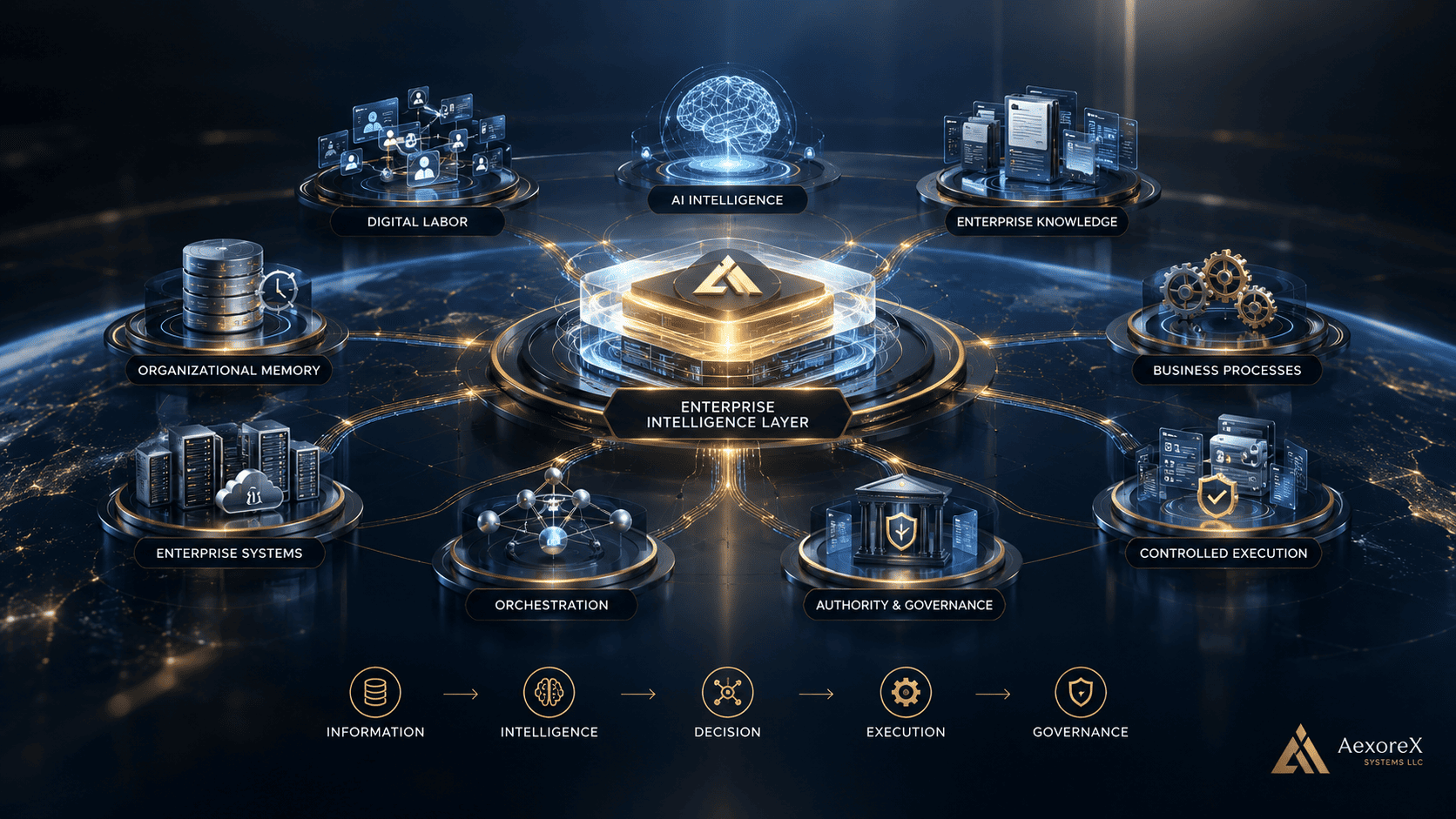
The Evolution of Enterprise AI
As artificial intelligence continues to advance, enterprises are moving beyond simple conversational interfaces and isolated automation tools. This evolution introduces Digital Labor: AI systems capable of performing defined business work within specific scopes, policies, permissions, and operational boundaries.
However, Digital Labor alone does not create an Autonomous Enterprise. For it to operate effectively across complex organizations, enterprises require a method to connect intelligence with enterprise systems, business processes, knowledge, memory, authority, governance, and execution. This is where the concept of an enterprise intelligence layer becomes crucial.
Beyond the Chatbot
Traditional chatbots primarily facilitate communication with people, answering questions, generating content, summarizing information, and assisting with individual tasks. Digital Labor extends this capability by performing defined work, interacting with systems, following policies, and contributing to measurable business outcomes.
Deploying multiple Digital Labor units across an enterprise, however, can introduce complexity. One unit might handle customer operations, another finance, and others procurement, service operations, knowledge management, or internal workflows. Without a coordinating intelligence layer, these capabilities risk remaining fragmented, leaving the enterprise with many AI capabilities but no unified operational model.
The Intelligence Layer
An enterprise intelligence layer provides a common environment to connect intelligence, context, workflows, systems, authority, and governance. Its objective is not to replace existing enterprise applications such as ERP, CRM, service management, cloud infrastructure, collaboration platforms, databases, or custom systems. Instead, an intelligence layer acts as a connective and orchestration layer across this diverse technology landscape.
The distinction is significant: the enterprise stack remains the system landscape, while the intelligence layer connects, coordinates, governs, and activates capabilities across that environment.
From Intelligence to Action
Enterprise AI gains significant value when intelligence can be linked to controlled action. This progression can be viewed as:
- **Information:** Provides underlying data and knowledge.
- **Intelligence:** Interprets information within a business context.
- **Decision:** Determines an appropriate action within defined authority.
- **Execution:** Carries out the authorized work.
- **Governance:** Establishes policies, permissions, controls, auditability, and human oversight for the process.
This model fundamentally differs from simply querying an AI system. The focus shifts from "What can AI answer?" to "What authorized work can intelligence perform within the enterprise?"
The Role of Authority
Autonomous operation in an enterprise environment does not imply unlimited independence. Authority must remain defined by the organization. Digital Labor should operate within explicit boundaries, including:
- Defined responsibilities
- Scoped objectives
- Policy constraints
- Permission controls
- Budget limitations
- Risk boundaries
- Audit requirements
- Human governance
- Revocation mechanisms
This establishes a key principle for autonomous enterprise operations: authority is delegated by the enterprise; it is not inherently owned by Digital Labor. Such a model allows organizations to pursue greater automation while maintaining operational accountability.
Connecting Digital Labor to Enterprise Systems
An intelligence layer also provides a framework for integrating Digital Labor with existing enterprise systems. The goal is not to create another isolated application but to enable controlled interaction across the organization's current systems. This includes enterprise applications, databases, communication platforms, cloud services, internal knowledge, business workflows, and custom systems.
This integration results in a more connected operational environment where Digital Labor can access necessary context, perform authorized work, and deliver outcomes to appropriate business processes. While technology architectures will vary, the underlying principle remains consistent: connect intelligence to the enterprise rather than creating intelligence in isolation.
Toward Autonomous Enterprise Operations
The transition to autonomous enterprise operations will likely involve multiple capabilities working in concert, rather than a single AI model or application. These capabilities include:
- **Enterprise Intelligence:** Understanding business context, information, and objectives.
- **Knowledge and Memory:** Maintaining relevant organizational context over time.
- **Orchestration:** Coordinating processes, systems, and Digital Labor.
- **Digital Labor:** Performing defined operational work.
- **Enterprise Authority:** Determining permitted actions and conditions.
- **Governance:** Maintaining policy, oversight, accountability, and auditability.
- **Execution:** Translating approved decisions into controlled operational outcomes.
Together, these form a broader operating model for enterprises adopting increasingly autonomous workflows.
The Emerging Operating Model
In the future, an enterprise may involve humans, enterprise systems, AI intelligence, and Digital Labor operating together within a governed environment, rather than simply employees using software with AI as an external assistant.
In this model: - Humans establish objectives, policies, authority, and oversight. - AI provides intelligence and reasoning. - Digital Labor performs defined work. - Enterprise systems serve as underlying systems of record and operational infrastructure. - An intelligence layer coordinates these elements.
This model does not eliminate human governance; it can make governance even more critical.
AEOS QUANTUM™ and the Intelligence Layer Concept
AexoreX Systems is developing AEOS QUANTUM™ — Autonomous Enterprise Operations Systems Quantum — based on this broader concept. AEOS QUANTUM™ is envisioned as an Enterprise Intelligence Operating Platform for Autonomous Enterprises. Its intended direction is to unify enterprise intelligence, AI, Digital Labor, process orchestration, knowledge, memory, and governance within a no-code operating platform.
Development is ongoing. AEOS QUANTUM™ is not designed to replace an enterprise's existing technology stack. Instead, the platform is being developed to connect, orchestrate, govern, and activate capabilities across the enterprise environment.
From AI Tools to an Enterprise Operating Layer
The evolution of enterprise AI may follow a progression:
- Chatbots
- AI Assistants
- Digital Labor
- Orchestrated Digital Labor
- Autonomous Enterprise Operations
Each stage introduces a greater degree of operational capability. However, increasing autonomy also heightens the importance of context, authority, governance, and control. The long-term opportunity is not merely to deploy more AI, but to create an enterprise environment where intelligence can operate responsibly across business processes and systems. This is the role an enterprise intelligence layer is intended to explore.
One Enterprise. One Intelligence. Unlimited Digital Labor.
AexoreX Systems continues to develop this vision through AEOS QUANTUM™ as it works toward a new operating model for enterprises entering the emerging era of autonomous operations.
Sources and attribution
- AexoreX Systems LLC · statement link
About the author
The editorial team behind AexoreX Newsroom, the official corporate publication of AexoreX Systems LLC.
More from AexoreX Systems Editorial Team →Related stories
- Why Enterprise AI Needs an Operating Layer, Not Another Copilot
- AexoreX Systems Defines the Enterprise Intelligence Control Plane for the Autonomous Enterprise
- AexoreX Systems Introduces AEOS Enterprise Authority™ as Governance Layer for Autonomous Enterprise Intelligence
- AexoreX Systems Advances AEOS QUANTUM™ as Enterprise Intelligence Operating Platform for Autonomous Enterprises
- AexoreX Systems Advances AEOS QUANTUM™ as a Unified Intelligence Layer for Autonomous Enterprises
- AEOS QUANTUM™ Envisions an Enterprise Intelligence Layer for the Emerging Autonomous Systems Era