
Why Enterprise AI Needs an Operating Layer, Not Another Copilot
The next phase of enterprise AI may depend less on better interfaces and more on the infrastructure connecting intelligence to execution.
The next phase of enterprise AI requires an operating layer to connect intelligence with execution, rather than just more copilots or interfaces.
Opinion · AI-assisted, human edited
Disclosure: AexoreX Systems LLC operates AexoreX Newsroom and is developing AEOS QUANTUM™. This article contains analysis and commentary regarding the company's technology direction and the broader enterprise AI market.
The Next Problem Is Not Model Capability
Enterprise artificial intelligence has spent its initial adoption phase demonstrating that machines can understand, generate, summarize, analyze, and increasingly reason over information. This has led to a proliferation of copilots, assistants, and AI-enabled applications.
However, as organizations shift from experimentation to operational deployment, a new challenge is emerging: intelligence alone cannot operate an enterprise. An enterprise comprises people, applications, databases, workflows, policies, documents, permissions, business processes, operational systems, and management structures.
An AI model may excel at reasoning about a problem, but it does not automatically possess the organizational context, authorization, memory, workflow connectivity, or governance needed to act within a real business. This creates an architectural gap between intelligence and execution.
Therefore, the next stage of enterprise AI may require more than just another interface for interacting with a model; it may necessitate an operating layer.
Why Copilots Alone Leave an Operational Gap
The copilot model has been a significant advancement in enterprise AI. It operates on a request-and-response basis: a user asks a question, and the system provides an answer; a user requests a summary, and the system generates one; a user asks for task assistance, and the system helps complete it.
This model is powerful because it integrates AI directly alongside human workers. However, the organization retains fundamental responsibility for coordinating the work. Someone still needs to determine: - what information the AI should access; - which systems it can use; - what context it should retain; - what workflow should follow its recommendation; - which actions require approval; - how activities are recorded; - how exceptions are escalated; - and how multiple AI systems interact with one another.
While humans can manage much of this coordination manually at a small scale, this approach becomes increasingly difficult at enterprise scale.
The challenge is no longer simply, "How do we give employees access to AI?" The larger question becomes, "How do we make intelligence part of the operating architecture of the enterprise?" This presents a fundamentally different systems problem.
From AI Assistance to Enterprise Orchestration
An enterprise operating environment is not a collection of isolated conversations; work moves through interconnected processes. For instance, a customer request can initiate a support workflow, which might lead to an engineering task. That task could require technical analysis, potentially influencing a management decision, which in turn might trigger financial, operational, or commercial actions. Each step can involve different people, systems, permissions, and policies.
AI becomes more valuable when it can participate in the flow of work rather than merely responding to individual prompts. This is where orchestration becomes critical. An enterprise AI operating layer could potentially coordinate the sequence from Intent → Context → Intelligence → Decision → Approval → Execution → Monitoring → Feedback.
The goal is not to eliminate human involvement. Instead, it is to create a controlled mechanism allowing humans, AI systems, and enterprise software to participate in the same operational process.
The Operating Layer Between Intelligence and Execution
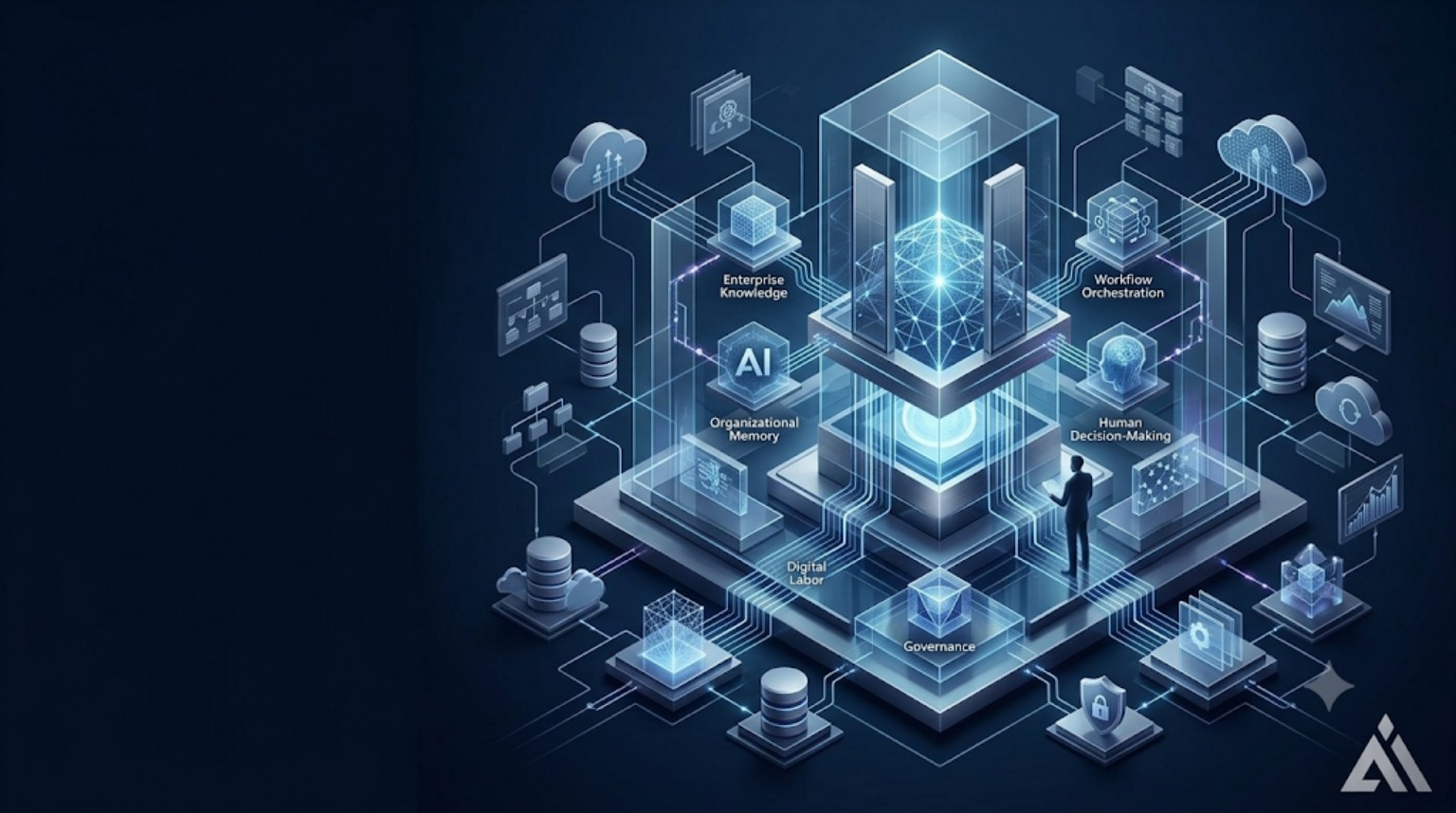
The emerging architecture can be conceptualized as a layer positioned between AI intelligence and existing enterprise systems. At one end are models and intelligence services, and at the other are business applications and operational infrastructure.
Between these two lies a set of capabilities responsible for understanding organizational context and controlling execution. Conceptually, this looks like:
Enterprise Systems ↓ Operating Layer ↓ Knowledge · Memory · Orchestration · Governance · Digital Labor ↓ AI Intelligence ↓ Human & Machine Execution
The precise implementation will vary across organizations, but the architectural principle is significant. AI should not necessarily connect directly to every enterprise system without an intermediate control structure. An operating layer can provide a dedicated space to define context, permissions, workflows, policies, and execution boundaries. It can also offer a common environment where diverse AI capabilities can participate in the same organizational processes.
Memory, Knowledge and Context Become Infrastructure
One limitation of conversational AI is that a conversation does not equate to organizational memory. Enterprises already possess vast amounts of information, including contracts, policies, product documentation, customer records, financial information, operational procedures, engineering knowledge, research, meeting records, and historical decisions.
The challenge is not just storing this information, but making the appropriate information available to the appropriate intelligence at the appropriate moment. This requires more than a simple search box; it demands contextual infrastructure.
Enterprise memory may need to understand: - who is asking; - which organization or business unit is involved; - what task is being performed; - which information is relevant; - what happened previously; - what policies apply; - what actions have already occurred; - and what should happen next.
Knowledge provides information, memory provides continuity, and context connects the two to an operational situation. Together, these can become foundational components of an enterprise intelligence architecture.
Digital Labor Changes the Unit of Automation
Traditional automation typically focuses on processes: a trigger occurs, a workflow executes, and the process completes. Agentic systems introduce a different possibility. Instead of automating only predefined action sequences, organizations can increasingly experiment with software-based workers capable of performing broader functions within defined boundaries. This gives rise to the concept of Digital Labor.
A digital worker could potentially be assigned a role, responsibilities, access permissions, operating policies, and measurable objectives. The unit of automation therefore shifts. Instead of asking, "Which task can we automate?", an organization can begin asking, "Which function of work can be performed by governed digital labor?"
This distinction could have significant implications. For example, a digital research worker might continuously monitor information, analyze developments, produce structured intelligence, and escalate relevant findings. A digital operations worker could monitor workflows, identify exceptions, and coordinate responses. A digital technology worker could assist with infrastructure intelligence, technical analysis, and operational coordination.
A critical distinction is that such systems should not be treated as unrestricted autonomous actors; their authority must remain defined by the organization.
Governance Must Operate Alongside Intelligence
As AI capabilities advance, treating governance as an afterthought becomes less sustainable. Enterprise AI systems can potentially access sensitive information, interact with business applications, and initiate consequential actions. This means organizations must address questions such as: - **Identity:** Who or what is performing the action? - **Authorization:** What is the system permitted to access? - **Scope:** Which tasks can it perform? - **Approval:** Which actions require human authorization? - **Auditability:** What happened, when, and under whose authority? - **Escalation:** What happens when the system encounters an exception? - **Accountability:** How is responsibility assigned?
These are not merely cybersecurity questions; they are operating-model questions. An enterprise may eventually have hundreds or thousands of AI agents, digital workers, or automated processes. Without a common governance architecture, this environment could become fragmented and difficult to control. Therefore, the operating layer needs to coordinate not only intelligence and execution but also authority and accountability.
Enterprise AI Architecture Is Becoming a Systems Problem
The first generation of enterprise AI adoption often focused on individual applications: a company deployed an assistant, another department deployed a document intelligence system, another team adopted an AI coding tool, and another implemented customer-service automation. Each initiative could deliver value independently.
However, enterprise-wide intelligence introduces a different challenge. The organization now needs to understand how these systems interact: Where does enterprise context reside? Which system owns memory? How are permissions propagated? How are agents identified? How are workflows coordinated? How are actions audited? How are conflicting instructions resolved? How does an executive obtain a unified view of activity?
The answer cannot simply be another AI application; it requires architecture. This is why enterprise AI increasingly resembles an infrastructure problem. The strategic question is shifting from, "Which AI tool should we buy?" toward, "What intelligence architecture should our enterprise operate on?"
The Emerging Autonomous Enterprise
The concept of an autonomous enterprise should not be interpreted as a company without people. A more realistic interpretation is an organization where increasing portions of digital work can be performed, coordinated, and monitored by intelligent software under defined governance.
Humans remain responsible for leadership, judgment, accountability, relationships, strategy, and decisions requiring human authority. Digital systems provide additional organizational capacity. The resulting model could look something like:
Human Workforce + Digital Workforce ↓ Enterprise Intelligence ↓ Orchestration ↓ Business Systems ↓ Governance & Control
The objective is not maximum autonomy but controlled organizational intelligence. An enterprise should be able to determine where autonomy creates value, where human approval is necessary, and where automation should not be permitted.
AexoreX's Perspective: Building an Intelligence Operating Platform
AexoreX Systems LLC is developing this architectural direction through AEOS QUANTUM™, positioned as an Enterprise Intelligence Operating Platform for Autonomous Enterprises. The platform is being developed around the idea that enterprise intelligence should not exist as a collection of disconnected AI tools. Instead, intelligence, knowledge, memory, orchestration, governance, security, and Digital Labor can be treated as interconnected components of an enterprise operating architecture.
The platform remains under development. This distinction matters: AEOS QUANTUM™ should therefore be understood as an active platform-building initiative rather than a claim that every element of the envisioned architecture is already universally deployed or commercially mature.
The broader architectural thesis is straightforward: AI should become part of how an enterprise operates, not merely another application employees open.
What Enterprises Should Evaluate Next
Organizations evaluating the next generation of enterprise AI may benefit from looking beyond model benchmarks and chatbot capabilities. Several questions become increasingly important: 1. **Context:** Can the system understand the organization's relevant business context? 2. **Knowledge:** Can enterprise information be made available in a controlled and usable manner? 3. **Memory:** Can the system maintain appropriate continuity across workflows and interactions? 4. **Orchestration:** Can intelligence coordinate multi-step enterprise processes? 5. **Digital Labor:** Can AI perform defined functions rather than isolated prompts? 6. **Governance:** Can organizations control what intelligent systems are allowed to do? 7. **Observability:** Can organizations understand what systems are doing and why? 8. **Human Control:** Can consequential actions be escalated to humans when appropriate? 9. **Integration:** Can the architecture connect existing enterprise systems rather than requiring organizations to replace everything? 10. **Scalability:** Can the operating model support increasing numbers of AI systems, digital workers, and automated processes without becoming unmanageable?
These questions may ultimately matter more than which individual model is considered the most capable at a particular point in time. Models will continue to evolve, but the enterprise architecture surrounding them may have to last much longer.
The Next Enterprise AI Advantage May Be Architectural
The AI industry has invested considerable effort competing on models, interfaces, and applications. The next competitive layer may increasingly involve architecture. Organizations will need ways to connect intelligence with: - People - Processes - Systems - Knowledge - Memory - Governance - Execution - Accountability
This is where an enterprise operating layer becomes strategically important. The future of enterprise AI may not be determined solely by who has the most capable model; it may also be determined by who can build the most effective infrastructure for putting intelligence to work.
The enterprise of the future is unlikely to be simply a collection of humans using AI. It may become a coordinated environment in which human workers, digital workers, intelligent systems, and enterprise software operate together. The transition from AI assistance to enterprise intelligence infrastructure could therefore become one of the defining architectural shifts of the next generation of enterprise technology.
If that transition occurs, the central question will no longer be, "Where can we add AI?" It will be, "What should the enterprise itself become when intelligence is built into its operating architecture?"
About AexoreX Systems LLC
AexoreX Systems LLC is developing Enterprise Intelligence Infrastructure for the evolution of modern organizations toward intelligent and autonomous operating models. Its primary platform initiative, AEOS QUANTUM™, is being developed as an Enterprise Intelligence Operating Platform for Autonomous Enterprises, with an architectural focus spanning enterprise intelligence, knowledge, memory, workflow orchestration, governance, security, and Digital Labor. The company is currently in the development and platform-building phase.
Editorial Note
This analysis reflects the editorial perspective of AexoreX Technology Desk. References to AexoreX Systems LLC, AEOS QUANTUM™, or Digital Labor describe the company's publicly stated development direction and should not be interpreted as claims that all described capabilities are currently deployed or generally available.
AI-assisted, human edited.
About the author
AexoreX Technology Desk is the newsroom's editorial desk covering enterprise technology, artificial intelligence, digital labor, automation, and emerging enterprise systems.
More from AexoreX Technology Desk →Related stories
- AexoreX Systems Simplifies Its Newsroom Publishing Workflow
- AexoreX Systems LLC Advances Digital Labor-as-a-Service Model as Enterprises Rethink the Future of Work
- Building AexoreX #004 — From AI Tools to Enterprise Intelligence Infrastructure
- AexoreX Systems Advances AEOS QUANTUM™ Toward a New Architecture for Autonomous Enterprise Operations
- Enterprise AI Moves Beyond Chatbots as Companies Build Intelligence Infrastructure for Autonomous Operations