
Beyond the Digital Workforce: Why Enterprise Intelligence Becomes the Next Infrastructure Layer
From Coordinated Digital Labor to an Intelligent Enterprise Operating Environment
AexoreX Systems envisions Enterprise Intelligence as the critical infrastructure layer needed to coordinate multiple Digital Labor capabilities and govern the transition to Autonomous Enterprises.
Opinion · AI-assisted, human edited
Introduction
The emergence of a Digital Workforce presents a new challenge for enterprises: coordination. As organizations adopt multiple Digital Labor capabilities, a need arises for shared context, knowledge, memory, identity, permissions, workflows, and governance. Enterprise Intelligence is positioned to become the infrastructure layer that connects and orchestrates these capabilities.
The future of enterprise AI may evolve from individual AI systems to coordinated intelligence operating across the entire organization. AEOS QUANTUM™ is being developed with this broader vision of an Enterprise Intelligence Operating Platform. Its objective is not to replace existing enterprise systems but to connect, orchestrate, govern, and activate them. Throughout this evolution, human authority, accountability, and governance remain fundamental as enterprise AI becomes increasingly capable.
The Digital Workforce Creates a New Problem
The initial challenge in AI was enabling it to perform useful work. The subsequent challenge is coordinating that work effectively. As discussed in a previous AexoreX Systems article, an organization can advance from a single Digital Labor capability to multiple specialized digital workers.
A company might deploy: - Digital Research Labor - Digital Sales Labor - Digital Marketing Labor - Digital Operations Labor - Digital Finance Labor - Digital Customer Service Labor - Digital IT Labor - Digital Security Labor - Digital Executive Labor
Each of these digital workers can have a specific role, responsibility, permission set, workflow, and operating boundary. While individually useful, an enterprise is not a collection of isolated departments; business activities are interconnected. Sales depends on customer information, Finance depends on transactions, Operations depends on supply and resource data, Executives depend on information from across the organization, Security depends on activity across systems, and Technology depends on infrastructure, applications, data, and operational requirements.
As the number of digital workers increases, a critical question emerges: How do all these digital workers operate together as one unified enterprise? This is where the concept of Enterprise Intelligence becomes increasingly important.
From Digital Workers to Digital Workforce
A single Digital Labor capability can perform defined work. When multiple Digital Labor capabilities are present, they can form a Digital Workforce. However, even a Digital Workforce requires an environment in which it can operate cohesively.
Consider a simple example: a Digital Sales worker identifies a potential enterprise customer. This worker may need information from a Customer Relationship Management (CRM) system, require market research, need pricing information, and potentially require approval before making a commercial commitment. It might then need to coordinate with another digital worker responsible for finance or operations.
The challenge is no longer just whether each AI system can perform its individual task. Instead, the challenge becomes: Can the organization coordinate intelligence, information, authority, and execution across all these interconnected activities? This is fundamentally an infrastructure problem.
The Enterprise Intelligence Layer
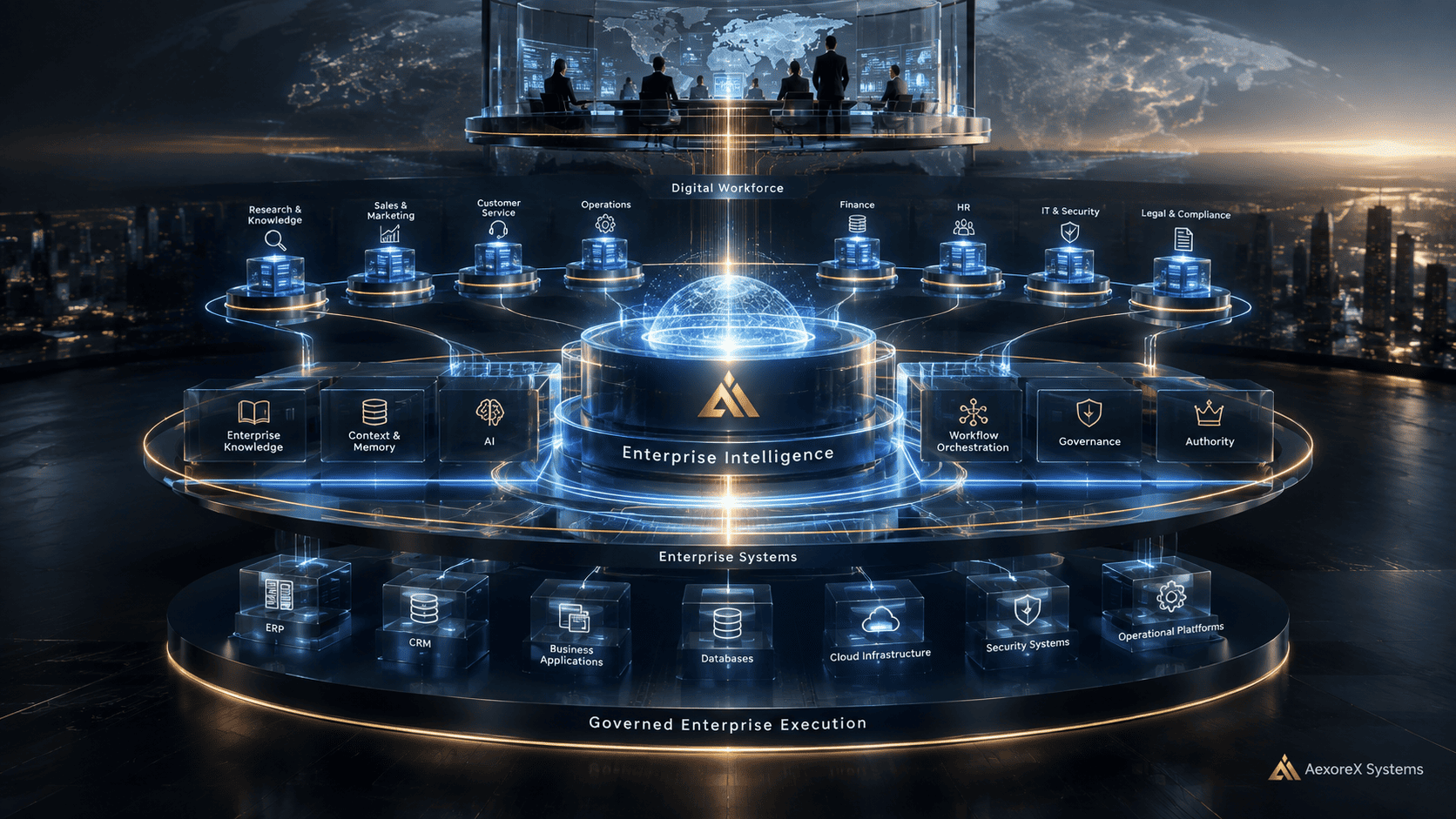
Enterprise Intelligence can be understood as an organizational intelligence layer that connects information, knowledge, AI, Digital Labor, workflows, systems, memory, governance, and human decision-making. It is not merely another chatbot or AI agent. It is not intended to replace existing Enterprise Resource Planning (ERP), CRM, Human Resources (HR) systems, accounting platforms, cloud platforms, databases, or other enterprise applications.
Instead, the concept is to provide an intelligence environment that can operate across the existing enterprise technology ecosystem. Conceptually, this architecture links:
- Enterprise Systems
- Data + Knowledge
- Enterprise Context + Memory
- Artificial Intelligence
- Digital Labor
- Workflow + Orchestration
- Governance + Authority
- Enterprise Execution
This architecture fundamentally alters the perspective on enterprise AI. The goal is not merely to add more AI, but to make intelligence operationally useful across the organization.
Why Context Matters
Intelligence without context can be unreliable. A Digital Labor system, even if highly capable, may lack the necessary information to make appropriate decisions. For example, a Digital Finance worker might be able to analyze a transaction but may not know the company's current financial policy, the authorized spending limit, the relevant business objective, whether the transaction has already been approved, whether a particular vendor is authorized, or if another department is already handling the issue.
The problem, therefore, is not simply a lack of intelligence, but a lack of contextual intelligence. Enterprise Intelligence aims to provide the appropriate context required for digital work while respecting access controls and organizational boundaries. This context can include:
- Enterprise knowledge
- Business data
- Organizational policies
- Historical context
- Operational state
- Relevant memory
- User and organizational identity
- Workflow state
- System information
- Permissions
- Authority
The quality of digital work depends not only on the intelligence of the underlying AI model but also on the quality and relevance of the context surrounding it.
Memory Becomes an Enterprise Capability
Just as a human employee begins each workday with memory of the organization—understanding previous conversations, remembering decisions, knowing organizational procedures, understanding relationships, recognizing ongoing projects, and recalling historical context—Digital Labor requires an equivalent concept of operational memory.
This does not imply that every piece of information should be retained indefinitely. Enterprise memory must be controlled. Organizations need to determine:
- What information may be retained?
- For how long?
- Who can access it?
- Which Digital Labor capabilities can use it?
- When should information expire?
- How should sensitive information be protected?
- How should historical context influence future work?
Therefore, memory becomes an integral part of enterprise architecture rather than simply an AI feature.
Intelligence Needs Authority
A fundamental principle of an enterprise AI environment is that capability and authority are distinct. An AI system may be technically capable of performing an action, but that does not mean it should be authorized to do so. For instance, a Digital Finance worker might technically be able to initiate a transaction, but the organization may decide that transactions exceeding a defined threshold require human approval. Similarly, a Digital Operations worker may be capable of changing an operational configuration, yet the organization might determine that such changes require a higher level of authorization.
This establishes an important principle: Capability does not automatically confer authority. Authority must be delegated by the organization. It must be:
- Defined
- Scoped
- Policy-bound
- Permissioned
- Risk-aware
- Auditable
- Human-governed
- Revocable
As Digital Workforce capabilities grow more powerful, this distinction becomes increasingly crucial.
From Automation to Governed Execution
Traditional automation typically follows predefined rules, such as "If X happens, then perform Y." AI introduces a more flexible capability, allowing a system to interpret information, reason across context, select tools, generate a plan, and potentially execute multiple steps.
This presents significant opportunities but also introduces new governance requirements. An enterprise must therefore answer questions like:
- What can the system do?
- What can it recommend?
- What can it decide?
- What can it execute?
- What requires approval?
- What happens when it encounters uncertainty?
- Who remains accountable?
These questions shift enterprise AI from simple automation toward governed execution.
The Enterprise Control Problem
Consider an organization with hundreds of Digital Labor capabilities. Without centralized coordination, the environment could become fragmented. One system might have access to customer information, another to financial information, another might operate within IT infrastructure, another communicate externally, and another execute operational workflows. Each capability might have been configured independently.
This fragmentation creates potential problems including:
- Inconsistent permissions
- Duplicated knowledge
- Fragmented memory
- Disconnected workflows
- Unclear authority
- Inconsistent policies
- Limited visibility
- Difficult auditing
- Uncontrolled AI actions
The more Digital Labor an enterprise deploys, the more critical centralized governance becomes. This is why the next stage of enterprise AI may not simply be about creating more agents, but about establishing the infrastructure that allows many intelligent systems to operate together safely.
Enterprise Intelligence as an Operating Layer
This leads to a broader concept: instead of viewing AI as a collection of individual applications, enterprises may increasingly view intelligence as an operating layer. Traditional enterprise architecture already encompasses multiple layers, including applications, databases, infrastructure, networks, security, identity, workflows, and data platforms.
The emergence of AI and Digital Labor introduces another question: Where does enterprise intelligence reside? An Enterprise Intelligence Operating Platform could potentially span these existing systems. Its role would not necessarily be to replace them, but rather to connect and coordinate them.
Conceptually:
- Existing Enterprise Stack
- Enterprise Intelligence Layer
- Digital Workforce
- Governance
- Coordinated Enterprise Operations
This is one of the architectural ideas being explored by AexoreX Systems.
Where AEOS QUANTUM™ Fits
This broader architecture provides the context for the development of AEOS QUANTUM™. AEOS QUANTUM™ is being developed as "The Enterprise Intelligence Operating Platform for Autonomous Enterprises."
The platform's vision is designed to integrate: - Enterprise Intelligence - Artificial Intelligence - Digital Labor - Knowledge - Memory and context - Workflow orchestration - Enterprise system integration - Governance - Organizational authority - Enterprise execution
The intention is not to create another isolated application that requires enterprises to abandon their existing technology stack. Instead, the long-term direction is to provide an operating environment capable of connecting, contextualizing, governing, orchestrating, and activating enterprise capabilities. This distinction is central to the AEOS QUANTUM™ vision.
AEOS QUANTUM™ Is Not the Enterprise Stack
Modern organizations already rely on extensive technology ecosystems. A global enterprise may use systems from multiple vendors across ERP, CRM, HR, Finance, Cloud, Security, Collaboration, Customer Service, Data, Analytics, and custom applications. An Enterprise Intelligence Operating Platform does not necessarily need to replace these systems.
The more practical architectural direction is interoperability. The enterprise retains its existing systems, and the intelligence layer connects to them. Digital Labor can then operate through approved interfaces, workflows, permissions, and policies. This establishes a simple principle: Do not replace the enterprise stack. Connect, contextualize, govern, orchestrate, and activate it. This is a foundational idea behind the AEOS QUANTUM™ development direction.
One Enterprise. Many Digital Workers. One Intelligence Environment.
The Digital Workforce concept introduces an important possibility. A company may eventually employ hundreds or thousands of specialized digital workers. However, human employees should not need to manage every digital worker independently. Instead, the organization could operate through a unified intelligence environment.
For example:
- Human Executive
- Enterprise Intelligence
- Digital Managers
- Digital Employees / Digital Labor
- Enterprise Systems
- Business Execution
In this model, intelligence can flow across organizational levels. A Digital Employee may perform a defined task, a Digital Manager may coordinate multiple Digital Employees, and an executive-level Digital Labor capability may synthesize information and support leadership. Humans retain organizational authority and accountability. The result is not a company devoid of people, but one where human and digital capabilities operate within a single coordinated environment.
From Digital Workforce to Autonomous Enterprise
This progression outlines a broader evolution:
- Human Workforce
- AI-Assisted Workforce
- Digital Labor
- Digital Workforce
- Enterprise Intelligence
- Governed Autonomous Operations
- Autonomous Enterprise
This should not be interpreted as a guaranteed or immediate technological progression. Different organizations will adopt varying levels of automation and autonomy. Some processes may remain entirely human, some may become AI-assisted, some highly automated, and some may eventually be capable of autonomous execution within strict boundaries. The important principle is that autonomy should be governed.
Autonomy Does Not Mean Unlimited Freedom
The term "autonomous" can sometimes create a misconception. An Autonomous Enterprise does not imply that AI systems operate without restrictions; quite the opposite. Greater autonomy necessitates stronger governance.
A digital worker operating with limited authority may require relatively simple controls. However, a digital worker capable of executing high-impact enterprise actions requires substantially stronger controls. Therefore: More capability leads to more potential authority, which in turn requires greater governance. This is why the architecture of an Autonomous Enterprise must include control mechanisms from its inception. Autonomy without governance creates operational risk. Autonomy with defined authority can create organizational capacity.
The Human Remains in the System
The evolution toward autonomous operations does not eliminate human responsibility. Human leaders remain responsible for:
- Strategy
- Organizational direction
- Accountability
- Governance
- Ethics
- Critical decisions
- Risk appetite
- Business objectives
- Legal responsibilities
Digital Labor can execute delegated work, but delegated authority remains organizational authority. This distinction is especially important for enterprise environments. The objective is not to transfer ownership of the enterprise to AI, but to assign AI systems clearly defined responsibilities within the enterprise.
A New Enterprise Architecture Is Emerging
The evolution from AI assistants to Digital Labor and Digital Workforce may ultimately create a new architectural requirement. Enterprises may need infrastructure specifically designed for: Intelligence + Context + Memory + Digital Labor + Orchestration + Authority + Governance + Execution.
This is broader than a simple AI model, an automation platform, or an agent builder. It is closer to an operating environment for enterprise intelligence. That is the category AexoreX Systems is exploring through AEOS QUANTUM™.
Building the Infrastructure Before the Future Arrives
AexoreX Systems is currently in the active development and foundational-building stage of this vision. The company is not presenting the Autonomous Enterprise as a finished reality. Instead, the focus is on establishing the architecture and infrastructure required to responsibly move toward it.
This includes exploring how: - AI can operate with enterprise context - Digital Labor can receive defined responsibilities - Multiple digital workers can coordinate - Enterprise systems can remain connected - Authority can be delegated - Actions can be governed - Memory can be controlled - Workflows can be orchestrated - Human oversight can remain meaningful - Enterprise execution can become increasingly intelligent
The technology must mature step by step. The architecture must be tested. The governance model must evolve. The platform must demonstrate real capability, and enterprise trust must be earned.
The Next Question Is Not "How Many Agents?"
The enterprise AI conversation often focuses on the number of agents an organization can deploy. However, quantity alone does not create enterprise intelligence. A company could deploy hundreds of agents and still operate in a fragmented environment.
The more important question may be: How intelligently can an enterprise coordinate its digital workforce? This shifts the focus from agent quantity to organizational capability. It moves the conversation from "More AI" to "More coordinated intelligence," from "More agents" to "More governed digital capacity," and from "More automation" to "More intelligent enterprise execution."
The Emerging Enterprise Intelligence Model
The broader model can be represented as:
- Enterprise
- People
- Digital Workforce
- Enterprise Knowledge
- Context & Memory
- Artificial Intelligence
- Orchestration
- Authority & Governance
- Enterprise Systems
- Execution
- Feedback
- Continuous Intelligence
This creates a potentially continuous operating cycle. The enterprise produces information, which becomes context. Context supports intelligence, and intelligence supports decisions and actions. Actions generate new information, which then becomes part of the next operating cycle. The enterprise therefore becomes progressively more connected and responsive.
AexoreX Perspective
AexoreX Systems believes the next major opportunity in enterprise AI may not simply be the creation of increasingly intelligent models, but rather the infrastructure surrounding those models. AI needs context. Digital Labor needs authority. Workflows need orchestration. Enterprise systems need interoperability. Organizations need governance. Executives need visibility. Humans need control.
These requirements converge into a broader infrastructure problem: Enterprise Intelligence Infrastructure. AEOS QUANTUM™ is being developed around this direction. The vision is straightforward: One Enterprise. One Intelligence. Unlimited Digital Labor. This phrase does not imply unlimited authority, but rather the potential to provision digital labor capacity at enterprise scale while maintaining that capacity within defined organizational governance.
The Road Ahead
The transition from one Digital Labor capability to a Digital Workforce is only one stage of a much larger transformation. The next challenge is coordination, followed by enterprise intelligence, then increasingly intelligent execution, and eventually, organizations may operate with a significantly higher degree of autonomous digital activity.
The path can be summarized as:
- One Digital Labor
- Digital Workforce
- Coordinated Digital Workforce
- Enterprise Intelligence
- Governed Enterprise Execution
- Increasingly Autonomous Enterprise
This journey will require time, technology, architecture, security, governance, integration, organizational change, and trust. However, the direction is becoming increasingly clear. The future of enterprise AI may not be defined by a single model, agent, or application, but by the infrastructure that enables intelligence to operate across the entire enterprise.
Conclusion
The emergence of a Digital Workforce fundamentally alters the enterprise AI equation. Once organizations move beyond a single AI worker and begin deploying multiple Digital Labor capabilities, coordination becomes a fundamental requirement. Digital workers need shared context, controlled access, knowledge, memory, workflows, authority, governance, and a common operating environment.
This creates the need for an Enterprise Intelligence layer, which may ultimately become one of the most important pieces of infrastructure in the transition toward Autonomous Enterprises. AexoreX Systems is exploring this future through the development of AEOS QUANTUM™, an Enterprise Intelligence Operating Platform for Autonomous Enterprises.
The platform is being developed around a simple but ambitious principle: The future enterprise will not simply use AI; it will operate with intelligence. And as Digital Labor becomes a workforce, the enterprise will need more than workers; it will need an intelligence infrastructure capable of coordinating them.
Sources and attribution
- AexoreX Systems LLC — Original Editorial Visual · statement link
About the author
Intelligence desk of AexoreX Newsroom.
More from AexoreX Intelligence Desk →Related stories
- AexoreX Systems Introduces AEOS Enterprise Authority™ as Governance Layer for Autonomous Enterprise Intelligence
- AexoreX Systems Advances AEOS QUANTUM™ as a Unified Intelligence Layer for Autonomous Enterprises
- AEXOREX NEWSROOM #014 THE ENTERPRISE IS ENTERING THE GOVERNED DIGITAL LABOR ERA
- AEOS QUANTUM™ Envisions an Enterprise Intelligence Layer for the Emerging Autonomous Systems Era
- From Digital Labor to Autonomous Enterprise Operations: Why an Intelligence Layer Matters
- From One Digital Labor to a Digital Workforce