
From One Digital Labor to a Digital Workforce
How enterprises can evolve from individual AI-enabled digital workers toward coordinated Digital Labor at organizational scale.
Enterprises can evolve from individual AI-enabled digital workers to coordinated Digital Labor at organizational scale, forming a Digital Workforce.
Opinion · AI-assisted, human edited
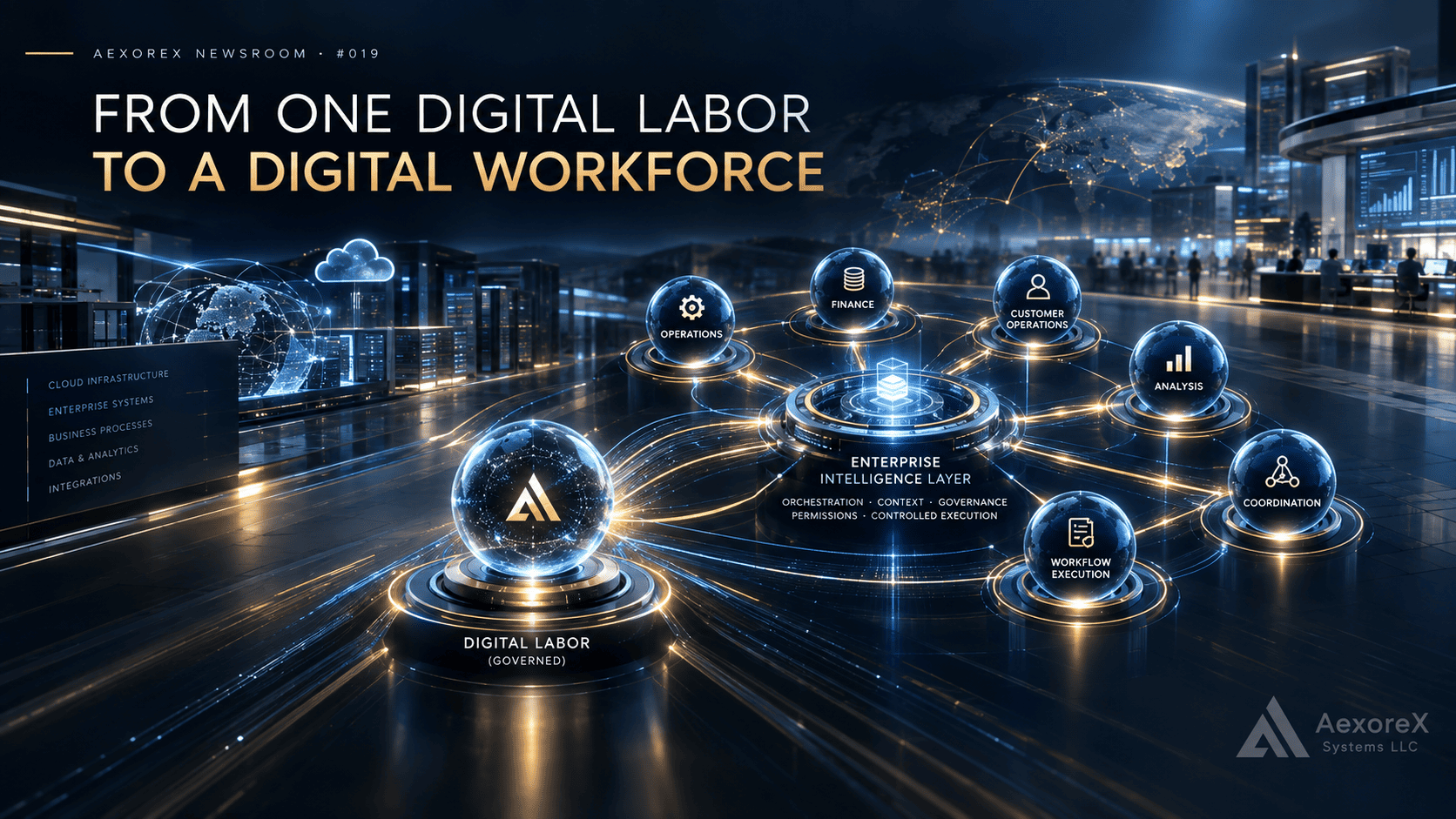
The adoption of Digital Labor can begin with a single role, not necessarily an entire workforce. This initial Digital Labor can be designed to support a specific business responsibility, operate within a defined scope, interact with approved systems, and perform work according to established policies and permissions. This demonstrates a crucial possibility: AI can evolve from merely assisting people to performing defined enterprise work.
Once an enterprise recognizes this potential, the question arises: What happens when one Digital Labor becomes many? This is where the concept of a Digital Workforce begins to take shape.
From Individual Capability to Workforce
While a single Digital Labor role is useful, multiple roles become significantly more powerful when their responsibilities are deliberately structured. Different Digital Labor roles may support various areas of an enterprise. For example, one might monitor operational activities, another prepare business information, a third support customer operations, a fourth assist with financial processes, a fifth coordinate defined workflows, and a sixth support management-level analysis.
The objective is not simply to deploy more AI, but to create specialized digital capacity around defined business responsibilities. This establishes a fundamental distinction: a collection of unrelated AI assistants is not necessarily a Digital Workforce. A Digital Workforce requires structure, defined responsibilities, scopes, permissions, policies, relationships, oversight, and accountability.
Digital Labor as Defined Roles
The concept of Digital Labor gains more meaning when each role has a clear operating definition. A Digital Labor role can be:
- **Defined** — assigned a specific responsibility.
- **Scoped** — limited to an operational domain.
- **Policy-Bound** — required to operate according to enterprise policies.
- **Permissioned** — granted controlled access to relevant systems and information.
- **Risk-Aware** — subject to controls appropriate to the work it performs.
- **Auditable** — capable of producing an observable record of relevant activity.
- **Human-Governed** — operating under authority established by the enterprise.
- **Revocable** — capable of having permissions or authority restricted or withdrawn.
This structure enables enterprises to think about Digital Labor less like an unrestricted AI assistant and more like a defined digital role within an operating organization.
A Workforce Needs More Than Workers
Human organizations function through roles, responsibilities, management structures, processes, policies, communication, resources, and accountability, not simply because employees exist. The same principle applies when enterprises begin deploying Digital Labor at scale.
Therefore, a Digital Workforce needs more than individual digital workers. It requires coordination, clear boundaries, mechanisms for assigning responsibilities, appropriate authority, governance, and a way to understand how different Digital Labor roles contribute to broader enterprise operations. This is where the architecture moves beyond individual automation.
Digital Labor at Different Levels
A Digital Workforce can potentially incorporate different levels of responsibility:
- At an **Employee level**, Digital Labor may perform defined operational tasks.
- At a **Manager level**, Digital Labor may coordinate defined activities, monitor workflows, or support operational decisions within delegated authority.
- At an **Executive level**, Digital Labor may support higher-level analysis, coordination, and decision processes, subject to appropriate enterprise governance.
These levels structure digital operational responsibilities; they do not imply replacing human employees, managers, or executives. The enterprise remains responsible for defining the role, establishing its authority, and determining its operational boundaries.
From Automation to Coordination
The first generation of enterprise automation often focused on individual processes, such as a workflow automating a task, a system triggering an action, or a script executing a predefined sequence. Digital Labor introduces the possibility of a system that can interpret context and perform defined work using AI capabilities.
However, as the number of Digital Labor roles increases, simple task automation becomes insufficient; the enterprise must also coordinate these roles. For example, a business process might require one Digital Labor role to identify an issue, another to analyze relevant information, another to prepare an action, and another to execute an authorized step. The value thus shifts from individual capability toward coordinated capability, marking the beginning of the Digital Workforce model.
The Importance of Authority
A Digital Workforce cannot be designed responsibly without considering authority. Capability does not equate to authority. An AI system capable of generating a recommendation should not automatically make the decision. Similarly, a Digital Labor role capable of performing an action should not automatically have permission to perform it.
Authority must be established by the enterprise, and can include:
- Defined permissions
- Operational boundaries
- Approval requirements
- Financial limits
- Risk controls
- Escalation conditions
- Audit requirements
- Human oversight
The principle is straightforward: Digital Labor operates through authority delegated by the enterprise, not authority owned by the Digital Labor itself.
The Emergence of Digital Workforce Management
As enterprises deploy multiple Digital Labor roles, new management challenges emerge:
- How does an organization understand what Digital Labor exists?
- Who is responsible for each role?
- What systems can each role access?
- What decisions can each role make?
- What actions can each role execute?
- What financial authority has been delegated?
- When should a role escalate?
- When should a human intervene?
- How can a role be paused, restricted, or revoked?
These are not merely technical questions but organizational and governance concerns. Consequently, Digital Workforce architecture must consider not only the intelligence of individual digital workers but also the relationships between workers, enterprise systems, authority, governance, and business objectives.
Digital Workforce Does Not Mean Unrestricted Autonomy
The term “Digital Workforce” should not be confused with unrestricted autonomous AI. A mature Digital Workforce does not necessarily mean every Digital Labor role can act independently. Instead, autonomy can be deliberately bounded.
Some Digital Labor may only recommend, while others may make defined decisions, execute authorized actions, require human approval for specific situations, or automatically escalate exceptions. This creates a controlled progression toward greater operational autonomy, with the enterprise determining where those boundaries exist.
Why the Digital Workforce Matters
The significance of the Digital Workforce lies not just in deploying more AI workers, but in expanding digital operational capacity across the enterprise. Instead of one AI assistant serving one user, enterprises can consider a broader model where Digital Labor serves business functions.
Multiple Digital Labor roles can support different responsibilities, interact with enterprise systems, have their activities coordinated, their permissions governed, their outputs contribute to broader workflows, and their execution remain subject to enterprise-defined authority. This creates the foundation for a new form of enterprise operating model.
From Digital Workforce to Enterprise Intelligence
However, a Digital Workforce introduces another architectural challenge: if many Digital Labor roles operate across different systems and business functions, they require context. They need access to relevant knowledge, organizational memory, information about enterprise processes, mechanisms for coordinating actions, and an understanding of relationships between business activities. The enterprise also needs visibility into how intelligence is being applied across operations. This is where the concept of Enterprise Intelligence becomes increasingly important.
The evolution therefore begins to look like: One Digital Labor → Digital Workforce → Enterprise Intelligence → Autonomous Enterprise Operations. Each stage introduces another layer of capability and coordination. The objective is not simply to create more digital workers, but to create an increasingly connected enterprise environment where those digital workers can operate responsibly and effectively.
Building Toward the Autonomous Enterprise
The journey toward the Autonomous Enterprise will likely develop progressively rather than as a single technological event. An enterprise may start with one governed Digital Labor role, then expand to multiple specialized roles. These roles may become coordinated as a Digital Workforce. Enterprise Intelligence can provide broader context and coordination. Governance and authority can establish operational boundaries, and orchestration can connect activities across enterprise systems.
Over time, these capabilities can contribute to increasingly autonomous enterprise operations. This progression is important because autonomy is not simply about giving AI more power; it is about building the intelligence, infrastructure, authority, governance, and operational foundations required to use that power responsibly.
The Next Evolution
The transition from one Digital Labor role to a Digital Workforce represents an important step in the evolution of enterprise AI. It shifts the question from "What can one AI system do?" to "How can an enterprise coordinate many forms of Digital Labor around its operations?"
That question naturally leads to the next architectural challenge: How does an enterprise create the intelligence layer required to connect knowledge, memory, systems, Digital Labor, orchestration, authority, and governance? This is the subject of the next stage in this editorial series.
**Coming Next — Article #020** **The Role of Enterprise Intelligence in Autonomous Enterprises**
As Digital Workforce models expand, Enterprise Intelligence becomes increasingly important for connecting intelligence, context, systems, and operational coordination. The next article explores why Enterprise Intelligence may become a critical foundation for enterprises moving toward autonomous operations.
AexoreX Systems The Global Enterprise Intelligence Infrastructure Company In Foundational Establishment & Active Development
Sources and attribution
- Original editorial content by AexoreX Systems LLC. · statement
About the author
The editorial team behind AexoreX Newsroom, the official corporate publication of AexoreX Systems LLC.
More from AexoreX Systems Editorial Team →Related stories
- Why Enterprise AI Needs an Operating Layer, Not Another Copilot
- AexoreX Systems Introduces AEOS Enterprise Authority™ as Governance Layer for Autonomous Enterprise Intelligence
- AexoreX Systems Advances AEOS QUANTUM™ as Enterprise Intelligence Operating Platform for Autonomous Enterprises
- AEXOREX NEWSROOM #014 THE ENTERPRISE IS ENTERING THE GOVERNED DIGITAL LABOR ERA
- Digital Labor vs. Chatbots: What Is the Difference?
- From Digital Labor to Autonomous Enterprise Operations: Why an Intelligence Layer Matters