
From Enterprise Intelligence to Governed Autonomous Execution: The Next Step Toward the Autonomous Enterprises
Why Enterprise AI Must Move Beyond Intelligence Toward Controlled, Accountable Execution
The transition to autonomous enterprises requires governed AI and Digital Labor systems that operate within defined organizational authority and controls, moving beyond mere intelligence to accountable execution.
Opinion · AI-assisted, human edited
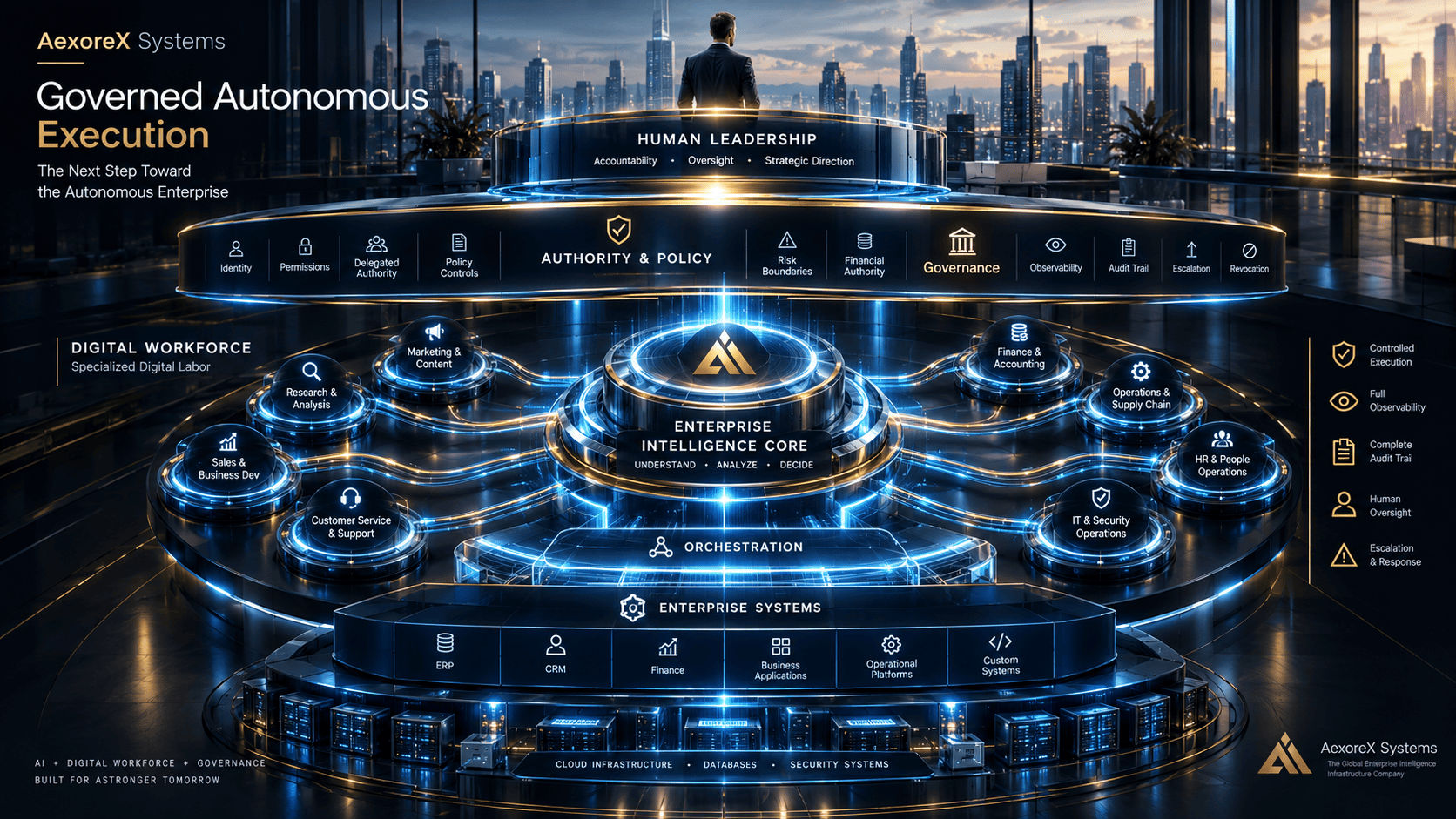
Key Points for Governed Autonomous Execution
Enterprise Intelligence offers a potential coordination layer for increasingly capable AI and Digital Workforce systems. The immediate challenge for enterprises is not just generating intelligence, but determining how it can support controlled and accountable execution. Autonomous execution demands clearly defined authority, permissions, policies, risk boundaries, and human oversight. Enterprise autonomy should be governed, not unrestricted. Different business processes can operate at varying levels of autonomy based on risk, authority, and organizational requirements. As AI capabilities integrate more deeply into enterprise operations, auditability, observability, escalation, and revocation become critically important. AEOS QUANTUM™ is currently in Foundational Establishment & Active Development, with individual capabilities progressing through different stages of maturity.
Intelligence Is Only the Beginning
Enterprise AI is moving beyond simple experimentation. Organizations are increasingly exploring AI assistants, AI-enabled workflows, Digital Labor, and more autonomous forms of enterprise operations. As previously discussed in this series, a single Digital Labor capability can evolve into a broader Digital Workforce. However, multiple digital workers necessitate coordination. This coordination requires shared context, knowledge, memory, identity, permissions, workflows, governance, and connections to existing enterprise systems, leading to the broader concept of Enterprise Intelligence Infrastructure.
A new question arises: What happens when enterprise intelligence can support not only information and recommendations, but also increasingly controlled enterprise action? This is where the concept of governed autonomous execution becomes vital. The goal is not simply to make AI more autonomous, but to explore how increasingly capable digital systems can operate within defined organizational authority, policies, risk boundaries, and human governance.
From Information to Action
Traditional enterprise systems are typically designed around defined processes: a user enters information, a system processes it, a workflow progresses, an employee reviews the result, a decision is made, and an action is executed. AI introduces a potentially different operating model. An intelligent system can analyze information, interpret context, generate recommendations, coordinate tasks, and — where appropriately authorized — interact with enterprise systems.
This creates a possible progression: Enterprise Context → Intelligence → Decision Support → Governed Action. The word "governed" is critical. Greater capability does not automatically justify greater autonomy. Instead, autonomy must be matched with appropriate controls.
Autonomy Is a Spectrum
Autonomy should not be viewed as a simple yes-or-no capability. Enterprise processes can potentially operate at different levels depending on their risk and business requirements.
- **Level 1 — Recommend**: The system analyzes information and recommends an action. A human makes the decision.
- **Level 2 — Decide Within Defined Boundaries**: The system may make a decision when predefined conditions are satisfied and the relevant authority has been delegated.
- **Level 3 — Decide and Execute Within Defined Authority**: The system may make and execute an approved class of decisions within a specific operational boundary.
- **Level 4 — Execute and Escalate Exceptions**: The system can operate autonomously for defined routine situations while escalating uncertainty, exceptions, high-risk events, or activities outside its authority.
This model provides a potential path toward increasing autonomy without treating it as unlimited freedom. The appropriate level depends on the specific process. A low-risk internal task may require limited human intervention, while a high-impact financial, legal, security, or strategic process may require significantly stronger controls.
Capability Is Not Authority
A crucial principle in autonomous enterprise architecture is the separation between technical capability and organizational authority. An AI system may technically be capable of accessing information, sending communications, modifying records, creating requests, initiating workflows, changing configurations, preparing financial actions, or executing approved processes. However, technical capability does not automatically grant permission. Authority must be established by the organization.
This raises several questions: What can the system do? Under which conditions? With which systems? Within what limits? For what business purpose? What requires human approval? What must be blocked? What happens when the system encounters an exception? These questions transform autonomy into an enterprise governance discipline.
Delegated Authority
Human organizations already operate through delegated authority, where employees have roles, managers have approval limits, executives have broader responsibilities, and system administrators have specific technical permissions. A similar principle can apply to Digital Labor. An organization can define a specific scope of authority for a digital capability. This authority can be defined, scoped, policy-bound, permissioned, risk-aware, budget-controlled, auditable, human-governed, and revocable.
The Digital Labor does not own this authority; it operates under authority delegated by the enterprise. This distinction is particularly important when digital capabilities interact with financial systems, operational systems, customer information, security infrastructure, or other high-impact resources.
Governance Before Autonomy
There is a natural tendency to begin with AI capability: build an intelligent system, give it access to tools, connect it to enterprise systems, and allow it to act. Enterprise environments, however, require a broader approach. A more controlled architectural sequence can be represented as: Identity ↓ Permission ↓ Policy ↓ Authority ↓ Context ↓ Intelligence ↓ Decision ↓ Execution ↓ Observation ↓ Audit ↓ Escalation or Continuation.
This sequence creates boundaries around autonomous activity. The system should not only ask, "Can I do this?" but also operate within questions such as: "Am I authorized?" "Does policy permit this?" "Do I have the required context?" "Is this action within my scope?" "Does this require human approval?" This is the foundation of governed autonomy.
The Enterprise Authority Layer
As Digital Workforce capabilities become increasingly connected to enterprise operations, organizations may require stronger mechanisms for managing authority. Conceptually, an authority layer can sit between intelligence and execution: Enterprise Intelligence ↓ Authority & Policy ↓ Orchestration ↓ Enterprise Systems ↓ Execution.
This differs from simply providing an AI system with API access. API access answers, "Can the system technically call this function?" Authority answers, "Is the system permitted to perform this action under these circumstances?" That distinction becomes increasingly important as AI systems gain broader operational capabilities.
Financial Authority as an Example
Financial activity clearly illustrates the principle of governed autonomy. Consider a Digital Labor capability supporting procurement. It could potentially identify a supplier, compare pricing, prepare an order, and interact with a procurement workflow. However, an enterprise may establish different levels of authority: routine purchases may be eligible for automated processing; purchases above a defined threshold may require approval; certain suppliers may require additional review; certain categories may be restricted; unusual transactions may require escalation; and financial actions may need to remain auditable. The Digital Labor therefore does not receive unlimited financial power; it receives defined and delegated financial authority. The organization remains the source of that authority.
Observability Is Essential
Execution alone is insufficient. An enterprise needs to understand what happened. For meaningful autonomous or AI-assisted actions, organizations may need visibility into: What triggered the action? What context was available? Which policy applied? Which authority was used? Which systems were accessed? What decision was made? What action occurred? What was the result? Was a human involved? Was the action escalated? Did an exception occur? This creates the requirement for strong observability and auditability. Autonomous systems should not become invisible operational actors inside critical enterprise environments. Organizations need appropriate operational visibility.
Auditability Becomes Part of the Operating Model
Traditional enterprise auditing primarily tracks human actions and system transactions. AI-enabled operations introduce another category: machine-initiated or machine-assisted activity. Organizations may therefore need to understand the operational chain behind significant actions. A conceptual record might look like: Event → Context → Policy → Authority → Decision → Action → Result.
This can support operational review, risk management, incident investigation, compliance processes, governance, performance analysis, and continuous improvement. The objective is not necessarily to record everything, but to provide appropriate evidence and visibility for meaningful enterprise activity.
What Happens When Intelligence Is Uncertain?
Autonomous systems will encounter situations that are ambiguous, unexpected, or outside their defined operating boundaries. The correct response should not always be to continue. Sometimes the appropriate action is to stop, sometimes clarification is required, and sometimes the situation should be escalated to a human. A governed model can therefore distinguish between:
- Routine → Continue or Execute
- Uncertain → Escalate
- High Risk → Human Approval
- Unauthorized → Block
- Policy Violation → Block and Record
This creates a controlled relationship between digital autonomy and human authority.
Revocation Matters
Delegating authority is only one side of governance. Organizations must also be able to change or remove that authority. A digital capability may need to be suspended, restricted, reconfigured, moved to a narrower scope, disabled, or revoked following an incident. Therefore, revocation should be considered part of the operating model for governed Digital Labor. An organization should be able to stop or change delegated authority when circumstances require it.
Autonomous Operations Need Clear Boundaries
The more capable a Digital Labor system becomes, the more important its boundaries become. These can include:
- **Role**: What function does it perform?
- **Scope**: Which processes can it operate within?
- **Permissions**: Which information and systems can it access?
- **Authority**: Which decisions can it make?
- **Budget**: What financial boundaries apply?
- **Risk**: Which activities require stronger controls?
- **Policy**: Which organizational rules apply?
- **Escalation**: When must a human become involved?
- **Audit**: Which activities require records?
- **Revocation**: How can authority be suspended or changed?
This framework provides a practical basis for governed Digital Labor.
The Enterprise as a System of Delegated Intelligence
This leads to a broader architectural perspective. An enterprise can potentially operate as a network of delegated intelligence. Humans establish strategy, objectives, policies, risk boundaries, and organizational authority. Digital Workforce capabilities perform analysis, coordination, operational work, decisions within defined boundaries, and authorized execution. Enterprise systems provide data, applications, infrastructure, and transactional capabilities. Enterprise Intelligence connects these elements, and governance establishes the boundaries. Together, they create a potential operating model for increasingly autonomous enterprise processes.
An Autonomous Enterprise Is Not a Humanless Enterprise
The phrase "Autonomous Enterprise" can easily be misunderstood. It does not necessarily mean an organization without people, removing human leadership, or allowing AI systems to make unlimited decisions. Instead, it can describe an enterprise where an increasing amount of operational work is performed by digital capabilities within defined organizational boundaries. Humans remain responsible for strategic direction, organizational accountability, governance, risk management, critical decisions, and business objectives. Digital Labor performs delegated work. The organization determines where autonomy is appropriate. That distinction is fundamental.
From Automation to Autonomous Operations
Traditional automation often follows: Trigger → Rule → Action. AI-enabled operations can potentially introduce: Objective → Context → Reasoning → Policy → Authority → Decision → Action → Outcome. The second model can provide greater flexibility, but this flexibility must remain bounded. The organization should define what the system can optimize, what it cannot change, which actions require approval, which conditions require escalation, and which actions must always be blocked. This is the difference between uncontrolled automation and governed autonomy.
Enterprise Intelligence as the Coordination Layer
Enterprise Intelligence sits conceptually at the center of this transition. It can provide an environment where information, context, knowledge, memory, AI, Digital Labor, workflows, authority, governance, and enterprise systems interact. A conceptual architecture is:
Enterprise Knowledge Context & Memory Artificial Intelligence ↓ Enterprise Intelligence ↓ Digital Workforce ↓ Authority & Governance ↓ Orchestration ↓ Enterprise Systems ↓ Governed Execution ↓ Observability & Audit ↓ Human Oversight
This creates a potential operating loop. Intelligence supports decisions, authority defines boundaries, orchestration coordinates activity, execution produces outcomes, observability provides visibility, and feedback can then inform future operations.
The Role of AEOS QUANTUM™
This is the broader architectural direction being explored through AEOS QUANTUM™. AEOS QUANTUM™ is being developed as "The Enterprise Intelligence Operating Platform for Autonomous Enterprises." The platform vision brings together concepts including Enterprise Intelligence, Artificial Intelligence, Digital Labor, Digital Workforce, enterprise knowledge, context and memory, workflow orchestration, enterprise-system connectivity, governance, authority, and enterprise execution.
However, AEOS QUANTUM™ is not being presented as a fully completed Autonomous Enterprise platform at this stage. Its current status is Foundational Establishment & Active Development. This means the platform's foundations, architecture, operating model, and individual capabilities are being progressively established and developed. Different capabilities may be at different maturity stages.
AEOS QUANTUM™ Development Status
To maintain clear expectations, the development status of AEOS QUANTUM™ can be understood through three broad categories:
- **Available**: Capabilities that have been implemented and are currently available within the applicable AEOS QUANTUM™ environment.
- **Designed**: Capabilities that form part of the defined architecture or operating model but are still being developed or integrated.
- **Planned**: Future capabilities identified as part of the development roadmap but not currently available.
This distinction is important because the overall AEOS QUANTUM™ vision is broader than the capabilities that are currently implemented. The platform is being developed incrementally. Not every capability described in the long-term architecture is available today.
Building the Foundation Before Expanding Autonomy
AexoreX Systems is approaching autonomous enterprise operations as a progressive development path. The focus is not simply on adding more AI capabilities; it includes establishing the underlying foundations required for responsible enterprise operation. These foundations include areas such as identity and access, security, enterprise connectivity, intelligence, context and memory, Digital Labor, orchestration, governance, authority, observability, auditability, and human oversight. Some of these capabilities may already have implementation work underway, while others remain at designed or planned stages. The architecture is therefore being developed progressively rather than presented as a completed system.
Connect. Contextualize. Govern. Orchestrate. Execute.
The broader AEOS QUANTUM™ direction can be summarized through five operating principles:
- **Connect**: Connect enterprise intelligence with existing systems and relevant information.
- **Contextualize**: Provide appropriate enterprise context, knowledge, and memory.
- **Govern**: Apply permissions, policies, authority, risk controls, human oversight, and auditability.
- **Orchestrate**: Coordinate Digital Labor, workflows, and enterprise systems.
- **Execute**: Enable authorized actions within defined boundaries.
These principles describe the intended operating direction rather than a claim that every element is already fully implemented.
Autonomy Should Be Earned
The path toward greater autonomy should be progressive. A process may begin with Human Decision → AI Recommendation → Bounded AI Decision → Bounded Autonomous Execution → Higher Levels of Governed Autonomy. Each transition should be evaluated against factors such as reliability, risk, business impact, governance maturity, observability, demonstrated performance, and organizational requirements. This creates a more responsible path toward autonomous operations.
The Enterprise Interface May Become Intelligence
Enterprise employees traditionally interact with organizations through applications: opening a CRM, an ERP, a service platform, or financial software, and navigating dashboards. As Enterprise Intelligence develops, enterprise interaction may increasingly become contextual and action-oriented. A user could potentially interact with an intelligence environment that understands the relevant enterprise context and coordinates approved systems and Digital Labor. The underlying enterprise applications do not necessarily disappear; they remain part of the enterprise infrastructure. The intelligence layer can potentially provide a more unified way to work across them. This is an architectural direction—not a claim that such an experience is already fully realized within AEOS QUANTUM™.
A New Enterprise Architecture
The Autonomous Enterprise therefore requires more than an intelligent AI model. It requires an operating foundation. That foundation can include:
- **Identity**: Who is requesting or executing an action?
- **Context**: What does the system need to know?
- **Memory**: What relevant historical information should be available?
- **Intelligence**: What analysis or reasoning is required?
- **Authority**: What is the system authorized to decide or execute?
- **Policy**: What rules apply?
- **Orchestration**: Which Digital Labor and systems should participate?
- **Execution**: What authorized action should occur?
- **Observability**: What happened?
- **Audit**: Can the activity be reviewed?
- **Escalation**: When should a human become involved?
- **Revocation**: How can delegated authority be changed or stopped?
These are foundational considerations for governed autonomous operations.
Intelligence Should Operate Through Authority
The emerging architecture can be summarized by one principle: Intelligence should not automatically become authority. Intelligence should operate through authority. An intelligent system may understand a situation, recommend an action, and even be technically capable of executing that action. But the enterprise determines whether the action is authorized. This separation allows organizations to pursue greater digital autonomy while retaining organizational control.
The Road Toward Autonomous Enterprises
The progression described across this series can now be extended: One Digital Labor → Digital Workforce → Coordinated Digital Workforce → Enterprise Intelligence → Governed Decision-Making → Governed Autonomous Execution → Increasingly Autonomous Enterprise. Each stage introduces new capabilities, and each stage also introduces new governance requirements. The challenge is therefore not only technological; it is organizational, operational, architectural, and governance-related.
AexoreX Perspective
AexoreX Systems believes the transition toward increasingly autonomous enterprises will require infrastructure designed specifically for the relationship between intelligence and enterprise operations. AI models provide intelligence. Digital Labor provides digital capacity. Enterprise systems provide operational capabilities. Governance establishes boundaries. Authority defines what can be delegated. Orchestration coordinates work. Observability provides visibility. Human leadership retains accountability. This is the broader problem space AexoreX Systems is exploring.
AEOS QUANTUM™ is currently in Foundational Establishment & Active Development. The platform is being progressively developed toward an Enterprise Intelligence Operating Platform for Autonomous Enterprises. Its long-term vision is not to remove humans from enterprise operations. It is to enable organizations to delegate appropriate work to digital capabilities while retaining authority, governance, visibility, and accountability.
Conclusion
The next stage of enterprise AI may not be determined solely by how intelligent AI models become. It may increasingly depend on how effectively intelligence can operate inside real organizations. Digital Workforce creates digital capacity. Enterprise Intelligence creates coordination and context. Authority defines what can be delegated. Governance establishes boundaries. Orchestration coordinates work. Execution creates outcomes. Observability provides visibility. Human oversight maintains accountability. Together, these elements provide a potential foundation for governed autonomous execution.
The Autonomous Enterprise should therefore not be understood as an enterprise where AI operates without limits. It can instead be understood as an enterprise where digital intelligence progressively performs more work within clearly defined organizational authority. The destination is not uncontrolled autonomy; it is governed autonomy at enterprise scale. For AexoreX Systems, that journey is still being built. AEOS QUANTUM™ is in Foundational Establishment & Active Development. The architecture is being established. The platform is being developed. Capabilities are progressing at different maturity levels. And the long-term objective remains clear: One Enterprise. One Intelligence. Unlimited Digital Labor.
Sources and attribution
- AexoreX Systems LLC — AI-generated visual · statement link
About the author
Intelligence desk of AexoreX Newsroom.
More from AexoreX Intelligence Desk →Related stories
- AexoreX Systems Defines the Enterprise Intelligence Control Plane for the Autonomous Enterprise
- AexoreX Systems Introduces AEOS Enterprise Authority™ as Governance Layer for Autonomous Enterprise Intelligence
- AexoreX Systems Advances AEOS QUANTUM™ as Enterprise Intelligence Operating Platform for Autonomous Enterprises
- AEOS QUANTUM™ Envisions an Enterprise Intelligence Layer for the Emerging Autonomous Systems Era
- From Digital Labor to Autonomous Enterprise Operations: Why an Intelligence Layer Matters
- From One Digital Labor to a Digital Workforce