
What Is Digital Labor (LaaS)?
Understanding the Emerging Model of AI-Powered Digital Work
Digital Labor is an emerging model where AI-powered workers perform specific tasks within an organization, distinct from traditional software or chatbots.
Opinion · AI-assisted, human edited
Introduction
Artificial Intelligence (AI) is transforming organizational operations. Historically, software functioned as a tool, operated by employees who engaged in tasks like data entry, workflow execution, analysis, customer communication, and decision-making. AI is progressively introducing a different operational paradigm.
Instead of software solely serving as a user-operated tool, AI can increasingly participate in defined business activities. This involves understanding information, performing tasks, interacting with systems, generating outputs, and supporting decisions. This evolving concept is often termed Digital Labor.
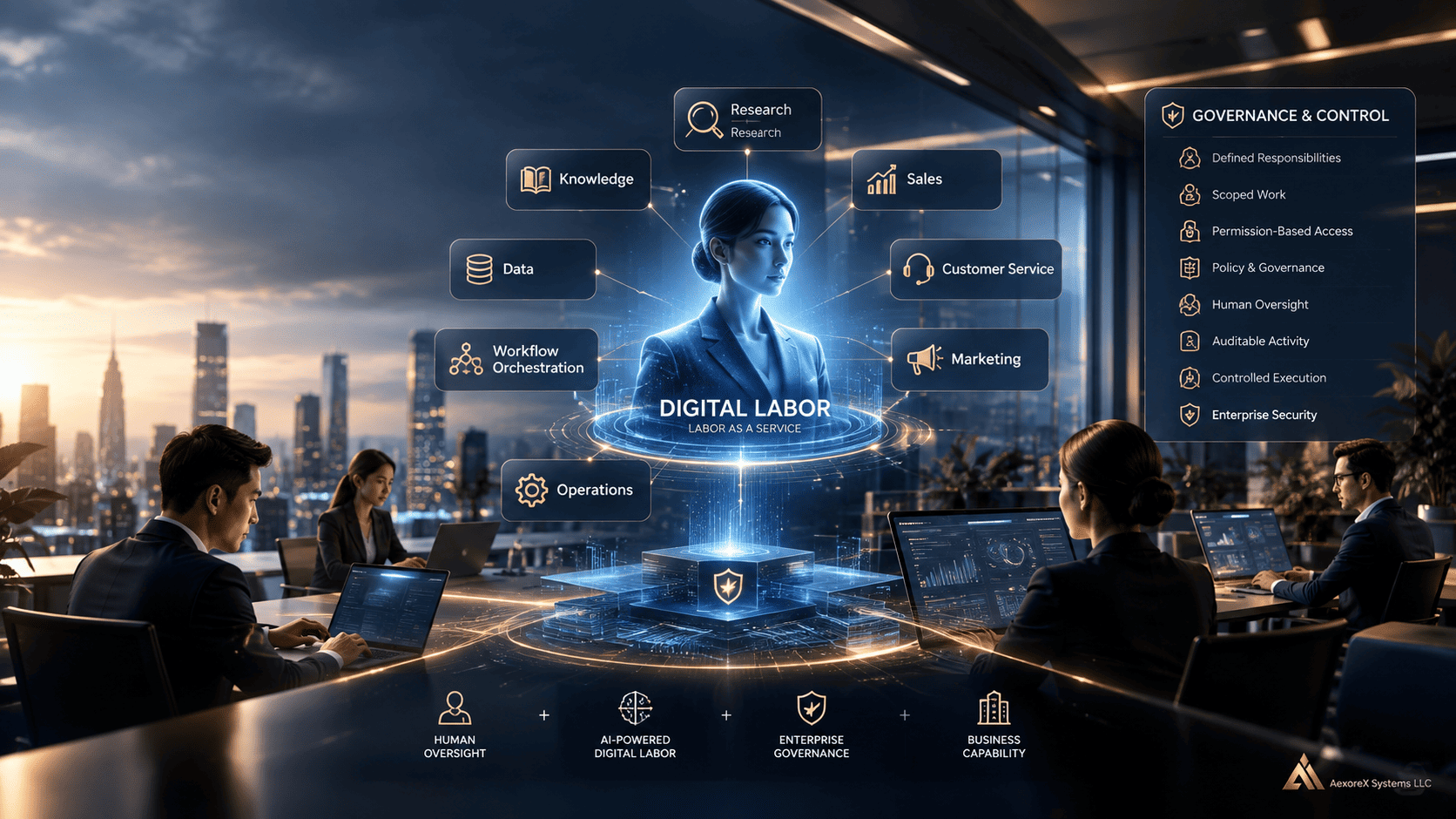
Digital Labor refers to AI-powered digital workers designed to perform specific tasks within an organization's operational environment. This concept spans from relatively simple task execution to more complex systems capable of handling multi-step workflows, coordinating information, utilizing approved tools, and operating within defined policies and permissions.
A helpful way to frame this idea is:
Digital Labor is AI applied to work — with defined responsibilities, boundaries, permissions, and human oversight.
The term LaaS, or Labor as a Service, describes a service-oriented model. In this model, organizations can access digital labor capabilities without the need to build and maintain every underlying AI system themselves. This article will explain the meaning of Digital Labor, its distinctions from conventional software and chatbots, the importance of governance, and how this concept may contribute to the development of more intelligent and increasingly autonomous enterprises.
What Is Digital Labor?
At its core, Digital Labor represents AI-enabled capabilities organized around specific work. Traditional software typically provides tools. For instance, a Customer Relationship Management (CRM) system offers customer-management functionality; an accounting system manages financial records; an Enterprise Resource Planning (ERP) system handles enterprise processes; a communication platform facilitates collaboration; and a database stores information. A human employee operates these systems to achieve business objectives.
Digital Labor introduces an additional layer. A Digital Labor system may be designed around a specific responsibility or a set of related tasks.
Consider Digital Labor for Research, which could potentially:
1. Receive a defined research objective. 2. Search approved information sources. 3. Collect relevant information. 4. Organize findings. 5. Compare information. 6. Produce a structured report. 7. Identify uncertainty or missing information. 8. Submit the result for human review.
A crucial point is that Digital Labor is not merely "AI that can answer questions." It is AI structured around work and outcomes.
Digital Labor Is Not Simply a Chatbot
Terms like AI assistant, chatbot, AI agent, automation, and Digital Labor are sometimes used interchangeably, but they are not necessarily synonymous. A chatbot is primarily designed for interactive conversations. While a Digital Labor system may incorporate conversational capabilities, its purpose extends beyond simple dialogue.
For example, a chatbot interaction typically follows: Human → Question → AI → Answer.
In contrast, Digital Labor operates as: Business objective → Assigned work → AI processing → Approved tools/systems → Output/action → Review or escalation.
A chatbot might instruct an employee on how to perform a task. Digital Labor, however, may potentially perform defined portions of that task itself. This distinction is significant. Therefore, Digital Labor is better understood as a work-oriented operating model for AI, rather than just another name for a chatbot.
Digital Labor vs. Traditional Automation
Automation is a long-standing practice in organizations. Traditional automation generally operates based on predefined rules, such as: "If an invoice is received, send it to the accounting workflow." While highly useful, many business activities involve information that is incomplete, unstructured, dynamic, or challenging to express entirely through fixed rules.
AI can introduce additional capabilities, including:
- Understanding natural language
- Interpreting documents
- Summarizing information
- Classifying content
- Extracting information
- Reasoning across multiple pieces of context
- Generating structured outputs
- Supporting decisions
- Interacting with approved tools
Digital Labor can integrate these AI capabilities with conventional automation. Consequently, the future of enterprise automation may involve combining: Software + Automation + AI + Data + Knowledge + Governance + Human Oversight into a coordinated operating environment, rather than replacing traditional automation.
Why the Word "Labor" Matters
The term "labor" is important because the concept focuses on work, not just technology. While a software feature performs a function, a Digital Labor capability can be structured around a responsibility.
Examples of potential applications include:
- **Research:** A Digital Labor capability could support information gathering and analysis.
- **Sales:** A Digital Labor capability could assist with activities such as lead research, preparation, follow-up, or information organization, depending on available systems and permissions.
- **Customer Service:** A Digital Labor capability could support defined customer-service processes, information retrieval, classification, and escalation.
- **Marketing:** A Digital Labor capability could aid in research, content preparation, campaign analysis, or other approved activities.
- **Operations:** A Digital Labor capability could support repetitive operational processes, monitoring, reporting, and workflow coordination.
These examples illustrate potential applications, not claims that every Digital Labor capability is universally available from all providers. Actual capabilities depend on the specific technology, integrations, data access, governance policies, and implementation.
Digital Labor Needs a Defined Role
Just as a human organization typically assigns employees defined roles and responsibilities, the same principle applies, and is even more critical, for AI. A Digital Labor capability should have a clearly defined role.
For example, a "Research Digital Labor" could have:
- **Purpose:** Support market research activities.
- **Responsibilities:** Gather approved information, organize research findings, identify relevant trends, and prepare reports.
- **Boundaries:** Use only authorized sources and systems, refrain from making unauthorized commitments, avoid accessing restricted information, and not perform activities outside its assigned scope.
- **Human oversight:** Require human review where necessary, escalate when uncertainty is high, and allow for suspension or revocation of access.
This structured approach makes Digital Labor more understandable and controllable.
Digital Labor Requires Authority and Permissions
A fundamental principle of Digital Labor is authority. An AI system should not automatically be granted unlimited authority simply because it is technically capable of performing an action. Authority must be delegated by the organization.
For instance, a Digital Labor capability might be permitted to:
- Read specific information.
- Create a draft.
- Prepare a report.
- Update an approved record.
- Trigger a predefined workflow.
However, it may not be authorized to:
- Approve major financial transactions.
- Change critical enterprise policies.
- Access confidential information without authorization.
- Make commitments on behalf of the organization.
- Execute high-risk actions without required approval.
The technical ability to perform an action and the organizational authority to perform that action are distinct concepts. This distinction is fundamental to responsible enterprise AI.
Governance Is Part of Digital Labor
Digital Labor should be considered not just an AI capability, but also a governance challenge. Organizations must address key questions:
- What actions can the Digital Labor perform?
- What actions is it prohibited from performing?
- What information can it access?
- Which systems can it utilize?
- Who authorized its deployment?
- Who supervises its operations?
- When is human approval required?
- What procedures are in place for when issues arise?
- Can its authority be revoked?
These questions become increasingly vital as AI systems transition from generating information to executing actions. A responsible Digital Labor architecture should therefore incorporate controls such as:
- Defined scope
- Explicit permissions
- Policy constraints
- Access controls
- Auditability
- Human oversight
- Escalation mechanisms
- Revocable authority
- Risk controls
- Monitoring
- Accountability
The goal is not to render AI incapable of action, but to ensure AI acts within clearly defined organizational boundaries.
Digital Labor and Human Employees
Digital Labor does not necessarily imply replacing every human employee. A more practical perspective views this technology as an additional form of organizational capability. Humans excel in areas such as judgment, creativity, leadership, empathy, relationship building, strategic thinking, ethical responsibility, and contextual understanding.
AI systems, on the other hand, demonstrate strengths in:
- High-speed information processing
- Repetitive task execution
- Large-scale data handling
- Consistent workflow execution
- Rapid information retrieval
- Continuous availability
- Automated reporting
Therefore, the most valuable model may involve humans and Digital Labor collaborating. For example:
Human → Defines objective
↓
Digital Labor → Performs approved work
↓
Human → Reviews important result
↓
Digital Labor → Executes approved next step
↓
Human → Retains organizational accountability
This framework establishes a model of human-governed digital work.
From One Digital Labor to a Digital Workforce
An organization might initially deploy a single, narrowly defined Digital Labor capability, such as a Research Digital Labor. Over time, it could introduce additional capabilities like Sales Digital Labor, Customer Service Digital Labor, Marketing Digital Labor, Operations Digital Labor, Finance-support Digital Labor, and Executive-support Digital Labor. Each capability would have its own role, responsibilities, permissions, and policies.
Collectively, these capabilities can form what may be termed a Digital Workforce. Conceptually, this progresses from one Digital Labor to multiple Digital Labor capabilities, then to a Digital Workforce, and finally to coordinated Enterprise Operations.
The primary challenge lies in coordination. When managing numerous AI-powered workers, an organization requires more than just individual AI systems. It needs a system to manage:
- Identity
- Context
- Knowledge
- Permissions
- Workflows
- Policies
- Communication
- Memory
- Monitoring
- Governance
- Human intervention
This is where broader enterprise intelligence platforms become crucial.
What Does LaaS Mean?
LaaS, or Labor as a Service, describes the delivery of digital labor capabilities as a service. This approach eliminates the need for every organization to build its own AI workforce infrastructure from scratch. Instead of primarily considering "We need to buy another software application," an organization might increasingly think, "We need additional digital capacity to perform this type of work."
This represents a different software consumption model. Traditional software is often purchased based on features. LaaS, however, may increasingly be evaluated according to:
- Work performed
- Responsibilities
- Outcomes
- Capacity
- Availability
- Governance
- Integration
- Performance
The precise commercial model will vary. LaaS could potentially be delivered via subscriptions, usage-based models, outcome-based models, enterprise contracts, or various combinations. There is no single, universal commercial definition of LaaS; the concept is still evolving.
Why Enterprises May Adopt Digital Labor
Organizations constantly face pressure to enhance productivity while managing cost, complexity, speed, and operational risk. Digital Labor may offer an additional mechanism to address some of these challenges.
Potential benefits include:
- **Increased operational capacity:** Organizations may be able to handle larger volumes of defined digital work.
- **Faster execution:** AI-powered systems can process certain types of information much faster than traditional manual workflows.
- **Consistency:** Well-designed workflows can execute defined tasks consistently according to established policies.
- **Scalability:** Digital capabilities can potentially scale more easily than adding a human resource for every incremental task.
- **24/7 availability:** Digital systems can operate continuously, subject to their infrastructure and operating policies.
- **Employee augmentation:** Digital Labor can potentially reduce repetitive workloads, allowing employees to focus on higher-value activities.
- **Better information flow:** AI can help connect information from different systems and transform it into usable context.
These benefits are potential outcomes, not guarantees. Successful implementation depends on the quality of the underlying data, AI models, integrations, governance, workflows, security, and human oversight.
Digital Labor Also Creates New Risks
The advent of Digital Labor introduces significant responsibilities. Organizations must consider risks such as:
- Incorrect AI outputs
- Hallucinations or fabricated information
- Unauthorized access
- Data leakage
- Excessive permissions
- Poorly designed workflows
- Security vulnerabilities
- Unclear accountability
- Unexpected actions
- Regulatory requirements
- Bias or unfair outcomes
- Over-reliance on automated decisions
Therefore, Digital Labor should not be evaluated solely by asking, "How intelligent is the AI?" A more comprehensive question is, "How intelligently, safely, and controllably can the AI perform its assigned work?" This distinction becomes increasingly important as AI systems move closer to real-world execution.
Human Governance Remains Important
Even highly capable AI systems operate within human institutions. Businesses are composed of owners, executives, managers, employees, customers, regulators, partners, shareholders, and legal obligations. AI does not automatically replace these structures. Instead, Digital Labor should operate under organizational authority.
This establishes an important principle: "AI may execute delegated work, but organizational authority remains with the organization and its authorized people."
Human governance can encompass:
- Approval requirements
- Escalation policies
- Role-based permissions
- Financial limits
- Data-access restrictions
- Audit trails
- Monitoring
- Suspension
- Revocation
- Periodic review
These controls become increasingly vital as organizations deploy a greater number of AI-powered systems.
Digital Labor and Enterprise Intelligence
Digital Labor becomes more powerful when it can operate within a broader enterprise context. An enterprise may have information distributed across various systems, including:
- ERP systems
- CRM systems
- HR systems
- Customer-support systems
- Cloud platforms
- Databases
- Documents
- Communication systems
- Internal knowledge bases
- Custom applications
A Digital Labor capability may require access to some of this information to perform its assigned work, but this access must be controlled. This creates a need for an intelligence layer that can help coordinate data, knowledge, context, AI, Digital Labor, processes, memory, governance, and authority. The long-term vision is not merely to create more AI workers, but to establish an environment where digital work can be coordinated across the enterprise in a controlled and intelligent manner.
The Relationship Between Digital Labor and Autonomous Enterprises
The concept of an Autonomous Enterprise represents a long-term direction for enterprise transformation. An Autonomous Enterprise does not necessarily mean a company devoid of people. Instead, it can describe an organization where many operational activities are intelligently coordinated and executed with a high degree of automation and AI assistance, while humans retain strategic authority, governance, accountability, and control. Digital Labor can be a key component of this transformation.
A conceptual progression could be:
Traditional Enterprise (Human-driven processes)
↓
Automated Enterprise (Rule-based automation)
↓
AI-Augmented Enterprise (AI assists people and processes)
↓
Digital Workforce (Multiple Digital Labor capabilities perform defined work)
↓
Intelligent Enterprise (Enterprise intelligence coordinates information, processes, AI, and digital work)
↓
Increasingly Autonomous Enterprise (More operational activities become intelligently coordinated and executed under human governance)
This is a transformation journey, not an instantaneous change.
Where AEOS QUANTUM™ Fits
AexoreX Systems is exploring Digital Labor as part of a broader enterprise technology vision. AEOS QUANTUM™ is being developed as an Enterprise Intelligence Operating Platform for Autonomous Enterprises. The platform vision aims to integrate areas such as:
- Enterprise Intelligence
- Artificial Intelligence
- Digital Labor
- Process orchestration
- Enterprise knowledge
- Memory and context
- Governance
- Organizational authority
- Integration with enterprise systems
The objective is not to replace every existing enterprise application. Instead, the broader vision is to provide an operating environment that can connect, orchestrate, govern, and activate enterprise capabilities across an existing technology ecosystem. Therefore, Digital Labor is an important component of the broader AEOS QUANTUM™ vision, but it is not the entirety of the platform.
A Practical Example
Consider a company that receives hundreds of business inquiries weekly. A traditional process might involve a customer inquiry, an employee reading the message, researching the customer, checking internal systems, preparing a response, a manager reviewing certain cases, and finally, the employee sending the response.
A Digital Labor approach could potentially support parts of this workflow:
Customer inquiry
↓
Digital Labor receives the assigned task
↓
Classifies the inquiry
↓
Retrieves permitted information
↓
Researches relevant context
↓
Prepares a response
↓
Checks applicable policies
↓
Escalates sensitive cases
↓
Human approves when required
↓
Approved response is delivered
The Digital Labor does not automatically receive unlimited authority. Its capabilities depend on the organization's policies, permissions, systems, data, risk controls, and human approval requirements. This differentiates a governed Digital Labor model from simply granting an AI system unrestricted access to business systems.
The Future of Digital Labor
The technology is continually evolving. AI models are becoming more capable, enterprise software is becoming increasingly connected, automation platforms are growing more intelligent, and AI agents are becoming more adept at using tools and completing multi-step tasks. These developments may accelerate the adoption of Digital Labor.
In the future, organizations may increasingly view their workforce as a combination of Human Labor + Digital Labor. Humans may increasingly concentrate on areas where judgment, leadership, creativity, relationships, accountability, and strategic decision-making are critical. Digital Labor may increasingly manage defined digital activities where speed, scale, consistency, and information processing offer advantages.
The most important question may therefore shift from "Can AI do this task?" to "Should AI do this task, under what authority, with what controls, and with what level of human oversight?" This is fundamentally an enterprise governance question.
Digital Labor Is a New Operating Concept
Digital Labor should be understood as more than just another AI feature. It represents a broader shift in how organizations may approach digital work. Traditional software provided tools for people. Automation allowed systems to execute predefined rules. AI introduced systems capable of understanding and generating information. Digital Labor extends this direction toward AI-powered work performed within defined organizational responsibilities.
The emerging model can be summarized as:
AI Capability
+
Defined Work
+
Tools & Systems
+
Permissions
+
Policies
+
Context & Knowledge
+
Human Governance
=
Digital Labor
As these capabilities mature, multiple Digital Labor systems may form a Digital Workforce, and coordinated Digital Workforces may become part of a broader enterprise intelligence architecture.
AexoreX Perspective
AexoreX Systems views Digital Labor as an important building block in the transition toward more intelligent and increasingly autonomous enterprises. The opportunity extends beyond simply creating AI that can perform isolated tasks. The larger opportunity is to create enterprise environments where AI-powered digital work can be:
Defined.
Scoped.
Policy-bound.
Permissioned.
Budget-controlled.
Risk-aware.
Auditable.
Human-governed.
Revocable.
This approach recognizes that enterprise AI must be not only capable but also understandable, controllable, accountable, and aligned with organizational authority. AEOS QUANTUM™ is being developed around this broader direction.
Conclusion
Digital Labor represents an emerging model for applying AI to real business work. It moves the conversation beyond AI as a conversational tool and toward AI as a participant in defined organizational activities. This concept can begin with a single, narrowly defined responsibility and then expand:
One Digital Labor
↓
Multiple Digital Labor capabilities
↓
Digital Workforce
↓
Enterprise Intelligence
↓
Increasingly Autonomous Enterprise
This journey will require more than just advanced AI models. It will necessitate integration, data, knowledge, context, workflow orchestration, security, governance, authority, monitoring, and human oversight. Therefore, Digital Labor is not merely about making AI more autonomous. It is about making digital work more capable, more scalable, and more intelligently governed. This may become one of the defining elements of the next generation of enterprise operations.
Sources and attribution
- AexoreX Systems LLC · statement link
About the author
AexoreX Technology Desk is the newsroom's editorial desk covering enterprise technology, artificial intelligence, digital labor, automation, and emerging enterprise systems.
More from AexoreX Technology Desk →Related stories
- AexoreX Systems LLC Advances Digital Labor-as-a-Service Model as Enterprises Rethink the Future of Work
- AexoreX Systems Defines the Enterprise Intelligence Control Plane for the Autonomous Enterprise
- AexoreX Systems Introduces AEOS Enterprise Authority™ as Governance Layer for Autonomous Enterprise Intelligence
- AexoreX Systems Advances AEOS QUANTUM™ as Enterprise Intelligence Operating Platform for Autonomous Enterprises
- AEXOREX NEWSROOM #014 THE ENTERPRISE IS ENTERING THE GOVERNED DIGITAL LABOR ERA
- AEOS QUANTUM™ Envisions an Enterprise Intelligence Layer for the Emerging Autonomous Systems Era