
Digital Labor vs. Chatbots: What Is the Difference?
Understanding the Difference Between Conversational AI and AI-Powered Digital Work
Digital Labor performs defined work with governance, while chatbots are primarily conversational interfaces for interaction and information exchange.
Opinion · AI-assisted, human edited
AI Is Not One Thing
Artificial intelligence (AI) is increasingly integrated into how people search, communicate, analyze data, create content, and perform digital tasks. Chatbots represent one of the most familiar forms of AI. In these interactions, a user asks a question, and the AI responds, which can be highly useful.
However, as enterprises explore AI for operational work, another concept, Digital Labor, is gaining prominence. Both Digital Labor and chatbots leverage AI, but they are not the same. The primary distinction isn't merely the intelligence of the underlying AI model, but rather the system's design and authorized capabilities.
What Is a Chatbot?
A chatbot is typically a software system designed for conversational interaction with users. Its potential functions include answering questions, explaining information, providing guidance, generating text, summarizing content, helping users navigate information, supporting customer conversations, and assisting with specific tasks.
The interaction fundamentally revolves around a conversation between a human and the software. For instance, a human might ask, "What are the main causes of customer complaints this month?" and the chatbot responds with, "Based on the available information, the main categories appear to be…" The chatbot provides information, and the user then decides how to act on it. This represents a primarily conversational interaction model.
What Is Digital Labor?
Digital Labor is a broader concept, describing AI-powered digital work organized with defined responsibilities, boundaries, permissions, and human oversight. A Digital Labor capability may be designed around a specific role or operational responsibility. Unlike chatbots, which primarily respond to questions, Digital Labor can potentially participate in a defined workflow.
For example, a "Research Digital Labor" capability could be designed to perform a specific research process. "Customer Operations Digital Labor" might support defined customer-service workflows, while "Sales Operations Digital Labor" could assist with defined sales processes. "Knowledge Digital Labor" could be designed to organize and maintain defined knowledge workflows. These are conceptual examples and do not imply universal availability in all Digital Labor platforms.
The Simplest Difference
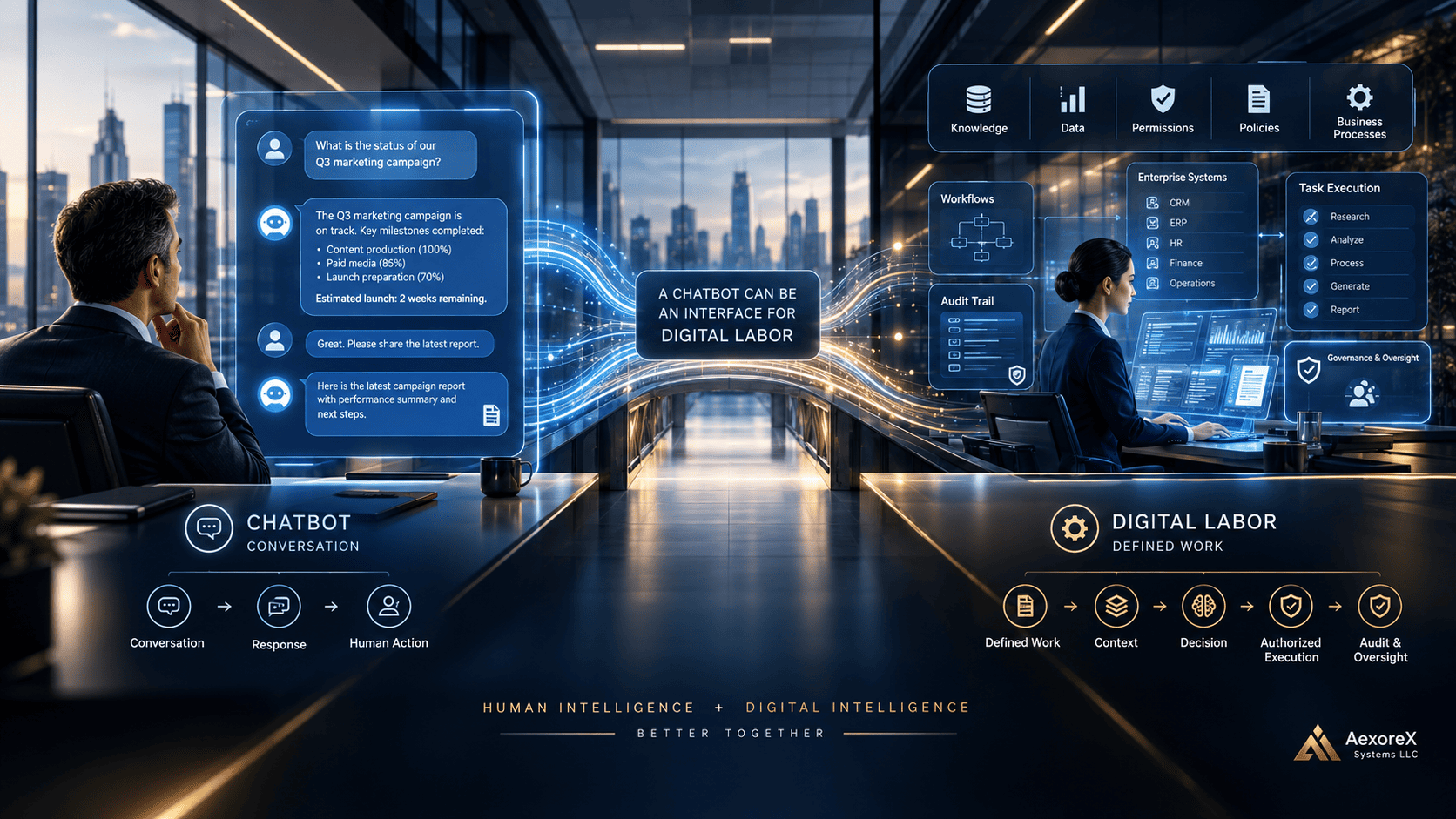
A straightforward way to understand the distinction is: a chatbot is primarily designed to communicate, whereas Digital Labor is designed to perform defined digital work.
A chatbot might answer, "What should I do?" In contrast, a Digital Labor capability could potentially be designed to analyze, decide within its authority, perform an authorized action, record the result, and escalate when necessary. Its precise behavior depends on its design, permissions, governance, technology, and operating environment.
Chatbots Are Usually Interaction-Centered
The traditional chatbot model can be visualized as: - Human - ↓ - Conversation - ↓ - AI Response - ↓ - Human Action
Here, the human remains the primary actor, with the AI providing information, assistance, or interaction. This makes chatbots highly effective for conversational experiences in areas like customer support, FAQs, information retrieval, product assistance, internal knowledge, and general AI assistance. A chatbot typically does not require authority over enterprise systems to deliver value.
Digital Labor Is Work-Centered
The Digital Labor model is structured differently: - Enterprise Objective - ↓ - Defined Digital Labor Role - ↓ - Context & Knowledge - ↓ - Policy & Permissions - ↓ - Decision or Recommendation - ↓ - Authorized Execution - ↓ - Audit & Oversight
The focus shifts from conversation to work. This doesn't mean every Digital Labor capability must operate autonomously. One might only recommend an action, another could be authorized to make a defined decision, and yet another might be empowered to execute a specific workflow. The appropriate level of autonomy should align with an organization's requirements and risk controls.
A Chatbot Can Be Part of Digital Labor
This distinction is crucial: chatbots and Digital Labor are not necessarily competing categories. A chatbot can serve as an interface through which a Digital Labor capability interacts with humans.
For instance, a human manager could use a conversational interface to communicate with a Digital Labor capability. The manager might say, "Prepare the weekly sales analysis." The Digital Labor capability could then access authorized data, analyze the information, prepare the requested output, present the result, and request approval if an action requires authorization. In this scenario, the conversational interface provides the chatbot-like experience, while the broader system performing the defined work is the Digital Labor capability. Therefore, a chatbot can act as the interface, and Digital Labor can be the worker.
Chatbot vs. Digital Labor: A Practical Comparison
The following table outlines conceptual differences, not a universal technical standard. Different products may combine characteristics from both categories.
**Dimension: Chatbot** - Primary purpose: Conversation - Main interaction: Human ↔ AI - Typical output: Response or information - Role definition: Often general - Scope: Usually conversation-focused - Permissions: May be limited - Workflow participation: Possible - Governance: Important - Auditability: Depends on system - Authority: Usually limited - Human oversight: Often present - Revocability: System-dependent
**Dimension: Digital Labor** - Primary purpose: Defined digital work - Main interaction: Enterprise ↔ Digital Worker - Typical output: Work product, decision, or authorized action - Role definition: Explicitly defined - Scope: Operationally scoped - Permissions: Can be explicitly permissioned - Workflow participation: Core concept - Governance: Central requirement - Auditability: Expected for enterprise operations - Authority: Can be delegated within boundaries - Human oversight: Fundamental for controlled operation - Revocability: Important design principle
The Importance of Defined Responsibilities
One of the most significant differences between Digital Labor and a general chatbot is the concept of a defined role. A Digital Labor capability should have clearly articulated responsibilities.
For example, a "Sales Research Digital Labor" role might have the responsibility to prepare structured research on potential business prospects. Its scope would be limited to only approved research sources and authorized information, with read-only access to defined resources. Its authority might allow it to recommend prospects but not approve commercial commitments. Any requests falling outside its defined scope would be escalated to a human. This structure establishes clear boundaries for the AI's role, a principle applicable to other Digital Labor capabilities.
Capability Does Not Equal Authority
This is a critical concept for enterprise AI. An AI system's technical capability to perform an action does not automatically mean it should be authorized to do so. For instance, an AI system might be capable of creating a purchase order. However, an organization may decide it can prepare the order and recommend the vendor, but cannot approve the purchase. A human must authorize transactions above a defined threshold. Therefore, capability does not equal authority. Authority must be deliberately delegated by the enterprise.
Digital Labor Needs Boundaries
Enterprise Digital Labor should not be viewed as unrestricted AI. A controlled Digital Labor capability may be: - Defined - Scoped - Policy-Bound - Permissioned - Budget-Controlled - Risk-Aware - Auditable - Human-Governed - Revocable
These characteristics help establish boundaries around what the Digital Labor capability is expected and permitted to do. The appropriate controls will vary depending on the use case; a low-risk research workflow, for example, may require different controls than a financial transaction or a regulated business process.
What About AI Agents?
The distinction between chatbots and Digital Labor also prompts a question about AI agents. AI agents typically refer to AI systems capable of pursuing goals through multiple steps, potentially using tools, accessing information, and interacting with software systems. While Digital Labor can potentially employ agentic AI techniques, the concepts are not identical.
AI Agent primarily describes a technical or behavioral approach to AI-driven task execution. Digital Labor, conversely, describes a broader organizational concept: AI-powered digital work organized around defined responsibilities and enterprise governance. In essence, agentic AI can be a technological component, while Digital Labor can be the organizational role built around that capability. This distinction is particularly important in enterprise environments.
Digital Labor and Traditional Automation
Digital Labor also differs from traditional automation, which typically follows predefined rules (e.g., if an invoice is received, move it to a specific workflow). AI-powered Digital Labor can potentially handle more variable work involving unstructured information, natural language, context, reasoning, classification, research, interpretation, and decision support.
However, this doesn't imply that AI should replace deterministic automation. In many enterprise settings, the two can work together, with a Digital Labor capability potentially using traditional automation as part of a larger workflow.
The Enterprise Operating Context
A standalone chatbot can provide useful information without deeply interacting with an organization's operating environment. Digital Labor, by contrast, often requires access to enterprise context, including: - Enterprise knowledge - Business processes - Policies - Data - Workflow state - Organizational structure - System permissions - Memory and context - Governance rules
This highlights the increasing importance of Enterprise Intelligence, which can provide the contextual foundation for AI-powered work to operate more effectively within an organization.
Human + Digital Labor
The objective of Digital Labor doesn't necessarily have to be human replacement. A more useful model involves combining Human Intelligence with Digital Intelligence.
Humans can provide leadership, judgment, accountability, strategic decisions, relationships, creativity, and ethical oversight. Digital Labor can potentially provide information processing, research, structured analysis, repetitive digital work, workflow assistance, and defined execution. This creates the possibility of a hybrid enterprise workforce, where humans remain accountable for the organization's governance and strategic direction.
Why This Difference Matters
The distinction between a chatbot and Digital Labor becomes increasingly important as organizations transition from experimentation to enterprise deployment. A company deploying a chatbot might ask, "How can AI help our employees?" A Digital Labor strategy, however, asks a different question: "What defined work should AI perform within our enterprise?"
This question necessitates considering roles, processes, permissions, authority, governance, risk, security, accountability, and human oversight. The conversation thus shifts from AI as a tool to AI as an operational capability.
From Chatbots to Digital Work
This evolution can be conceptually viewed as:
- **Chatbot:** AI communicates with humans.
- ↓
- **AI Assistant:** AI helps humans perform tasks.
- ↓
- **AI Agent:** AI can potentially perform multi-step tasks using tools.
- ↓
- **Digital Labor:** AI-powered work is organized around defined responsibilities, permissions, governance, and accountability.
- ↓
- **Digital Workforce:** Multiple Digital Labor capabilities operate as a coordinated workforce.
- ↓
- **Enterprise Intelligence:** Enterprise data, knowledge, context, AI, memory, processes, governance, and authority become increasingly connected.
- ↓
- **Autonomous Enterprise:** An organization can potentially execute a growing portion of its operations through coordinated intelligence and authorized automation under appropriate human governance.
This is a conceptual progression, not a universal industry roadmap.
The AexoreX Perspective
AexoreX Systems views Digital Labor as more than a conversational AI experience. The broader objective is to explore how AI can become an integral part of the enterprise operating model. This requires more than just an AI model; it demands: - **Intelligence:** Understanding enterprise information and context. - **Authority:** Knowing what the Digital Labor capability is authorized to do. - **Execution:** Performing defined work within approved boundaries. - **Governance:** Ensuring actions align with enterprise policies. - **Memory:** Maintaining relevant context across workflows where appropriate. - **Orchestration:** Connecting Digital Labor capabilities with processes and enterprise systems.
This represents the broader direction being explored through AEOS QUANTUM™.
AEOS QUANTUM™ and Digital Labor
AEOS QUANTUM™ — The Enterprise Intelligence Operating Platform for Autonomous Enterprises — is being developed around the broader idea of connecting enterprise intelligence, AI, Digital Labor, process orchestration, knowledge, memory/context, governance, authority, and enterprise systems. The platform is not positioned simply as a chatbot, nor is the concept limited to creating individual AI agents.
The broader direction is an enterprise operating environment that can potentially: - **Connect:** Enterprise systems, information, knowledge, and AI capabilities. - **Orchestrate:** Coordinate processes and Digital Labor capabilities. - **Govern:** Apply policies, permissions, authority, risk controls, and human oversight. - **Activate:** Enable authorized Digital Labor to participate in defined enterprise work.
The objective is not to replace the enterprise technology stack but to connect, orchestrate, govern, and activate capabilities across it. Specific capabilities, integrations, autonomy levels, and commercial availability may vary according to the development stage.
The Key Difference
The simplest distinction is: a chatbot talks, while Digital Labor works. However, the difference runs deeper. A chatbot is primarily a conversational interface. Digital Labor is an emerging model for organizing AI-powered work around defined responsibilities, permissions, governance, authority, and human oversight.
A chatbot may answer a question; Digital Labor may potentially complete a defined workflow. A chatbot may provide information; Digital Labor may potentially transform information into an authorized business action. Furthermore, in an increasingly connected enterprise, multiple Digital Labor capabilities may eventually operate together as a Digital Workforce.
Conclusion
Chatbots have introduced millions of people to artificial intelligence through conversation. Digital Labor represents a broader possibility. Instead of solely asking, "What can AI tell me?" organizations can begin asking, "What work can AI perform responsibly within our enterprise?"
This question changes the conversation by introducing roles, responsibilities, permissions, authority, governance, accountability, execution, and human oversight. The future of enterprise AI may therefore involve more than increasingly intelligent chat interfaces; it may involve AI becoming an organized participant in digital work.
The journey can be summarized simply: Chat → Assist → Act → Work → Coordinate → Operate. The technology and business models behind this evolution are still developing. Yet, one principle remains crucial: the more capable AI becomes, the more important defined authority and governance become.
Sources and attribution
- AexoreX Systems LLC · statement link
About the author
AexoreX Technology Desk is the newsroom's editorial desk covering enterprise technology, artificial intelligence, digital labor, automation, and emerging enterprise systems.
More from AexoreX Technology Desk →Related stories
- Enterprise AI Moves Beyond Chatbots as Companies Build Intelligence Infrastructure for Autonomous Operations
- From Enterprise Software to Enterprise Intelligence Infrastructure: The Architecture Behind AEOS QUANTUM™
- AexoreX Systems Defines the Enterprise Intelligence Control Plane for the Autonomous Enterprise
- AexoreX Systems Introduces AEOS Enterprise Authority™ as Governance Layer for Autonomous Enterprise Intelligence
- AEXOREX NEWSROOM #014 THE ENTERPRISE IS ENTERING THE GOVERNED DIGITAL LABOR ERA
- What Is Digital Labor (LaaS)?