
Identity & Context: The First Layer of Enterprise Intelligence
Who acts, what they know, and what they are authorized to understand
Identity and Context are foundational for autonomous operations, determining who is acting and the operational circumstances for enterprise intelligence.
Opinion · AI-assisted, human edited
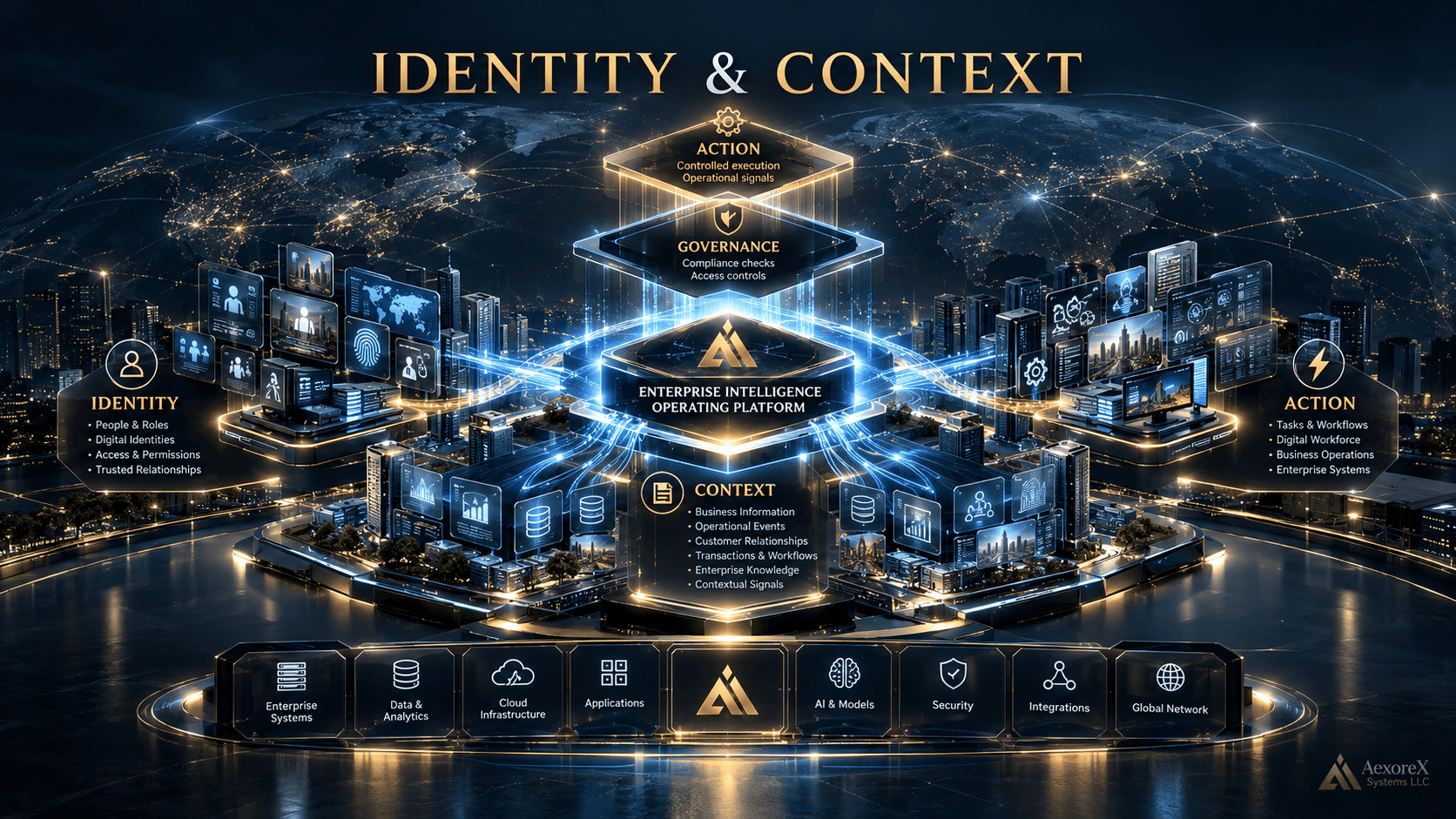
As enterprises transition from conventional automation to increasingly intelligent and autonomous operations, a fundamental question arises:
Who is actually acting, and in what context?
An enterprise cannot safely delegate operational work to AI or Digital Labor simply because a system can generate an answer or complete a task. Before intelligence can recommend, decide, coordinate, or execute, the enterprise must establish two fundamental layers: Identity and Context. These layers determine who or what is acting, on whose behalf, what information is relevant, and the circumstances surrounding every operational decision. This architectural layer follows the infrastructure foundations introduced in AexoreX Newsroom #023.
From Infrastructure to Intelligence
The previous chapter established that an Autonomous Enterprise requires more than an AI model. It needs an underlying Enterprise Intelligence Infrastructure capable of connecting systems, contextualizing information, governing authority, orchestrating Digital Labor, executing actions, and producing evidence. Within that infrastructure, Identity and Context form the first critical foundation.
Without reliable identity, an enterprise cannot confidently answer: - Who initiated this action? - Which employee, system, Digital Labor, or service is acting? - On whose behalf is the action being performed? - What role does the actor have? - Which organization, department, business unit, or process does the actor belong to?
Without context, the enterprise cannot reliably determine: - What is happening? - Which customer, transaction, project, asset, or business process is involved? - What information is relevant? - What policies apply? - What happened previously? - What conditions exist right now?
Intelligence without these foundations can produce technically sophisticated outputs while lacking the operational understanding an enterprise requires.
Identity Is More Than Authentication
Traditional enterprise systems typically treat identity as a login problem: a person authenticates, a system verifies credentials, and access is granted based on predefined permissions. Enterprise intelligence introduces a broader requirement, demanding that identity become an operational concept.
An enterprise intelligence environment may involve human employees, applications, APIs, services, automated workflows, AI systems, and Digital Labor. Each actor needs a distinguishable identity and an associated operational role. The important question therefore changes from "Who logged in?" to "Who or what is acting, under whose authority, for what purpose, and within which organizational context?"
This distinction becomes increasingly important as enterprises introduce Digital Labor into real operational processes. A Digital Employee performing a defined task should not be treated as an anonymous software process. Its identity must be traceable, its role defined, its scope understood, and its actions attributable to the enterprise's governance framework. This establishes the foundation for accountable digital operations.
Context Turns Data Into Operational Understanding
Identity establishes "who." Context establishes "what is happening." Modern enterprises possess enormous volumes of data across applications, databases, documents, communications, transactions, workflows, and operational systems. The challenge is not merely obtaining more data, but understanding which information matters to a specific operation at a specific moment.
Consider a simple enterprise event: a customer places an order. A conventional system may record the transaction. An intelligent operating environment needs to understand much more: - The customer - The account - The order - The inventory position - The contractual conditions - The payment status - The delivery requirements - The customer's history - The applicable business policies - The responsible business unit - The current operational conditions - The previous actions taken - Potentially, the authority required for the next action
This is context. Context transforms disconnected information into an operational picture that intelligence can reason over.
Identity + Context
Identity and Context work together. Identity answers "Who is acting?" Context answers "What is happening?" Together, they establish the operational starting point for enterprise intelligence. The resulting model can be expressed simply:
Identity → Context → Intelligence → Governance → Action
This does not mean every operation should automatically proceed to execution. In fact, the opposite principle is fundamental: understanding does not automatically create authority. An intelligence system may understand a situation without being authorized to change it. A Digital Labor system may identify the correct action without possessing permission to execute it. A recommendation may be valid while the corresponding action still requires human approval. This separation is essential to building trustworthy autonomous operations.
Identity for Digital Labor
The emergence of Digital Labor makes identity architecture even more important. A Digital Labor unit may operate continuously, process information at machine speed, interact with multiple enterprise systems, and perform tasks traditionally handled by human workers. However, increased capability must not eliminate accountability.
Digital Labor therefore needs enterprise-defined characteristics such as: - Defined role - Defined scope - Permissioned access - Policy boundaries - Financial authority where applicable - Risk classification - Auditability - Human governance - Revocability
The principle is straightforward: Authority is delegated by the enterprise, not owned by Digital Labor. This principle allows Digital Labor to become part of the enterprise workforce without becoming an uncontrolled actor.
Context Across the Enterprise
Enterprise context should not exist as isolated fragments. A customer-service process may require CRM information. A finance process may require ERP information. A procurement process may require supplier information. A security process may require identity and risk information. A management decision may require information from several of these systems simultaneously.
The enterprise therefore needs a way to connect these contextual signals without forcing every intelligent capability to understand every underlying system independently. This is where an enterprise intelligence architecture becomes important. Rather than creating isolated AI experiences around individual applications, the enterprise can establish a common intelligence layer capable of contextualizing information across the existing technology environment. The objective is not necessarily to replace the enterprise stack, but to make the existing enterprise environment more understandable, governable, and executable through a unified intelligence architecture.
Context Must Be Governed
Not all context should automatically be available to every actor. Enterprise context can contain sensitive business information, customer information, financial information, operational data, intellectual property, and other restricted information. Therefore, context itself must participate in governance.
An intelligent operating environment should be capable of determining: - Who can access the context? - Why do they need it? - Which portion of the context is relevant? - Under which policy? - For how long? - What action can result from that context?
This creates an important distinction between simply having enterprise data and having governed enterprise context. The latter is significantly more useful for autonomous operations because intelligence can operate within clearly defined boundaries.
The Beginning of Enterprise Intelligence
Identity and Context may appear foundational, but their importance increases as enterprise autonomy grows. At low levels of automation, a system may simply execute a predefined workflow. At higher levels of intelligence, systems begin interpreting conditions, recommending actions, coordinating work, and potentially executing decisions.
As autonomy increases, the quality of the underlying identity and context becomes increasingly consequential. An enterprise cannot responsibly ask an intelligent system to act autonomously if it cannot reliably establish: - Who is acting. - What they understand. - What situation they are operating within. - Which information they are permitted to use. - What authority exists for the next step.
Identity and Context therefore represent more than technical infrastructure; they become part of the enterprise's operational control model.
Toward the Autonomous Enterprise
This is the architectural progression AexoreX Systems is developing through AEOS QUANTUM™: - **Connect:** Connect enterprise systems, data, applications, and operational signals. - **Contextualize:** Establish the identity, relationships, history, and circumstances surrounding enterprise operations. - **Govern:** Apply enterprise policies, controls, risk boundaries, and governance. - **Orchestrate:** Coordinate intelligence and Digital Labor across operational processes. - **Authorize:** Determine whether an action is permitted and under what authority. - **Execute:** Carry out approved actions across connected enterprise systems. - **Optimize:** Learn from outcomes, evidence, and operational performance to continuously improve the enterprise.
Identity and Context sit near the beginning of this sequence because an intelligent enterprise must first understand the operational world in which it exists.
Building the Foundation Incrementally
AEOS QUANTUM™ is currently in Foundational Establishment & Active Development. Its architecture is being developed incrementally, with individual capabilities progressing through defined maturity stages rather than being presented as completed functionality before they exist. The objective is not to create another isolated AI interface. The objective is to establish an enterprise intelligence operating platform capable of bringing together: Systems, Context, Knowledge, Memory, Intelligence, Digital Labor, Authority, Orchestration, Execution, Governance, and Evidence.
Identity and Context are therefore not the destination. They are the beginning of the intelligence infrastructure required for the next generation of enterprise operations.
The Next Layer
Once an enterprise can establish who is acting and understand the context surrounding an operation, another fundamental requirement emerges: What does the enterprise actually know, remember, and retain? That leads to the next layer of Enterprise Intelligence Infrastructure: Knowledge & Memory.
In the next chapter of the AexoreX Newsroom series, we examine how enterprise knowledge and memory can provide continuity across operations, enabling intelligence to work with more than isolated events or individual interactions. The journey from automation to autonomous enterprise operations does not begin with giving machines more authority. It begins with giving enterprise intelligence a reliable understanding of identity, context, knowledge, governance, and responsibility.
AexoreX Newsroom The Intelligence, Research & Institutional Publication of AexoreX Systems
Sources and attribution
- AexoreX Systems LLC · statement link
About the author
AexoreX Technology Desk is the newsroom's editorial desk covering enterprise technology, artificial intelligence, digital labor, automation, and emerging enterprise systems.
More from AexoreX Technology Desk →Related stories
- AexoreX Systems Defines the Enterprise Intelligence Control Plane for the Autonomous Enterprise
- AexoreX Systems Introduces AEOS Enterprise Authority™ as Governance Layer for Autonomous Enterprise Intelligence
- AEOS QUANTUM™ Envisions an Enterprise Intelligence Layer for the Emerging Autonomous Systems Era
- From Digital Labor to Autonomous Enterprise Operations: Why an Intelligence Layer Matters
- Beyond the Digital Workforce: Why Enterprise Intelligence Becomes the Next Infrastructure Layer
- The Infrastructure Behind the Autonomous Enterprise: Building the Foundation for Enterprise Intelligence