
The Infrastructure Behind the Autonomous Enterprise: Building the Foundation for Enterprise Intelligence
Why autonomous enterprise operations require an intelligence infrastructure — not simply more AI applications
The autonomous enterprise requires a robust intelligence infrastructure to integrate AI, context, authority, and governance across organizational operations.
Opinion · AI-assisted, human edited
By AexoreX Technology Desk · AexoreX Systems Newsroom September 17, 2026 Technology & Enterprise Architecture · AI-assisted, human-edited
The Conversation Is Moving From AI to Infrastructure
Discussions around enterprise AI have primarily concentrated on models. Questions like "Which model is more capable?", "Which system can reason better?", "Which AI can generate better answers?", and "Which agent can perform more tasks?" are important. However, as enterprises transition towards increasingly intelligent and autonomous operating models, a critical question emerges: What infrastructure enables intelligence to operate across the entire enterprise?
An enterprise cannot achieve autonomy merely by deploying an AI model. AI requires context. Digital Labor needs identity. Execution demands authority, which in turn needs governance. Governance relies on policy. Operations necessitate observability. Decisions require evidence. Crucially, enterprise systems need a controlled method to interact within the operating environment. This leads to a broader architectural concept: The Autonomous Enterprise necessitates Enterprise Intelligence Infrastructure. This infrastructure layer is what AexoreX Systems is actively building.
Intelligence Is Becoming an Infrastructure Concern
Traditionally, enterprise software was largely structured around individual applications. Finance had its own systems, as did Sales, Operations, and Human Resources. Data was fragmented across multiple platforms, and automation connected only selected processes. Artificial intelligence was then integrated into specific applications.
The emerging paradigm is different. Instead of intelligence remaining confined within individual applications, enterprises increasingly require intelligence that can function across organizational contexts and operational boundaries. This means intelligence must comprehend more than just a single database or workflow. It may need to understand organizational structures, business objectives, policies, enterprise knowledge, institutional memory, processes, roles, permissions, operational events, business systems, risk boundaries, financial constraints, previous decisions, and expected outcomes. The outcome is not just an AI feature; it is an infrastructure requirement.
What Is Enterprise Intelligence Infrastructure?
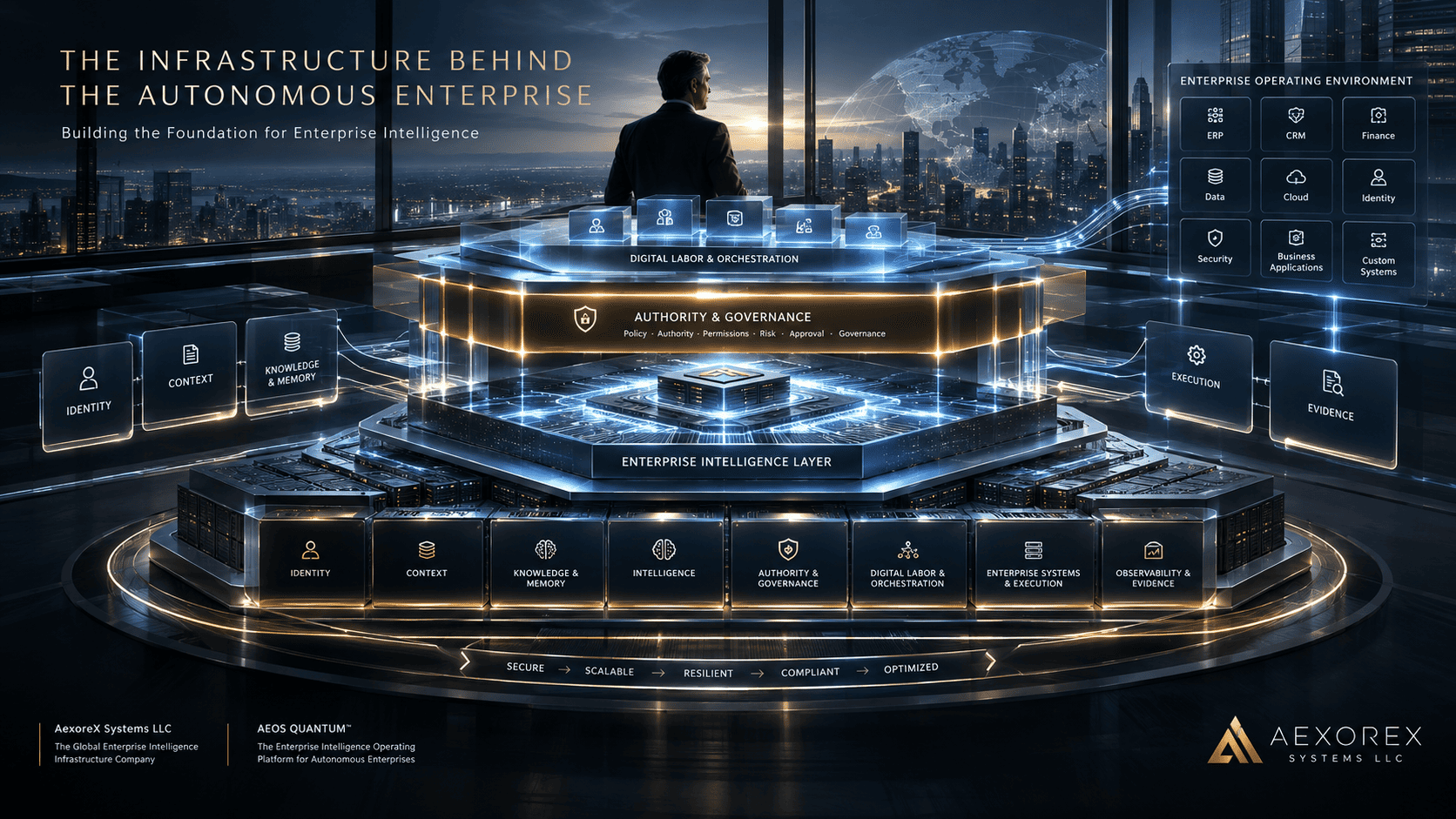
Enterprise Intelligence Infrastructure is the collection of technological and governance foundations that allow enterprise intelligence to operate across organizational systems and processes. It connects the following elements: Enterprise Context → Intelligence → Authority → Orchestration → Digital Labor → Execution → Evidence → Optimization.
This infrastructure does not necessarily replace existing enterprise technology. Instead, it provides a coordinated operating layer around it. ERP systems continue to manage enterprise resource processes, CRM systems manage customer relationships, and financial systems handle financial operations. Cloud platforms still provide computing infrastructure, identity systems manage access, and data platforms store and process information. The intelligence infrastructure integrates these diverse environments into a cohesive operating model.
The Seven Foundations
While implementations will vary by organization, an enterprise intelligence infrastructure can be understood through several foundational layers.
1. Identity
Before an intelligent system can operate, the enterprise must know who or what is performing an action. Identity establishes the relationship between people, systems, Digital Labor, services, and organizational roles. Therefore, identity is not just a login mechanism; in an autonomous operating environment, it becomes integral to operational accountability.
2. Context
Intelligence is limited without context. Enterprise context can encompass organizational structure, processes, policies, knowledge, historical information, operational conditions, and business objectives. Context allows intelligence to interpret information according to the specific enterprise environment in which an action occurs, which is why Enterprise Intelligence is broader than a conventional AI assistant.
3. Knowledge and Memory
Enterprises accumulate knowledge over many years, including documents, policies, processes, decisions, customer information, operational records, lessons learned, and institutional experience. An intelligence infrastructure must therefore provide mechanisms to make relevant knowledge and memory accessible to authorized intelligence and Digital Labor. Memory should not merely involve storing everything; it should include appropriate access, relevance, governance, retention, and control.
4. Intelligence
The intelligence layer provides capabilities such as analysis, reasoning, recommendation, decision support, classification, planning, interpretation, and prediction where appropriate. Different AI models may perform different roles, and an enterprise should not necessarily depend on a single model. The infrastructure can instead provide an abstraction layer through which various intelligence capabilities can be evaluated and utilized based on enterprise requirements. This supports the broader principle of Vendor Independence by Design™. The enterprise should maintain control over its operating architecture, preventing the entire operating model from becoming inseparable from one technology provider.
5. Authority and Governance
Intelligence can determine what *might* be done, but authority determines what *may* be done. This distinction is fundamental. The authority layer establishes the boundaries within which intelligent systems and Digital Labor are permitted to operate. These boundaries can include: Identity → Context → Policy → Authority → Risk → Approval → Execution → Evidence → Outcome. The enterprise remains the source of delegated authority, meaning authority is delegated *by* the enterprise, not owned *by* Digital Labor. This creates the necessary control relationship for increasingly autonomous operations.
6. Orchestration and Digital Labor
Once authority is established, work can be coordinated. Orchestration defines how tasks, systems, workflows, intelligence, and Digital Labor interact. Digital Labor can then perform defined responsibilities within its assigned scope. For example, a Digital Employee may execute specific operational tasks, a Digital Manager may coordinate Digital Labor and workflows, and a Digital Executive may support higher-order operational coordination and decision intelligence within defined authority. The crucial principle remains: Digital Labor should operate within authority, not outside it.
7. Execution, Observability, and Evidence
The final infrastructure requirement is the ability to execute while maintaining visibility. An enterprise should be able to understand: What happened? Who or what acted? Under what authority? Which policy applied? What systems were involved? What decision was made? What action occurred? What outcome resulted? This is where execution, observability, audit trails, and evidence become interconnected. Autonomous execution without observability creates a blind spot; governed execution requires visibility.
The Architecture Is More Important Than Any Single Model
A powerful AI model can offer remarkable capabilities, but the model itself does not create an autonomous enterprise. Consider a simple analogy: a powerful engine does not automatically create a complete vehicle. A vehicle also requires steering, brakes, controls, navigation, safety systems, power management, and operating procedures. Enterprise intelligence functions similarly. The intelligence model is one component; the operating infrastructure dictates how that intelligence interacts with the enterprise. This is why the future enterprise AI architecture may increasingly be defined not by a single model, but by the infrastructure surrounding the models.
From AI Stack to Enterprise Intelligence Stack
A conventional AI implementation might look like: Application → AI Model → User. An enterprise intelligence architecture can be considerably broader:
Enterprise Systems ↓ Data, Knowledge & Memory ↓ Enterprise Context ↓ Intelligence Layer ↓ Authority & Governance ↓ Orchestration ↓ Digital Labor ↓ Execution ↓ Observability & Evidence ↓ Optimization
The difference is significant. The second architecture treats intelligence as an operational capability rather than simply a conversational feature.
The Enterprise Intelligence Control Plane
As enterprise intelligence expands, organizations will need a control plane to help coordinate the environment. Such a control plane can conceptually provide visibility and control over identity, context, intelligence, Digital Labor, authority, policies, workflows, systems, actions, risk, cost, and outcomes.
This does not imply that every enterprise must implement all capabilities at once. In practice, maturity will be progressive. Some organizations may start with assisted intelligence, others may automate selected workflows, and some may introduce Digital Labor into narrowly defined functions. Over time, organizations can expand autonomy as evidence, governance, and operational confidence develop.
Autonomy Is an Infrastructure Journey
Autonomy is often presented as a destination, but in reality, it is a progression. A conceptual maturity path can be represented as:
- **A0 — Human Only:** Human performs the work and makes the decision.
- **A1 — Assisted:** Intelligence supports human work.
- **A2 — Automated:** Defined workflows execute automatically.
- **A3 — Autonomous:** Intelligent systems execute defined responsibilities within established boundaries.
- **A4 — Managed Autonomy:** Autonomous operations are continuously governed through monitoring, escalation, intervention, and policy.
- **A5 — Enterprise Autonomy:** Autonomous capabilities operate across broader enterprise functions under institutional authority and governance.
These levels are not claims about universal industry maturity; they represent an architectural framework for conceptualizing increasing delegation. The appropriate level depends on business requirements, risk, regulation, technology readiness, and organizational governance.
Security Is Part of the Foundation
Enterprise intelligence infrastructure cannot be separated from security. As intelligent systems gain access to enterprise information and operational systems, security must extend beyond conventional application boundaries. The architecture must consider identity, authentication, authorization, least privilege, data protection, network security, secrets management, policy enforcement, threat detection, operational monitoring, and auditability. Security is not an additional feature added after autonomy; it is an essential part of the foundation required to enable it responsibly.
Financial Authority Is Another Foundation
The same principle applies to financial operations. An intelligent system may be capable of identifying an expense, preparing a transaction, recommending a purchase, or coordinating a payment workflow. However, capability does not automatically create financial authority. Financial authority must be explicitly delegated and can be constrained by budget, transaction limits, vendor rules, approval requirements, risk thresholds, business policies, organizational role, and audit requirements. This is why Financial Authority for Digital Labor™ is part of the broader architectural direction being developed by AexoreX Systems. The principle is simple: The ability to act financially must not be confused with the authority to spend.
Observability Becomes a Core Enterprise Capability
Traditional monitoring informs an organization whether systems are functioning. Autonomous operations introduce an additional dimension: Why did the system act? Observability therefore needs to expand towards operational intelligence. An enterprise may need to understand which Digital Labor acted, which intelligence capability was used, which context influenced the decision, which policy was evaluated, which authority was applied, which system was accessed, which action was executed, which outcome occurred, whether escalation was triggered, and whether human intervention occurred. This creates an evidence chain, and evidence creates accountability.
Why Vendor Independence Matters
Enterprise infrastructure can become deeply dependent on individual technology vendors at the AI-model level, integration level, data level, identity level, or workflow level. A long-term enterprise architecture should therefore consider abstraction where practical. The objective is not to avoid vendors, as vendors can accelerate development. The objective is to prevent the enterprise operating model from becoming permanently dependent on one provider when alternatives are technically and economically viable. This is the principle behind Vendor Independence by Design™: Use vendors where they create value, abstract where appropriate, retain architectural control, and replace components when justified. The enterprise should own the operating model even when it uses many technology providers.
AEOS QUANTUM™ and the Infrastructure Direction
AexoreX Systems is developing AEOS QUANTUM™ — Autonomous Enterprise Operations Systems Quantum — as The Enterprise Intelligence Operating Platform for Autonomous Enterprises. Its architectural direction focuses on integrating Enterprise Context, Knowledge & Memory, Intelligence, Digital Labor, Orchestration, Authority, Governance, Enterprise Systems, Execution, Observability, and Optimization. The objective is to establish an operating environment where these capabilities can work together under enterprise governance. The platform is not positioned as a replacement for the enterprise technology stack; it is being developed as an intelligence and operating layer that can connect with the systems organizations already use.
Building the Foundation Before Scaling the Autonomy
AexoreX Systems is currently in Foundational Establishment & Active Development. This means the company is actively establishing the architecture, infrastructure, governance model, platform components, and operating principles required for the long-term AEOS QUANTUM™ vision. Not every capability described in this article is currently available. Capabilities are being developed progressively and may fall into different maturity categories:
- **Available:** Implemented and currently available within the applicable environment.
- **Designed:** Defined as part of the architecture or operating model and undergoing development, integration, or implementation.
- **Planned:** Part of the future roadmap and not currently available.
This distinction is fundamental to how AexoreX Systems communicates its development. The objective is ambitious infrastructure development without presenting future architecture as completed functionality.
The Bigger Shift
The enterprise technology landscape is undergoing another major transition. First, organizations digitized work. Then they connected systems. Then they automated processes. Then they introduced AI. Now, the next question is emerging: How can intelligence become an integral part of the enterprise operating infrastructure itself? This question changes the architecture, how organizations think about software, workforce models, authority, governance, and enterprise execution. The Autonomous Enterprise will not emerge from AI alone; it will emerge from the combination of Intelligence + Context + Authority + Governance + Digital Labor + Systems + Execution + Evidence. That combination requires infrastructure.
The Infrastructure Before the Autonomy
The future of enterprise AI may ultimately be defined less by the intelligence of a single model and more by the quality of the infrastructure surrounding that intelligence. The enterprise needs to know: What does the system know? What is it allowed to do? Why is it doing it? What systems can it access? Who delegated the authority? What policy governs the action? What happened afterward? Can the organization prove it? These questions form the foundation of responsible autonomy. Therefore, the path toward the Autonomous Enterprise begins not with removing human control, but with building the infrastructure capable of supporting intelligence, authority, governance, execution, and accountability at scale. AexoreX Systems is building toward that infrastructure.
One Enterprise. One Intelligence. Unlimited Digital Labor. Connect. Contextualize. Govern. Orchestrate. Authorize. Execute. Optimize.
About AexoreX Systems
AexoreX Systems LLC is an enterprise technology company in Foundational Establishment & Active Development, focused on the emerging field of Enterprise Intelligence Infrastructure. Its flagship platform, AEOS QUANTUM™ — Autonomous Enterprise Operations Systems Quantum, is being developed as The Enterprise Intelligence Operating Platform for Autonomous Enterprises. AexoreX Systems is building toward an architecture that connects enterprise intelligence, context, knowledge, memory, Digital Labor, orchestration, authority, governance, enterprise systems, execution, observability, and optimization.
AexoreX Systems LLC The Global Enterprise Intelligence Infrastructure Company AEOS QUANTUM™ The Enterprise Intelligence Operating Platform for Autonomous Enterprises.
Editorial Note
This article presents an architectural and technological perspective on Enterprise Intelligence Infrastructure and the development direction of AexoreX Systems. AEOS QUANTUM™ remains in Foundational Establishment & Active Development. The infrastructure layers and capabilities described in this article represent a combination of current foundations, defined architecture, active development, and future roadmap direction. Individual capabilities may be classified as Available, Designed, or Planned. Descriptions of autonomous operations, Digital Labor, authority, governance, financial authority, observability, and enterprise execution should therefore not be interpreted as a claim that all referenced functionality is currently generally available. The purpose of this article is to explain the infrastructure and operating principles being developed toward the long-term vision of the Autonomous Enterprise.
Sources and attribution
- AexoreX Systems — Original Editorial Visual · statement link
About the author
Intelligence desk of AexoreX Newsroom.
More from AexoreX Intelligence Desk →Related stories
- AexoreX Systems Defines the Enterprise Intelligence Control Plane for the Autonomous Enterprise
- AexoreX Systems Introduces AEOS Enterprise Authority™ as Governance Layer for Autonomous Enterprise Intelligence
- AexoreX Systems Advances AEOS QUANTUM™ as Enterprise Intelligence Operating Platform for Autonomous Enterprises
- From Digital Labor to Autonomous Enterprise Operations: Why an Intelligence Layer Matters
- From Enterprise Intelligence to Governed Autonomous Execution: The Next Step Toward the Autonomous Enterprises
- Beyond AI: Building the Enterprise Operating Model for Intelligence, Digital Labor, Governance, and Execution.