
Beyond AI: Building the Enterprise Operating Model for Intelligence, Digital Labor, Governance, and Execution.
Why the next generation of enterprise transformation requires more than AI, automation, or digital labor
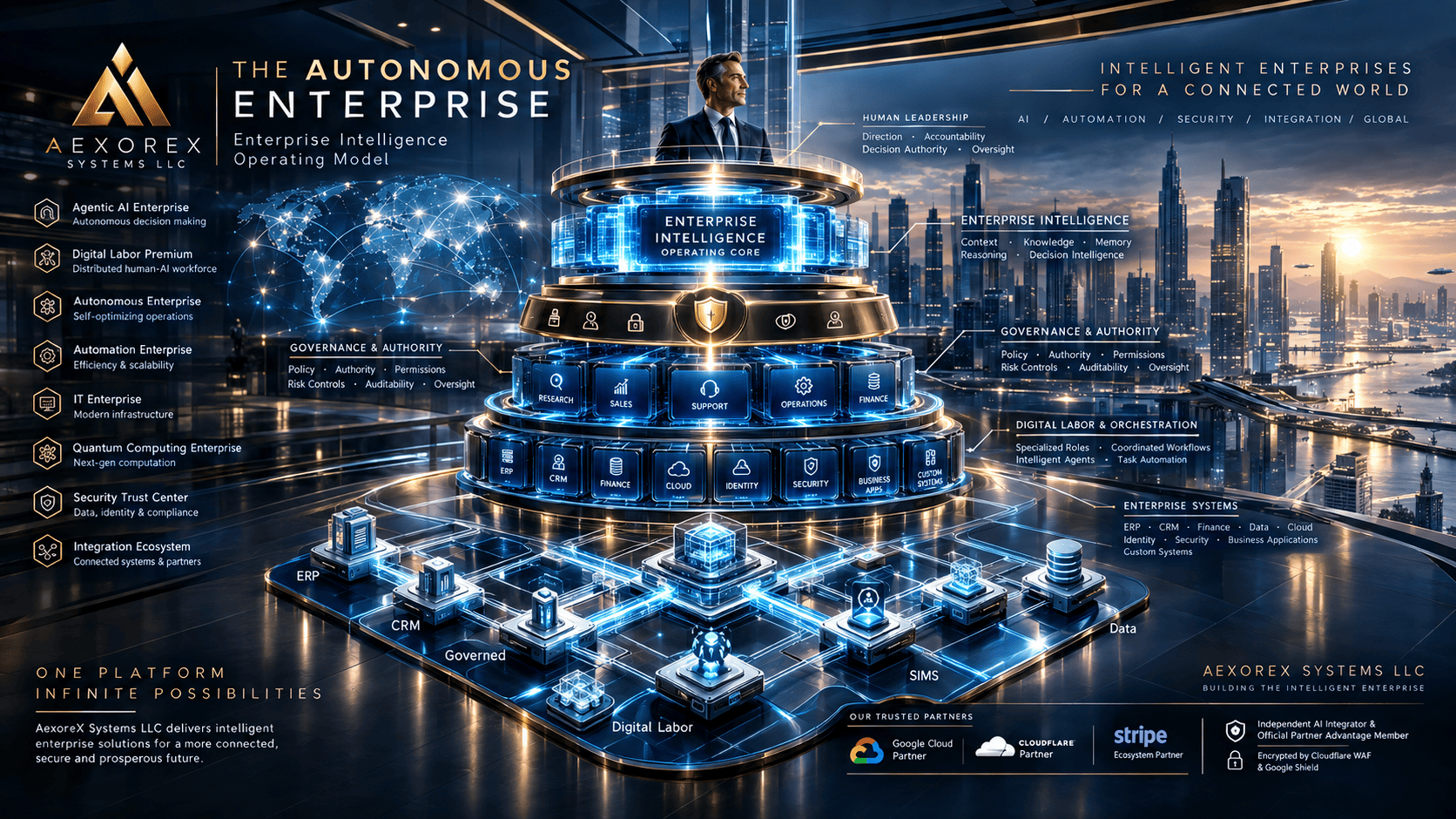
The Autonomous Enterprise integrates intelligence, Digital Labor, and governance into a new operating model, moving beyond isolated AI applications.
Opinion · AI-assisted, human edited
The Enterprise Is Entering a Different Computing Model
For decades, enterprise technology has largely followed a familiar pattern. People work through applications, applications process data, and systems execute predefined workflows. Automation connects individual processes, and Artificial Intelligence (AI) adds increasingly sophisticated capabilities to selected parts of that environment.
However, the emergence of more capable AI, agentic systems, and Digital Labor is beginning to challenge this established model. The question is no longer simply how an enterprise can add AI to its existing technology stack. A more fundamental question is emerging: What happens when intelligence itself becomes part of the enterprise operating model?
This distinction is crucial. Adding AI to an enterprise creates an intelligent capability. In contrast, building an enterprise that can operate with intelligence requires a broader integration of context, knowledge, memory, identity, authority, governance, orchestration, Digital Labor, execution, observability, and human accountability. This holistic approach represents the architectural direction behind the emerging concept of the Autonomous Enterprise, and it is also the direction in which AexoreX Systems is developing AEOS QUANTUM™.
From Digital Transformation to Enterprise Intelligence
Enterprise transformation has progressed through several major phases. Organizations moved from manual to digitized workflows, adopted enterprise software, connected systems, introduced cloud infrastructure, expanded automation, and embraced analytics and AI. Now, another significant transition is beginning: Enterprise Intelligence.
Enterprise Intelligence is not merely another AI application. Instead, it describes an operating model where intelligence can understand and interact with the broader enterprise context. This context may encompass:
- Organizational structures
- People and roles
- Business processes
- Enterprise knowledge
- Institutional memory
- Policies
- Objectives
- Enterprise systems
- Operational events
- Decisions
- Permissions
- Authority
- Risk boundaries
- Business outcomes
Without this comprehensive context, intelligence remains largely isolated. With it, intelligence can become an integral part of the enterprise operating environment.
The Autonomous Enterprise Is Not a Robot Enterprise
The phrase "Autonomous Enterprise" can easily create a misconception. It does not imply an organization without people, nor does it mean machines independently controlling a company. It does not suggest that every business decision should be delegated to AI, or that human accountability is removed.
Instead, an Autonomous Enterprise can be understood as an organization that progressively increases its ability to allow intelligent systems and Digital Labor to perform defined responsibilities within clearly established enterprise controls. Humans continue to establish objectives, policies, strategic direction, risk tolerance, organizational authority, and accountability. Intelligent systems increasingly provide analysis, coordination, decision support, and execution within delegated boundaries.
The result is not a conflict between humans and machines. It is a new operating relationship: Human Authority + Enterprise Intelligence + Governed Digital Labor + Enterprise Systems + Accountable Execution.
Why AI Alone Is Not Enough
While an AI model can reason, a workflow engine can automate, an integration platform can connect systems, a database can store information, an identity system can authenticate users, an observability platform can provide operational visibility, an enterprise application can execute business processes, and a Digital Labor system can perform defined work, an Autonomous Enterprise requires these capabilities to operate as part of a coherent operating model.
The challenge, therefore, shifts from individual capability to coordination. The enterprise needs to understand:
- Who is acting?
- What do they know?
- What are they authorized to do?
- Which policy applies?
- Which systems may they access?
- What level of autonomy is permitted?
- When is human approval required?
- What happened during execution?
- Can the action be audited?
- Can authority be revoked?
These are operating-model questions, not simply AI-model questions.
The Enterprise Intelligence Operating Model
A mature autonomous operating environment can be conceptualized as a continuous flow: Intent → Context → Intelligence → Policy → Authority → Orchestration → Digital Labor → Execution → Verification → Governance → Optimization. Each stage has a distinct responsibility.
**Intent** The enterprise establishes its desired achievements.
**Context** The operating environment provides the organizational, operational, historical, and business context relevant to that objective.
**Intelligence** AI and other intelligence capabilities interpret information, reason over context, generate recommendations, and support decisions.
**Policy** Enterprise policies define the boundaries within which actions may occur.
**Authority** The enterprise determines who or what has permission to make decisions or execute actions.
**Orchestration** Processes, systems, intelligence, and Digital Labor are coordinated.
**Digital Labor** Governed digital workers perform delegated responsibilities within defined scopes.
**Execution** Authorized actions are carried out through enterprise systems and operational environments.
**Verification** Results are checked against expected outcomes, policies, and operational conditions.
**Governance** Evidence, accountability, controls, approvals, exceptions, and auditability remain integral to the operating cycle.
**Optimization** Outcomes and operational evidence inform the next cycle of improvement.
This represents an operating model, not merely a software feature.
The Role of Digital Labor
Digital Labor is an important component of this emerging model. Instead of treating AI agents as isolated assistants, enterprises can increasingly organize intelligent software capabilities into defined operational roles. A Digital Employee may execute specific tasks, a Digital Manager may coordinate Digital Labor and workflows, and a Digital Executive may support higher-order operational coordination and decision intelligence within defined authority.
The critical principle is that these roles should not receive unrestricted power simply because they are technically capable. Capability is not authority. Authority must be deliberately delegated and remain bounded by organizational policy, permissions, risk controls, budgets (where applicable), auditability, and human governance. This distinction separates governed Digital Labor from uncontrolled automation.
The Authority Layer Becomes Critical
As enterprise intelligence becomes more capable, authority becomes increasingly important. A system may be capable of performing an action without being authorized to perform it. This distinction must remain fundamental.
Therefore, a governed operating model requires an authority relationship between intelligence and execution: Human Authority → Enterprise Governance → Intelligence → Orchestration → Digital Labor → Authorized Execution. The objective is not to prevent autonomous operation but to establish the conditions under which it is permitted. This principle is central to the architectural direction of AEOS Enterprise Authority™, which AexoreX Systems is developing as the authority, governance, and control plane for autonomous enterprise operations.
Autonomy Should Be Progressive
Autonomy should not be treated as a binary state. An enterprise can progressively increase the amount of responsibility delegated to intelligent systems. A conceptual progression includes:
- **A0 — Human Only:** Human performs the work and makes the decision.
- **A1 — Assisted:** Intelligence supports the human.
- **A2 — Automated:** Defined workflows execute automatically.
- **A3 — Autonomous:** The system can execute defined responsibilities within established boundaries.
- **A4 — Managed Autonomy:** Autonomous systems operate continuously while governance, monitoring, escalation, and intervention remain active.
- **A5 — Enterprise Autonomy:** Autonomous capabilities operate across broader enterprise functions under institutional authority, governance, and accountability.
Not every organization needs to reach the highest level. The appropriate level depends on business requirements, risk, regulation, operating maturity, technology readiness, and organizational governance. The important principle is that autonomy should be earned through capability, control, evidence, and trust.
Observability Is Part of Autonomy
An enterprise cannot responsibly delegate operational authority if it cannot understand what happened. As autonomous execution increases, observability becomes more important. Enterprise leaders need visibility into questions such as:
- Which system acted?
- Which Digital Labor performed the work?
- What context was used?
- Which policy governed the action?
- What authority was delegated?
- What decision was made?
- Which systems were accessed?
- What was executed?
- What outcome occurred?
- Was an exception triggered?
- Was human intervention required?
This establishes an important principle: Autonomous execution must be observable execution. Furthermore, observable execution should produce evidence that can support accountability and audit.
The Control Tower Is More Than a Dashboard
Traditional dashboards primarily display information. An Autonomous Enterprise requires a broader capability. Its operational command surface must potentially provide visibility into: Agents, Digital Labor, Processes, Systems, Decisions, Actions, Approvals, Risk, Authority, Cost, and Performance Outcomes.
This is why AexoreX Systems describes the Control Tower concept as an executive and operational command surface rather than simply another analytics dashboard. The architectural direction is to provide visibility into what autonomous operations are doing, why they are doing it, under what authority, and what outcomes they produce. This capability is being introduced progressively as the platform develops.
Existing Enterprise Systems Still Matter
An Autonomous Enterprise does not require organizations to abandon their existing systems. ERP remains ERP, CRM remains CRM, finance remains finance, cloud infrastructure remains cloud infrastructure, data platforms remain data platforms, and identity systems remain identity systems. The emerging intelligence layer operates across these environments.
The architectural direction can therefore be represented as:
Existing Enterprise Environment ↓ Enterprise Intelligence Infrastructure ↓ AEOS QUANTUM™ ↓ Enterprise Authority & Governance ↓ Digital Labor & Orchestration ↓ Governed Enterprise Execution
This approach is intended to allow organizations to progressively introduce intelligence and autonomy without treating existing enterprise infrastructure as disposable.
AEOS QUANTUM™: Building Toward the Operating Platform
AexoreX Systems is developing AEOS QUANTUM™ — Autonomous Enterprise Operations Systems Quantum — as an Enterprise Intelligence Operating Platform for Autonomous Enterprises. Its architectural direction brings together: Context, Intelligence, Knowledge, Memory, Digital Labor, Orchestration, Authority, Governance, Execution, and Optimization.
The objective is not to create another isolated AI tool. Instead, it is to build an operating environment in which enterprise intelligence can interact with organizational context, Digital Labor, business processes, enterprise systems, and governance. The long-term direction is summarized by the operating sequence: Connect. Contextualize. Govern. Orchestrate. Authorize. Execute. Optimize.
Building, Not Claiming Completion
AexoreX Systems is currently in Foundational Establishment & Active Development. This distinction is important. AEOS QUANTUM™ is not being presented as a fully completed Autonomous Enterprise platform. The architecture, operating model, platform components, governance mechanisms, integrations, Digital Labor capabilities, and operational surfaces are being progressively designed, developed, tested, and introduced.
Individual capabilities may exist at different maturity stages:
- **Available:** Capabilities that are implemented and currently available within the applicable environment.
- **Designed:** Capabilities whose architecture or operating model has been defined and which are being developed, integrated, or progressively implemented.
- **Planned:** Future capabilities on the development roadmap that are not currently available.
This approach allows the vision to remain ambitious without confusing architectural direction with current product availability.
The Infrastructure Beneath the Autonomous Enterprise
The emerging Autonomous Enterprise will not be created by a single model. It will require an ecosystem of technologies and operating disciplines working together.
AI models provide intelligence. Enterprise systems provide operational foundations. Knowledge and memory provide context. Digital Labor provides operational capacity. Orchestration coordinates work. Authority establishes permission. Governance establishes boundaries. Security protects the environment. Observability provides visibility. Auditability provides evidence. Human leadership retains accountability.
The opportunity is to connect these capabilities into one coherent operating model. That is the infrastructure problem AexoreX Systems is pursuing.
The Next Enterprise Architecture
The enterprise of the next era may not be defined simply by how many AI applications it deploys. It may be defined by how effectively intelligence operates across the organization. The strategic transition can therefore be understood as:
Manual Enterprise ↓ Digital Enterprise ↓ Intelligent Enterprise ↓ AI-Powered Enterprise ↓ Digital Labor Enterprise ↓ Governed Autonomous Enterprise
Each stage builds on the previous one. The objective is not to skip the foundations but to build them correctly.
What Comes Next
The next phase of enterprise AI will increasingly move from isolated intelligence toward coordinated operational capability. That transition will require enterprises to think differently about software architecture.
The important question will no longer be only: “Which AI should we deploy?” It will increasingly become: “How should intelligence operate across our enterprise?” That question encompasses context, authority, governance, Digital Labor, security, execution, and above all, accountability.
The Autonomous Enterprise is therefore not simply an AI destination. It is an evolving enterprise operating model. AexoreX Systems is building toward that model, not by claiming the destination has already been reached, but by establishing the infrastructure, architecture, governance, and operating principles required to move toward it.
One Enterprise. One Intelligence. Unlimited Digital Labor. Intelligence. Authority. Autonomous Execution.
Sources and attribution
- AexoreX Systems LLC — AI-generated visual · statement link
About the author
Intelligence desk of AexoreX Newsroom.
More from AexoreX Intelligence Desk →Related stories
- AexoreX Systems Defines the Enterprise Intelligence Control Plane for the Autonomous Enterprise
- AexoreX Systems Introduces AEOS Enterprise Authority™ as Governance Layer for Autonomous Enterprise Intelligence
- AexoreX Systems Advances AEOS QUANTUM™ as Enterprise Intelligence Operating Platform for Autonomous Enterprises
- From Digital Labor to Autonomous Enterprise Operations: Why an Intelligence Layer Matters
- From One Digital Labor to a Digital Workforce
- From Enterprise Intelligence to Governed Autonomous Execution: The Next Step Toward the Autonomous Enterprises