
#025 — The Enterprise AI Inflection Point: From AI Agents to Governed Autonomous Operations
Knowledge, Memory, Authority, and the Architecture Behind Autonomous Enterprise Operations
Enterprise AI is shifting from answering questions to performing governed, multi-step operations within defined boundaries, introducing the concept of Digital Labor.
Opinion · AI-assisted, human edited
The Next Phase of Enterprise AI
Enterprise artificial intelligence (AI) is undergoing a fundamental transition, moving beyond simple conversation. AI is now increasingly integrated with enterprise information, applications, tools, workflows, and operational systems. This enables AI to participate in multi-step work, rather than just answering questions or generating content.
This shift changes the central enterprise question from "What can AI generate?" to the more critical "What can AI responsibly do?" This distinction marks the beginning of a new phase of enterprise intelligence.
From Intelligence to Action
Traditional enterprise AI primarily supported human decision-making. An employee would ask a question, AI would produce an answer, a person would review the result, and then that person would perform the actual work.
Agentic AI introduces a different operating model. An AI system can now potentially: - Understand a business objective - Retrieve relevant information - Use enterprise tools - Coordinate multiple steps - Make bounded decisions - Request approvals - Execute authorized actions - Record outcomes
The transition is therefore moving from AI that answers to AI that acts. Once AI begins acting, intelligence alone is insufficient; the enterprise needs control around that intelligence.
The Five Infrastructure Challenges
The emergence of operational AI presents five interconnected challenges.
01 — Intelligence Is Becoming Operational
AI is increasingly shifting from an assistant role to active participation in business processes. This offers opportunities for faster execution and greater operational capacity. However, operational participation also introduces new requirements. An enterprise must understand what an AI system is doing, why, what information it uses, and its granted authority. AI capability thus becomes an operational concern, not merely a technology feature.
02 — Enterprise Data Needs Context
Historically, enterprise data was designed around known users, applications, and predictable access patterns. AI-driven operations introduce a far more dynamic environment. Multiple AI systems may interact with various datasets, applications, documents, knowledge repositories, and business processes.
Simply providing AI access to information is not enough. Enterprise intelligence requires: - Trusted Data - Context - Identity - Permissions - Data Lineage - Source Authority - Policy - Auditability
The critical question becomes: "Which information should this intelligence use, in this context, for this purpose?" This leads directly to the next architectural requirement: Knowledge and Memory.
Knowledge & Memory: The Intelligence Continuity Layer
An enterprise operates not only on what is happening at present but also on what it knows, has learned, and what has happened previously. This includes established policies and procedures, existing relationships, past decisions, and accumulated institutional knowledge.
This creates an important distinction between data, context, knowledge, and memory: - **Data:** Represents recorded information. - **Context:** Establishes the circumstances surrounding information at a particular moment. - **Knowledge:** Represents information that has been organized, interpreted, validated, and made useful for enterprise understanding. - **Memory:** Provides continuity across interactions, decisions, events, and operational history.
Together, these layers enable enterprise intelligence to move beyond isolated prompts and events.
Knowledge Is More Than a Document Repository
Enterprise knowledge can reside in many sources, including: - Policies - Procedures - Contracts - Product information - Organizational knowledge - Technical documentation - Customer information - Operational records - Financial information - Historical decisions - Business rules - Internal expertise
The challenge is not merely storage. The enterprise needs to establish whether information is: - Relevant. - Current. - Authoritative. - Applicable. - Permitted. - Contextually appropriate.
An intelligent system therefore requires more than retrieval; it needs a way to understand the relationship between knowledge and the operational situation in which that knowledge is being used.
Memory Creates Continuity
Knowledge informs intelligence about what the enterprise knows. Memory helps intelligence understand what has occurred. Consider an enterprise process spanning several days or weeks. A single interaction may capture only part of the story. Previous decisions can affect current actions, earlier customer interactions may alter the appropriate response, prior approvals can establish operational context, and historical outcomes may influence future recommendations.
Without continuity, intelligence repeatedly treats each event as isolated. With governed memory, an enterprise intelligence environment can maintain relevant continuity across operations. This does not imply remembering everything, but rather retaining information that the enterprise has deemed should remain available for legitimate operational purposes.
Memory Must Also Be Governed
Memory introduces its own governance requirements. Not all information should be remembered indefinitely, not every actor should access all memories, and not every historical event should automatically influence new decisions.
Enterprise memory therefore requires controls around: - Ownership - Source - Relevance - Retention - Access - Purpose - Accuracy - Provenance - Privacy - Policy - Auditability
This establishes a fundamental principle: enterprise memory must be governed just as enterprise access and authority are governed. The objective is not maximum memory, but useful, trusted, relevant, and controlled continuity.
03 — Capability Does Not Equal Authority
A core principle of autonomous enterprise architecture is that an AI system being technically capable of performing an action does not mean it is authorized to perform that action. A Digital Labor system may technically be able to send a communication, change a record, initiate a transaction, create an order, or execute a workflow. However, technical capability differs from enterprise authority.
Authority must be explicitly delegated. That authority may depend on factors such as: - Identity - Role - Context - Policy - Risk - Approval - Budget - Scope - Time - Business purpose
This creates a fundamental architectural separation: Capability ≠ Permission, and Intelligence ≠ Authority.
04 — Autonomous Execution Requires Accountability
The moment AI begins executing work, enterprises need to reconstruct what happened. A trustworthy autonomous operation should be able to answer: - Who initiated the work? - Which Digital Labor performed it? - What context was available? - What knowledge was used? - What memory was relevant? - What policy applied? - What authority was delegated? - What risk was identified? - Was approval required? - Which system was accessed? - What action was executed? - What evidence was generated? - What was the outcome?
This creates an important architectural principle: Autonomous execution must produce evidence. Without evidence, organizations can struggle to understand, audit, investigate, and improve autonomous operations.
05 — Governance Must Become Part of Execution
Governance cannot remain a document separate from the operational system. As AI capabilities advance, governance must become increasingly connected to execution itself. This means policy should be able to influence whether an operation can proceed.
A mature architecture may follow a chain such as: Identity ↓ Context ↓ Knowledge + Memory ↓ Policy ↓ Authority ↓ Risk ↓ Approval ↓ Execution ↓ Evidence ↓ Outcome
This is not merely an AI feature; it is an enterprise operating requirement.
From AI Agents to Digital Labor
The next logical evolution is the emergence of Digital Labor. An AI agent primarily represents a technical capability, whereas Digital Labor signifies a broader operational concept: a governed digital workforce capable of performing defined enterprise work within delegated boundaries.
Digital Labor can operate at various levels of responsibility, for example: - D1 — Recommend - D2 — Decide - D3 — Decide & Execute - D4 — Escalate
The appropriate level depends on enterprise policy, risk, authority, and business context. The objective is not unlimited autonomy, but controlled autonomy.
The New Enterprise Intelligence Layer
Enterprise organizations already operate extensive technology environments, including ERP, CRM, HR, finance, data platforms, cloud infrastructure, security systems, communication platforms, business applications, and industry-specific systems. The emergence of AI does not necessarily eliminate these systems. Instead, AI introduces a new requirement: how can intelligence operate across them while remaining governed?
This creates the conceptual need for an enterprise intelligence layer capable of connecting systems, understanding context, using governed knowledge and memory, controlling access, coordinating work, authorizing actions, and producing evidence.
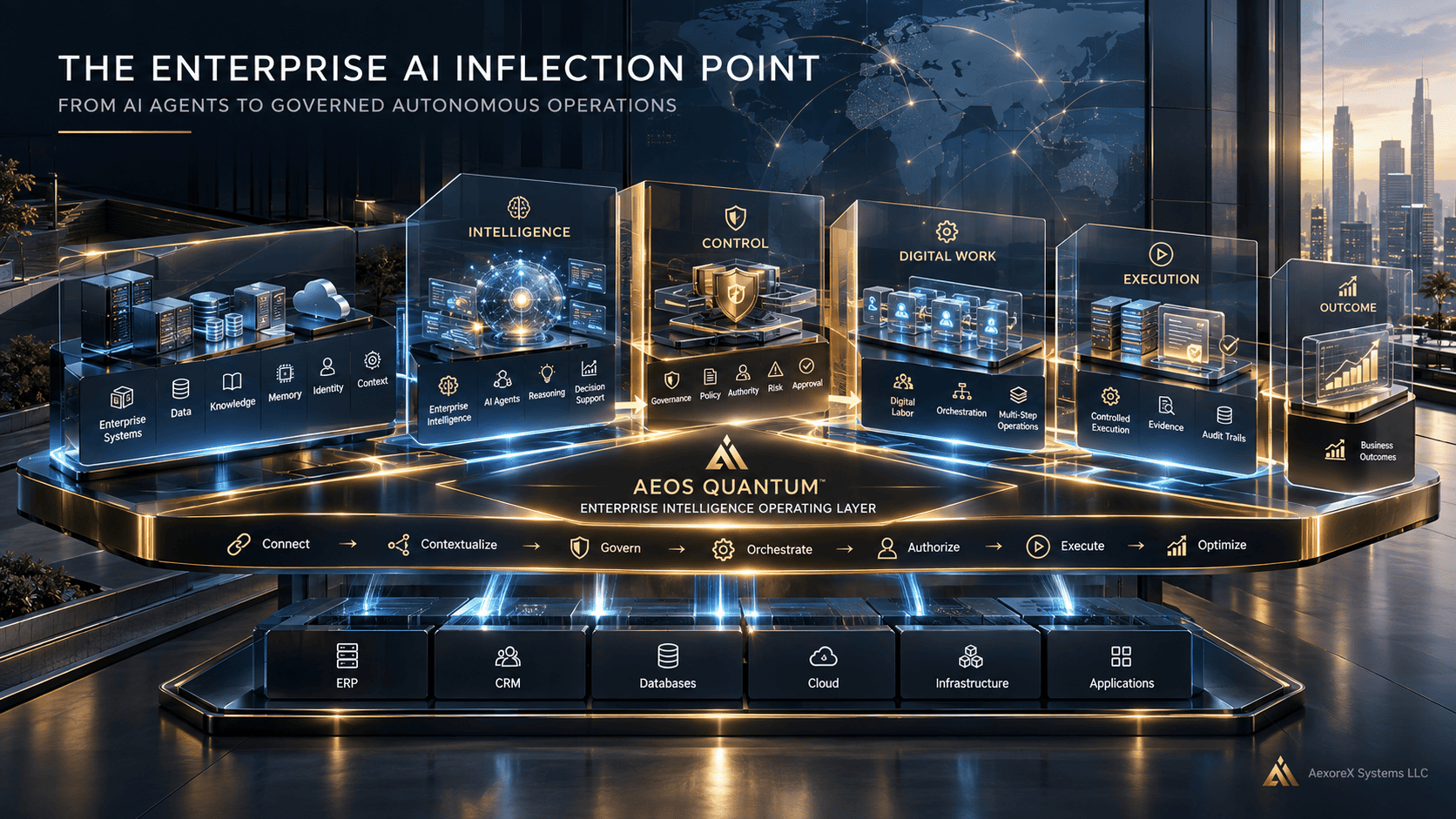
The architecture can be expressed as: Enterprise Systems ↓ Data + Knowledge + Memory ↓ Identity + Context ↓ Enterprise Intelligence ↓ Digital Labor ↓ Governance + Authority + Risk ↓ Orchestration ↓ Execution ↓ Evidence ↓ Business Outcomes
The AexoreX Perspective
AexoreX Systems is developing AEOS QUANTUM™ — the Enterprise Intelligence Operating Platform for Autonomous Enterprises. Its architectural direction is built around seven fundamental operating capabilities: - **Connect:** Connect enterprise systems, applications, data, knowledge, and operational environments. - **Contextualize:** Transform disconnected information into usable enterprise context. - **Govern:** Apply policies, controls, permissions, risk boundaries, and governance requirements. - **Orchestrate:** Coordinate Digital Labor, workflows, systems, and multi-step operations. - **Authorize:** Determine whether a proposed action is permitted under delegated enterprise authority. - **Execute:** Enable authorized Digital Labor and connected systems to perform approved work. - **Optimize:** Use operational outcomes and evidence to continuously improve enterprise processes.
One Enterprise. One Intelligence. Unlimited Digital Labor.
The objective is not to replace the enterprise technology stack. AEOS QUANTUM is being developed around a different idea: to connect the enterprise rather than fragment it. Existing enterprise platforms can continue performing their designed functions. AEOS provides an emerging intelligence and orchestration architecture around them.
This creates a model in which: - Enterprise Systems provide capabilities. - Data provides information. - Knowledge provides understanding. - Memory provides continuity. - Context establishes operational meaning. - Intelligence provides reasoning. - Digital Labor provides digital work capacity. - Governance defines boundaries. - Authority defines permission. - Orchestration coordinates operations. - Execution produces outcomes. - Evidence provides accountability.
From Automation to Governed Autonomy
Traditional automation asks: "Can this process be automated?" AI asks: "Can intelligence perform this task?" Agentic AI asks: "Can an intelligent system coordinate multiple actions?" Autonomous enterprise architecture asks a deeper question: "Can intelligence perform enterprise work within defined authority, governance, risk, and accountability boundaries?"
That distinction is fundamental. The future of enterprise AI does not require organizations to choose between human control and machine autonomy. It requires an architecture capable of defining where autonomy is appropriate, where approval is required, and where human judgment remains essential.
The Enterprise Operating Model Is Changing
The emerging model can be represented as: Human Intent ↓ Identity ↓ Context ↓ Knowledge + Memory ↓ Intelligence ↓ Digital Labor ↓ Authority ↓ Governance ↓ Orchestration ↓ Execution ↓ Evidence ↓ Outcome
This changes the role of humans. Instead of manually performing every operational step, people can increasingly define objectives, establish policies, delegate authority, review exceptions, and govern outcomes. The enterprise becomes less dependent on humans manually moving information between systems and more capable of coordinating digital work through governed intelligence.
The Real Infrastructure Question
The next generation of enterprise transformation will not be determined solely by which AI model an organization chooses. Models will continue to evolve, capabilities will expand, and new agents will emerge. The more durable architectural question is: "What infrastructure surrounds intelligence when intelligence can act?"
That infrastructure must address: - Context - Data - Identity - Knowledge - Memory - Policy - Authority - Risk - Approval - Execution - Evidence - Outcome
Without these elements, autonomous capability can remain disconnected from enterprise governance. With them, organizations can begin building a more structured path toward autonomous operations.
Toward the Autonomous Enterprise
The evolution can be viewed as a progression: AI Model ↓ AI Assistant ↓ AI Agent ↓ Multi-Step AI Workflows ↓ Digital Labor ↓ Enterprise Intelligence ↓ Governed Autonomous Operations ↓ Autonomous Enterprise
Not every organization will move through these stages at the same speed. Some will remain focused on productivity, others will automate specific workflows, and more advanced organizations may begin delegating increasingly complex operational responsibilities to governed Digital Labor. The architecture will evolve incrementally, but the direction is becoming clearer: AI is moving from a tool people use toward an intelligence layer that can increasingly participate in how enterprises operate.
The Beginning of a New Enterprise Era
The defining characteristic of the next enterprise technology era may not simply be more intelligent AI. It may be the integration of: - Intelligence - Context - Knowledge - Memory - Digital Labor - Authority - Governance - Orchestration - Execution - Evidence - Optimization
Together, these capabilities create the foundation for a different kind of enterprise operating model. One in which intelligence can move through the organization while remaining connected to the rules, systems, authorities, knowledge, memory, and objectives established by the enterprise.
This is the direction AexoreX Systems is exploring through AEOS QUANTUM™. It is not an ERP replacement, a CRM replacement, another chatbot, or simply another AI-agent platform. It is an emerging Enterprise Intelligence Operating Platform for Autonomous Enterprises.
The Next Question
The question is no longer simply: "How intelligent can AI become?" The next enterprise question is: "How responsibly can an enterprise turn intelligence into governed digital work?"
That question may define the next chapter of enterprise technology. The answer will depend not on intelligence alone, but on the architecture that gives intelligence: - Context. - Knowledge. - Memory. - Authority. - Governance. - Execution. - Accountability.
This is the emerging foundation of the Enterprise Intelligence Era.
AexoreX Systems Technology Desk
This article represents the independent editorial and architectural perspective of AexoreX Systems. References to industry developments are used for research and contextual analysis and do not imply endorsement, partnership, affiliation, or certification by any third party.
**Research Sources** Selected industry reporting and analysis reviewed by AexoreX Systems Technology Desk, September 2026, covering: - The transition toward agentic AI - Enterprise AI infrastructure - Enterprise data and contextual intelligence - AI-agent access to authoritative information - Enterprise knowledge and memory architectures - AI governance and accountability - Digital Labor and autonomous operations - Enterprise orchestration and execution
Source category: Industry technology research and reporting Editorial treatment: Independent synthesis and analysis by AexoreX Systems Technology Desk
Sources and attribution
- AexoreX Systems, LLC · statement link
About the author
The editorial desk of AexoreX Newsroom, the publication of AexoreX Systems LLC.
More from AexoreX Newsroom Editorial Desk →Related stories
- AexoreX Systems Advances AEOS QUANTUM™ as Enterprise Intelligence Operating Platform for Autonomous Enterprises
- From Digital Labor to Autonomous Enterprise Operations: Why an Intelligence Layer Matters
- From One Digital Labor to a Digital Workforce
- From Enterprise Intelligence to Governed Autonomous Execution: The Next Step Toward the Autonomous Enterprises
- Beyond AI: Building the Enterprise Operating Model for Intelligence, Digital Labor, Governance, and Execution.
- The Infrastructure Behind the Autonomous Enterprise: Building the Foundation for Enterprise Intelligence