
#027 — Authority & Governance
When Enterprise Intelligence Needs Authority, Governance and Control
As enterprise AI moves from providing information to executing actions, organizations must establish robust authority and governance frameworks to manage capabilities, define permissions, and ensure accountability for intelligent systems.
Opinion · AI-assisted, human edited
From Intelligence to Authority
The enterprise AI conversation is entering a new phase. For years, organizations focused on integrating AI into individual workflows for tasks like content generation, document analysis, knowledge retrieval, employee assistance, software development, information summarization, and business decision support.
The next challenge is fundamentally different. As AI systems become increasingly capable of performing multi-step tasks and interacting with enterprise systems, organizations must address a more fundamental question: Who—or what—is authorized to act?
This question changes the architecture of enterprise AI. An AI system that only provides information can primarily be governed as a software capability. However, an AI system that can access enterprise data, make decisions, trigger workflows, and execute actions becomes an operational participant, making it far more consequential. This transition creates a new requirement: intelligence needs authority, and authority needs governance.
Intelligence Alone Is Not Enough
The growing deployment of AI agents is exposing a fundamental distinction between what an AI system can do and what it is permitted to do.
Gartner reported in May 2026 that applying the same governance approach to all AI agents, regardless of their autonomy and scope, can lead to failure. Gartner forecasts that by 2027, 40% of enterprises could demote or decommission autonomous AI agents due to governance gaps identified after production incidents.
The issue is not simply an agent's intelligence. It is whether the organization has defined the boundaries within which that intelligence may operate. A highly capable system with insufficient authority controls can introduce risk, while a highly restricted system may create unnecessary friction. The challenge, therefore, is to establish governance proportional to the agent's capabilities, autonomy, access, and operational context.
The objective is not to prevent intelligence from acting. The objective is to ensure that action is authorized, bounded, observable, and accountable.
The Authority Gap
Traditional enterprise software generally operates through predefined permissions. A user has an identity, a role determines access, policies define what can happen, and systems enforce those permissions while logs record activity.
AI introduces a new variable. Instead of every action being directly initiated by a human, an AI system may interpret context, make a decision, and initiate a sequence of actions across multiple systems. The architecture must therefore answer questions such as:
- Who is the AI system?
- What role does it have?
- What information can it access?
- What systems can it interact with?
- What decisions can it make?
- What actions can it execute?
- What financial authority has been delegated?
- Which actions require human approval?
- What happens when risk exceeds a defined threshold?
- How can its authority be suspended or revoked?
- How can the organization prove what happened?
These are not simply AI-model questions; they are enterprise authority questions.
Authority Is Not Capability
One of the most important distinctions in the emerging autonomous enterprise is that capability does not equate to authority. An intelligence system may be technically capable of performing an action without being authorized to perform that action.
This distinction creates four separate layers:
- **Capability:** What the system can technically do.
- **Authority:** What the enterprise permits it to do.
- **Governance:** The policies, controls, and conditions governing that authority.
- **Evidence:** The record showing what was actually decided and executed.
This separation becomes increasingly important as AI moves from assistance toward operational execution. The World Economic Forum's 2026 work on AI agents similarly emphasizes the need to define the conditions under which agents are authorized to act and to make delegated decisions and actions auditable, enforceable, and accountable. Its Agent Capability and Authorization Profile framework is intended to formalize these requirements across the agent lifecycle.
From Identity to Execution
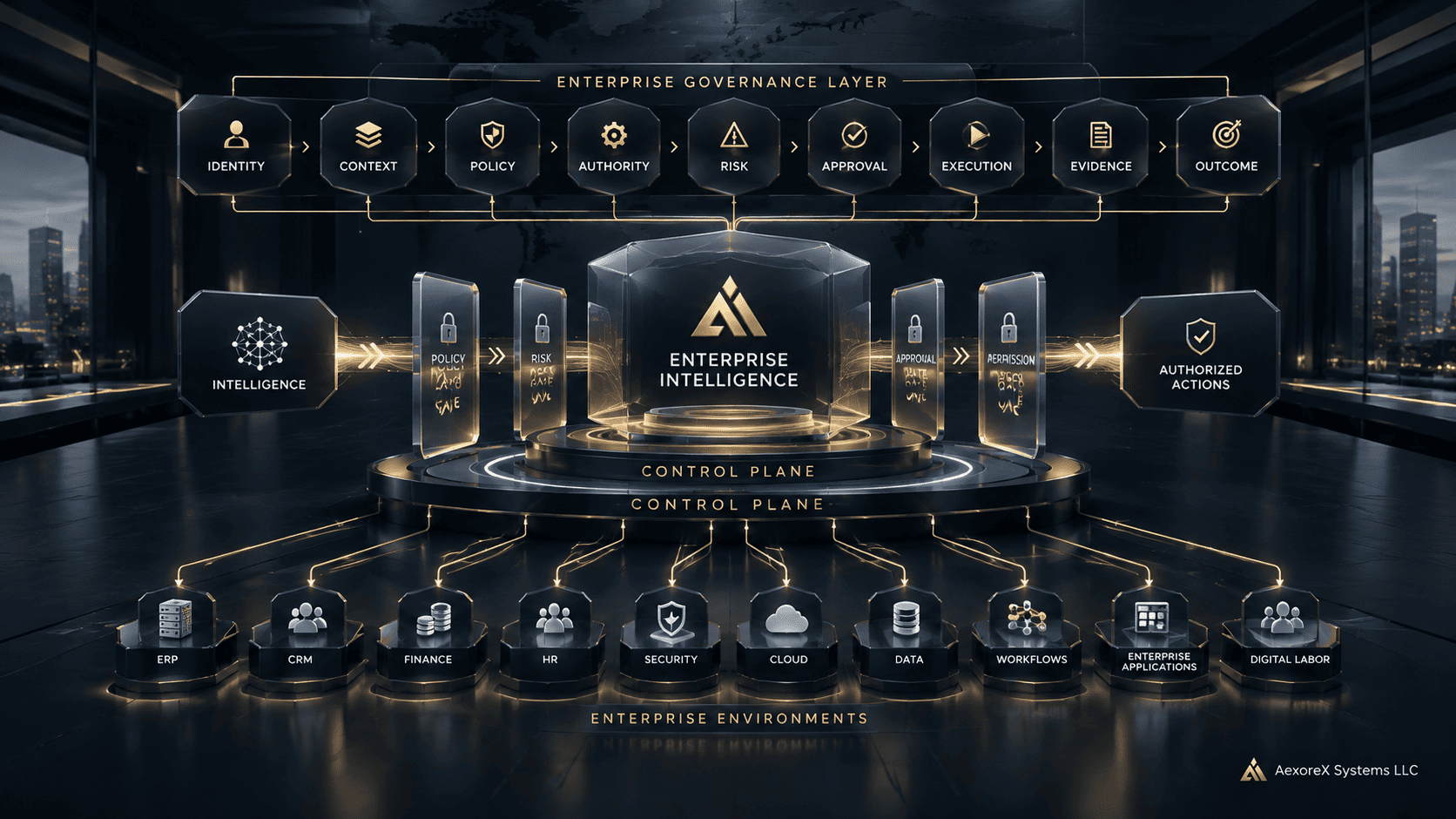
A governed intelligence system therefore requires more than a prompt. A useful enterprise authority sequence can be expressed as: Identity → Context → Policy → Authority → Risk → Approval → Execution → Evidence → Outcome.
Each stage answers a different question:
- **Identity:** Who or what is acting?
- **Context:** What does the system know about the situation?
- **Policy:** Which enterprise rules apply?
- **Authority:** What has the enterprise delegated?
- **Risk:** What level of risk is associated with the proposed action?
- **Approval:** Does the action require human authorization?
- **Execution:** What action is actually performed?
- **Evidence:** What was decided, by whom or what, under which authority?
- **Outcome:** What happened as a result?
This transforms autonomy from an unrestricted capability into a governed operating process.
The Enterprise Intelligence Control Plane
This is where the concept of an Enterprise Intelligence Control Plane becomes significant. BCG describes an Enterprise AI Control Plane as a governance layer that can provide common identity, visibility, and control across AI agents operating across multiple platforms and business units. Its discussion highlights identity and authentication, runtime policy enforcement, monitoring, audit trails, and standardized deployment paths as important components.
The broader architectural idea is straightforward: Instead of governing every AI system independently, an enterprise can establish a common control layer through which intelligence is identified, governed, monitored, and authorized.
The control plane does not necessarily replace existing enterprise systems. ERP remains ERP, CRM remains CRM, HR systems remain HR systems, financial systems remain financial systems, and cloud infrastructure remains cloud infrastructure. The control layer instead governs how intelligence interacts with those environments.
The architecture begins to look more like: Enterprise Intelligence → Context → Governance → Authority → Orchestration → Enterprise Systems → Evidence.
This creates an important separation between the intelligence layer and the authority layer:
- Intelligence determines what may be appropriate.
- Governance determines what is permitted.
- The enterprise determines what authority is delegated.
- Execution systems perform the authorized action.
- Evidence records the result.
Governance Must Become Operational
Having an AI governance policy is not the same as having governance that works during execution. EY's September 2026 survey of 202 senior AI decision-makers at U.S. publicly traded companies with at least $1 billion in annual revenue found that 98% reported having formal AI governance policies, while 47% said their organization had previously bypassed its AI governance process for urgent deployments. The survey also found that 36% had experienced an AI incident or failure with a materially negative impact.
This highlights a critical distinction: governance on paper is not the same as governance at runtime. For autonomous systems, governance must increasingly become enforceable inside the operational environment. Policies need to influence actual access, permissions need to affect actual execution, risk thresholds need to trigger actual controls, approvals need to be connected to actual actions, and audit records need to correspond to actual system events. Furthermore, authority must be capable of being changed when circumstances change.
From AI Agents to Digital Labor
This becomes even more important when organizations begin treating AI systems as a form of Digital Labor. A digital worker may need:
- an identity;
- a defined role;
- business context;
- scoped permissions;
- operational policies;
- financial boundaries;
- approval requirements;
- escalation rules;
- execution limits;
- monitoring;
- and an auditable record.
At that point, the organization is no longer simply deploying software. It is designing a governed digital workforce. The question becomes less about "Which AI agent should we deploy?" and more about "What responsibilities, authority, and boundaries should this digital worker receive?" This distinction will become increasingly important as enterprises move from isolated AI experiments toward portfolios of intelligent systems.
Governed Autonomy
An autonomous enterprise is therefore not simply an enterprise with many AI agents. It is an enterprise capable of allowing intelligence to participate in operations within clearly defined boundaries. Governed autonomy does not mean removing humans from the system. It means determining where humans remain directly involved, where intelligence can recommend, where it can decide, where it can execute, and where it must escalate.
Different levels of autonomy can require different levels of control. A system that only retrieves information does not necessarily require the same authority model as a system capable of executing financial transactions or modifying production systems. The governance model must therefore reflect scope, risk, authority, and consequence. This principle is consistent with current enterprise discussions around proportional governance and authorization for AI agents.
AexoreX Perspective
AexoreX Systems is developing this architectural direction through AEOS QUANTUM™, positioned as the Enterprise Intelligence Operating Platform for Autonomous Enterprises. The platform concept brings together enterprise systems, context, knowledge, memory, intelligence, Digital Labor, orchestration, authorization, execution, and governance within a unified operating environment.
At the center of this direction is AEOS Enterprise Authority™ — a conceptual authority and governance layer based on a foundational principle: Authority is delegated by the enterprise, not owned by Digital Labor. Under this model, Digital Labor is not treated as an unrestricted autonomous actor. Its authority is defined by the enterprise. Permissions can be scoped, policies can be applied, risk can determine whether additional approval is required, higher-risk actions can be escalated, execution can generate evidence, and delegated authority can be revoked. The objective is not maximum autonomy; the objective is governed autonomy.
AEOS QUANTUM remains in active development. The concepts described here represent the architectural direction being developed by AexoreX Systems and should not be interpreted as a claim that every capability described is currently available as a production feature.
The Next Enterprise Architecture
The transition from AI assistants toward AI-powered operations will require more than increasingly capable models. It will require architecture: identity architecture, data architecture, integration architecture, security architecture, governance architecture, and increasingly, authority architecture.
The enterprise of the future may not be defined simply by how many AI systems it deploys. It may be defined by how effectively it can connect intelligence to its operating environment while maintaining control over what that intelligence is allowed to do. The central question is therefore evolving. Not simply: "How intelligent is the AI?" But: "What is the enterprise willing to authorize that intelligence to do?"
That question sits at the foundation of governed autonomy. And as enterprises move from AI assistance toward AI-driven operations, authority may become one of the defining architectural layers of the Agentic AI Era.
Sources and attribution
- AexoreX Systems Newsroom — Original Editorial Visual · statement link
About the author
The editorial desk of AexoreX Newsroom, the publication of AexoreX Systems LLC.
More from AexoreX Newsroom Editorial Desk →Related stories
- From Enterprise Intelligence to Governed Action
- AexoreX Systems Introduces AEOS Enterprise Authority™ as Governance Layer for Autonomous Enterprise Intelligence
- AexoreX Systems Advances AEOS QUANTUM™ as Enterprise Intelligence Operating Platform for Autonomous Enterprises
- From Enterprise Intelligence to Governed Autonomous Execution: The Next Step Toward the Autonomous Enterprises
- Beyond AI: Building the Enterprise Operating Model for Intelligence, Digital Labor, Governance, and Execution.
- The Infrastructure Behind the Autonomous Enterprise: Building the Foundation for Enterprise Intelligence