
From Enterprise Intelligence to Governed Action
When Intelligence Becomes Operational
Enterprise AI is moving beyond generating answers to reliably transitioning intelligence into governed action, requiring a new operating architecture.
Opinion · AI-assisted, human edited
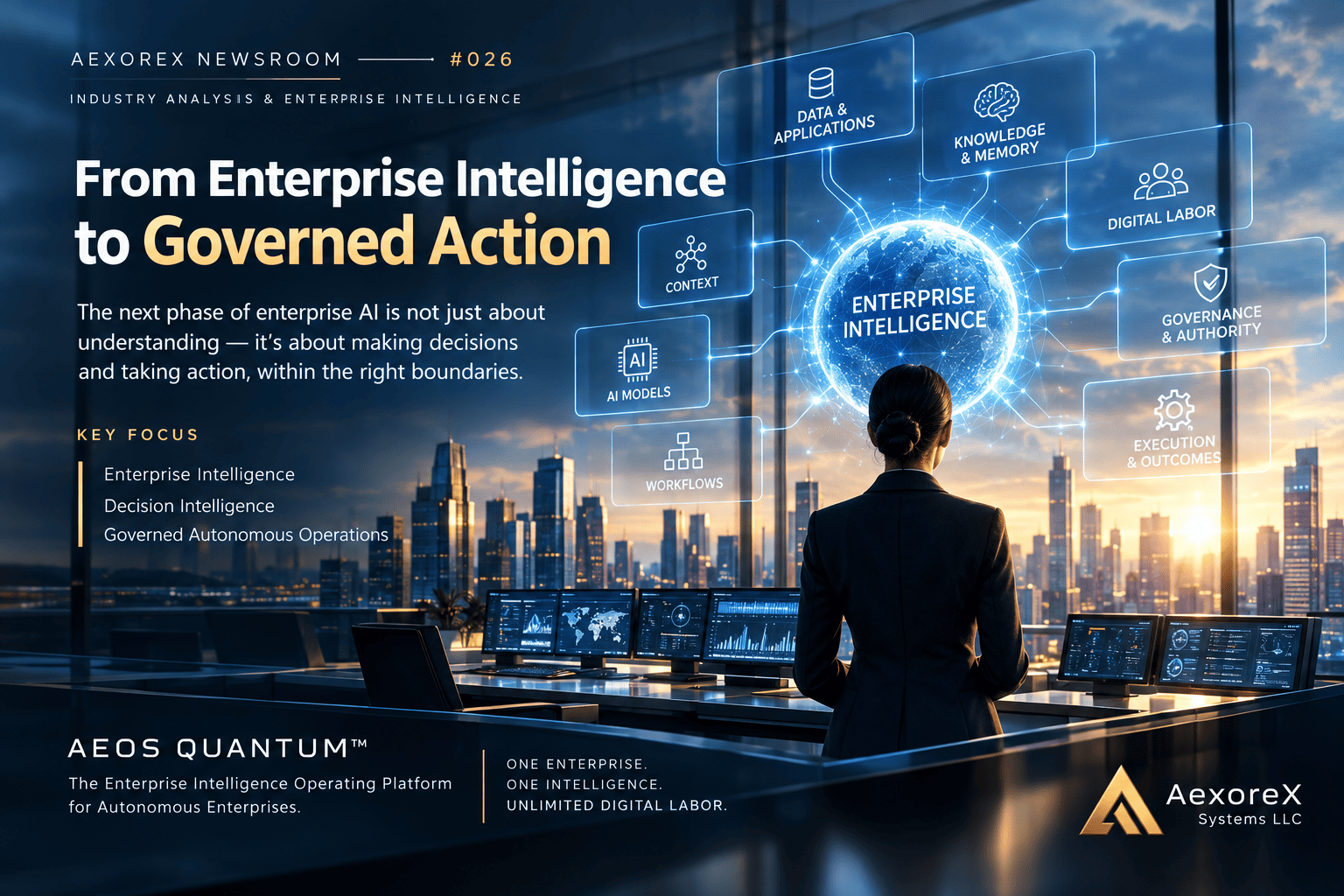
Enterprise AI is entering a new phase where the central challenge extends beyond an AI system's ability to generate an answer. The critical question now is how enterprise intelligence can reliably transition from understanding to decision, and from decision to governed action. This distinction is becoming increasingly important as AI integrates with business systems, operational data, organizational knowledge, workflows, and digital work.
Intelligence Alone Is Not Enough
An enterprise may possess powerful AI models, extensive data, and sophisticated applications. However, these capabilities do not automatically translate into operational enterprise intelligence. To make intelligence operational, an enterprise must establish a clear chain connecting what is known, what is happening, what should happen, who is authorized to act, and what actually occurred.
This can be understood through a simplified model: - **Context**: What is happening? - **Knowledge**: What does the enterprise know? - **Intelligence**: What does the information mean? - **Decision**: What should happen next? - **Authority**: Who or what is permitted to act? - **Action**: What authorized operation should be performed? - **Evidence**: What actually happened? - **Outcome**: What business result followed?
Without these connections, intelligence can remain isolated from the operational reality of the enterprise.
From Answers to Decisions
Traditional enterprise AI has often focused on information retrieval, analysis, summarization, prediction, and recommendations. While these capabilities remain valuable, an autonomous enterprise requires an additional layer: decision intelligence.
Decision intelligence connects information and context with policies, business objectives, risk, authority, and available actions. Its objective is not merely to produce a recommendation but to determine whether that recommendation can become an authorized enterprise decision. This highlights an important distinction: intelligence can inform a decision, but authority determines if that decision can become an action.
The Enterprise Decision Boundary
As AI becomes more operational, enterprises need clear boundaries around the capabilities and limitations of Digital Labor. A Digital Worker may be permitted to: - analyze information; - recommend an action; - prepare a transaction; - request approval; - execute a predefined operation; - escalate an exception.
The permitted level of action depends on identity, context, policy, risk, authority, and the specific operation. Therefore, autonomy should not be treated as a single switch but rather as a controlled spectrum: - **D1 — Recommend** - **D2 — Decide** - **D3 — Decide & Execute** - **D4 — Escalate**
The architecture surrounding each level dictates how responsibly Digital Labor can operate.
Governance Must Follow Intelligence
Governance cannot exist solely as a document, policy manual, or administrative process external to the operational system. When intelligence gains the capacity to initiate or influence real actions, governance must become integrated with execution. This means an enterprise should be able to establish: - Who - What - Why - Under Which Policy - With What Authority - At What Risk - With Which Approval - What Action - What Evidence - What Outcome
This transforms governance from a passive control into an operational control layer.
Enterprise Intelligence as an Operating Layer
This direction guides the development of AEOS QUANTUM™, which is being engineered as an Enterprise Intelligence Operating Platform for Autonomous Enterprises. Its role is not to replace existing ERP, CRM, cloud infrastructure, business applications, databases, or other systems. Instead, its architectural aim is to connect enterprise systems, context, knowledge, memory, intelligence, Digital Labor, authority, governance, orchestration, execution, evidence, and outcomes.
The progression can be expressed as: Connect → Contextualize → Govern → Orchestrate → Authorize → Execute → Optimize. This represents a shift from viewing AI as an isolated capability toward integrating intelligence as a fundamental part of an enterprise operating architecture.
From Automation to Governed Autonomy
Traditional automation follows predefined instructions. AI introduces the ability to interpret changing conditions and generate new recommendations or decisions. Digital Labor extends this capability into defined digital responsibilities. Governed autonomy adds a further requirement: the ability to act within explicitly delegated enterprise authority.
This is where the distinction between capability and authority becomes fundamental. A system may be technically capable of performing an operation, but that does not imply the enterprise has authorized it to do so. Capability does not equal Authority.
Building Incrementally
AEOS QUANTUM™ is currently in the foundational establishment and active development phases. The platform is not presented as a complete autonomous enterprise system. Its capabilities are progressing through different maturity stages: Available → In Development → Planned → Vision.
The objective is to establish the foundational architecture first, then progressively expand governed intelligence, Digital Labor, authority, orchestration, execution, and outcome management. This incremental approach acknowledges an important reality: enterprise autonomy cannot be responsibly created by simply adding more AI capability. It requires an operating architecture capable of connecting intelligence with enterprise boundaries.
The Emerging Enterprise Model
The enterprise architecture of the Agentic AI Era may therefore evolve toward: - Human Intent - Identity - Context - Knowledge + Memory - Intelligence - Decision - Authority - Governance - Digital Labor - Orchestration - Execution - Evidence - Outcome
The significance lies not in mandating a single architecture for every enterprise but in recognizing that as AI becomes more capable of acting, enterprises will increasingly need to define the relationship between intelligence, authority, action, and accountability. This relationship forms a critical foundation for autonomous enterprise operations.
The Next Infrastructure Question
The question is no longer solely, "How intelligent can AI become?" A more operational question is emerging: "How can enterprise intelligence become action without losing control?" This question sits at the intersection of AI, enterprise architecture, governance, Digital Labor, security, automation, and operational accountability. It is also one of the architectural questions AexoreX Systems is working to explore through the development of AEOS QUANTUM™.
One Enterprise. One Intelligence. Unlimited Digital Labor.
AEOS QUANTUM™ The Enterprise Intelligence Operating Platform for Autonomous Enterprises.
AexoreX Systems LLC The Global Enterprise Intelligence Infrastructure Company
Sources and attribution
- AexoreX Systems LLC · statement link
About the author
Intelligence desk of AexoreX Newsroom.
More from AexoreX Intelligence Desk →Related stories
- AexoreX Systems Advances AEOS QUANTUM™ as Enterprise Intelligence Operating Platform for Autonomous Enterprises
- From Digital Labor to Autonomous Enterprise Operations: Why an Intelligence Layer Matters
- From Enterprise Intelligence to Governed Autonomous Execution: The Next Step Toward the Autonomous Enterprises
- Beyond AI: Building the Enterprise Operating Model for Intelligence, Digital Labor, Governance, and Execution.
- The Infrastructure Behind the Autonomous Enterprise: Building the Foundation for Enterprise Intelligence
- #025 — The Enterprise AI Inflection Point: From AI Agents to Governed Autonomous Operations