
Enterprise Intelligence Infrastructure and Governed Autonomy: The Architectural Foundation for the Autonomous Enterprise
How Enterprise AI Is Moving From Intelligent Assistance to Governed Action Through Context, Authority, Orchestration, Execution, Evidence, and Optimization
Enterprise AI is shifting from informational assistance to governed operational action, requiring new infrastructure to connect intelligence with context, authority, and control.
Opinion · AI-assisted, human edited
Executive Summary
Enterprise Artificial Intelligence (AI) is evolving beyond systems primarily focused on generating information. It is moving towards systems capable of planning, utilizing tools, coordinating workflows, and executing actions across various business applications.
This transition is already evident in enterprise adoption patterns. KPMG's Q3 2025 AI Quarterly Pulse reported that 42% of surveyed organizations had deployed at least some AI agents, a significant increase from 11% just two quarters prior. Similarly, a May 2025 PwC survey of 300 senior executives found that 88% planned to increase AI-related budgets over the next 12 months due to agentic AI. Furthermore, 79% of these executives stated that AI agents were already being adopted within their companies. These figures are based on survey findings and do not represent universal measures of enterprise adoption.
Concurrently, the industry faces a fundamental structural challenge: an AI system's ability to act does not automatically define what it should be permitted to do.
Gartner has cautioned that applying uniform governance to agents with diverse autonomy levels and access scopes can contribute to AI agent failures within enterprises. By 2027, Gartner predicts that 40% of enterprises will either demote or decommission autonomous AI agents due to governance deficiencies identified after production incidents.
This situation presents an architectural question that goes beyond mere model intelligence: How should enterprises connect AI capabilities with controlled business authority? This article will explore this question through the lens of emerging Enterprise Intelligence Infrastructure and Governed Enterprise Autonomy.
The Enterprise AI Inflection
Historically, enterprise software has relied on deterministic systems. Enterprise Resource Planning (ERP) systems process transactions based on predefined rules, while Customer Relationship Management (CRM) platforms maintain customer records. IT Service Management (ITSM) systems manage service workflows, and databases enforce structured operations. Access-control systems regulate which users or applications can perform specific actions.
Generative AI introduced probabilistic intelligence into this established environment. Initially, Enterprise AI was largely informational, performing tasks such as summarizing documents, generating drafts, retrieving knowledge, analyzing information, and assisting employees with recommendations.
Agentic AI fundamentally alters this operational boundary. An agent can potentially interpret context, formulate a plan, invoke tools, interact with applications, and progress through multiple steps to achieve an outcome. This introduces a fundamentally different operational and risk profile. An inaccurate summary might simply require human correction. In contrast, an autonomous transaction could modify an enterprise system, consume financial resources, alter customer records, or trigger subsequent processes.
Therefore, the critical distinction is not merely whether AI is intelligent, but whether that intelligence has been linked to authority and execution.
From AI Assistance to Operational Action
This shift is increasingly evident across enterprise technology.
KPMG's Q3 2025 AI Quarterly Pulse reported that 42% of surveyed organizations had deployed at least some AI agents, a notable increase from 11% two quarters earlier.
PwC's May 2025 survey of 300 senior executives revealed that 79% had already adopted AI agents within their companies, and 88% planned to increase AI-related budgets due to agentic AI. However, PwC also observed that relatively few businesses were connecting agents across multiple workflows and functions.
Meanwhile, Gartner projects that by the end of 2026, 40% of enterprise applications will be integrated with task-specific AI agents, a significant jump from less than 5% in 2025. This is a strategic forecast, not a current adoption measurement.
These developments suggest an enterprise environment where AI is no longer confined to a single interface, but increasingly integrated into the operational fabric.
The Missing Layer: Governance and Authority
As AI moves closer to execution, conventional application permissions alone often become insufficient for many autonomous workflows. While existing identity and access controls remain fundamental and relevant, an autonomous system introduces an additional dimension: dynamic operational behavior.
An agent might receive information from multiple sources, reason over that information, select a tool, generate parameters, call another system, receive a response, and then continue the workflow.
Consequently, enterprises need to evaluate not only "Who is accessing the system?" but also: "What is the system attempting to do, under which policy, with what authority, at what risk level, and with what accountability?"
Gartner's May 2026 analysis emphasizes that agents can operate at different autonomy levels and across various trust boundaries. It highlights that governance should differentiate between an agent's technical ability to act and the scope of access it is granted. This forms the basis of an AexoreX architectural principle: Capability Is Not Authority.
Capability Is Not Authority
An AI system may possess the technical capability to formulate an API request, generate a database query, recommend a financial transaction, modify a customer record, initiate a workflow, or coordinate multiple software tools. However, none of these capabilities, by themselves, establish enterprise authority.
Capability describes what a system can technically perform. Authority describes what an enterprise has explicitly permitted that system to perform within a defined operational boundary.
This distinction is crucial because an enterprise may require the same AI capability to operate under varying levels of authority depending on factors such as identity, role, business process, transaction value, data sensitivity, risk, regulatory requirements, time, approval state, and overall operational context.
The architectural implication is significant: AI reasoning should not automatically translate into transactional authority. Instead, the transition from a proposed action to an authorized execution should pass through explicit governance controls.
It is important to note that "Capability ≠ Authority" is an AexoreX Systems architectural principle, not an industry-wide technical standard.
Proportional Autonomy
Enterprise autonomy should not be viewed as a binary condition. Organizations are not forced to choose solely between AI that can only read and AI that can execute anything.
Gartner's May 2026 proportional-governance research distinguishes between autonomy levels and stresses governance tailored to autonomy and access scope. For clarity in this article, the following model is presented as a practical representation of that Gartner framework, rather than as a universal ISO, IEEE, or regulatory taxonomy:
- **Observe:** Read and monitor information without altering the enterprise state.
- **Advise:** Analyze context and recommend actions, with execution remaining a human responsibility.
- **Act with Approval:** Prepare and perform actions only after necessary human authorization.
- **Act Autonomously:** Execute independently within explicitly pre-authorized boundaries and controls.
As autonomy increases, the importance of identity, policy enforcement, monitoring, approval mechanisms, exception handling, and evidence also grows. Therefore, autonomy should be bounded, delegated, and revocable.
From Agents to Digital Labor
The increasing deployment of AI agents also introduces a broader operational concept: Digital Labor. While a task-specific agent performs a particular function, Digital Labor describes a more structured operational model where non-human digital workers are assigned defined responsibilities across enterprise workflows.
This is an emerging analytical concept rather than a universally standardized enterprise classification. A governed Digital Labor model may necessitate:
- Defined scope
- Identifiable non-human identity
- Delegated authority
- Operational policies
- Performance expectations
- Risk boundaries
- Escalation procedures
- Monitoring
- Evidence
- Human accountability
The objective is not to eliminate humans from enterprise operations, but to establish a controlled relationship between human authority and machine execution. Singapore's Model AI Governance Framework for Agentic AI, launched by IMDA in January 2026, emphasizes responsible deployment, technical and non-technical safeguards, and the principle that humans remain ultimately accountable.
The Enterprise Intelligence Control Plane
As enterprises deploy agents across multiple systems, another architectural challenge emerges: fragmentation. A modern enterprise might operate various systems including ERP, CRM, SCM, ITSM, finance systems, HR platforms, cloud infrastructure, data platforms, proprietary applications, and internal APIs.
While individual vendors can embed AI capabilities within their own applications, enterprise workflows frequently span across these application boundaries. A business process might require information from a CRM, inventory data from an ERP, an approval from a finance system, and execution through another operational platform.
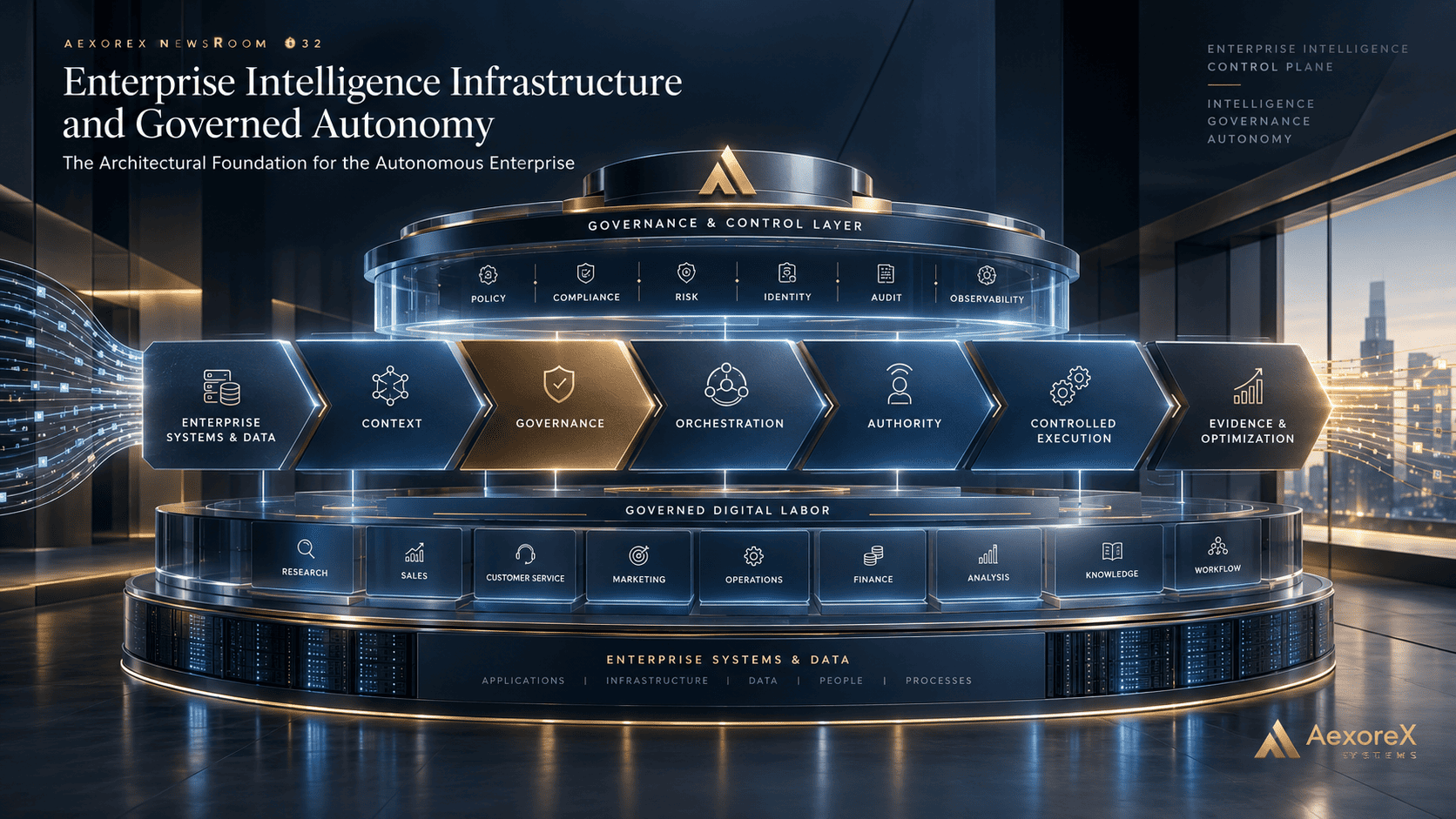
This necessitates an architectural layer capable of coordinating intelligence and execution across the existing enterprise environment. A conceptual Enterprise Intelligence Control Plane could provide a common governance architecture for this environment. Within the AexoreX proposed architecture, its responsibilities can include:
- **Identity:** Establishing the identity of the executing AI or Digital Labor.
- **Context:** Providing relevant enterprise context.
- **Policy:** Evaluating actions against business rules.
- **Authority:** Determining whether the requested action is authorized.
- **Risk:** Evaluating operational, financial, security, and compliance exposure.
- **Approval:** Introducing human authorization when required.
- **Execution:** Dispatching authorized actions to destination systems.
- **Evidence:** Maintaining records of relevant decisions and actions.
- **Outcome:** Measuring results and incorporating feedback into continuous optimization.
This is an AexoreX proposed architectural model, not an established industry-standard control-plane specification. It aims to govern how intelligence interacts with existing systems of record, rather than replacing them.
Orchestration Across the Enterprise Stack
Open protocols are gaining importance in the emerging agentic ecosystem. Anthropic introduced the Model Context Protocol (MCP) in November 2024 as an open standard for connecting AI applications with external systems, tools, and data. MCP has since evolved into a broader open ecosystem and was donated by Anthropic to the Linux Foundation's Agentic AI Foundation in 2025.
The crucial architectural distinction is that connectivity does not equate to authority. MCP can facilitate interaction between AI applications and external tools or data, but it does not, by itself, constitute an enterprise-wide policy engine, financial authorization framework, dynamic risk engine, or organizational accountability model.
Therefore:
- Connectivity enables interaction.
- Governance determines permission.
- Authority determines delegation.
- Execution changes enterprise state.
This distinction is critical when designing production-grade autonomous systems.
Controlled Autonomous Execution
A governed autonomous workflow can be designed with explicit boundaries. Consider a procurement workflow where an AI system identifies that inventory has fallen below a defined threshold and proposes a replenishment order. The control architecture can then evaluate:
- Agent identity
- Supplier identity
- Inventory context
- Purchase value
- Approved supplier status
- Spending authority
- Policy
- Risk
- Approval requirements
If the transaction falls within a pre-authorized policy boundary, it may proceed automatically. If it exceeds that boundary, execution can be paused, and an approval workflow can be triggered.
The architecture thus doesn't ask, "Should AI be autonomous?" Instead, it asks, "Where, under what conditions, and within which authority boundary should autonomy operate?" This is a more useful enterprise architecture question.
Security, Risk, and Accountability
Agentic systems introduce security considerations beyond traditional application access. Relevant risks include:
- **Indirect Prompt Injection:** Untrusted content can influence an agent's reasoning, potentially altering its intended behavior. Anthropic's agent security guidance also highlights the risk of attackers manipulating agent instructions or interactions with external systems.
- **Excessive Privilege:** Agents operating with broad credentials can create unnecessary blast radius if their behavior deviates from intended policy.
- **Non-Human Identity Sprawl:** As AI agents proliferate, organizations must maintain visibility into which non-human identities exist, what they can access, and who is accountable for their behavior.
- **Multi-Agent Cascades:** Outputs from one agent may become inputs to another, potentially propagating incorrect or malicious instructions throughout a workflow.
- **Insufficient Evidence:** Without proper records, organizations may struggle to reconstruct what information was available, what action was proposed, what authorization was applied, and what execution occurred.
These risks elevate identity, policy, monitoring, authorization, and evidence from optional security features to fundamental architectural concerns.
Governance Is Becoming an Operational Architecture
Regulatory and standards organizations are increasingly addressing AI governance requirements.
NIST's AI Risk Management Framework 1.0 establishes the functions Govern, Map, Measure, and Manage. NIST describes the framework as voluntary, use-case agnostic, and applicable across AI systems. Its Generative AI Profile, NIST AI 600-1, provides additional guidance for risks associated with Generative AI. NIST is currently revising the AI RMF while continuing to maintain the 1.0 framework and related resources.
ISO/IEC 42001:2023 provides requirements for establishing, implementing, maintaining, and continually improving an Artificial Intelligence Management System (AIMS) within organizations. This is an organizational management-system standard, not a real-time runtime authorization engine.
The European Union's AI Act includes requirements concerning logging and human oversight for applicable high-risk AI systems. Specifically, Article 12 addresses record-keeping/logging requirements, and Article 14 addresses human oversight. These requirements apply based on the Act's classification and scope; they should not be interpreted as universal requirements covering every autonomous AI system.
Singapore's Model AI Governance Framework for Agentic AI, launched in January 2026, offers guidance for organizations deploying Agentic AI. It emphasizes technical and non-technical measures, responsible deployment, and human accountability.
Collectively, these developments indicate an important architectural trend: AI governance is becoming operational infrastructure.
Where the Industry Is Today
The enterprise AI landscape can be understood across several maturity horizons:
- **Available Today:** Generative assistants, retrieval systems, task-specific agents, tool connectivity. Governance implication: Human-led execution and bounded automation.
- **Emerging:** Multi-agent workflows, agent interoperability, broader tool use, domain-specific systems. Governance implication: Greater need for runtime controls and identity management.
- **In Development:** Cross-system orchestration, dynamic authorization, centralized agent governance, stronger evidence architectures. Governance implication: Separation of capability from authority.
- **Longer-Term Vision:** Large-scale governed Digital Labor across enterprise operations. Governance implication: Continuous optimization, adaptive controls, and increasingly autonomous workflows.
This maturity model is an AexoreX analytical framework, not an industry-standard maturity taxonomy. The industry is not progressing directly from chatbots to fully autonomous enterprises, but rather moving through a series of increasingly consequential trust boundaries.
AexoreX Systems Perspective
AexoreX Systems is developing Enterprise Intelligence Infrastructure for Governed Enterprise Autonomy, with a status of Foundational Establishment & Active Development.
The architectural thesis is that enterprise autonomy demands more than just increasingly capable AI models. It requires infrastructure that connects intelligence to enterprise context, governance, authority, execution, evidence, and outcomes. AexoreX Systems structures this direction through seven functional stages: Connect → Contextualize → Govern → Orchestrate → Authorize → Execute → Optimize.
- **Connect:** Establish connectivity across enterprise applications without necessitating the replacement of existing systems of record.
- **Contextualize:** Transform enterprise data and information into operational context relevant to AI-driven workflows.
- **Govern:** Apply policies, identity controls, risk boundaries, and governance conditions before intelligence translates into action.
- **Orchestrate:** Coordinate workflows, systems, agents, tasks, dependencies, and exceptions across the enterprise environment.
- **Authorize:** Determine whether a proposed action falls within delegated authority and if human approval is required.
- **Execute:** Dispatch authorized actions to destination systems within controlled operational boundaries.
- **Optimize:** Capture relevant evidence, outcomes, performance signals, and feedback for continuous improvement.
The central AexoreX architectural principle remains: Capability ≠ Authority. A system may be technically capable of performing an action, but the enterprise must still determine whether that action is authorized.
AEOS QUANTUM Perspective
AEOS QUANTUM™ is currently In Development, with foundational capabilities and architectural elements at different stages of Designed / Planned / Vision maturity.
Its positioning is: The Enterprise Intelligence Operating Platform for Autonomous Enterprises. The underlying concept is: One Enterprise. One Intelligence. Unlimited Digital Labor.
AEOS QUANTUM is being designed around the principle that enterprise intelligence should operate across existing enterprise infrastructure rather than requiring organizations to replace their core business systems. Therefore, AEOS does not replace the enterprise stack; instead, it connects, orchestrates, governs, and activates it.
The intended architectural model is an intelligence and governance overlay capable of functioning across heterogeneous enterprise environments. Potential enterprise environments may include ERP, CRM, ITSM, cloud infrastructure, data platforms, and proprietary systems. Examples may include SAP, Oracle, Salesforce, ServiceNow, Microsoft, Google, AWS, and custom enterprise systems. These examples illustrate the types of enterprise environments AEOS is designed to interact with; they do not imply partnerships, integrations, customers, or commercial relationships unless separately announced by AexoreX Systems.
What Comes Next
The next phase of Enterprise AI will not be solely defined by which model produces the strongest response. It will increasingly be defined by how organizations address several architectural questions:
- Who is the AI?
- What does it know?
- What is it allowed to do?
- Who delegated that authority?
- What happens when risk increases?
- When must a human approve?
- What evidence is retained?
- How can the action be reversed or contained?
- How is the outcome measured?
These questions elevate AI from an application feature to a core enterprise operating concern. They also redefine the role of enterprise architecture. The objective is not merely to make AI more autonomous, but to make autonomy governable.
Conclusion
The Enterprise AI transition is entering an operational phase. AI agents are increasingly capable of interacting with enterprise tools, coordinating tasks, and participating in business workflows. Adoption and investment are accelerating, even as governance maturity remains uneven. KPMG, PwC, Gartner, NIST, IMDA, and other institutions are documenting various aspects of this transition.
The architectural challenge is therefore no longer simply, "Can AI perform the task?" The more consequential question is, "Under what conditions is AI authorized to perform the task?"
This distinction separates capability from authority, and it highlights a new infrastructure requirement for the autonomous enterprise:
- Intelligence must be connected to context.
- Context must be governed by policy.
- Policy must define authority.
- Authority must control execution.
- Execution must produce evidence.
- Evidence must improve the system.
This is the foundation of Governed Enterprise Autonomy, and it is the architectural direction AexoreX Systems is building toward through Enterprise Intelligence Infrastructure.
Sources and attribution
- AexoreX Newsroom — AexoreX Systems Technology Desk, supported by referenced primary sources including Gartner, KPMG, PwC, NIST, ISO, European Union, IMDA Singapore, and Anthropic · statement link
About the author
AexoreX Technology Desk is the newsroom's editorial desk covering enterprise technology, artificial intelligence, digital labor, automation, and emerging enterprise systems.
More from AexoreX Technology Desk →Related stories
- From Enterprise Software to Enterprise Intelligence Infrastructure: The Architecture Behind AEOS QUANTUM™
- AexoreX Systems Defines the Enterprise Intelligence Control Plane for the Autonomous Enterprise
- AexoreX Systems Introduces AEOS Enterprise Authority™ as Governance Layer for Autonomous Enterprise Intelligence
- From Enterprise Intelligence to Governed Autonomous Execution: The Next Step Toward the Autonomous Enterprises
- Beyond AI: Building the Enterprise Operating Model for Intelligence, Digital Labor, Governance, and Execution.
- The Infrastructure Behind the Autonomous Enterprise: Building the Foundation for Enterprise Intelligence