
From Autonomous Execution to Enterprise Evidence
How Execution, Evidence & Optimization Are Becoming Core Infrastructure for Governed Enterprise Intelligence
AexoreX Systems introduces a framework for Governed Enterprise Intelligence, balancing AI's new execution capabilities with robust enterprise authority, security, and evidence.
Opinion · AI-assisted, human edited
By AexoreX Systems Technology Desk
The Next Enterprise AI Question Is Not Only What AI Can Do — But What It Is Authorized to Do
Enterprise artificial intelligence is undergoing a significant transition. For years, AI was primarily used by organizations to analyze information, generate content, identify patterns, and support human decision-making. However, the emerging generation of intelligent systems introduces a new capability: execution.
AI systems are increasingly capable of interacting with software tools, APIs, workflows, enterprise applications, and other digital environments. This raises a fundamental enterprise question: How should an organization govern an intelligent system's actions when it can act?
The answer extends beyond artificial intelligence models. It encompasses identity, context, policy, authority, risk, approval, execution, evidence, outcomes, and continuous optimization. This is where the concept of Governed Enterprise Intelligence becomes increasingly relevant.
From AI Capability to Enterprise Authority
A system may be technically capable of performing an action, but that does not mean it should be authorized to do so. This distinction can be expressed simply as: Capability ≠ Authority.
An intelligent system might be capable of: - accessing an enterprise API; - creating or modifying a record; - initiating a workflow; - interacting with financial infrastructure; - changing a configuration; - or executing an operational task.
Enterprise governance must determine whether such an action is actually permitted. Authority can depend on the system's identity, role, context, policy, risk level, scope, financial limits, approval requirements, and operating environment.
This creates a more structured model for enterprise autonomy. Instead of "AI → Action," the enterprise model becomes:
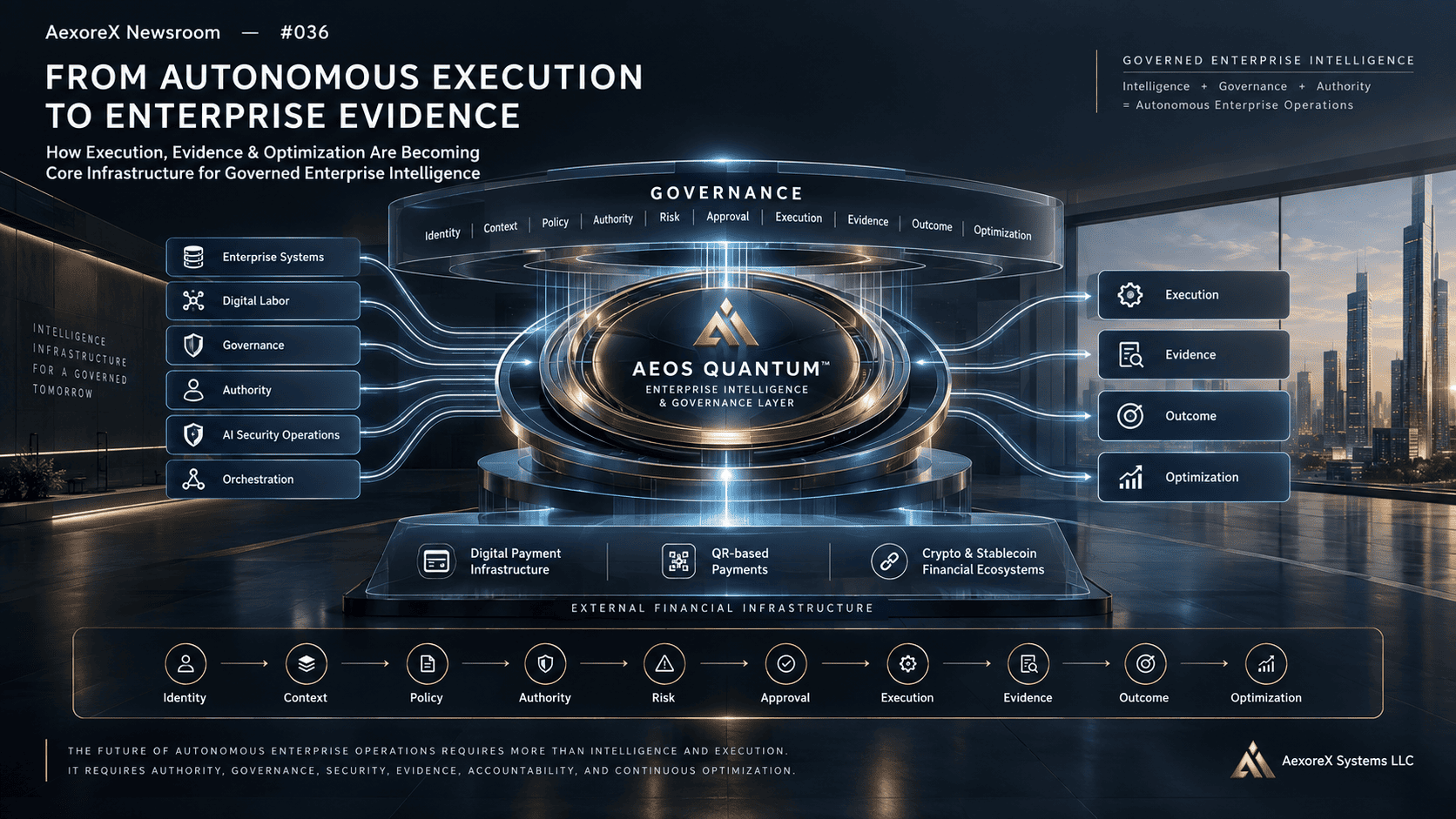
Identity → Context → Policy → Authority → Risk → Approval → Execution → Evidence → Outcome → Optimization
AexoreX Systems presents this sequence as a reference architectural framework, not an industry standard. Its purpose is to illustrate how intelligent execution can remain connected to enterprise governance.
Execution Alone Is Not Enough
Traditional automation generally follows predefined instructions. Agentic systems can introduce greater flexibility by interpreting context, selecting tools, and determining sequences of actions. However, increasing autonomy also increases the importance of control.
An enterprise cannot evaluate autonomous execution solely by asking, "Did the system complete the task?" It must also ask: - "Was the action authorized?" - "Was the correct policy applied?" - "Was the risk acceptable?" - "Was approval required?" - "What actually happened?" - "What was the resulting business outcome?"
This changes the role of execution. Execution becomes one component of a broader enterprise operating architecture.
Evidence Becomes Part of the Architecture
When humans perform an important enterprise action, organizations typically require records, approvals, documentation, and accountability. Autonomous systems require the same principle to be applied to machine-driven operations.
Evidence should help establish relationships between: Who or what acted ↓ What context existed ↓ Which policy applied ↓ What authority was delegated ↓ What approval was provided ↓ What action occurred ↓ What result followed
Provenance technologies can help describe relationships between entities, activities, and agents. However, provenance and cryptographic integrity should not be treated as the same thing. A provenance model can describe what was related to what and how an activity occurred. Cryptographic mechanisms can separately be used to help establish integrity and tamper-evidence for appropriate records. This distinction matters when designing enterprise evidence architectures. The objective is not simply to generate more logs, but to create a structured record of enterprise decisions, authorized actions, execution, and outcomes.
Digital Labor Requires Delegated Authority
The emergence of Digital Labor introduces another change in enterprise architecture. AI-driven systems can increasingly be designed to perform defined operational responsibilities. However, Digital Labor should not receive unlimited authority.
A governed Digital Labor model can define: - identity; - role; - responsibilities; - permitted tools; - operational scope; - financial authority; - risk boundaries; - approval requirements; - escalation rules; - evidence requirements.
This creates a relationship between human organizational authority and machine execution. Humans establish objectives, policies, boundaries, and accountability. Digital Labor performs delegated responsibilities within those boundaries. Higher-risk operations can require additional authorization or human intervention. The objective is therefore not to eliminate humans from enterprise operations, but to make the relationship between human authority and machine execution more structured and auditable.
Security and AI SOC
As intelligent systems receive access to more enterprise environments, security operations become increasingly connected with enterprise governance. An AI-assisted Security Operations Center (AI SOC) can help organizations detect suspicious behavior, correlate signals, investigate events, and support security response.
However, security detection and business authorization are different questions. A security system may determine, "This activity appears unusual." An enterprise governance layer can ask, "Is this activity authorized in this business context?" This distinction becomes particularly important when Digital Labor interacts with sensitive systems.
A governed architecture can combine: Identity + Context + Policy + Authority + Risk + Security before allowing certain actions to proceed. Depending on the risk level, an action could be: Execute → Hold → Escalate → Human Control. This creates an important relationship between AI SOC and Enterprise Intelligence. Security helps protect the operating environment, while governance determines whether actions are permitted within the enterprise operating model.
Financial Operations Enter a More Connected Era
Enterprise financial infrastructure is also becoming increasingly digital and interconnected. Businesses may interact with: - banking systems; - payment processors; - card networks; - digital wallets; - QR-based payment systems; - financial APIs; - cross-border payment infrastructure; - digital assets; - crypto ecosystems; - stablecoins; - treasury and settlement systems.
The architectural question is therefore not simply whether an intelligent system can connect to a financial system. The more important question is: Under what authority can the system perform a financial action? A financial action may require: Identity → Context → Policy → Financial Authority → Risk → Approval → Execution → Evidence. This provides a foundation for controlled Digital Labor within financial operations.
QRIS as a Customer Payment Option
Digital commerce also requires practical payment choices for customers. QRIS can serve as one of those choices for customers in Indonesia, while supported cross-border QR payment arrangements can extend QR-based payments to participating markets and payment ecosystems.
For a technology company serving customers across different markets, this illustrates an important principle: Global commerce does not require a single payment method. Different markets can require different payment rails and customer preferences. Accordingly, a global-ready enterprise can support multiple payment options depending on market availability, payment providers, regulatory requirements, and customer needs.
For AexoreX Systems, QRIS is positioned as a customer payment option, not as the company's core business or as a claim that AexoreX operates the QRIS infrastructure itself. Cross-border availability similarly depends on the relevant participating payment networks and providers.
Crypto and Stablecoins Within the Broader Financial Landscape
Crypto and stablecoins represent another emerging category within digital financial infrastructure. Stablecoins are designed to maintain a relatively stable value against a reference asset or basket of assets, although their mechanisms, risks, regulatory treatment, and practical applications can differ significantly.
From an enterprise architecture perspective, the important question is not whether every company should use crypto or stablecoins. The question is how emerging financial technologies could potentially interact with enterprise governance when they are relevant to a particular business model.
Potential enterprise considerations include: - identity; - authorization; - custody; - transaction limits; - risk controls; - compliance; - accounting; - settlement; - evidence; - approval; - operational security.
Therefore, crypto and stablecoins should be considered as potential components of a broader digital financial ecosystem, rather than defining the identity of an enterprise intelligence platform. For AexoreX Systems, any future connectivity with digital assets would need to remain subject to appropriate technical, security, financial, regulatory, and governance requirements. No specific crypto network integration is implied by this discussion.
From Enterprise Applications to Enterprise Intelligence Infrastructure
Modern enterprises operate across heterogeneous technology environments: ERP, CRM, IT service management, cloud infrastructure, identity systems, cybersecurity platforms, payment systems, financial infrastructure, data platforms, APIs, and digital assets.
The challenge is not simply connecting these systems. The challenge is coordinating intelligence and action across them while maintaining enterprise control. This is where an enterprise intelligence infrastructure layer can become relevant.
A conceptual model is: Enterprise Systems ↓ Connectivity & Integration ↓ Enterprise Intelligence ↓ Digital Labor ↓ Governance ↓ Authority ↓ Security & AI SOC ↓ Orchestration ↓ Execution ↓ Evidence ↓ Outcome ↓ Optimization
The architecture creates a distinction between systems that provide capabilities and the governance mechanisms that determine when, why, and under whose authority those capabilities should be activated.
AEOS QUANTUM and the Evolution Toward Governed Enterprise Autonomy
This architectural direction is being explored by AexoreX Systems through AEOS QUANTUM™ — Autonomous Enterprise Operations Systems Quantum. AEOS QUANTUM is being developed as "The Enterprise Intelligence Operating Platform for Autonomous Enterprises."
Its conceptual operating sequence is: Connect → Contextualize → Govern → Orchestrate → Authorize → Execute → Optimize. This sequence reflects an important principle: Enterprise intelligence should not be separated from enterprise governance.
AEOS QUANTUM is not positioned as a replacement for ERP, CRM, ITSM, financial systems, cybersecurity platforms, payment infrastructure, or other enterprise systems. Instead: "AEOS does not replace the enterprise stack. AEOS connects, orchestrates, governs, and activates it." This approach supports the broader concept of Vendor Independence by Design™. The enterprise remains able to operate across multiple technologies and systems while maintaining a consistent intelligence, governance, and authority model.
Toward a More Accountable Autonomous Enterprise
Autonomous enterprise operations should not be defined simply by how much activity machines can perform. A more meaningful measure is how effectively an organization can govern that activity.
The emerging model is therefore: Intelligence understands. Context explains the situation. Governance defines the rules. Authority defines what is permitted. Security protects the environment. Orchestration coordinates the work. Execution performs the authorized action. Evidence records what occurred. Outcome measures the result. Optimization improves the next cycle.
This represents a shift from "AI that can act" toward "enterprise infrastructure that can govern intelligent action."
Building the Infrastructure for Governed Enterprise Intelligence
The next phase of enterprise AI will not be defined only by increasingly capable models. It will also depend on the infrastructure surrounding those models: - Identity. - Context. - Policy. - Authority. - Risk. - Security. - Orchestration. - Execution. - Evidence. - Optimization.
Together, these capabilities can provide the foundation for a more structured approach to autonomous enterprise operations. Human leadership remains responsible for objectives, policy, boundaries, accountability, and high-impact decisions. Digital Labor operates within delegated authority. Enterprise systems provide the underlying operational capabilities. Security systems protect the environment. Evidence provides operational traceability. Optimization creates the feedback loop. This is the direction toward which Governed Enterprise Intelligence is evolving.
And it is the architectural territory that AexoreX Systems is exploring through AEOS QUANTUM™. Not intelligence without control. Not automation without accountability. Not autonomy without authority. But an enterprise operating environment where intelligence can connect to action — while action remains connected to governance, authority, security, evidence, and outcomes.
AexoreX Systems The Global Enterprise Intelligence Infrastructure Company AEOS QUANTUM™ The Enterprise Intelligence Operating Platform for Autonomous Enterprises. One Enterprise. One Intelligence. Unlimited Digital Labor. Intelligence. Authority. Autonomous Execution. Status: In Development
Sources and attribution
- AexoreX Systems — Original Editorial Visual Created for AexoreX Newsroom #036 · statement link
About the author
AexoreX Technology Desk is the newsroom's editorial desk covering enterprise technology, artificial intelligence, digital labor, automation, and emerging enterprise systems.
More from AexoreX Technology Desk →Related stories
- Governing Autonomous Execution: Enterprise Control Planes and the Shift to Digital Labor
- AexoreX Systems Defines the Enterprise Intelligence Control Plane for the Autonomous Enterprise
- AexoreX Systems Introduces AEOS Enterprise Authority™ as Governance Layer for Autonomous Enterprise Intelligence
- AexoreX Systems Advances AEOS QUANTUM™ as Enterprise Intelligence Operating Platform for Autonomous Enterprises
- From Enterprise Intelligence to Governed Autonomous Execution: The Next Step Toward the Autonomous Enterprises
- Beyond AI: Building the Enterprise Operating Model for Intelligence, Digital Labor, Governance, and Execution.