
Governing Autonomous Execution: Enterprise Control Planes and the Shift to Digital Labor
As AI moves from generating answers to performing enterprise actions, identity, authorization, governance, and evidence are becoming central to autonomous execution.
As enterprise AI moves from providing answers to performing actions, identity, authorization, governance, and evidence are becoming critical for autonomous execution.
Opinion · AI-assisted, human edited
The Enterprise AI Shift
Enterprise artificial intelligence is undergoing a significant architectural transition. For years, enterprise AI primarily assisted humans by helping them find information, understand data, summarize documents, generate content, and produce recommendations. The next phase introduces a fundamental distinction: AI systems are now increasingly designed to interact with enterprise tools and systems, execute multi-step workflows, and perform actions on behalf of users or organizations.
"AI that can answer is not the same as AI that can act."
When AI begins to act, enterprise architecture must address a more complex set of questions: - Who is the AI? - What systems can it access? - What is it allowed to do? - Who granted this authority? - What limits apply? - When is human approval required? - How can the organization prove what happened?
The challenge, therefore, is evolving beyond mere intelligence. It is becoming a matter of governed execution.
From Intelligence to Execution
This evolution can be understood through three stages:
- **Stage 1: Human → Enterprise System → Human Action**
- The system provides information or tools, while the human performs the work.
- **Stage 2: Human → AI → Answer → Human Action**
- AI helps interpret information and generate recommendations, but the human remains responsible for the final operational action.
- **Stage 3: Human → AI → Enterprise Systems → Action → Evidence**
- AI can participate directly in operational workflows.
This third stage significantly alters architectural requirements. An AI system capable of executing an action needs more than intelligence; it requires identity, access controls, policies, authorization, risk boundaries, oversight, and evidence.
Gartner has projected that 40% of enterprise applications will include task-specific AI agents by the end of 2026, a substantial increase from less than 5% in 2025. Gartner describes these agents as capable of performing complex, end-to-end tasks. The significance lies not just in the number of AI agents, but in the increasing amount of enterprise work that software may be able to perform.
Why Execution Changes Enterprise Architecture
When AI's function is limited to generating an answer, organizations primarily focus on whether that answer is accurate, relevant, and useful. However, when AI can perform an action, the control requirements broaden considerably. An enterprise must then consider: - identity - access - permissions - policy - authority - risk - human approval - execution - monitoring - evidence
This introduces a new architectural principle:
"Capability does not equal authority."
An AI system may technically be capable of performing an operation without possessing the organizational permission to do so. For example, a Digital Labor system might technically be able to create a transaction, modify a record, initiate a workflow, or access a business service. However, that technical capability does not automatically imply the enterprise has authorized the action. The distinction between what a system *can* do and what it *is permitted* to do becomes fundamental.
MCP: Connecting AI to Enterprise Tools
The Model Context Protocol (MCP) represents an important development in this transition. MCP is an open protocol designed to provide a standardized way for AI applications to discover and interact with external tools, data sources, and systems.
The MCP specification has evolved rapidly, with the July 28, 2026, update introducing a stateless protocol core, header-based routing, cacheable tool lists, authorization hardening, a formal extensions framework, and other changes aimed at scalability and enterprise use. In essence:
"MCP helps AI connect and communicate with tools and systems in a standardized way."
However, a crucial distinction must be maintained:
"Connection is not authority."
An MCP connection does not, by itself, grant an AI system permission to perform every operation exposed by a connected system. Connection addresses: "How can the AI communicate with this capability?" Governance must answer: "Is the AI allowed to use this capability for this particular action?" This distinction becomes increasingly important as AI transitions from information retrieval to operational execution.
The Rise of Non-Human Identity
Human employees are typically recognized through organizational identities, complete with accounts, roles, permissions, responsibilities, and access policies. Autonomous software requires a comparable concept, often referred to as Non-Human Identity (NHI).
NHI broadly describes digital identities used by software, services, workloads, applications, and automated systems. As Digital Labor becomes more capable, organizations need to know: - which digital identity is acting - which organization or user it represents - what permissions it has - what credentials it uses - what systems it can access - under what policies it may operate
The identity of an autonomous system, therefore, becomes an integral part of the enterprise control model.
Capability ≠ Authority
This principle warrants special attention. A system can possess a technical capability without possessing the authority to exercise it.
For example: - **Capability:** The Digital Labor can technically send a request to an enterprise system. - **Authority:** The enterprise has explicitly permitted that Digital Labor to send that particular request under defined conditions.
These are distinct concepts. A mature autonomous enterprise cannot rely solely on technical permissions. It requires a mechanism that integrates identity, policy, risk, and authority before execution.
Authorization Becomes a Runtime Function
Authorization is the process of determining whether a requested action should be permitted. This is especially critical when decisions are made during an active workflow. A simplified model illustrates this:
AI requests action ↓ Identity identified ↓ Context evaluated ↓ Policy checked ↓ Authority evaluated ↓ Risk evaluated ↓ Human approval if required ↓ Allow / Deny / Hold ↓ Execution ↓ Evidence
The OpenID Foundation approved Authorization API 1.0 as a final specification in January 2026, developed by the OpenID AuthZEN Working Group. This specification defines an API approach for authorization interactions. Architecturally, its broader significance is that authorization is increasingly treated as a distinct function that can be evaluated and enforced, rather than being hidden within individual applications.
The Emerging Enterprise Control Plane
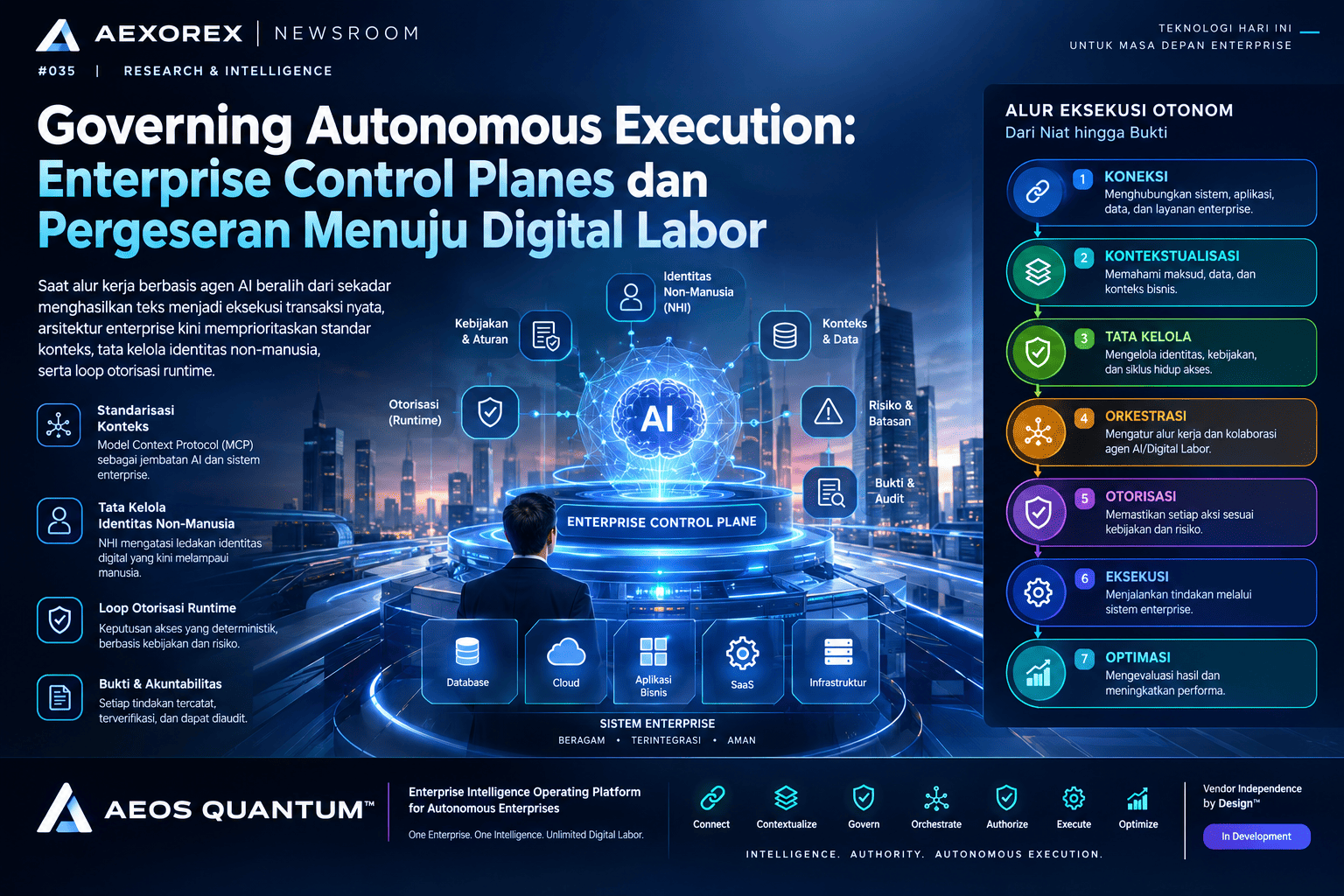
This leads to the concept of an Enterprise Control Plane. In simple terms, a control plane is a central layer for determining and managing how systems operate. For autonomous enterprise operations, such a control layer can provide a consistent framework for: Identity → Context → Policy → Authority → Risk → Approval → Execution → Evidence.
The objective is not necessarily to replace existing enterprise applications. Instead, the control layer can span the operational environment, helping to coordinate how autonomous systems interact with it.
This architectural direction is already evident across major enterprise technology platforms. ServiceNow, for instance, describes its AI Control Tower as a central hub to discover, secure, govern, observe, and measure AI across an enterprise. Its capabilities include inventorying AI agents, models, and MCP servers, tracking AI identity and access, and enforcing least-privilege access.
Microsoft describes Agent 365 as a control plane for AI agents, offering centralized governance, visibility, and auditability across agent activity. Similarly, AWS Bedrock AgentCore provides mechanisms for authentication, authorization, gateways, identity, observability, and controlled access to agent runtimes and MCP-based tools. AWS documentation highlights its Gateway as a governed entry point capable of applying policy-based authorization and observability.
While these implementations differ in architecture and scope, they collectively illustrate a common industry direction:
"Autonomous software requires more than a model. It requires operational control."
From AI Agents to Governed Digital Labor
The term AI agent is increasingly used to describe software capable of planning, using tools, and executing tasks. However, from an enterprise operational perspective, the larger question is not merely the existence of an agent. It's whether software performing work can operate as a controlled form of Digital Labor.
Digital Labor can be understood as software-based labor capable of performing defined digital work. For enterprise use, Digital Labor may require: - identity - context - skills - permissions - authority - policies - approvals - execution controls - evidence - optimization
This shifts the conversation from: "How intelligent is the agent?" toward: "How can the enterprise safely authorize and govern the work performed by autonomous software?"
The Governance Gap
Enterprise environments are rarely built around a single technology vendor. Organizations typically operate combinations of business applications, cloud platforms, security systems, databases, custom applications, identity systems, data platforms, and AI services. As autonomous capabilities become distributed across these diverse environments, governance can become fragmented.
One system might manage identity, another authorization, another AI agents, another security, another enterprise workflows, and yet another might provide the underlying AI model.
This presents a significant architectural question:
"How does an enterprise establish a consistent operating model for autonomous work across a heterogeneous technology environment?"
The challenge, therefore, is not simply building more AI, but connecting AI capability with enterprise authority.
The Emerging Autonomous Enterprise Architecture
A more mature autonomous enterprise can be viewed as a layered operating model:
Enterprise Systems Business applications, data, workflows, infrastructure, and services.
↓
Connectivity Standardized interfaces and integration mechanisms.
↓
Intelligence Models, reasoning, knowledge, and context.
↓
Identity & Access Identification and controlled access.
↓
Governance & Authority Policies, permissions, risk limits, and approvals.
↓
Orchestration Coordination of workflows and Digital Labor.
↓
Execution Controlled action within enterprise systems.
↓
Evidence Records of what happened, under which authority, and with what outcome.
This architecture does not eliminate existing enterprise systems. Instead, it establishes a control and intelligence layer that governs how autonomous capabilities interact with them.
The AEOS QUANTUM Architectural Response
AexoreX Systems is developing AEOS QUANTUM™ as an Enterprise Intelligence Operating Platform for Autonomous Enterprises. The architecture is designed around a straightforward operational sequence: Connect → Contextualize → Govern → Orchestrate → Authorize → Execute → Optimize.
- **Connect:** Link enterprise systems, applications, data, services, and operational capabilities.
- **Contextualize:** Integrate the information and context required to understand the work.
- **Govern:** Apply enterprise policies, rules, controls, and operating boundaries.
- **Orchestrate:** Coordinate workflows and Digital Labor across enterprise operations.
- **Authorize:** Determine whether a specific action is permitted under the relevant authority and conditions.
- **Execute:** Perform the approved action through connected enterprise systems.
- **Optimize:** Use outcomes and operational evidence to improve future execution.
Evidence is a cross-cutting requirement throughout this model, ensuring traceability and accountability across governed execution.
AEOS Enterprise Authority
This architecture introduces a core AexoreX principle:
"Capability ≠ Authority"
Digital Labor may possess skills and technical capabilities, but authority is delegated by the enterprise; it is not inherently owned by the Digital Labor. This creates a distinction between what Digital Labor *can* do and what Digital Labor *is authorized* to do.
AEOS Enterprise Authority™ is being developed within this architectural direction as an authority, governance, and control concept for autonomous enterprise operations. The intended principle is direct:
"Authority should be explicitly delegated, context-aware, policy-controlled, risk-aware, and traceable."
Evidence and Accountability
Autonomous execution cannot conclude once an action is completed. The enterprise also needs to understand what transpired. A governed execution model should enable the establishment, where appropriate, of: - which digital identity acted - what context was available - what policy applied - what authority was delegated - whether approval was required - what action was executed - which system was affected - what outcome resulted
This marks a significant shift. The enterprise is no longer solely concerned with: "Did the AI complete the task?" It must also be able to ask: "Why was the action allowed?" and: "What evidence demonstrates what occurred?"
What Autonomous Enterprise Actually Means
Autonomous enterprise operations should not be interpreted as AI operating without boundaries. A more useful interpretation is:
"Autonomous enterprise operations are software-driven activities that can execute defined work within enterprise identity, authority, policy, risk, and governance boundaries."
Human control does not disappear. Instead, human involvement can become more structured. Some actions may be automatically authorized, while others may require approval, be restricted, or be stopped and escalated. The objective is not unrestricted autonomy; it is governed autonomy.
Building Toward Governed Enterprise Autonomy
AexoreX Systems is developing AEOS QUANTUM™ around this emerging architectural model.
AEOS QUANTUM™ The Enterprise Intelligence Operating Platform for Autonomous Enterprises. One Enterprise. One Intelligence. Unlimited Digital Labor. Intelligence. Authority. Autonomous Execution.
AEOS is not positioned as a replacement for the enterprise technology stack. Its intended role is to connect, contextualize, govern, orchestrate, authorize, execute, and optimize enterprise operations across a heterogeneous technology environment.
Vendor Independence by Design™
Current status: AEOS QUANTUM™ — In Development
Conclusion: From AI Capability to Enterprise Authority
The next phase of enterprise AI is not solely defined by increasingly capable models, but by what those models and autonomous software are permitted to do. As AI transitions from generating answers to executing enterprise work, organizations require a stronger connection among Intelligence, Identity, Authority, Governance, Execution, and Evidence.
The fundamental question is thus changing. It is no longer only:
"Can AI do this?"
The enterprise question is becoming:
"Should AI be allowed to do this, under whose authority, within what boundaries, and with what evidence?"
This represents the architectural challenge behind governed autonomous execution. It is where the concept of Digital Labor moves beyond AI assistance toward a new enterprise operating model. AexoreX Systems is building toward that model with AEOS QUANTUM™.
Sources and attribution
- AexoreX Systems Technology Desk — Original Editorial Visual, September 2026. · statement link
About the author
AexoreX Technology Desk is the newsroom's editorial desk covering enterprise technology, artificial intelligence, digital labor, automation, and emerging enterprise systems.
More from AexoreX Technology Desk →Related stories
- The Non-Human Identity Control Plane: Dynamic Authority and Traceable Delegation for Autonomous Enterprise Operations
- AexoreX Systems Defines the Enterprise Intelligence Control Plane for the Autonomous Enterprise
- AexoreX Systems Introduces AEOS Enterprise Authority™ as Governance Layer for Autonomous Enterprise Intelligence
- Enterprise Intelligence Infrastructure and Governed Autonomy: The Architectural Foundation for the Autonomous Enterprise
- From Digital Labor to Autonomous Enterprise Operations: Why an Intelligence Layer Matters
- From Enterprise Intelligence to Governed Autonomous Execution: The Next Step Toward the Autonomous Enterprises
- Authoritative Control Planes for Autonomous Digital Labor: Identity, Authority & Verifiable Execution
- Beyond AI: Building the Enterprise Operating Model for Intelligence, Digital Labor, Governance, and Execution.
- Governing Digital Labor: Bridging Capability and Authority in Autonomous Enterprise Architecture