
The Autonomous Enterprise: From Intelligence to Governed Action
As enterprise AI moves from generating information toward taking action, the next challenge is no longer intelligence alone. It is building the architecture that connects intelligence with authority, governance, execution, evidence, and continuous optimization
As enterprise AI moves from generating information to taking action, the key challenge is building architecture that connects intelligence with authority and governance.
Opinion · AI-assisted, human edited
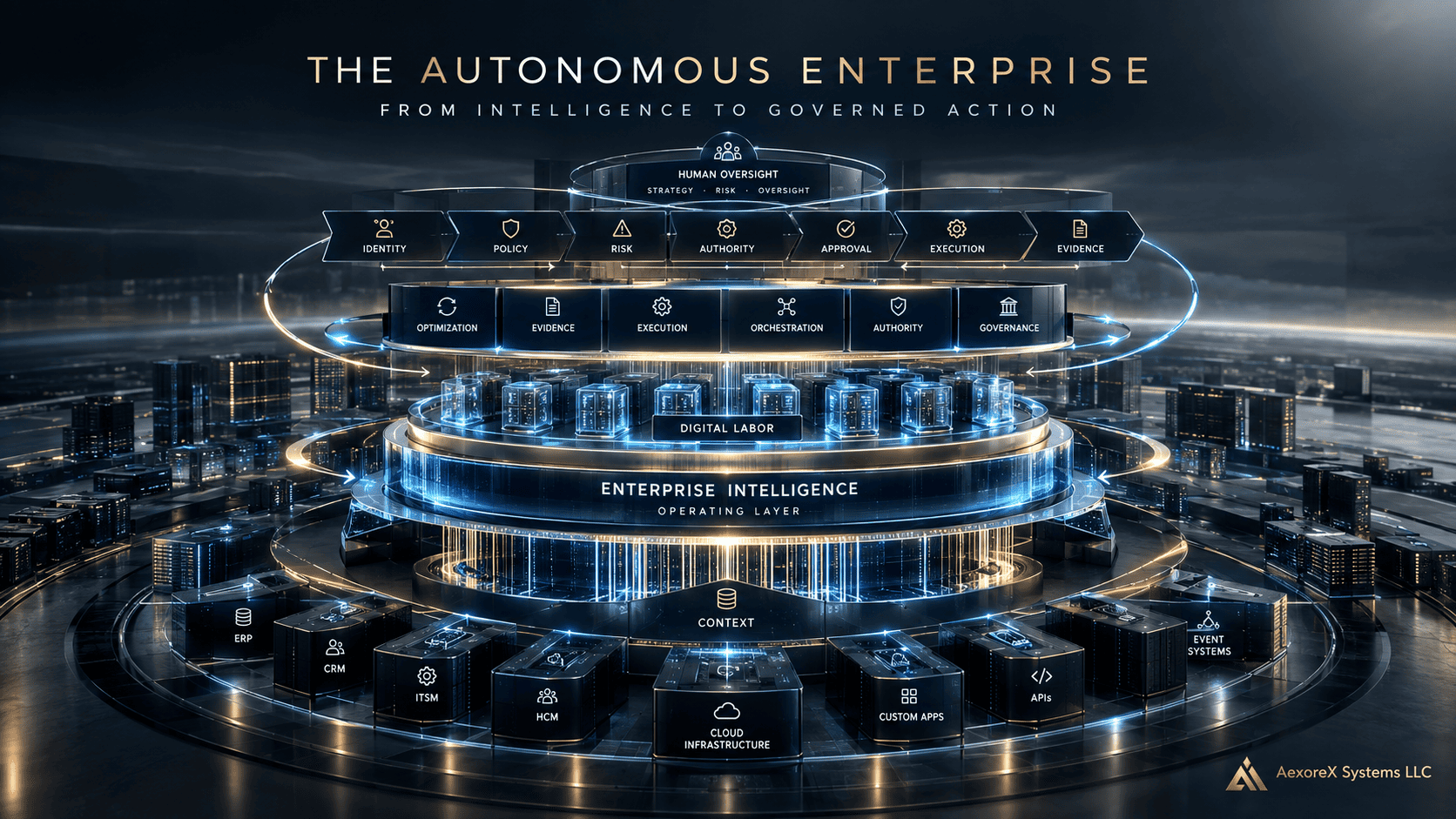
The Autonomous Enterprise: From Intelligence to Governed Action
As enterprise AI transitions from generating information to executing actions, the primary challenge is no longer intelligence alone. Instead, it involves constructing an architecture that seamlessly connects intelligence with authority, governance, execution, evidence, and continuous optimization.
Enterprise AI is now entering a new architectural phase. For years, the central question for enterprises revolved around how artificial intelligence could assist humans in finding information, summarizing knowledge, generating content, analyzing data, and recommending decisions.
The emerging question is fundamentally different: What happens when AI can act?
An AI system capable of invoking an API, updating a record, initiating a workflow, deploying software, or interacting with an enterprise application is no longer just producing information; it is actively participating in the operational environment of the enterprise. This transition necessitates a different architectural approach for AI.
The challenge extends beyond simply making AI more capable. It involves defining what an AI system is permitted to do, under what conditions, with what level of authority, under whose accountability, and with what evidence of its actions. This distinction is becoming increasingly vital as enterprises explore agentic AI.
In February 2026, the U.S. National Institute of Standards and Technology (NIST) announced its focus on identity and authorization for software and AI agents. NIST recognized the necessity of applying established identity standards and best practices to agents that can access diverse data, tools, and applications. This direction is significant: the industry is beginning to acknowledge that an AI agent cannot be treated merely as another software feature when it can independently interact with enterprise systems.
From Intelligence to Action
The first generation of enterprise AI largely operated within a human-directed model. A person would pose a question, the AI would generate an answer, the person would review the result, decide on a course of action, and then execute that action.
Agentic systems introduce an additional possibility: an AI system can interpret a goal, develop a plan, select tools, interact with external systems, evaluate intermediate results, and progress toward an outcome with limited human intervention. NIST describes AI agents as systems capable of autonomous decision-making and action with limited human supervision, while also noting that the scale and range of these actions can introduce new risks.
This creates a fundamental architectural distinction: capability does not equal authority. A system may possess the technical capability to perform an action without being authorized to do so. An AI model might be able to construct a valid API request, but that does not imply the enterprise has authorized the transaction. An agent may be able to access a database, but that does not grant it unrestricted authority over the data. Similarly, an automated system may be capable of approving a transaction, but this does not automatically delegate approval authority to it from the enterprise.
As AI moves closer to operational execution, the distinction between technical capability and enterprise authority becomes foundational.
The Autonomous Enterprise
An autonomous enterprise should not be understood merely as an organization that has deployed a large number of AI agents. Nor is autonomy synonymous with eliminating humans from operational processes. A more useful architectural interpretation defines an autonomous enterprise as one where intelligence, context, policy, authority, orchestration, execution, evidence, and optimization operate as a coordinated system within defined governance boundaries.
The objective is not uncontrolled automation but rather governed autonomy. This distinction is crucial because enterprise operations are subject to real constraints, including:
- Financial authority
- Regulatory obligations
- Security policies
- Contractual commitments
- Organizational responsibilities
- Data protection requirements
- Operational risk
- Business rules
- Approval thresholds
- Accountability structures
Therefore, autonomous systems must operate within these constraints, not outside them.
The Enterprise Intelligence Operating Layer
Existing enterprises already utilize powerful transactional systems. ERP systems manage financial and operational records, CRM systems handle customer relationships, ITSM platforms oversee service operations, HCM platforms manage workforce processes, cloud platforms operate infrastructure, and data platforms manage information.
These systems do not necessarily need to be replaced for enterprises to become more autonomous. Instead, an emerging architectural question is whether enterprises require an operational intelligence layer positioned above these heterogeneous systems. This layer would be capable of connecting context, governance, orchestration, authorization, execution, and evidence across the existing technology environment.
The conceptual architecture can be expressed as follows:
Knowledge → Intelligence → Decision → Authority → Orchestration → Execution → Evidence → Outcome → Optimization
Each stage addresses a specific question:
- **Knowledge**: What information exists?
- **Intelligence**: What does the enterprise understand from that information?
- **Decision**: What action should be considered?
- **Authority**: Is that action permitted?
- **Orchestration**: How should the required work be coordinated?
- **Execution**: Which systems should perform the action?
- **Evidence**: What happened, and under which policy and authorization?
- **Outcome**: What was the operational result?
- **Optimization**: What should change based on the result?
This approach is fundamentally different from treating an AI agent as an isolated automation component.
Governance Must Move Into the Runtime
Traditional governance often operates outside the execution path. Policies are documented, controls are defined, audits are conducted, and reports are generated. However, autonomous systems operate at runtime. An agent may encounter information or circumstances that were not explicitly anticipated during workflow design.
This necessitates governance mechanisms that can operate dynamically during execution. The architecture increasingly needs to consider the following sequence:
Identity → Context → Policy → Authority → Risk → Approval → Execution → Evidence
- **Identity** establishes who or what is acting.
- **Context** determines the relevant enterprise state.
- **Policy** establishes applicable rules.
- **Authority** determines what has been delegated.
- **Risk** determines whether the proposed action remains within acceptable boundaries.
- **Approval** introduces human authorization where required.
- **Execution** commits the authorized action.
- **Evidence** establishes what occurred.
This does not imply that every AI action requires human approval. In fact, excessive human approval can diminish the value of automation and lead to "approval fatigue." NIST's recent analysis emphasizes the importance of balancing human oversight with practical agentic operation.
A more scalable model involves risk-based escalation. Low-risk actions may proceed automatically within defined boundaries, while higher-risk actions may require additional controls. Actions exceeding delegated authority may necessitate human authorization. Consequently, the governance model becomes dynamic rather than simply procedural.
Identity Becomes More Important
An autonomous system needs to be identifiable, especially when agents act on behalf of individuals or organizations. NIST's ongoing work specifically examines identification, authorization, auditing, and non-repudiation for software and AI agents. NIST has also cautioned against simply sharing human credentials with agents, as this can create accountability, privacy, and legal gaps. Its 2026 guidance discusses the importance of unique identifiers, credentials, and entitlements for agents, and points toward established and emerging authorization mechanisms for delegated access.
The architectural principle is straightforward: an agent should not become authoritative simply by inheriting someone's credentials. Instead, enterprises increasingly need mechanisms to establish:
- Which agent is acting.
- On whose behalf.
- For what purpose.
- With what permissions.
- Under which policy.
- For how long.
- Against which systems.
- With what accountability.
This forms the foundation for what can be described as governed Digital Labor.
From AI Agents to Digital Labor
The terminology surrounding AI workers remains unsettled, with terms such as AI agent, AI worker, digital employee, and Digital Labor used differently across vendors and analysts. However, for enterprise architecture, an important distinction can be made: an AI agent primarily describes a technical capability, whereas Digital Labor describes an operational role.
The distinction, therefore, is less about whether the underlying technology is an AI agent and more about whether that software-based entity has:
- A defined role
- An operational scope
- Delegated authority
- Access boundaries
- Governance policies
- Escalation rules
- Accountability
- Measurable outcomes
This conceptual shift matters because enterprises do not ultimately manage "AI" in isolation. They manage work, responsibilities, permissions, outcomes, and risk. As software systems undertake increasingly complex operational work, enterprises may need to govern these systems in ways that more closely resemble operational workforce management, while recognizing that they remain software entities rather than human employees.
The Control Plane for Autonomous Operations
The emerging architecture can thus be viewed as a coordinated control environment. At its core are governance mechanisms for:
- **Identity**: Who or what is acting?
- **Context**: What enterprise information is relevant?
- **Policy**: Which rules apply?
- **Authority**: What has been delegated?
- **Risk**: How consequential is the proposed action?
- **Approval**: Does the action require human authorization?
- **Execution**: Which enterprise system should perform it?
- **Evidence**: What must be recorded?
- **Outcome**: What happened?
- **Optimization**: What should change next?
This architecture does not necessarily require a single physical software product; it represents an architectural pattern. Different enterprises may implement these capabilities using identity platforms, policy engines, integration platforms, AI infrastructure, security systems, observability platforms, workflow engines, and custom components. The strategic question is whether these capabilities can operate coherently rather than as disconnected controls.
Enterprise Architecture Is Becoming More Interoperable
The enterprise environment is inherently heterogeneous, with organizations rarely operating on a single technology stack. A business process may traverse an ERP system, CRM platform, communication system, data warehouse, identity provider, cloud infrastructure, and custom application. Consequently, an autonomous operating model faces an integration challenge.
AI reasoning must ultimately interact with structured enterprise systems. APIs, events, connectors, identity systems, authorization mechanisms, and policy enforcement become critical infrastructure. This is a key reason why the future of enterprise autonomy is unlikely to be determined solely by the quality of an AI model. The model provides intelligence, but the surrounding architecture dictates whether that intelligence can be safely converted into enterprise action.
Evidence Is Part of the Operation
When a human employee performs an action, an organization can generally associate that action with an identity, role, responsibility, and organizational process. Autonomous software complicates this chain. A useful enterprise evidence model therefore needs to establish more than just whether an API call succeeded. Where appropriate, it should be possible to establish:
- The identity of the acting software entity
- Relevant context
- Applicable policy
- Delegated authority
- Authorization decision
- Tool or API invocation
- Resulting state change
- Timestamp
- Responsible human or organizational owner
- Resulting outcome
The purpose is not merely to create larger log files, but to ensure operational accountability. Evidence becomes an integral part of the architecture through which autonomous systems can be trusted at enterprise scale.
The Human Role Is Changing
Governed autonomy does not necessarily imply the elimination of human participation. Instead, the role of humans can ascend in the operational hierarchy. Rather than manually executing every routine action, people can increasingly focus on defining:
- Policies
- Authority boundaries
- Risk thresholds
- Approval requirements
- Operating objectives
- Exception handling
- Accountability structures
The system then operates within these defined boundaries. Humans remain responsible for decisions requiring organizational judgment, policy interpretation, accountability, or authority beyond the delegated scope. The result is not "Human → replaced by AI" but rather:
Human governance → Digital Labor → Enterprise systems → Measured outcomes
The exact division of responsibility will vary by process, risk, regulation, and organizational design.
From Automation to Governed Autonomy
Traditional automation generally follows a predefined sequence: if condition A occurs, perform action B. Agentic systems introduce greater flexibility, allowing the system to determine the appropriate sequence of actions based on context. This flexibility presents both opportunity and risk.
Therefore, the enterprise needs a clear boundary between adaptive reasoning and authorized execution. This yields an important architectural principle: "Autonomy should expand within governance boundaries—not outside them."
The goal is not to eliminate deterministic controls but to combine deterministic governance with probabilistic intelligence. Policy can remain deterministic, identity can remain verifiable, authorization can remain bounded, and execution can remain observable. Within these boundaries, AI can provide adaptive reasoning and orchestration.
The Closed Operational Loop
A mature autonomous enterprise cannot stop at execution. Execution must generate evidence, evidence must produce outcome information, and outcome information must continuously improve future operations. This creates a closed loop:
Sense → Understand → Decide → Authorize → Act → Observe → Learn → Optimize
Optimization may involve:
- Improving context retrieval
- Refining workflow routing
- Adjusting authorization thresholds
- Improving tool selection
- Identifying recurring exceptions
- Updating policies
- Improving human escalation
- Measuring operational outcomes
This is where autonomous enterprise architecture moves beyond mere automation. The system is not simply executing workflows; it is continuously evaluating how those workflows perform.
What Enterprises Need to Build Next
The autonomous enterprise is still an emerging architecture. There is no single universally accepted blueprint; industry standards, identity models, agent protocols, security controls, and governance practices continue to evolve. NIST's launch of its AI Agent Standards Initiative in 2026 reflects this broader transition toward interoperability, security, identity, and trusted adoption of agentic systems. Research from IBM has similarly explored runtime policy enforcement for enterprise agents, including policy intervention at planning, tool-use, approval, and output stages.
The direction is becoming clearer, even if the final architecture remains unsettled. Enterprises moving toward autonomous operations will need to consider at least five foundational capabilities:
1. **Identity**: Every operational software entity needs an appropriate identity and entitlement model. 2. **Context**: Agents need access to relevant enterprise state without receiving unnecessary access. 3. **Governance**: Policies need to be enforceable at runtime. 4. **Authority**: Capability must remain separate from delegated enterprise authority. 5. **Evidence**: Autonomous actions need traceability sufficient for operational accountability and assurance.
Around these core capabilities sit orchestration, execution, observability, security, and continuous optimization.
Building Toward the Autonomous Enterprise
The autonomous enterprise will not emerge simply through the deployment of more AI agents. It will emerge when intelligence becomes intrinsically linked to the operational architecture of the enterprise. This means connecting:
- Knowledge with context.
- Intelligence with decision.
- Decision with authority.
- Authority with orchestration.
- Orchestration with execution.
- Execution with evidence.
- Evidence with outcomes.
- Outcomes with optimization.
This represents the deeper transition underway. The enterprise is shifting from AI as an information interface to AI as an operational participant. This transition embeds governance directly into the operating architecture itself.
The question is no longer simply, "What can AI do?" The more consequential enterprise question becomes, "What should AI be authorized to do, under what conditions, and how can the enterprise prove what happened?" That is the foundation of governed autonomy.
AexoreX Systems: Building Toward Governed Enterprise Autonomy
This emerging architectural direction also informs the development of AEOS QUANTUM™ at AexoreX Systems. AEOS QUANTUM is being developed as an Enterprise Intelligence Operating Platform for Autonomous Enterprises, featuring an architectural sequence centered on: Connect → Contextualize → Govern → Orchestrate → Authorize → Execute → Optimize.
The platform is intended to explore how enterprise intelligence can operate across heterogeneous enterprise systems while maintaining governance, delegated authority, controlled execution, and operational evidence. AEOS QUANTUM is in development and is not positioned as a replacement for the enterprise systems organizations already use. Instead, its architectural direction is based on connecting, contextualizing, governing, orchestrating, authorizing, executing, and optimizing across an existing enterprise technology environment.
This reflects a broader principle: the future enterprise stack may not be defined by replacing every system, but rather by how intelligently and safely those systems can operate together.
Conclusion
The Autonomous Enterprise is not merely the next stage of automation; it represents a potential shift in how enterprise technology is structured.
- AI provides increasingly capable intelligence.
- Enterprise systems provide transactional authority and operational state.
- Integration connects systems.
- Identity establishes who or what is acting.
- Governance defines boundaries.
- Authorization determines what may happen.
- Orchestration coordinates work.
- Execution changes enterprise state.
- Evidence establishes accountability.
- Optimization closes the operational loop.
Together, these capabilities form a foundation for governed enterprise autonomy. The architecture is still evolving, standards are still developing, terminology is still being defined, and implementation patterns will continue to change. However, one principle is becoming increasingly difficult to ignore: capability does not equal authority.
As AI moves closer to execution, enterprises that can connect intelligence with context, governance, authority, evidence, and outcomes will be addressing a fundamentally different problem than simply deploying another AI tool. The next phase of enterprise AI may therefore be less about creating systems that can act, and more about creating systems that can act with authority, within boundaries, and with evidence. That is the architectural challenge of the Autonomous Enterprise.
Sources and attribution
- AexoreX Systems — Original AI-generated editorial visual, 2026. · statement link
About the author
Intelligence desk of AexoreX Newsroom.
More from AexoreX Intelligence Desk →Related stories
- From Enterprise Intelligence to Governed Action
- AexoreX Systems Introduces AEOS Enterprise Authority™ as Governance Layer for Autonomous Enterprise Intelligence
- AexoreX Systems Advances AEOS QUANTUM™ as Enterprise Intelligence Operating Platform for Autonomous Enterprises
- From Enterprise Intelligence to Governed Autonomous Execution: The Next Step Toward the Autonomous Enterprises
- The Infrastructure Behind the Autonomous Enterprise: Building the Foundation for Enterprise Intelligence
- #025 — The Enterprise AI Inflection Point: From AI Agents to Governed Autonomous Operations