
The Non-Human Authorization Crisis: Re-Architecting Identity, Governance, and Execution for Autonomous Enterprise Systems
Why Autonomous Enterprises Need a New Authority Layer Between Artificial Intelligence and Enterprise Action
The rise of autonomous enterprise AI agents necessitates a new authority layer to govern execution, moving beyond mere capability to ensure secure, policy-controlled action.
Opinion · AI-assisted, human edited
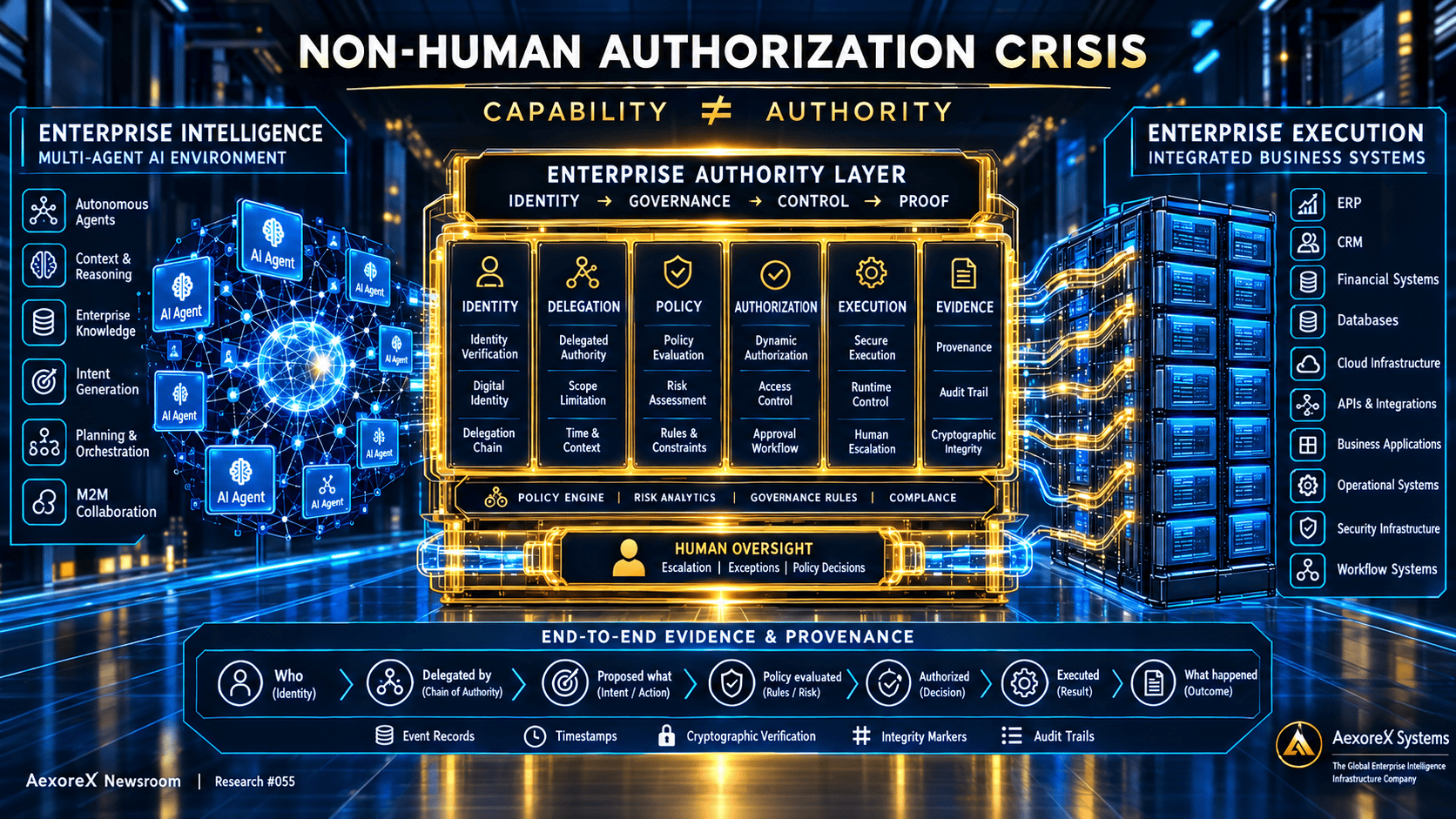
The Non-Human Authorization Crisis: Re-Architecting Identity, Governance, and Execution for Autonomous Enterprise Systems AexoreX Systems Research — #055
Executive Thesis
The conversation surrounding enterprise AI is rapidly shifting from intelligence generation to autonomous execution. Enterprises are no longer solely evaluating AI systems based on their ability to generate, summarize, recommend, or predict. Instead, there's a growing interest in whether software agents can make decisions, invoke tools, access enterprise systems, coordinate workflows, and execute actions with limited human intervention.
This transition introduces a fundamental infrastructure question: If an AI system can act, what grants it the authority to do so?
Traditional enterprise security architectures were primarily designed around human identities, applications, services, devices, and relatively stable permissions. Autonomous AI, however, introduces a different operational reality where software entities can reason, delegate, invoke other agents, select tools, cross application boundaries, and act repeatedly at machine speed.
The core issue, therefore, is not merely identity, but authority. An agent may possess the technical capability to perform an action without having the necessary authority to perform it in a specific context. This distinction can be summarized by a foundational principle: Capability ≠ Authority.
The next generation of enterprise infrastructure must evolve beyond simply identifying who or what is connecting to a system. It must establish, evaluate, constrain, authorize, observe, and prove what an autonomous entity is permitted to do at the moment it attempts an action. This is the emerging non-human authorization problem.
1. Enterprise AI Is Moving From Answers to Actions
The trajectory of enterprise AI is changing significantly. Earlier enterprise AI deployments primarily focused on assistance, such as generating content, retrieving information, summarizing documents, supporting employees, and augmenting individual productivity.
The next stage is becoming increasingly operational. AI agents are being designed to interact with business applications, databases, APIs, development environments, security systems, workflow engines, and other software agents.
Gartner projects that 40% of enterprise applications will incorporate task-specific AI agents by the end of 2026, a significant increase from less than 5% in 2025. Gartner also forecasts that by 2028, AI agent ecosystems will increasingly enable specialized agents to collaborate across applications and business functions.
However, Gartner also warns that more than 40% of agentic AI projects could be canceled by the end of 2027 due to escalating costs, unclear business value, or inadequate risk controls. This message is critical: Enterprise autonomy is advancing faster than enterprise readiness.
Consequently, the strategic question is no longer simply, “How capable can AI become?” It is increasingly, “How much authority can an enterprise safely delegate to AI?”
2. The Identity Model Was Built for a Different World
Enterprise identity and access management (IAM) remains foundational. Authentication establishes identity, while authorization establishes permitted access. Privileged access management controls elevated privileges, and service identities allow software to operate without continuous human presence. These mechanisms are still essential.
However, autonomous enterprise systems introduce additional dimensions. An AI agent might: - Receive an objective from a human - Interpret that objective - Formulate a proposed action - Invoke a tool - Access multiple enterprise systems - Delegate work to another agent - Operate under a temporary scope - Encounter changing contextual conditions - Produce additional actions as the workflow evolves
A static permission model can become insufficient when the decision to act depends on identity, context, purpose, delegation, policy, and current state. The challenge is not necessarily that existing IAM technologies are obsolete, but that autonomous execution creates a new authorization surface around them.
NIST's Software and AI Agent Identity and Authorization project explicitly recognizes this emerging problem. Its work focuses on standards-based approaches to identify, manage, and authorize access and actions taken by software and AI agents, including auditing and non-repudiation considerations. In September 2026, NIST reported that its concept-paper process had received over 600 responses, and its first implementation use case would demonstrate AI-agent identity and authorization within the software development lifecycle. This is a significant institutional signal, indicating that the identity problem for AI agents is becoming an infrastructure problem in its own right.
3. Capability Is Not Authority
Consider a procurement agent. Technically, the agent may have the ability to: - Read supplier information - Compare prices - Generate a purchase order - Communicate with vendors - Submit an order
However, technical capability does not automatically mean that the enterprise should authorize every one of those actions. The enterprise may instead determine that: - The agent may compare suppliers. - The agent may prepare a purchase order. - The agent may not approve purchases above a certain threshold. - The agent may only operate within an approved supplier set. - The agent may not modify banking information. - The agent must escalate unusual transactions. - The authority expires after a defined period. - Every consequential action must generate evidence.
Therefore, the agent requires more than just access; it requires bounded authority. This leads to a more precise authorization question: Not “Can the agent do this?” but “Is the agent authorized to do this, here, now, for this purpose, under this delegation, within this risk boundary?” That distinction is foundational to autonomous enterprise architecture.
4. Delegation Becomes a First-Class Security Primitive
Human-to-software delegation is already well-understood in modern security architectures. For example, OAuth 2.0 Token Exchange provides standardized mechanisms for obtaining security tokens involving impersonation and delegation. OAuth 2.0 Rich Authorization Requests offer another important building block by allowing fine-grained authorization data to be carried through the `authorization_details` parameter.
These standards, however, do not by themselves constitute an autonomous enterprise authority architecture; they are building blocks. The emerging problem is how these building blocks operate when delegation becomes dynamic, contextual, multi-step, machine-driven, and potentially recursive.
A future enterprise may contain a chain such as: Human → Agent A → Agent B → Tool → Enterprise System. The authorization system must be capable of answering: - Who initiated the authority? - Who delegated it? - What authority was delegated? - For what purpose? - Under what policy? - For how long? - To which agent? - Can that authority be further delegated? - What restrictions survive downstream? - What happens when the context changes? - What evidence proves the final action?
This is where conventional static access models begin to encounter architectural pressure.
5. The Need for Dynamic Attenuation
A powerful principle for autonomous systems is least authority: an agent should receive only the authority required to accomplish an approved objective. However, autonomous workflows introduce another requirement: authority should be able to shrink as delegation moves downstream.
Suppose a chain like: Human → Procurement Agent → Supplier Agent → Payment Tool. The downstream agent should not automatically inherit the full authority of the original principal. Instead, Authority downstream ≤ Authority upstream.
The delegated scope can be attenuated by: - Action type - Resource - Transaction value - Geographic boundary - Business function - Time - Risk level - Data classification - Environmental context - Approval state - Purpose - Policy
This produces a more sophisticated model where authority should not merely be inherited but explicitly constrained at every delegation boundary. This is the architectural foundation of dynamic authorization.
6. The Enterprise Authority Boundary
Autonomous AI creates a new boundary between two fundamentally different layers: - **Intelligence:** Determines what *could* be done. - **Authority:** Determines what *may* actually be done.
This distinction is critical. An AI model can generate a highly convincing recommendation, and an agent can formulate an apparently reasonable action, but neither fact establishes authorization.
A mature autonomous enterprise therefore requires an explicit transition: Intent → Proposed Action → Authorization Decision → Execution. This creates an important architectural separation: Intelligence proposes. Authority permits. Execution performs. Evidence proves. This separation can reduce the risk of allowing the reasoning capability of an AI system to implicitly become its operational authority.
7. From IAM to an Enterprise Authority Architecture
The emerging architecture can be conceptualized as a control plane between enterprise intelligence and enterprise execution. - **Intelligence Layer:** Models, agents, reasoning systems, planning systems, and enterprise context. - **Intent Layer:** Business objective, user intent, workflow objective, and proposed action. - **Identity Layer:** Human identity, workload identity, agent identity, service identity, and delegated identity. - **Authorization Layer:** Policy evaluation, scope, purpose, risk, delegation, constraints, approval requirements, and expiration. - **Execution Layer:** APIs, applications, databases, infrastructure, financial systems, communication systems, and operational tools. - **Evidence Layer:** Decision records, authorization context, delegation chain, execution events, outcomes, and integrity mechanisms.
The resulting architecture is not necessarily a replacement for IAM; rather, it is an orchestration and control layer that connects identity, policy, authorization, execution, and evidence around autonomous activity. This distinction matters because the enterprise does not need another isolated security silo. It needs a coherent way to govern autonomous action across the systems it already operates.
8. Cryptographic Provenance Is About Proof — Not Private Reasoning
One of the most important technical distinctions is between execution provenance and an AI model's private reasoning process. An enterprise does not necessarily need to retain or expose an AI model's private chain-of-thought. What it does need is sufficient evidence to establish what happened.
A mature execution-provenance record could include, where appropriate: - Agent or workload identity - Model or software version - Relevant input/context references - Requested objective - Proposed action - Selected tool - Authorization decision - Policy evaluated - Delegation chain - Authorization scope - Timestamp - Execution result - Relevant evidence references - Integrity or cryptographic verification metadata
The central audit question becomes: Who → delegated by whom → proposed what → which policy was evaluated → what was authorized → what was executed → what happened? Cryptographic mechanisms can strengthen the integrity and verifiability of such records, but cryptography is a means, not the definition of governance. The objective is verifiable execution provenance.
9. Regulation Is Increasingly Moving Toward Traceability and Human Oversight
Regulation is also evolving around AI accountability. The EU AI Act establishes requirements for high-risk AI systems covering areas including risk management, data governance, logging, human oversight, accuracy, robustness, and cybersecurity.
Importantly, the regulation should not be misrepresented as mandating one particular technical architecture. For example, Article 12 establishes requirements concerning automatic recording of events and traceability for high-risk AI systems. It does not simply mandate that every organization implement one specific cryptographic immutable-ledger technology. Likewise, Article 14 establishes human-oversight requirements for high-risk AI systems, including mechanisms that can allow appropriate intervention, override, or interruption depending on the circumstances.
Therefore, "Regulation → obligation → control objective → engineering implementation" is a more accurate way to reason about compliance than "Regulation → one mandatory technology." This distinction is essential for enterprise architecture.
10. The Regulatory Timeline Has Also Changed
The regulatory environment itself is dynamic. The EU AI Act was originally structured around multiple implementation dates. However, Regulation (EU) 2026/1744 amended the implementation framework. Under the amended schedule, the application of Chapter III, Sections 1–3 for high-risk AI under Article 6(2) and Annex III is deferred to December 2, 2027, while the corresponding requirements for high-risk AI under Article 6(1) and Annex I are deferred to August 2, 2028.
This illustrates a broader lesson: Enterprise AI governance cannot be designed as a one-time compliance project. Regulation, standards, technical guidance, threat models, and AI capabilities will continue to evolve. Governance infrastructure therefore needs to be adaptable.
11. Governance Cannot Be Binary
A simplistic governance model asks: Trusted or untrusted? Autonomous enterprise systems require a more nuanced model. An agent might be authorized to: - **D1 — Recommend:** The agent proposes an action, and a human decides. - **D2 — Decide:** The agent may make a defined decision within a bounded policy, though execution may still require another control boundary. - **D3 — Decide & Execute:** The agent may make and execute defined actions autonomously within explicitly authorized limits. - **D4 — Control & Escalation:** The system may coordinate or control a larger operational process, but escalation boundaries, exceptional conditions, and human accountability remain explicit.
The important concept is not the label; it is the principle: Autonomy must be proportional to authority, reliability, risk, and context. Gartner's 2026 research reinforces this direction, warning that applying uniform governance across AI agents can create failure and predicting that 40% of enterprises could demote or decommission autonomous agents by 2027 due to governance gaps. Governance therefore cannot simply mean “allow” or “deny”; it must be adaptive.
12. The Enterprise Authority Vacuum
This leads to a broader structural problem. Enterprises have spent decades developing systems for: - Identity - Authentication - Authorization - Security - Workflow - Observability - Compliance - Data governance - Application integration
Yet autonomous agents increasingly operate across all of them. The resulting question is: Where is the enterprise-wide authority boundary for autonomous software? If the answer is scattered across individual applications, API keys, service accounts, workflow engines, model providers, and manually configured permissions, autonomous execution can become fragmented.
Each system may know something about authorization, but no single layer necessarily understands the complete chain: Intent → Identity → Delegation → Policy → Authority → Execution → Evidence. That is the emerging Enterprise Authority Vacuum.
13. Why This Matters Economically
This is not only a cybersecurity problem; it is also an economic architecture problem. If autonomous agents become capable of executing business processes across multiple enterprise systems, the value of software increasingly moves from human interaction with applications toward machine execution of outcomes.
Gartner estimates that up to $234 billion of enterprise application software spending could be exposed to agentic arbitrage between now and 2030, representing roughly 20% of enterprise SaaS spending by 2030. This creates a strategic shift. Competitive advantage may no longer belong solely to the application that owns the interface; it may increasingly belong to the infrastructure that can safely coordinate intelligence, authority, execution, and evidence across applications.
14. The Emerging Enterprise Intelligence Infrastructure
This creates the opportunity for a new infrastructure category: Enterprise Intelligence Execution & Authorization Infrastructure. Its purpose would not be to replace IAM, ERP, CRM, HRIS, financial platforms, cloud infrastructure, security platforms, workflow systems, or AI models. Instead, it would connect and govern autonomous activity across them.
The architectural responsibility would be to answer: - What is being attempted? - Who or what is attempting it? - Who delegated the authority? - What authority exists? - What policy applies? - What constraints apply? - Is additional approval required? - What can actually execute? - What evidence must be generated? - What happens when conditions change?
This is the infrastructure challenge behind autonomous enterprise operations.
15. AexoreX Systems' Architectural Thesis
AexoreX Systems is developing an architectural direction around this emerging problem through AEOS QUANTUM™ — the Enterprise Intelligence Operating Platform for Autonomous Enterprises. The thesis is intentionally different from building another AI assistant. AEOS QUANTUM is designed around the principle that enterprise autonomy requires a controlled transition from intelligence to action.
The conceptual operating sequence is: Connect → Contextualize → Govern → Orchestrate → Authorize → Execute → Optimize, with Evidence operating across the lifecycle rather than as a final afterthought. This architecture reflects a simple principle: AI capability should never be treated as intrinsic enterprise authority.
AEOS QUANTUM's intended role is therefore not to replace the enterprise stack; it is to connect, orchestrate, govern, and activate it. The long-term architectural objective is to create a vendor-independent control plane through which enterprise intelligence can interact with enterprise systems while authority remains explicit, bounded, policy-controlled, and observable.
16. Vendor Independence Becomes Strategic
An enterprise authority layer should not depend on one model provider. The intelligence ecosystem will continue to change. Models will improve, providers will compete, open-source models will evolve, enterprise applications will introduce native agents, and specialized agents will emerge.
Therefore, the authority architecture should remain independent from the intelligence provider. The enterprise should be able to change the underlying model without automatically changing the enterprise's fundamental authority model. This is the logic behind Vendor Independence by Design™. The authority boundary should belong to the enterprise, not to the model, not to the application vendor, not to an individual agent, and not to a single AI provider.
17. The Autonomous Enterprise Needs an Authority Plane
The future enterprise architecture can therefore be viewed as several interacting planes: - **Intelligence Plane:** Models, agents, reasoning, planning, and contextual intelligence. - **Integration Plane:** APIs, connectors, events, workflows, and enterprise systems. - **Authority Plane:** Identity, delegation, policy, authorization, constraints, escalation, and decision boundaries. - **Execution Plane:** The actual systems and tools that perform business actions. - **Evidence Plane:** Provenance, auditability, traceability, integrity, and operational records.
The Authority Plane becomes the critical bridge. Without it, intelligence can become disconnected from governance. With it, intelligence can become operational while remaining bounded.
18. What the Enterprise Must Be Able to Prove
The mature autonomous enterprise will eventually need to answer questions that traditional application architectures rarely had to answer at machine scale: - Why did this agent act? - Who authorized the action? - What authority was delegated? - Was that authority attenuated? - Which policy permitted it? - Which constraints were active? - What information influenced the action? - Which tool was invoked? - What system was changed? - What happened afterward? - Could the organization reconstruct the event independently?
This is why evidence must not be treated as a reporting feature added after execution. Evidence should be part of the execution architecture itself.
19. The New Security Boundary Is the Action
Traditional security thinking often focuses on protecting identities, networks, applications, data, and endpoints. Autonomous enterprise systems add another critical object: The Action.
An action is the point at which intelligence becomes operational reality. Reading a document is one level of risk, generating a recommendation is another, changing a customer record is another, executing a financial transaction is another, and deploying production infrastructure is yet another. The authorization architecture must therefore understand not only who is acting but also what action is being attempted and under what circumstances.
This creates a more precise security equation: Identity + Intent + Context + Delegation + Policy + Action + Evidence. That is the foundation of executable enterprise intelligence.
20. From Artificial Intelligence to Accountable Intelligence
The industry has spent enormous effort increasing model capability. The next phase requires equal attention to accountability. The most capable model is not necessarily the most valuable enterprise system. The valuable system is the one that can operate within clearly defined boundaries while producing measurable outcomes and sufficient evidence.
This means enterprise AI maturity should increasingly be evaluated across multiple dimensions: - **Capability:** Can the system perform the task? - **Reliability:** Can it perform the task consistently? - **Authority:** Is it permitted to perform the task? - **Governance:** Are the rules explicit and enforceable? - **Execution:** Can the action be safely carried out? - **Evidence:** Can the organization prove what happened? - **Optimization:** Can the system continuously improve without silently expanding its authority?
This produces a different definition of enterprise AI maturity.
21. The Strategic Inflection Point
The enterprise AI market is entering an important inflection point. The first wave asked: What can AI generate? The second asks: What can AI do? The third will increasingly ask: What should AI be allowed to do? And the fourth: Can the enterprise prove that AI did only what it was authorized to do?
That final question may become one of the defining infrastructure requirements of autonomous enterprises. Because once software can act at scale, authority becomes an infrastructure primitive.
22. AexoreX Research Position
AexoreX Systems' position is therefore not that traditional IAM, security, workflow, or enterprise software will disappear. The opposite is more likely: those systems become foundational components within a broader autonomous operating environment. The emerging opportunity is the layer that coordinates them around autonomous execution.
AEOS QUANTUM™ is being developed around that architectural direction. Its purpose is not to give AI unlimited autonomy, but to make autonomy governable. Not: “Let the agent do everything,” but: “Give the agent exactly the authority required, within clearly defined boundaries, with explicit governance and evidence.” This is the difference between automation and enterprise-grade autonomous execution.
23. The Principle for the Autonomous Enterprise
The future enterprise should not ask AI to become inherently trustworthy. It should build systems in which trust is continuously constrained, evaluated, and evidenced.
The enterprise should not assume: Capability → Authority. It should enforce: Capability → Intent → Authorization → Execution → Evidence. And when delegation occurs: Authority → Constrained Delegation → Re-Authorization → Execution → Evidence. That architecture creates a fundamentally different relationship between intelligence and enterprise control.
Conclusion: The Enterprise Does Not Primarily Have an Intelligence Problem
The autonomous enterprise does not primarily have an intelligence problem; it has an authority problem. AI models are becoming increasingly capable, agents are becoming increasingly operational, and enterprise applications are becoming increasingly agentic. The number of autonomous actors is likely to increase.
However, capability alone cannot determine enterprise authority. The enterprise must establish a control boundary between what an intelligent system can do and what it is actually permitted to do. That boundary must understand identity, delegation, and context. It must enforce policy, constrain authority, control execution, and produce evidence.
The next generation of enterprise infrastructure will therefore not be defined solely by better models. It will be defined by the infrastructure that makes increasingly capable intelligence accountable enough to operate. That is the emerging opportunity: The Enterprise Authority Layer — the infrastructure between enterprise intelligence and enterprise action. And the foundational principle remains: Capability ≠ Authority.
AexoreX Systems Research — #055
The views expressed in this research represent an architectural and strategic perspective under active development. References to emerging technologies, standards, regulations, or market forecasts do not constitute legal, regulatory, security, or compliance advice. AEOS QUANTUM™ capabilities described as future or architectural concepts should not be interpreted as currently available production functionality unless explicitly identified otherwise.
Sources and attribution
- AexoreX Systems Research — Original Research & Strategic Analysis · statement link
About the author
Research desk of AexoreX Newsroom.
More from AexoreX Research Desk →Related stories
- The Non-Human Identity Shift: Why Enterprise Autonomy Demands a Governed Control Plane
- The Non-Human Identity Control Plane: Dynamic Authority and Traceable Delegation for Autonomous Enterprise Operations
- The Identity-to-Execution Seam: Governing Non-Human Identities and Dynamic Delegation in Autonomous Enterprise Operations
- AexoreX Systems Defines the Enterprise Intelligence Control Plane for the Autonomous Enterprise
- AexoreX Systems Introduces AEOS Enterprise Authority™ as Governance Layer for Autonomous Enterprise Intelligence
- Authoritative Control Planes for Autonomous Digital Labor: Identity, Authority & Verifiable Execution