
The Non-Human Identity Shift: Why Enterprise Autonomy Demands a Governed Control Plane
As AI systems move from generating recommendations to taking governed action, enterprises need a new control layer for identity, authority, risk, approval, execution, and evidence.
The rise of agentic AI necessitates a new enterprise control plane to govern non-human identity, authority, and actions, moving beyond model-centric security.
Opinion · AI-assisted, human edited
Executive Summary
Enterprise AI is entering a new operational phase. The defining change is not solely the increased capability of AI models, but the growing ability of AI agents to plan across multiple steps, use tools, interact with enterprise systems, and perform actions on behalf of users or organizations.
In February 2026, NIST launched its AI Agent Standards Initiative, specifically focusing on enabling AI agents capable of autonomous actions to operate securely and interoperably. Similarly, Singapore's Infocomm Media Development Authority (IMDA) has established a governance framework for agentic AI, which emphasizes bounded autonomy, meaningful human accountability, technical controls, and end-user responsibility.
This shift fundamentally alters a core enterprise security question. The inquiry is no longer only, "What can the AI model generate?" Instead, it increasingly becomes, "Which non-human entity is acting, what authority has been delegated to it, what is it allowed to do at this moment, and how can the enterprise prove what happened?"
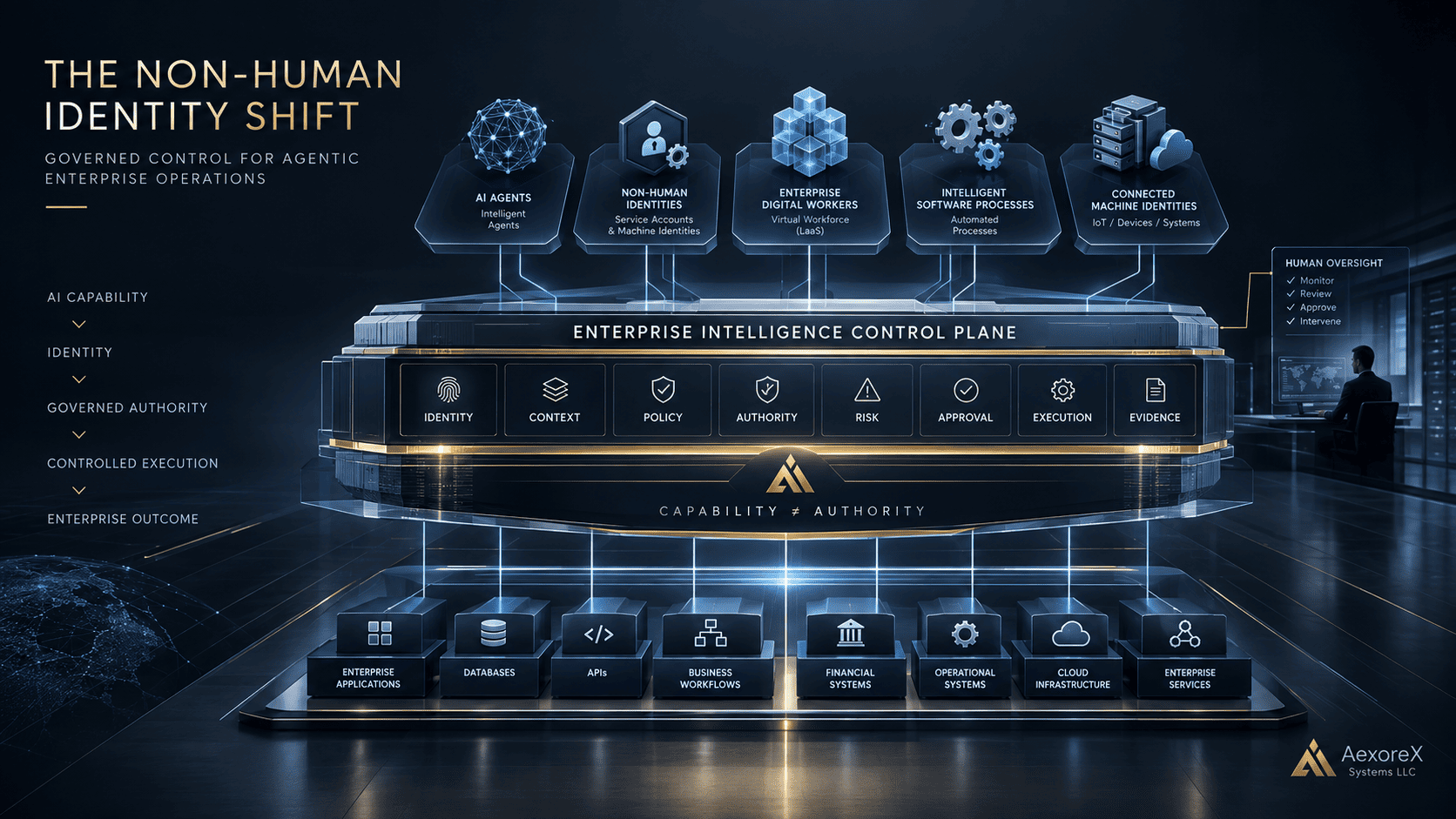
This highlights the growing importance of Non-Human Identity (NHI). However, identity alone is insufficient. The emerging enterprise requirement is broader: an integrated architecture connecting identity, authorization, runtime controls, governance, human oversight, execution, and evidence. AexoreX refers to this architectural concept as the Enterprise Intelligence Control Plane.
From AI Assistance to AI Action
Initially, generative AI transformed enterprise computing primarily through interaction: employees asked questions, generated documents, summarized information, analyzed data, or received recommendations. Agentic AI introduces an additional dimension: action. AI agents can use tools, access enterprise resources, interact with applications, and perform multi-step tasks. NIST's 2026 AI Agent Standards Initiative specifically describes agents as systems capable of autonomous actions and identifies their interaction with external systems and internal data as a significant challenge for real-world deployment.
Industry projections indicate this transition is accelerating. Gartner projects that 40% of enterprise applications will feature task-specific AI agents by the end of 2026, compared with less than 5% in 2025. IDC separately forecasts that by 2030, 45% of organizations will centrally manage the orchestration of AI agents to support collaboration, operational scale, and governance. These are forward-looking projections, not current measurements of adoption.
The architectural significance is that as software begins acting on behalf of people, enterprises must govern not only information generated by software, but also actions initiated by software.
The Emergence of a New Identity Boundary
Traditional enterprise identity systems were primarily designed around human users, applications, services, devices, and workloads. AI agents introduce another operational identity class.
Microsoft Entra Agent ID provides specialized identity constructs for AI agents, allowing agents to authenticate and access enterprise resources through dedicated agent identities. Microsoft documents capabilities including agent identity blueprints, sponsors, authorization, lifecycle governance, access controls, monitoring, and audit logging. Microsoft's documentation also distinguishes agent identities from conventional human identities. Agent identities can operate autonomously or act on behalf of users, with their activity attributable to the agent identity itself.
This is significant because it allows for more precise attribution. Instead of an enterprise seeing only:
Human → Application
the operational chain may increasingly become:
Human → AI Agent → Tool → Application → Enterprise Data
This additional layer requires corresponding governance.
Non-Human Identity Is Becoming an Enterprise Security Concern
The concept of Non-Human Identity extends beyond AI agents. API keys, service accounts, OAuth tokens, workload identities, automation accounts, and machine-to-machine connections have long operated inside enterprise environments. AI agents increasingly use these mechanisms to interact with enterprise systems.
Cisco's acquisition of Astrix Security illustrates the strategic importance placed on this area. Cisco announced its intention to acquire Astrix in May 2026 and subsequently completed the acquisition. Cisco described Astrix's technology as focused on discovering and securing non-human identities and credentials, including API keys, service accounts, OAuth tokens, excessive privileges, and AI-agent access.
The significance is not that one vendor has established a universal industry standard. Rather, it provides evidence of a broader market movement: machine identity is becoming an increasingly important component of enterprise AI security architecture.
Identity Alone Does Not Create Authority
An identity answers: Who or what is acting? Authorization answers: What is that entity allowed to do? Runtime governance adds another question: Should it be allowed to do that action right now, under the current context and risk conditions?
These distinctions become increasingly important as agents operate with tools and permissions. Palo Alto Networks, for example, describes AI-agent security around identity, privilege, access, runtime controls, and Zero Trust principles. Its 2026 materials also describe an AI Control Plane architecture combining governance, identity, and runtime controls. CrowdStrike has similarly introduced an Agentic Identity Provider designed to establish trusted identities for AI agents and continuously control their access based on real-time context.
These developments suggest an important architectural distinction:
Authentication is not authorization. Authorization is not execution governance. Execution governance is not evidence.
Enterprise autonomy requires these four elements to work together.
The Governance Problem: Capability ≠ Authority
An AI system may technically possess the capability to perform an action without being authorized to perform that action. This distinction is central to the AexoreX architecture: Capability ≠ Authority.
A system may be capable of:
- reading customer records;
- modifying enterprise data;
- sending communications;
- creating transactions;
- invoking APIs;
- initiating workflows;
- delegating work to another agent.
That does not automatically mean the system should be authorized to perform those actions. Authority must be explicitly delegated, scoped, governed, and revocable.
This principle becomes particularly important when AI agents operate at machine speed. A mistaken human action may affect one workflow. An incorrectly authorized automated workflow, however, may potentially repeat or propagate the same error across many systems before a human notices. The architectural objective therefore shifts from simply enabling AI capability toward controlling operational authority.
Runtime Governance Becomes Critical
Traditional access management often determines whether an identity can access a resource. Agentic environments increasingly require more contextual decisions, such as:
- Which agent is acting?
- Which human or system authorized it?
- What task is it performing?
- Which tool is it attempting to use?
- What data is involved?
- What level of authority was delegated?
- Is the action reversible?
- Does the action exceed the approved scope?
- Has the risk context changed?
- Is human approval required?
Singapore's IMDA Model AI Governance Framework for Agentic AI addresses this problem through four broad governance dimensions:
1. Assess and bound risks 2. Enable meaningful human accountability 3. Implement technical controls 4. Enable end-user responsibility
The framework specifically recommends placing limits on agents' autonomy and access to tools and data, as well as establishing meaningful human checkpoints. The May 2026 update added real-world case studies and guidance concerning multi-agent systems, third-party agents, and automation bias. This provides strong evidence for an emerging governance principle: "Autonomy should be bounded by risk, authority, and accountability."
The Security Problem Is Not Only the Model
Agentic security cannot be reduced to model safety. OWASP's State of Agentic AI Security and Governance 2.01, published in June 2026, examines the broader security and governance landscape surrounding autonomous AI systems, including frameworks, governance models, and regulatory developments.
One important implication is that security must extend beyond the model itself into the surrounding operational environment. An agent can interact with:
- enterprise applications;
- APIs;
- databases;
- files;
- browsers;
- MCP tools;
- other agents;
- external services.
Consequently, an attack or unintended behavior can become more consequential when an agent possesses broad operational authority. Prompt injection is one example. The problem is not simply that an instruction can influence a model. The greater concern emerges when manipulated instructions can influence an agent that also possesses permission to take consequential actions. This is why prompt-level filtering alone should not be treated as a complete enterprise control strategy.
Shadow Agents and Privilege Drift
Another emerging governance issue is the growth of unmanaged or insufficiently governed agents. Organizations may eventually have agents created through multiple platforms, development teams, SaaS products, automation systems, and third-party services.
Without centralized visibility, organizations can lose track of:
- which agents exist;
- who sponsors them;
- what systems they can access;
- what credentials they use;
- what permissions they possess;
- what actions they perform;
- whether those permissions remain appropriate.
Palo Alto Networks explicitly identifies discovery, inventory, classification, and identity controls for AI agents—including shadow agents—as important elements of an identity-first Zero Trust approach. The resulting risk is not necessarily that an agent is malicious. A legitimate agent can become a governance problem if its authority grows beyond its original business purpose. This creates the possibility of privilege drift.
Multi-Agent Delegation Changes the Control Problem
Agentic systems can also involve delegation. One agent may call another agent. An orchestrator may assign subtasks to specialized agents. A coding agent may invoke development tools. An enterprise workflow may involve several automated systems operating sequentially.
The resulting architecture is no longer simply:
User → AI
It may become:
Human → Agent → Orchestrator → Sub-Agent → Tool → Application → Data
Every additional delegation point introduces another identity and authorization relationship. This makes traceability increasingly important. The enterprise needs to know not only what happened, but also: who—or what—authorized the action chain that produced the outcome?
The Emerging Control Plane
Taken together, these developments point toward a broader architectural requirement. The control layer for agentic enterprise operations increasingly needs to connect: Identity → Context → Policy → Authority → Risk → Approval → Execution → Evidence → Outcome.
This is where AexoreX introduces the concept of the Enterprise Intelligence Control Plane™. The AexoreX concept places a governed control layer between probabilistic AI reasoning and deterministic enterprise execution. Its purpose is not to replace enterprise applications, systems of record, identity providers, security platforms, or existing infrastructure. Instead, the architectural objective is to connect and govern them.
A simplified execution sequence is:
Request ↓ Identity Verification ↓ Context Evaluation ↓ Policy Evaluation ↓ Authority Check ↓ Risk Assessment ↓ Human Approval — when required ↓ Controlled Execution ↓ Evidence & Audit Record ↓ Outcome & Optimization
This is AexoreX Architecture, not an established industry standard.
From Static Permissions Toward Context-Aware Authority
Enterprise authorization has historically relied heavily on predefined roles and permissions. Agentic systems create pressure for more contextual authorization. An agent may be permitted to perform one action but not another. It may be authorized to act within one business process but not another. It may have access during one operational context but require additional approval under another. This suggests a potential future direction toward increasingly dynamic, risk-aware authorization.
CrowdStrike's Agentic Identity Provider and Microsoft Entra Agent ID illustrate different approaches to the emerging problem of establishing, governing, and controlling AI-agent identities. The broader industry direction remains in development. No single architecture has yet become a universal enterprise standard.
The Regulatory and Standards Environment Is Also Evolving
Governance requirements are developing alongside the technology. NIST launched its AI Agent Standards Initiative in February 2026 to support secure, interoperable AI-agent standards and protocols. Singapore's IMDA has published and subsequently updated a dedicated Model AI Governance Framework for Agentic AI. The Cloud Security Alliance has also published a draft Agentic AI Governance Maturity Model. Its proposed model contains five maturity levels and addresses dimensions including agent identity governance, runtime behavioral controls, tool and capability management, human oversight, incident response, compliance, and workforce capability. Because the document is explicitly marked draft, it should not be presented as a finalized industry standard.
The European Union's AI Act provides significant penalties for certain prohibited AI practices, including fines of up to €35 million or 7% of worldwide annual turnover, subject to the specific violation and applicable legal conditions.
The important point is that regulatory frameworks should not be treated as interchangeable with technical standards. Regulation establishes legal obligations. Standards establish technical or organizational guidance. Enterprise architecture implements controls. These layers should remain conceptually distinct.
A Potential Enterprise Architecture Trajectory, 2026–2028
The following should be understood as an AexoreX analysis of potential architectural direction, not as established fact.
2026 — Identity and Visibility
Enterprises increasingly begin establishing:
- dedicated agent identities;
- agent inventories;
- sponsorship and ownership;
- permission visibility;
- access controls;
- audit trails;
- basic runtime monitoring.
2027 — Context and Continuous Governance
A potential next stage is broader adoption of:
- contextual authorization;
- risk-aware access;
- dynamic privilege controls;
- stronger human checkpoints;
- multi-agent governance;
- runtime policy enforcement.
2028 and Beyond — Federated Enterprise Autonomy
A longer-term possibility is an enterprise environment in which:
- agents operate across multiple platforms;
- identities become portable across trusted environments;
- machine-to-machine delegation becomes more structured;
- authority is dynamically scoped;
- execution evidence becomes a native part of enterprise operations.
These are Future Vision concepts, not claims about a predetermined industry outcome.
The AexoreX Perspective
AexoreX views the emerging agentic enterprise through a simple architectural principle: Capability ≠ Authority. An AI system should not gain operational authority merely because it possesses the technical capability to perform an action.
Authority should be:
- Identity-bound.
- Context-aware.
- Policy-controlled.
- Risk-sensitive.
- Scoped.
- Auditable.
- Revocable.
This perspective forms part of the broader AexoreX Enterprise Intelligence Infrastructure architecture.
Its operating sequence is:
**Connect** Connect enterprise systems, data, applications, tools, and services.
**Contextualize** Establish the business context required for intelligent decisions.
**Govern** Apply policies, controls, risk boundaries, and accountability.
**Orchestrate** Coordinate people, AI agents, workflows, systems, and Digital Labor.
**Authorize** Determine what an entity is actually permitted to do.
**Execute** Perform approved actions across connected enterprise environments.
**Optimize** Use evidence, outcomes, and operational feedback to improve future execution.
This is the architectural foundation through which AexoreX defines Governed Enterprise Autonomy.
Digital Labor and the Autonomous Enterprise
AexoreX uses the term Digital Labor (LaaS) to describe software-based entities capable of performing defined enterprise work within delegated authority. The concept is intentionally broader than simply calling every system an "AI agent."
Digital Labor may involve:
- intelligence;
- reasoning;
- workflow execution;
- system interaction;
- specialized skills;
- delegated authority;
- collaboration;
- escalation;
- evidence generation.
The objective is not unrestricted autonomy. The objective is bounded, governed execution. Under this model, an autonomous enterprise is not defined by removing humans from the control structure. It is defined by creating an operating environment in which human and digital capabilities can work together while authority remains explicit and accountable.
Conclusion
The rise of agentic AI is changing the enterprise security boundary. The central question is moving beyond, "Can AI perform this task?" toward, "Who—or what—is performing the task, under whose authority, with what permissions, under which policies, and with what evidence?"
Non-Human Identity is therefore becoming an important component of the emerging enterprise architecture. But identity alone is not the destination. The larger requirement is an integrated control architecture connecting:
Identity. Context. Policy. Authority. Risk. Approval. Execution. Evidence. Outcome.
Microsoft, Cisco/Astrix, Palo Alto Networks, CrowdStrike, NIST, OWASP, CSA, and Singapore's IMDA represent different parts of a rapidly developing ecosystem around these challenges. Their approaches are not identical, and no single architecture should yet be treated as the universal model.
The architectural direction, however, is becoming increasingly clear: Enterprise AI cannot be governed only at the model layer. As software begins to act on behalf of the enterprise, the enterprise must govern the identity, authority, context, execution, and evidence of those actions. That is the foundation of what AexoreX defines as the Enterprise Intelligence Control Plane™.
And it leads to a fundamental principle for the emerging autonomous enterprise: "Capability does not create authority. Authority must be deliberately delegated, governed, and accountable."
Research Classification
- **Verified** — Documented facts, official frameworks, products, announcements, and published institutional developments.
- **Projection** — Forward-looking forecasts explicitly attributed to organizations such as Gartner and IDC.
- **Interpretation** — AexoreX synthesis of documented developments and their architectural implications.
- **AexoreX Architecture** — Concepts and architectural frameworks developed or positioned by AexoreX Systems, including Enterprise Intelligence Control Plane™, Capability ≠ Authority, Digital Labor (LaaS), and Connect → Optimize.
- **Future Vision** — Potential future directions that remain subject to technological, regulatory, and market development.
Primary Research Sources
- NIST — AI Agent Standards Initiative.
- Singapore IMDA — Model AI Governance Framework for Agentic AI and May 2026 update.
- Cloud Security Alliance — Agentic AI Governance Maturity Model, currently marked Draft.
- OWASP GenAI Security Project — State of Agentic AI Security and Governance 2.01.
- Microsoft — Microsoft Entra Agent ID documentation.
- Cisco — Astrix Security acquisition announcement and acquisition information.
- Palo Alto Networks — AI agent identity and AI Control Plane materials.
- CrowdStrike — Agentic Identity Provider.
- Gartner — Enterprise AI-agent forecasts.
- IDC — AI-agent orchestration forecast.
Sources and attribution
- Primary research and publicly available authoritative sources. · statement link
About the author
AexoreX Technology Desk is the newsroom's editorial desk covering enterprise technology, artificial intelligence, digital labor, automation, and emerging enterprise systems.
More from AexoreX Technology Desk →Related stories
- Governing Autonomous Execution: Enterprise Control Planes and the Shift to Digital Labor
- From Enterprise Software to Enterprise Intelligence Infrastructure: The Architecture Behind AEOS QUANTUM™
- The Non-Human Identity Control Plane: Dynamic Authority and Traceable Delegation for Autonomous Enterprise Operations
- AexoreX Systems Defines the Enterprise Intelligence Control Plane for the Autonomous Enterprise
- Enterprise Intelligence Infrastructure and Governed Autonomy: The Architectural Foundation for the Autonomous Enterprise
- Governing Digital Labor: Bridging Capability and Authority in Autonomous Enterprise Architecture