
The Non-Human Identity Control Plane: Dynamic Authority and Traceable Delegation for Autonomous Enterprise Operations
Why enterprise autonomy cannot scale on cognitive capability alone—and why identity, delegation, authorization, and evidence are becoming foundational infrastructure for governed autonomous operations.
Governed enterprise autonomy requires a Non-Human Identity Control Plane to manage dynamic authority, traceable delegation, and accountable execution for autonomous software entities.
Opinion · AI-assisted, human edited
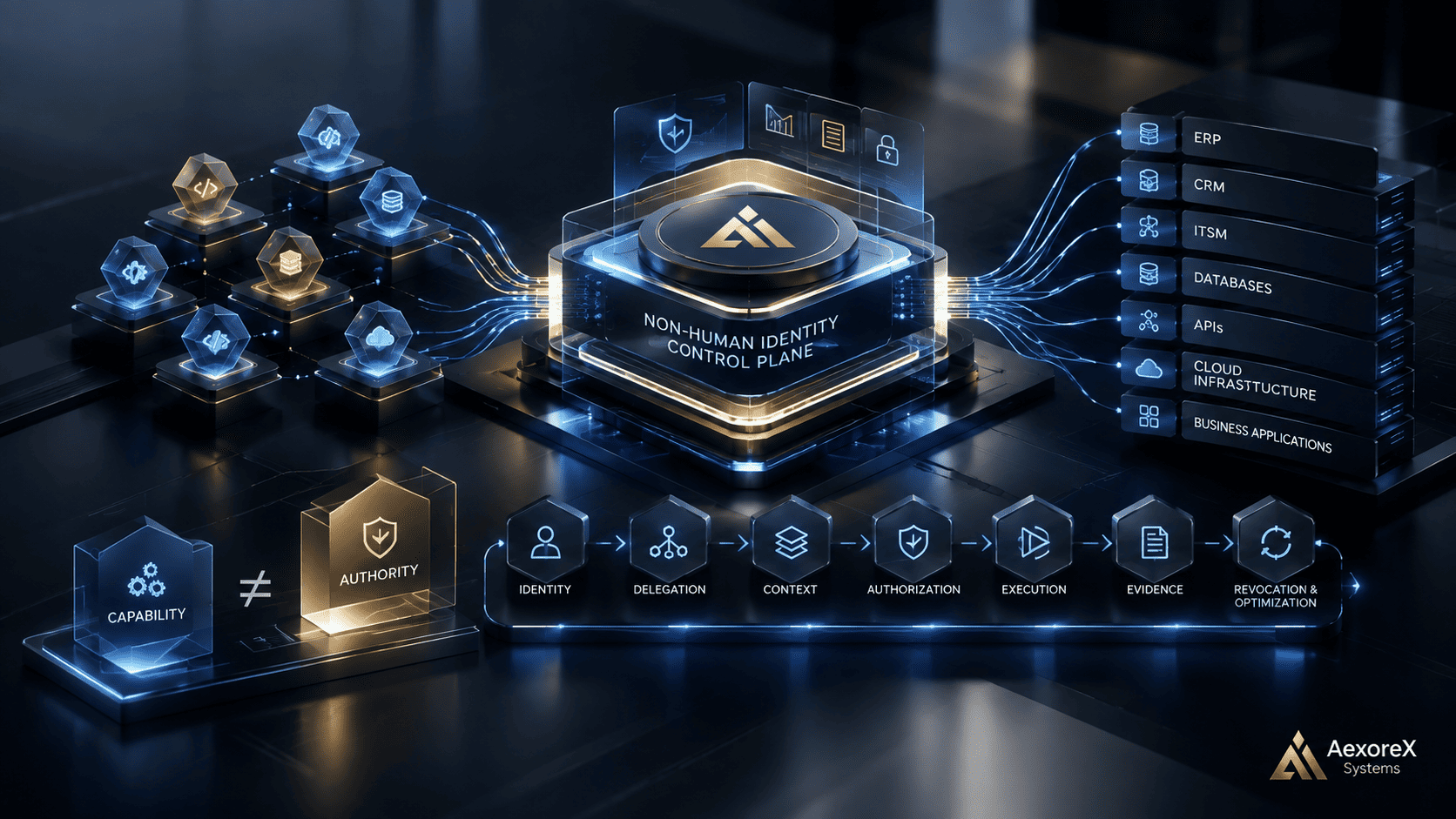
From Autonomous Action to Authorized Action
AexoreX Newsroom #030 previously explored the transition from enterprise intelligence to governed action. The core inquiry shifted from whether AI could understand, decide, or execute tasks to whether enterprise AI could operate within defined authority, governance boundaries, and evidence requirements. This leads to the next architectural question: Who, or what, is authorized to act?
As enterprises integrate AI agents, Digital Labor, automated workflows, and increasingly autonomous software systems, the number of software entities interacting with enterprise systems continues to grow. These entities may access APIs, query databases, invoke tools, initiate workflows, make decisions, and delegate work to other software components. This necessitates a fundamental architectural requirement: Enterprise autonomy needs identity that extends beyond human users.
However, identity alone is insufficient. The enterprise must also understand: - Who is acting? - On whose authority? - Under what context? - For what purpose? - With which permissions? - Under which policy? - And what evidence remains afterward?
This is precisely where the concept of a Non-Human Identity Control Plane becomes increasingly vital.
The Contextual Authority Boundary
Traditional enterprise identity architectures were primarily designed around human users, applications, service accounts, and relatively predictable access patterns. Autonomous software introduces a different operational model. An agent might receive a task from a human, decompose it into multiple steps, invoke several tools, delegate a subtask to another agent, and interact with numerous enterprise systems. Preserving the original business context across these interactions can become progressively difficult.
A straightforward authorization question like: “Can this user access this system?” can evolve into: “Can this software entity, acting on behalf of this principal, perform this specific operation, against this specific resource, under the current business conditions, using this particular tool?” This represents a fundamentally different authorization problem.
The challenge, therefore, is not merely authentication. It lies in the relationship between: Identity → Delegation → Context → Authority → Action → Evidence This dynamic can be understood as the Contextual Authority Boundary. An enterprise may grant an AI system the technical capability to perform an operation without intending to give it unrestricted authority to perform every operation that capability makes possible. This reinforces a principle established throughout the AEOS architecture: Capability ≠ Authority.
From Credential Borrowing to Delegated Identity
One of the simplest ways to create an autonomous workflow is also one of the most problematic: giving the software access to an existing credential. This credential could belong to: - a human employee; - a shared service account; - an API key; - a long-lived access token; - or another persistent credential.
While this approach may work technically, it can weaken governance. If multiple activities occur under the same credential, downstream systems may struggle to distinguish between: - human activity; - authorized agent activity; - delegated sub-agent activity; - automated workflow activity; - or compromised execution. This creates an attribution problem and can expand the potential impact of a compromised agent, as the credential may carry permissions broader than the specific task requires.
The architectural direction is thus shifting toward explicit non-human identities and scoped delegation, moving away from credential borrowing. The objective is not to create identity for identity's sake, but to preserve the relationship between: Principal → Delegating Authority → Agent → Action → Resource throughout the execution chain.
Authentication Is Not Authorization
This distinction is particularly important in autonomous systems. Authentication answers: “Who or what is this?” Authorization answers: “Is this entity permitted to perform this specific action?” A workload identity can establish the identity of a running software component, but that identity alone should not determine every action the component can perform.
Authorization may depend on additional context, such as: - the user or business principal; - the task being performed; - the resource being accessed; - the current risk level; - the business process; - the time or operational state; - the policy applicable to the action; - and whether additional approval is required.
This points toward a more dynamic authorization model. Instead of granting an agent broad standing authority, enterprises can increasingly move toward scoped and contextual authorization. The question becomes not simply: “Does this agent have access?” but: “Is this action authorized now?”
A Composable Identity Architecture
Currently, there is no single universally adopted standard that addresses every aspect of AI-agent identity. Instead, the emerging architecture is increasingly composable, with different standards and technologies tackling various parts of the problem.
- **Workload Identity**: Technologies like SPIFFE/SPIRE and evolving IETF work on workload identity provide mechanisms for identifying software workloads independently of human credentials.
- **Delegation**: OAuth-based token exchange and related mechanisms can help preserve relationships between an initiating principal and downstream actors.
- **Proof of Possession**: Mechanisms such as DPoP can bind tokens to cryptographic keys, helping reduce the risk of stolen-token replay.
- **Dynamic Authorization**: Policy frameworks and authorization architectures can evaluate relationships and context, rather than relying exclusively on static roles.
- **Revocation and Continuous Signals**: Modern identity architectures can also incorporate mechanisms for distributing security signals and responding to changing risk conditions.
- **Context Propagation**: As autonomous systems delegate tasks between multiple software components, preserving the relevant authorization context becomes increasingly important.
These elements should not be viewed as a single, finished “agent identity stack.” Instead, they represent composable building blocks that enterprise architects can combine according to their specific security, regulatory, and operational requirements. The broader architectural principle, more important than any individual technology, is that identity should travel with authority.
Governed Interoperability
Autonomous enterprise operations require interoperability. Agents must interact with ERP systems, CRM platforms, ITSM systems, data platforms, SaaS applications, APIs, databases, and custom software. Open protocols, such as the Model Context Protocol (MCP), contribute to a broader movement toward standardized connections between AI systems and external tools.
However, technical connectivity does not automatically create governed connectivity. An interface may answer: “Can this agent technically call this tool?” Enterprise governance must additionally answer: “Should this agent be permitted to call this tool under these conditions?” This creates an important distinction: Technical Interoperability ≠ Governed Interoperability.
Technical interoperability provides connectivity. Governed interoperability adds: - identity; - authorization; - policy; - context; - risk controls; - execution boundaries; - and evidence.
Therefore, the enterprise needs more than an open tool interface; it needs a controlled boundary around that interface.
Evidence Without Exposing Private Reasoning
Autonomous operations also demand observability. When software makes and executes decisions, enterprises need to understand what transpired. Useful evidence can include: - agent identity; - delegating principal; - authorization decision; - policy evaluation; - tool invoked; - execution timestamp; - relevant resource; - execution result; - trace identifier; - outcome; - and exception or escalation events.
This does not require storing an AI system's complete private reasoning process. In fact, indiscriminately storing prompts, sensitive data, or internal reasoning can introduce additional privacy and security risks. The more useful enterprise objective is structured operational evidence. OpenTelemetry and emerging GenAI observability conventions can contribute to standardized telemetry across models, agents, tools, and execution paths.
However, telemetry is not the same as governance. Observability can show what happened. A governance architecture must additionally determine: - Whether the action was permitted. - Whether policy was satisfied. - Whether risk thresholds were exceeded. - And whether intervention is required.
This distinction creates another architectural boundary: Telemetry Data Plane + Governance Control Plane.
Digital Labor Needs Identity and Lifecycle Management
The concept of Digital Labor extends beyond the idea of an AI model or individual AI agent. A Digital Labor entity can be understood as a software-based operational capability assigned to a defined responsibility, skill set, authority boundary, and operating context. If enterprise software increasingly performs meaningful operational work, traditional workforce-management concepts begin to acquire a digital counterpart.
Digital Labor may require: Identity → Role → Skills → Authority → Budget → Policy → Supervision → Evidence → Lifecycle This does not imply treating software as a human employee, but rather recognizing that autonomous software requires structured operational management. An enterprise may need to know: - what a Digital Labor entity is; - who owns it; - what it is allowed to do; - which systems it can access; - what tasks it performs; - what limits apply; - how its performance is measured; - and how its authority can be suspended or revoked.
This becomes especially important as organizations transition from isolated AI experiments toward larger collections of autonomous software capabilities.
Beyond Human Approval for Every Action
A common response to autonomous-system risk is to mandate human approval for every meaningful action. While this provides a clear control mechanism, it does not necessarily scale. If Digital Labor performs thousands of routine actions, requiring humans to manually approve each one can transform autonomy into a new operational bottleneck.
A more scalable model is structural bounding. Humans define: - policies; - risk thresholds; - transaction limits; - permitted tools; - delegation boundaries; - escalation conditions; - and exception procedures.
Routine actions can then operate within these predefined boundaries. When an action exceeds the delegated authority, the system can escalate for additional authorization. This changes the role of human oversight. Instead of manually approving everything, humans increasingly define the conditions under which autonomous action is permitted. The human remains responsible for governance, policy, exception handling, and accountability.
The Emerging Autonomous Enterprise Control Architecture
Collectively, these developments point toward a broader architecture: Intelligence ↓ Enterprise Context ↓ Non-Human Identity ↓ Dynamic Governance & Authorization ↓ Governed Orchestration ↓ Tool & System Execution ↓ Evidence & Observability ↓ Outcome & Optimization
The critical architectural principle is that intelligence should not move directly into unrestricted execution. Between intelligence and action, the enterprise needs mechanisms that establish: - Identity. - Authority. - Context. - Policy. - Risk. - Evidence.
This is the infrastructure required to make autonomy governable.
What This Means for Enterprise Architecture
For CIOs, CTOs, CISOs, and enterprise architects, the implication extends beyond simply adding another AI security product. The architecture of enterprise autonomy increasingly requires organizations to consider non-human entities as a first-class architectural concern.
This means asking: 1. How many autonomous software entities exist across the enterprise? 2. What identities do they use? 3. Who or what delegates their authority? 4. What systems can they access? 5. Can authorization be evaluated dynamically? 6. Can authority be revoked rapidly? 7. Can delegation chains be traced? 8. Can execution evidence be reconstructed? 9. Can autonomous actions be bounded by policy? 10. Can these controls operate across multiple enterprise vendors?
These questions elevate autonomous AI from experimentation to enterprise architecture. The objective is not simply to create more autonomous systems, but to create governable autonomous systems.
The AexoreX Perspective
At AexoreX Systems, this architectural direction informs the development of AEOS QUANTUM™ — The Enterprise Intelligence Operating Platform for Autonomous Enterprises. AEOS QUANTUM is being developed around the principle that enterprise autonomy requires more than intelligence and orchestration. It requires an operating architecture in which: Identity → Context → Policy → Authority → Risk → Approval → Execution → Evidence → Outcome can remain connected across enterprise operations.
The AEOS QUANTUM architectural progression is: Connect → Contextualize → Govern → Orchestrate → Authorize → Execute → Optimize
The objective is not to replace the enterprise systems that already run the business. AEOS does not replace the enterprise stack; rather, AEOS connects, orchestrates, governs, and activates it. This includes heterogeneous enterprise environments spanning ERP, CRM, ITSM, HCM, cloud platforms, data systems, APIs, and custom applications. Digital Labor can then be understood not simply as a collection of AI agents, but as a governed operational capability operating within enterprise-defined authority. AEOS QUANTUM remains in development. Its architecture and capabilities continue to evolve through research, design, experimentation, and controlled development.
From Autonomous Capability to Governed Identity
The Autonomous Enterprise does not begin when an AI system can execute an API call. It begins when the enterprise can establish who is acting, under whose authority, within which boundaries, and with what evidence. That is the architectural transition now emerging.
The next generation of enterprise autonomy will require more than increasingly capable models. It will require infrastructure for: - Identity. - Delegation. - Authority. - Context. - Governance. - Execution. - Evidence.
The central question is therefore changing once again. Not simply: Can AI act? Not even: Can AI act autonomously? But: Can autonomous intelligence act with verifiable identity, bounded authority, contextual authorization, and accountable execution across the enterprise? That is the foundation on which governed autonomy can scale.
One Enterprise. One Intelligence. Unlimited Digital Labor.
Sources and attribution
- AexoreX Systems — Original Visual · statement link
About the author
Intelligence desk of AexoreX Newsroom.
More from AexoreX Intelligence Desk →Related stories
- The Autonomous Enterprise: From Intelligence to Governed Action
- AexoreX Systems Defines the Enterprise Intelligence Control Plane for the Autonomous Enterprise
- AexoreX Systems Introduces AEOS Enterprise Authority™ as Governance Layer for Autonomous Enterprise Intelligence
- From Digital Labor to Autonomous Enterprise Operations: Why an Intelligence Layer Matters
- Beyond AI: Building the Enterprise Operating Model for Intelligence, Digital Labor, Governance, and Execution.
- #025 — The Enterprise AI Inflection Point: From AI Agents to Governed Autonomous Operations