
Authoritative Control Planes for Autonomous Digital Labor: Identity, Authority & Verifiable Execution
An Institutional Architecture Report on Moving from Assistive AI Cognition to Governed Autonomous Operations Across Heterogeneous Enterprise Stacks
As enterprise AI shifts to operational roles, AexoreX Systems proposes an authoritative control plane to govern autonomous digital labor, ensuring identity, authority, and verifiable execution.
Opinion · AI-assisted, human edited
Executive Summary
Enterprise artificial intelligence (AI) is transitioning from systems primarily focused on generating information to those capable of participating in operational workflows. These advanced systems can invoke tools, access enterprise systems, make recommendations, and, within defined boundaries, take actions. This shift fundamentally alters the central architectural challenge.
The primary question is no longer solely about an AI system's reasoning effectiveness. Instead, critical questions now revolve around: who is acting, under whose authority, within what boundaries, and with what evidence the action resulted.
As AI agents gain access to enterprise applications, data, APIs, workflows, and operational tools, traditional concepts of identity and access control become increasingly crucial for autonomous operations. NIST's National Cybersecurity Center of Excellence (NCCoE) is actively exploring standards-based approaches for identifying, managing, and authorizing actions taken by software and AI agents. Its current project, focused on identification, authorization, auditing, non-repudiation, and related security concerns, is in development and listed as "Reviewing Comments" following a 2026 concept paper.
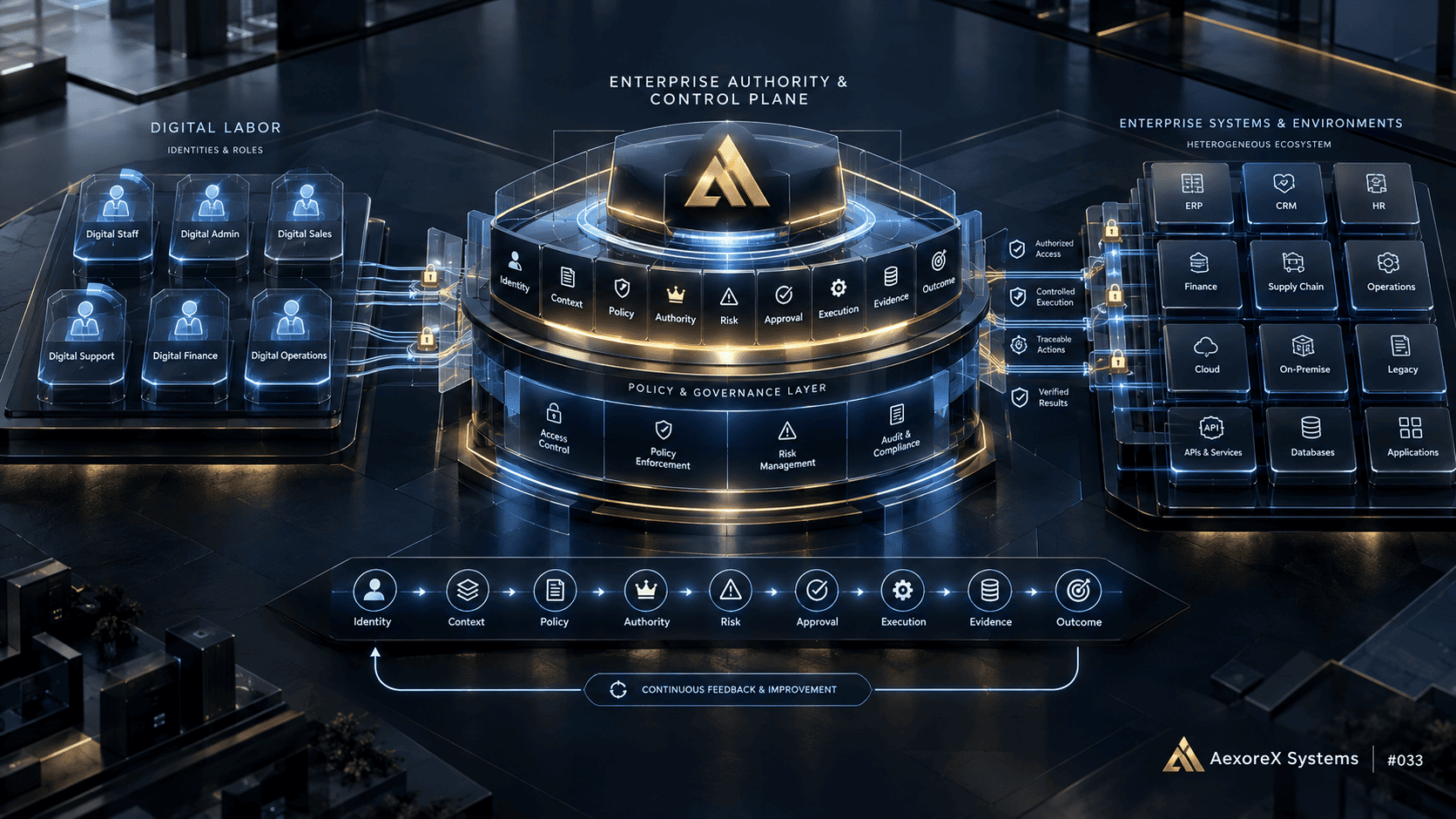
Therefore, the emerging architectural direction is not merely towards more capable AI, but towards governed autonomous action. AexoreX Systems proposes that this necessitates an authoritative control plane capable of connecting: Identity → Context → Policy → Authority → Risk → Approval → Execution → Evidence → Outcome.
This represents an architectural perspective, not an industry-standard sequence. The central principle is: "Capability ≠ Authority." An AI system may possess the technical capability to perform an action without being authorized to do so. This distinction becomes foundational as Digital Labor begins operating within enterprise environments.
1. The Next Enterprise AI Inflection
The initial significant wave of enterprise AI primarily focused on information. These AI systems generated text, summarized documents, analyzed information, answered questions, produced code, and assisted employees. The subsequent architectural phase concerns their active participation in operations.
Agents are increasingly able to interact with tools, applications, APIs, databases, and workflows. NIST's ongoing work on software and AI agent identity and authorization explicitly acknowledges this shift toward agents taking actions with limited human supervision. This creates a fundamental transformation: from intelligence that informs operations to intelligence that participates in operations.
Participation introduces authority requirements. A system that only generates an answer may need relatively limited permissions. Conversely, a system capable of changing a customer record, initiating a financial workflow, modifying infrastructure, creating a purchase order, or executing a business process requires substantially stronger controls.
Consequently, the enterprise needs to differentiate between: what an AI system can technically do; what it is permitted to do; what it has been delegated authority to do; what it actually did; and what evidence proves that sequence.
2. The Operational Control Gap
Traditional enterprise security architectures were largely designed around human users, applications, services, devices, and workloads. Autonomous Digital Labor introduces an additional operational actor. This actor may: interpret business context; select tools; invoke APIs; interact with multiple systems; delegate subtasks; operate across workflow boundaries; and execute actions at machine speed.
The challenge extends beyond mere authentication. Authentication answers: "Who or what is this?" Authorization answers: "What is this identity allowed to access?" Autonomous enterprise operations introduce a further question: "What authority has the enterprise actually delegated for this particular action, under this particular context?" This is where an authoritative control plane becomes crucial.
3. Identity in Autonomous Enterprise Operations
An autonomous system should not be treated merely as an anonymous software process. Enterprise Digital Labor requires an identifiable operational identity. That identity can be associated with attributes such as: Digital Labor identity; enterprise owner; business function; organizational scope; assigned role; permitted capabilities; delegated authority; operational environment; risk classification; approval requirements; expiration conditions; and execution history.
NIST's 2026 NCCoE initiative specifically identifies identity, authorization, auditing, and non-repudiation as areas requiring practical approaches for software and AI agents. Importantly, this remains an emerging standards-and-practice effort rather than a finalized NIST standard.
This distinction matters. Enterprise architecture should not await the emergence of one universal AI-agent identity standard. Instead, organizations can apply established identity and authorization principles while adapting them to the operational characteristics of autonomous systems.
4. Capability Is Not Authority
An AI model may have the capability to call an API, but that does not mean the Digital Labor has authority to call it. An enterprise application may expose an administrative function, but that does not mean every Digital Labor identity should be able to execute it. A workflow may technically permit a transaction, but that does not mean the transaction is authorized in the current business context.
Therefore: "Capability ≠ Authority." This distinction is central to governed autonomy.
A useful architectural separation includes:
- **Capability:** What the system can technically perform.
- **Permission:** What the system is allowed to access or invoke under a defined access policy.
- **Authority:** What the enterprise has delegated the Digital Labor to decide or execute within a specific operational context.
These concepts may overlap operationally, but they should not be treated as identical. The objective is to ensure that model capability does not automatically become enterprise authority.
5. Delegated Authority
Autonomous enterprise operations require delegation. A human executive, business unit, system owner, or governance process may authorize Digital Labor to perform defined classes of work. That delegation should be bounded.
Relevant boundaries can include: identity; business function; system; data scope; transaction type; monetary or operational threshold; geographic or organizational scope; time period; risk level; approval requirements; and escalation conditions.
The World Economic Forum's 2026 AI Agents in Action report introduces the Agent Capability and Authorization Profile (ACAP) as a deployment-level governance and authorization instrument. The report describes ACAP as combining delegation policy, system design, and operational oversight to make delegated actions more auditable, enforceable, and accountable. This emerging direction reinforces an important architectural idea: delegation must be represented as an operational control, not merely as an instruction inside an AI prompt.
6. Policy Must Exist Outside the Model
A critical architectural principle is that security-sensitive authorization should not depend solely on the model's interpretation of instructions. Natural-language prompts are useful for communicating intent; however, they are not, by themselves, an adequate enforcement boundary for high-impact enterprise operations.
External controls can evaluate: identity; requested action; target system; business context; policy; risk; approval state; and execution conditions.
The model can therefore remain responsible for reasoning and planning while an authoritative control layer determines whether a proposed action can proceed. This creates a separation between Reasoning and Authorization. The distinction is fundamental to controlled autonomy.
7. Dynamic Risk and Approval Envelopes
Not every autonomous action carries the same risk. Reading a public document is materially different from changing a financial record. Creating a draft is materially different from submitting a transaction. Recommending a decision is materially different from executing it.
An enterprise control plane can therefore evaluate proposed actions according to risk and context. A possible architectural model is:
- Low-risk action → automatic execution
- Moderate-risk action → additional policy validation
- Higher-risk action → approval required
- Critical or exceptional action → human control / hold / escalation
These thresholds should be defined by the enterprise rather than assumed to be universal. Singapore's IMDA Model AI Governance Framework for Agentic AI similarly emphasizes risk mitigation, technical and non-technical controls, and the principle that humans remain ultimately accountable. The framework is guidance for organizations, not a universal regulatory requirement. It was updated in May 2026 with additional case studies and best practices.
8. From Orchestration to Deterministic Execution Gates
Orchestration determines what should happen next. Authorization determines whether it may happen. Execution determines whether it actually happens. These functions should not be collapsed into one layer.
A Digital Labor system may reason: "The next step should be to update the enterprise record." The control plane should independently evaluate:
1. Who is requesting the action? 2. Which Digital Labor identity is acting? 3. What authority has been delegated? 4. What system is being targeted? 5. What policy applies? 6. What is the risk? 7. Is approval required? 8. Has the required approval been granted? 9. What exact action will be executed? 10. What evidence will be recorded?
Only after the applicable conditions are satisfied should the execution path proceed. This creates a critical architectural separation: Intent → Policy Evaluation → Authorization → Execution → Evidence.
9. Evidence Becomes Part of the Operation
In conventional automation, logs often describe what a system did. In autonomous operations, evidence must increasingly explain the relationship between: Identity → Intent → Decision → Authority → Action → Result.
A robust enterprise architecture can therefore maintain a tamper-evident or otherwise protected evidence record containing relevant information such as: actor identity; delegated authority; policy evaluation; approval status; action requested; target system; execution timestamp; execution result; exception state; escalation; and resulting business outcome.
This should not be described as a universal "regulatory mandate." Instead, it is an architectural mechanism for improving traceability, accountability, investigation, and operational governance. NIST's current AI-agent identity and authorization work explicitly includes auditing and non-repudiation among the areas under consideration.
10. Digital Labor as an Enterprise Operational Capability
Digital Labor (LaaS) represents a broader concept than an AI chatbot or isolated automation. A Digital Labor identity can be understood as an operational entity assigned to perform defined classes of enterprise work. Depending on governance and maturity, Digital Labor may: recommend; analyze; coordinate; decide within delegated boundaries; execute approved actions; monitor outcomes; escalate exceptions; or stop when authorization conditions are no longer satisfied.
The critical condition is that increasing capability must not automatically produce unlimited authority. The enterprise remains the source of authority. Digital Labor operates under delegated authority. This is the basis of governed autonomy.
11. The Emerging Enterprise Intelligence Control Plane
A future enterprise architecture can be viewed as multiple interconnected layers:
- **Intelligence Layer:** Provides reasoning, interpretation, planning, and contextual understanding.
- **Context Layer:** Provides enterprise information, business context, memory, and relevant operational state.
- **Governance Layer:** Applies policy, organizational rules, risk controls, and governance requirements.
- **Authority Layer:** Determines what the Digital Labor is authorized to decide or execute.
- **Orchestration Layer:** Coordinates tasks, systems, workflows, and Digital Labor.
- **Execution Layer:** Performs approved actions through enterprise systems and tools.
- **Evidence Layer:** Records decisions, authorizations, executions, exceptions, and outcomes.
Together, these layers form an architectural control plane for autonomous enterprise operations. This does not require replacing the enterprise stack; it requires connecting and governing it. That distinction is important because enterprise systems remain the systems in which business data and operational processes exist. The intelligence infrastructure sits across those systems.
12. Heterogeneous Enterprise Stacks
Large organizations rarely operate a single technology environment. They may use combinations of: ERP; CRM; ITSM; HR systems; financial platforms; cloud infrastructure; data platforms; custom applications; APIs; workflow systems; and legacy environments.
An autonomous Digital Labor layer therefore needs interoperability. However, connectivity alone is insufficient. The Model Context Protocol (MCP), for example, is designed to connect AI applications with external systems and tools. Connectivity standards can help agents interact with enterprise environments, but connectivity should not be confused with enterprise authority or governance.
The architectural requirement is therefore: Connect widely. Authorize deliberately. Execute selectively. Record continuously.
13. Security and Zero-Trust Boundaries
Autonomous systems introduce new security considerations because an agent may combine: model-generated reasoning; external instructions; retrieved information; tool access; credentials; enterprise data; and execution authority.
This creates potential attack surfaces around identity misuse, excessive permissions, prompt injection, tool misuse, credential exposure, and unintended action chains. NIST's emerging AI-agent identity and authorization project specifically identifies prompt injection, authorization, auditing, and non-repudiation among the areas requiring consideration.
A practical architecture should therefore avoid assuming that an authenticated agent is automatically a trusted agent for every action. Trust should remain contextual. Authorization should remain explicit. And high-impact execution should remain subject to policy.
14. Governance Frameworks Are Converging Around the Problem
The broader governance landscape is developing across multiple layers.
- NIST AI RMF 1.0 provides a voluntary, use-case-agnostic framework for managing AI risks and incorporating trustworthiness considerations across the AI lifecycle.
- ISO/IEC 42001:2023 specifies requirements for establishing, implementing, maintaining, and continually improving an Artificial Intelligence Management System.
- Singapore's IMDA Model AI Governance Framework for Agentic AI provides organizational guidance for responsible deployment of agentic AI, including technical and non-technical measures and human accountability.
- The World Economic Forum's 2026 ACAP proposal focuses specifically on agent capability, authorization, delegation, operational oversight, and accountability.
- For supervised banking organizations, the Federal Reserve's SR 26-2 provides revised model risk management guidance emphasizing a risk-based approach tailored to an organization's model risk profile, size, and operational complexity. It is supervisory guidance, not a universal autonomous-agent control standard.
These initiatives are not interchangeable. They address different layers of governance, management, authorization, risk, and operational control. The architectural opportunity is to connect them rather than treat any one framework as the complete runtime control mechanism.
15. AexoreX Systems Architectural Perspective
AexoreX Systems approaches this emerging problem through the concept of Enterprise Intelligence Infrastructure and Governed Enterprise Autonomy. The architectural sequence is: Connect → Contextualize → Govern → Orchestrate → Authorize → Execute → Optimize.
Within this model, the authority layer becomes a critical bridge between intelligence and action. The principle is straightforward: "Digital Labor may possess capability without possessing authority." Authority is delegated by the enterprise. It is constrained by policy. It is evaluated in context. It can require approval. It is exercised through controlled execution. And the resulting action should produce evidence.
This creates a different model of autonomous enterprise architecture. Rather than allowing intelligence to directly become action, the enterprise introduces an authoritative control layer between the two.
16. AEOS QUANTUM Operating Model
AEOS QUANTUM™ is being developed around the concept of an Enterprise Intelligence Operating Platform for Autonomous Enterprises. Its architectural direction is to connect enterprise systems, contextualize enterprise intelligence, apply governance, orchestrate Digital Labor, manage delegated authority, enable controlled execution, and optimize outcomes.
The intended operating principle is: One Enterprise. One Intelligence. Unlimited Digital Labor. Within this model, Digital Labor is not treated simply as an AI agent; it is treated as an operational capability operating within enterprise-defined boundaries.
The broader AEOS architecture is therefore oriented toward: Intelligence. Authority. Autonomous Execution. The specific implementation of these capabilities remains subject to development, integration, validation, and enterprise deployment requirements.
17. The Control Plane as the Missing Bridge
The emerging enterprise architecture can be summarized as:
AI Models ↓ Reasoning & Planning ↓ Enterprise Context ↓ Governance & Policy ↓ Delegated Authority ↓ Risk & Approval ↓ Controlled Execution ↓ Evidence ↓ Business Outcome
This architecture does not eliminate human responsibility; it changes where human responsibility is exercised. Instead of requiring a human to manually approve every low-risk machine action, organizations can define policies, delegation boundaries, approval conditions, escalation rules, and monitoring mechanisms in advance. Humans can then concentrate oversight on actions and situations where intervention is actually required. That is the architectural foundation of scalable autonomy.
18. Open Questions
The industry has not yet resolved every problem associated with autonomous Digital Labor. Important questions remain:
- How should AI-agent identities be standardized across vendors?
- How should delegated authority be represented across heterogeneous systems?
- How should authority be transferred between multiple agents?
- How should authority expire?
- How should emergency revocation work?
- How should organizations distinguish model reasoning from enterprise authorization?
- How should evidence be standardized across autonomous workflows?
- How should liability be assigned when multiple systems participate in an action?
- How should organizations test autonomous systems before granting production authority?
- How should governance adapt as Digital Labor capabilities evolve?
NIST's current work itself demonstrates that identity and authorization for software and AI agents remain an active area of standards and implementation development. The architecture is therefore still evolving. That is precisely why the control-plane layer matters.
19. Strategic Roadmap
A practical maturity path can be structured as:
- **Phase 1 — Identify:** Establish Digital Labor identities and ownership.
- **Phase 2 — Contextualize:** Connect identity with enterprise context, systems, and operational state.
- **Phase 3 — Govern:** Define policies, boundaries, risk conditions, and escalation rules.
- **Phase 4 — Delegate:** Establish explicit authority envelopes for Digital Labor.
- **Phase 5 — Authorize:** Evaluate proposed actions against identity, policy, context, risk, and approval requirements.
- **Phase 6 — Execute:** Allow approved actions to reach enterprise systems through controlled execution pathways.
- **Phase 7 — Evidence:** Capture decision, authorization, execution, exception, and outcome evidence.
- **Phase 8 — Optimize:** Use operational evidence to improve workflows, controls, Digital Labor performance, and enterprise outcomes.
This creates a progression from AI capability to governed operational capability.
Conclusion
The next stage of enterprise AI is not defined only by increasingly capable models. It is defined by the ability to place those capabilities inside controlled enterprise operating environments. Autonomous Digital Labor introduces a fundamental architectural requirement:
- Identity must be explicit.
- Authority must be delegated.
- Policy must be enforceable outside the model.
- Execution must be controlled.
- Evidence must be retained.
- Human accountability must remain clear.
The emerging work from NIST, IMDA, the World Economic Forum, standards organizations, and sector-specific supervisory bodies demonstrates that identity, authorization, risk management, accountability, and governance are becoming increasingly important as AI systems move toward operational action.
For AexoreX Systems, this represents a foundational architectural direction: Enterprise Intelligence must not stop at knowing what should happen. It must understand who is authorized to act, under what conditions, through which systems, with what controls, and with what evidence of the outcome. That is the role of the authoritative control plane, and it is a critical step in moving from assistive AI cognition toward governed autonomous enterprise operations.
Sources and attribution
- AexoreX Systems Technology Desk / Original Visual · statement link
About the author
Intelligence desk of AexoreX Newsroom.
More from AexoreX Intelligence Desk →Related stories
- The Non-Human Identity Control Plane: Dynamic Authority and Traceable Delegation for Autonomous Enterprise Operations
- AexoreX Systems Defines the Enterprise Intelligence Control Plane for the Autonomous Enterprise
- AexoreX Systems Introduces AEOS Enterprise Authority™ as Governance Layer for Autonomous Enterprise Intelligence
- AEXOREX NEWSROOM #014 THE ENTERPRISE IS ENTERING THE GOVERNED DIGITAL LABOR ERA
- From Digital Labor to Autonomous Enterprise Operations: Why an Intelligence Layer Matters
- From Enterprise Intelligence to Governed Autonomous Execution: The Next Step Toward the Autonomous Enterprises
- Beyond AI: Building the Enterprise Operating Model for Intelligence, Digital Labor, Governance, and Execution.