
The Reconciliation Authority Problem
Who May Correct Conflicting Enterprise State When Autonomous Systems Disagree?
When autonomous systems disagree on business state, enterprises face the Reconciliation Authority Problem, requiring defined rules for who may resolve conflicts and implement corrections.
Opinion · AI-assisted, human edited
Executive Summary
An AI agent can successfully complete a task yet leave a business in an incorrect or conflicting state. For instance, a payment system might confirm a transaction while an order system indicates a cancellation, and a delivery service reports package arrival. Each system may hold its own record, and these records may not align.
This issue is explored in AexoreX Newsroom #069, "The Cross-System Consistency Problem," which explains why successful actions within individual systems do not always result in a consistent enterprise-wide business outcome. However, detecting a conflict raises a crucial subsequent question: Who holds the authority to decide the next course of action?
Should an AI agent automatically correct records? Should a business manager approve the correction? Should one system invariably serve as the source of truth? And how can an enterprise confirm that a correction was successful? These questions define the Reconciliation Authority Problem.
Reconciliation involves comparing records, investigating discrepancies, and bringing systems to an acceptable state. Reconciliation authority pertains to the rules that dictate who may decide how a conflict is resolved and who may implement that decision.
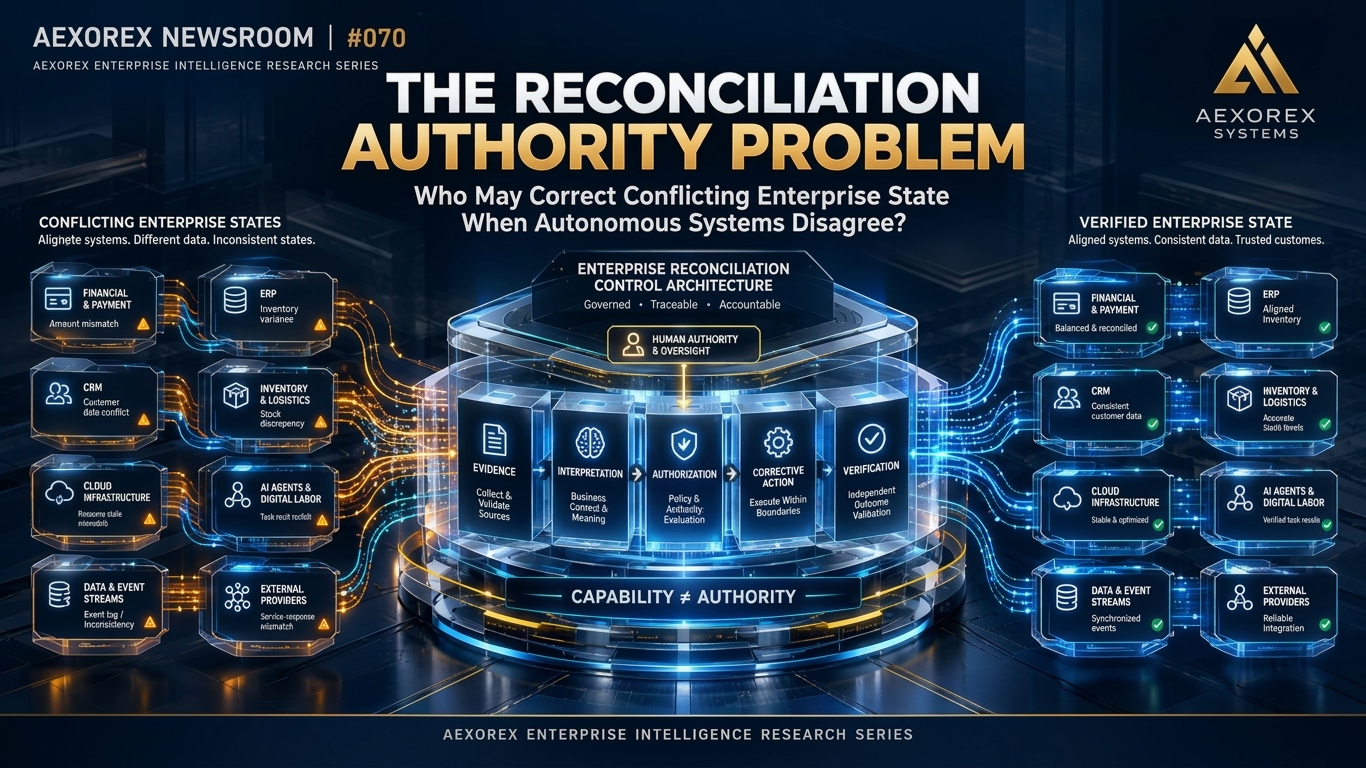
This article proposes a governance framework for autonomous enterprise workflows, separating five key responsibilities: - Establishing reliable evidence. - Determining the correct business interpretation. - Authorizing a corrective action. - Executing the action within defined limits. - Verifying the result and recording accountability.
Crucially, these responsibilities should not automatically reside with the same AI agent. The core principle is straightforward: Detecting a problem does not grant an AI agent permission to fix it, and permission to fix it does not guarantee the problem has been resolved.
Existing technologies already support distributed transactions, workflow coordination, recovery, and audit logging. This article does not claim to invent these technologies. Instead, it offers a clearer method for integrating them with enterprise decision rights, authorization, evidence, and accountability. The objective is to guide enterprises from automated activity toward controlled, verifiable, and accountable corrective action.
1. From Inconsistent State to Corrective Authority
Modern businesses rely on numerous interconnected systems. A single customer order, for example, may involve Customer Relationship Management (CRM), Enterprise Resource Planning (ERP), inventory management, payment processing, billing, logistics and delivery, and customer support. These systems exchange information and execute distinct parts of a business process.
However, these systems do not necessarily update simultaneously. Factors such as network failures, delayed events, duplicate requests, or partially completed workflows can lead to inconsistent records.
Consider the following scenario: A customer places an online order. The payment system confirms payment, the order system creates the order, the inventory system reserves the product, and the delivery provider accepts the shipment. Later, an event incorrectly marks the order as canceled. Consequently, the payment, inventory, order, and delivery systems may now disagree about the transaction.
The enterprise must then ascertain what occurred and what subsequent actions are necessary. The cancellation record might be erroneous, the shipment could have been canceled after payment, the order might have been processed twice, or the systems could be temporarily out of sync. Without understanding the situation, the enterprise cannot safely choose a correction.
Even once the facts are established, the next action can have significant implications. Refunding payment, releasing inventory, canceling a shipment, or contacting the customer each affects a different aspect of the business. This highlights why reconciliation is not merely a data-management issue; it is fundamentally a question of business authority. An enterprise must define who can interpret conflicting evidence, select a remedy, and authorize the resulting action.
2. The Difference Between Detecting and Correcting
An autonomous system may possess the technical capability to read records, compare values, and update databases. However, technical capability is distinct from legitimate authority.
Consider these five separate questions:
**Responsibility:** Detection **Question:** Do the records disagree?
**Responsibility:** Interpretation **Question:** What does the disagreement mean for the business?
**Responsibility:** Authorization **Question:** Who may approve the proposed correction?
**Responsibility:** Execution **Question:** Which system or agent may perform the correction?
**Responsibility:** Verification **Question:** Did the correction produce the intended result?
While related, these questions are not interchangeable. An AI agent might accurately detect that a customer was charged twice, but this does not automatically mean it should issue a refund without examining the transaction history, relevant policy, and its assigned permissions. Similarly, a workflow may successfully send a refund request to a payment provider. Yet, the successful request alone does not prove the money was returned or the customer account was correctly updated. Each stage requires its own controls.
Therefore, a safer enterprise architecture separates the ability to identify a problem from the authority to decide and perform a correction. This distinction is especially critical when an action impacts money, customer rights, contractual commitments, regulated records, or other high-impact business outcomes.
A practical rule suggests that an agent may be permitted to investigate a conflict without being allowed to independently resolve it. Depending on its assigned authority, it might gather evidence, recommend an action, or perform a limited correction. More consequential actions may necessitate approval from an authorized person or an additional approval process. The appropriate level of control is determined by business risk, applicable policy, and the repercussions of an incorrect decision.
3. Why Existing Distributed-Systems Patterns Are Not Enough on Their Own
Distributed systems already employ established methods for coordinating work across multiple services. A key example is the Saga pattern, which breaks a business process into smaller transactions. If a subsequent transaction fails, the system might retry the operation, follow an alternative path, or execute compensating transactions to reverse earlier changes. AWS and Microsoft document these techniques as proven approaches for maintaining consistency across distributed services.
These techniques are valuable because they help engineers design recovery paths rather than assuming every operation will succeed. However, a technical recovery mechanism does not address every business governance question.
Suppose a workflow charges a customer, reserves inventory, and arranges delivery, but a later step fails. The system might be designed to cancel the reservation and issue a refund. But what if the product has already shipped? What if the payment provider reports a different status? What if the customer has already received a legally significant notification? The original recovery plan may no longer suit the actual situation.
A corrective action may require a new business decision. The system must determine whether to: - Retry the failed operation. - Continue the original workflow. - Compensate for an earlier action. - Pause further changes. - Request a human decision. - Accept the current state with a documented explanation.
These are not always purely technical choices. The correct option may depend on business policy, contractual obligations, financial exposure, and the available evidence.
Correction is not always rollback. A common misconception is that an incorrect action can simply be reversed. In distributed systems, this is not always feasible. A completed payment may necessitate a separate refund transaction. A delivered product cannot be "undelivered" by changing a database field. A customer notification cannot be erased from the recipient's memory. A signed agreement may require a formal amendment, not a simple reversal.
The Saga pattern acknowledges the need for compensating transactions, but compensation differs from restoring history to its original state. Some actions are irreversible, and compensating operations can also fail. Therefore, a reconciliation process must distinguish between: - **Retry:** Attempting an operation again. - **Compensation:** Performing a new action to counteract an earlier effect. - **Forward recovery:** Continuing the process toward an acceptable final state. - **Containment:** Preventing further changes while a problem is investigated. - **Human adjudication:** Requesting an authorized person to decide how the conflict should be resolved.
A well-designed enterprise should define these paths before allowing autonomous systems to handle significant corrections.
4. The Reconciliation Authority Model
This article proposes a Reconciliation Authority Model for governing corrective actions within autonomous enterprise workflows. This is an architectural framework proposal, not an established industry standard or a claim of universal applicability.
The model encompasses five responsibilities:
4.1 Evidence Authority
**Question:** What evidence supports the claim that a conflict exists?
An enterprise may receive information from various sources, including internal databases, payment providers, delivery services, application logs, business event records, customer reports, and human investigations. These sources can vary in reliability, timing, and meaning. A newer record is not inherently more accurate than an older one. A successful API response does not necessarily confirm the final business outcome. A system may accurately report its own activity without knowing what occurred elsewhere.
Therefore, the enterprise requires rules for determining which evidence is pertinent to a specific question. For instance, a payment provider may be authoritative for whether it processed a payment but not for whether a product was delivered.
**Practical requirement:** Record the source, time, context, and relevant identifiers for all evidence used in a reconciliation decision.
4.2 Interpretation Authority
**Question:** Who or what determines the correct business meaning of the evidence?
Different systems may be authoritative for distinct facts. A payment platform might establish payment status, an inventory system might establish available stock, and a delivery provider might report a delivery event. However, none of these facts alone necessarily dictates whether the enterprise should issue a refund. That decision may depend on multiple facts combined with the company's refund policy.
Enterprises should therefore define which rules, business roles, or decision processes determine the appropriate response to each class of conflict.
**Practical requirement:** Do not allow an agent to treat one system as the universal source of truth for every business decision.
4.3 Correction Authority
**Question:** Who is allowed to perform the corrective action?
Detecting a valid discrepancy does not automatically authorize every possible remedy. An agent might be allowed to update a low-risk internal record, or only recommend a financial adjustment, or be prohibited from changing a contractual commitment without human approval. Permissions should reflect the specific action, the business context, and its potential consequences. For example, permission to read a payment record should not automatically include permission to issue a refund.
**Practical requirement:** Define correction permissions separately from investigation permissions.
4.4 Approval Authority
**Question:** Which actions require additional approval?
Not every correction demands the same level of oversight. A low-risk update might be automated under a clearly defined policy. However, a large financial adjustment, a disputed customer obligation, or an irreversible business action may require a qualified human decision-maker.
Approval rules should consider factors such as: - Financial value. - Reversibility. - Customer impact. - Legal or contractual implications. - Uncertainty in the available evidence. - Potential effects on other systems.
Approval should be based on the actual risk, not merely on whether an action was initiated by an AI agent.
**Practical requirement:** Establish explicit approval thresholds and define what happens when approval is unavailable.
4.5 Accountability Authority
**Question:** Who is responsible for the final decision and its outcome?
Automation does not negate the need for accountability. When a conflict is corrected, the enterprise should be able to determine: - What the original conflict was. - Which evidence was considered. - Which policy or rule applied. - Which actor proposed the correction. - Which actor authorized it. - Which system executed it. - Whether the outcome was independently verified. - Who owns any remaining unresolved issue.
The technical system may execute the action, but the organization must still define the responsible business owner.
**Practical requirement:** Preserve the decision history and the outcome evidence, not merely the final database value.
5. A Governed Reconciliation Lifecycle
The proposed model can be implemented through a seven-stage lifecycle: DETECT → CLASSIFY → ADJUDICATE → AUTHORIZE → CORRECT → VERIFY → CLOSE.
**Stage: 1. Detect** **What happens:** A possible conflict is identified. **Required control:** Capture the affected records and their sources.
**Stage: 2. Classify** **What happens:** The system determines the type of conflict that may have occurred. **Required control:** Distinguish temporary delays from genuine divergence where possible.
**Stage: 3. Adjudicate** **What happens:** The business meaning of the conflict is assessed. **Required control:** Apply the appropriate source-of-truth rules and business policies.
**Stage: 4. Authorize** **What happens:** A corrective action is approved within defined limits. **Required control:** Check permissions, risk thresholds, and approval requirements.
**Stage: 5. Correct** **What happens:** The approved action is performed. **Required control:** Restrict the action to its authorized scope.
**Stage: 6. Verify** **What happens:** The enterprise checks whether the intended outcome occurred. **Required control:** Obtain evidence from relevant systems, not only the agent's own report.
**Stage: 7. Close** **What happens:** The case is marked resolved or escalated. **Required control:** Preserve the decision history and record any remaining uncertainty.
This lifecycle connects established engineering mechanisms with explicit enterprise governance. It does not replace transaction coordination, access control, workflow orchestration, or audit systems. Instead, it defines how these mechanisms can collaborate when an autonomous workflow encounters conflicting business state.
Why verification matters: Suppose an agent sends a request to correct an order, and the API returns a successful response. What does that prove? It may prove that the receiving system accepted the request, but not necessarily that every related system has updated, that the payment has been corrected, or that the customer has received the intended outcome. Therefore, verification must be based on the specific business process requirements. A reconciliation case should not be marked fully resolved merely because one request succeeded. A correction is complete only when the required outcome has been confirmed to an appropriate level of confidence. If available evidence is insufficient, the system should preserve that uncertainty and escalate, rather than claiming successful resolution.
6. Five Common Failure Modes
Failure 1: Correcting a conflict too early
**What happens:** Two systems disagree because one is still processing an update. An agent immediately changes a record to synchronize the systems. The delayed update then arrives, creating another conflict. **Better approach:** Check if the discrepancy could be due to normal processing delays. Use appropriate waiting periods, repeated checks, and event identifiers where supported by the system. **Remaining risk:** Waiting too long can also prolong a genuine business problem. The waiting rule should reflect the process and its associated risk.
Failure 2: Trusting the wrong system
**What happens:** A reconciliation process assumes the newest record is always correct. However, the newest record might contain a duplicate event, a temporary status, or an incorrect update. **Better approach:** Define authority by business question. A system may be authoritative for payment processing but not for delivery or customer eligibility. **Remaining risk:** Some decisions span several business domains and require a documented rule for combining evidence.
Failure 3: Allowing an agent to authorize its own correction
**What happens:** An agent detects a conflict, chooses a remedy, approves it, and executes it without an independent policy check. The agent may be technically capable of performing every step but may lack legitimate authority for the entire process. **Better approach:** Separate permissions for investigation, recommendation, approval, and execution. Require additional approval when risk or uncertainty exceeds defined limits. **Remaining risk:** Human approval is not automatically effective. Reviewers still need adequate evidence, clear decision criteria, and meaningful authority to reject a proposal.
Failure 4: Creating a second problem while fixing the first
**What happens:** A correction updates one system but triggers another inconsistent state elsewhere. For example, canceling an order might release inventory while leaving a payment record unchanged. **Better approach:** Identify the expected effects on related systems, use established recovery patterns where appropriate, and verify the relevant business outcomes. **Remaining risk:** Some external systems cannot guarantee immediate consistency or provide complete evidence. The enterprise must account for these limitations.
Failure 5: Declaring success without proof
**What happens:** The workflow marks a case resolved after an action returns a successful response. The actual business outcome remains unknown. **Better approach:** Define the evidence required for closure before the corrective action begins. Verify important downstream results and escalate when confirmation is unavailable. **Remaining risk:** A system may provide incomplete or unreliable status information. Verification must consider the quality and limits of its sources.
7. How Enterprises Can Apply This Model
The Reconciliation Authority Model is most effective when translated into concrete operating rules.
Step 1: Define decision ownership
For each critical business process, identify who or what determines the correct outcome. Do not assume that a technical system's ability to update a record makes it the rightful decision-maker.
Step 2: Separate investigation from remediation
An agent may be allowed to collect records, compare evidence, and recommend a solution. This does not mean it should automatically be allowed to perform every proposed correction.
Step 3: Classify corrective actions by risk
Create clear categories such as: - **Read-only investigation:** Gather and compare information. - **Low-risk correction:** Perform a limited update under a defined policy. - **Approval-required correction:** Wait for an authorized decision-maker. - **Restricted or irreversible action:** Stop automation until the required authority and conditions are satisfied.
These are suggested categories; each enterprise should adapt them to its own processes.
Step 4: Define the safe response to uncertainty
If the system cannot ascertain what happened, it should not invent certainty. Depending on the process, the appropriate response may be to pause further actions, preserve evidence, request additional information, or escalate to a human.
Step 5: Design recovery before enabling automation
For each important workflow, determine what should happen if a step fails, a system disagrees, or a corrective action cannot be completed. Consider retries, compensation, forward recovery, and manual intervention. Established distributed-systems guidance emphasizes that recovery logic and compensating actions must be deliberately designed and cannot be safely assumed to work automatically in every situation.
Step 6: Verify the business outcome
Define what constitutes a successful resolution. For a payment correction, this may require confirmation of the payment status. For an inventory correction, it may require confirmation from the inventory system. For a customer dispute, it may require additional business review. A successful technical operation provides evidence of an action, but it is not always evidence of the final business result.
Step 7: Preserve a complete decision history
Record sufficient information to explain the original conflict, the chosen remedy, the authorization, the execution, and the verified outcome. This enables the enterprise to investigate failures, identify recurring problems, and refine future policies.
8. The Role of Identity and Delegated Authority
Corrective actions must be attributable to the correct actors. An enterprise should be able to distinguish between: - The person or business function that requested the original operation. - The AI agent that carried it out. - The system that executed the operation. - The agent or person that proposed a correction. - The authority that approved the correction.
These identities may be related but are not interchangeable. For example, an agent might act on behalf of a user under delegated permissions. A later correction should not erase that history or make the original action appear to have been performed by a different actor.
The IETF's OAuth 2.0 Token Exchange specification defines mechanisms for representing subjects and actors in delegated authorization scenarios. This can support attribution, though the specification itself does not determine the legitimacy of a business correction or the correctness of its outcome. This distinction is important: Identity helps establish who acted, authorization determines what that actor may do, evidence helps establish what happened, and business policy determines which outcome is acceptable. A reliable reconciliation process requires these elements to work together.
9. Implications for AEOS QUANTUM™
For AEOS QUANTUM™, the Reconciliation Authority Problem underscores a core architectural principle: Capability does not automatically grant authority. An enterprise AI platform may connect systems, coordinate workflows, and activate digital labor. However, the ability to perform an operation should remain distinct from the permission to perform it within a particular business context.
Within the proposed AEOS QUANTUM™ architecture, the reconciliation lifecycle could be mapped to the following sequence: CONNECT → CONTEXTUALIZE → GOVERN → ORCHESTRATE → AUTHORIZE → EXECUTE → OPTIMIZE. - **Connect:** Obtain relevant information from participating systems. - **Contextualize:** Understand the business process and identify conflicting evidence. - **Govern:** Apply the enterprise's policies and decision rules. - **Orchestrate:** Coordinate the investigation, approval, and correction workflow. - **Authorize:** Confirm that the proposed action is permitted. - **Execute:** Carry out the action within the approved boundaries. - **Optimize:** Improve future processes using verified outcomes and documented lessons.
Evidence should support every relevant stage. For example, an agent might identify a payment discrepancy and recommend a refund. The governance process determines if the refund is appropriate. The authorization process establishes whether the agent may initiate it or if human approval is required. The execution process submits the approved action. The verification process then checks whether the intended payment outcome occurred.
This is an architectural direction for AEOS QUANTUM™, not a claim that a complete reconciliation authority capability has already been implemented or independently validated. The objective is to establish a disciplined separation between intelligence, decision rights, execution, and proof.
10. What the Future May Require
As enterprises increasingly use AI agents across business systems, reconciliation is likely to remain a significant operational challenge. Three developments warrant attention:
More explicit action permissions
Enterprises will need clearer ways to articulate which agents may perform which actions, on whose behalf, and under what conditions. Identity and access-control mechanisms can support this, but business authorization must also account for the purpose and consequences of an action.
Better evidence from connected systems
Reconciliation becomes simpler when systems provide reliable operation identifiers, timestamps, status information, and confirmation of completed actions. Without these signals, an enterprise may struggle to differentiate a failed action from a delayed response or an action that succeeded but has not yet been universally reflected.
More structured recovery and escalation
Enterprise workflows will need defined responses for situations that cannot be automatically resolved. Some conflicts may be safely corrected under established policies. Others may require human judgment, especially when available evidence is incomplete or consequences are difficult to reverse.
These are architectural directions, not guaranteed predictions. Their feasibility will depend on the systems involved, the quality of available evidence, the enterprise's policies, and the level of control provided by its technology. The long-term objective should not be to automate every correction. It should be to automate decisions that can be made safely, escalate those requiring human judgment, and preserve evidence of what occurred in both scenarios.
11. The Practical Test: Can the Enterprise Explain the Correction?
An enterprise should be able to answer seven questions about any significant reconciliation: - What was inconsistent? - What evidence supported the investigation? - Why was one interpretation selected over the alternatives? - Who or what was authorized to approve the correction? - What action was performed, and by which actor? - How was the resulting business state verified? - Who owns the outcome if the correction is incomplete or incorrect?
If these questions cannot be answered, the enterprise may have automated a technical action without establishing a sufficiently governed business outcome. The answers do not always need to originate from a single system. They may be distributed across workflow records, business applications, approval logs, and external-provider receipts. What matters is the enterprise's ability to connect the evidence into a reliable account of the decision and its consequences. This is the distinction between merely recording activity and establishing accountability.
Conclusion: Reconciliation Must Be Governed, Not Merely Automated
An autonomous enterprise must do more than detect when its systems disagree. It must determine how those disagreements should be resolved, who may authorize the resolution, and what evidence is required before the matter can be considered complete.
Established distributed-systems patterns provide valuable tools for coordinating transactions, recovering from failures, and managing changes across services. These remain essential. However, technical recovery mechanisms must operate within clear business decision rights and authorization boundaries.
The proposed Reconciliation Authority Model highlights five responsibilities: Evidence, Interpretation, Correction, Approval, and Accountability. Together, these responsibilities offer a practical way to link distributed-system recovery with enterprise governance.
The central lesson is straightforward: An AI agent should not become the authority for correcting a business problem simply because it can detect the problem or access the systems involved. Its permissions must be defined, its decisions must adhere to applicable policy, consequential actions must receive the required authorization, and the resulting business outcome must be verified.
This article advances the AexoreX Enterprise Intelligence Research Series from the question of how conflicting enterprise state arises to the question of how corrective authority should be governed. The goal is not automation without limits, but autonomy within defined authority, supported by evidence that the intended outcome was achieved.
Research Notes and Limitations
This article develops a proposed architectural framework based on established distributed-systems and authorization concepts. The Saga pattern, compensating transactions, workflow coordination, and delegated authorization are existing technical approaches; the article does not claim to have invented them.
The Reconciliation Authority Model is presented as a proposal for connecting these mechanisms with business decision rights, corrective-action authorization, and outcome verification. Its effectiveness would require evaluation in specific enterprise environments. The framework does not supersede legal review, financial controls, existing security mechanisms, or domain-specific business rules. The appropriate level of automation and human approval will vary according to the process and its risks.
No claim is made that AEOS QUANTUM™ has already implemented this complete model, that it has been independently validated, or that the proposed framework is a formally recognized industry standard.
References and Further Reading
1. AexoreX Newsroom — #069: The Cross-System Consistency Problem: Why Successful Agent Actions Can Still Produce Conflicting Enterprise State https://news.aexorex.com/news/the-cross-system-consistency-problem-why-successful-agent-actions-can-still-produce-confli Provides direct research continuity: successful local actions do not necessarily produce a consistent enterprise-wide business outcome.
2. AWS Prescriptive Guidance — Saga Patterns https://docs.aws.amazon.com/prescriptive-guidance/latest/cloud-design-patterns/saga-patterns.html Explains local transactions, forward recovery, compensating transactions, and workflow coordination in distributed applications.
3. Microsoft Azure Architecture Center — Saga Design Pattern https://learn.microsoft.com/en-us/azure/architecture/patterns/saga Explains transaction coordination, compensation, retryable operations, and the limitations of recovery across distributed services.
4. IETF RFC 8693 — OAuth 2.0 Token Exchange https://datatracker.ietf.org/doc/html/rfc8693 Defines a token-exchange mechanism that includes subject and actor information relevant to delegated authorization and action attribution. It does not, by itself, determine business decision rights.
5. AexoreX Newsroom — The Evidence Sufficiency Problem: From Trustworthy Records to Verifiable Outcomes https://news.aexorex.com/news/the-evidence-sufficiency-problem-from-trustworthy-records-to-verifiable-enterprise-outcome Relevant background for distinguishing records of activity from evidence that a business outcome has actually been achieved.
6. AexoreX Newsroom — The Containment Gap: Autonomous AI & Enterprise Control https://news.aexorex.com/news/the-containment-gap Relevant background for the distinction between an agent's technical capabilities and the controls governing its actions.
AexoreX Newsroom
The Intelligence, Research & Institutional Publication of AexoreX Systems Research principle: Capability ≠ Authority. Operational principle: Autonomous where authorized. Human where required. Evidence principle: An action is not proof of an outcome.
Sources and attribution
- Original research and editorial analysis by AexoreX Systems, informed by publicly available technical documentation, research publications, and established enterprise architecture practices. · statement link
About the author
Research desk of AexoreX Newsroom.
More from AexoreX Research Desk →Related stories
- AexoreX Systems Introduces AEOS Enterprise Authority™ as Governance Layer for Autonomous Enterprise Intelligence
- AexoreX Systems Advances AEOS QUANTUM™ as Enterprise Intelligence Operating Platform for Autonomous Enterprises
- From Enterprise Intelligence to Governed Autonomous Execution: The Next Step Toward the Autonomous Enterprises
- The Infrastructure Behind the Autonomous Enterprise: Building the Foundation for Enterprise Intelligence
- #025 — The Enterprise AI Inflection Point: From AI Agents to Governed Autonomous Operations
- The Cross-System Consistency Problem: Why Successful Agent Actions Can Still Produce Conflicting Enterprise State