
The Cross-System Consistency Problem: Why Successful Agent Actions Can Still Produce Conflicting Enterprise State
Governing Distributed Transactions, State Reconciliation, and End-to-End Business Integrity Across Autonomous Workflows
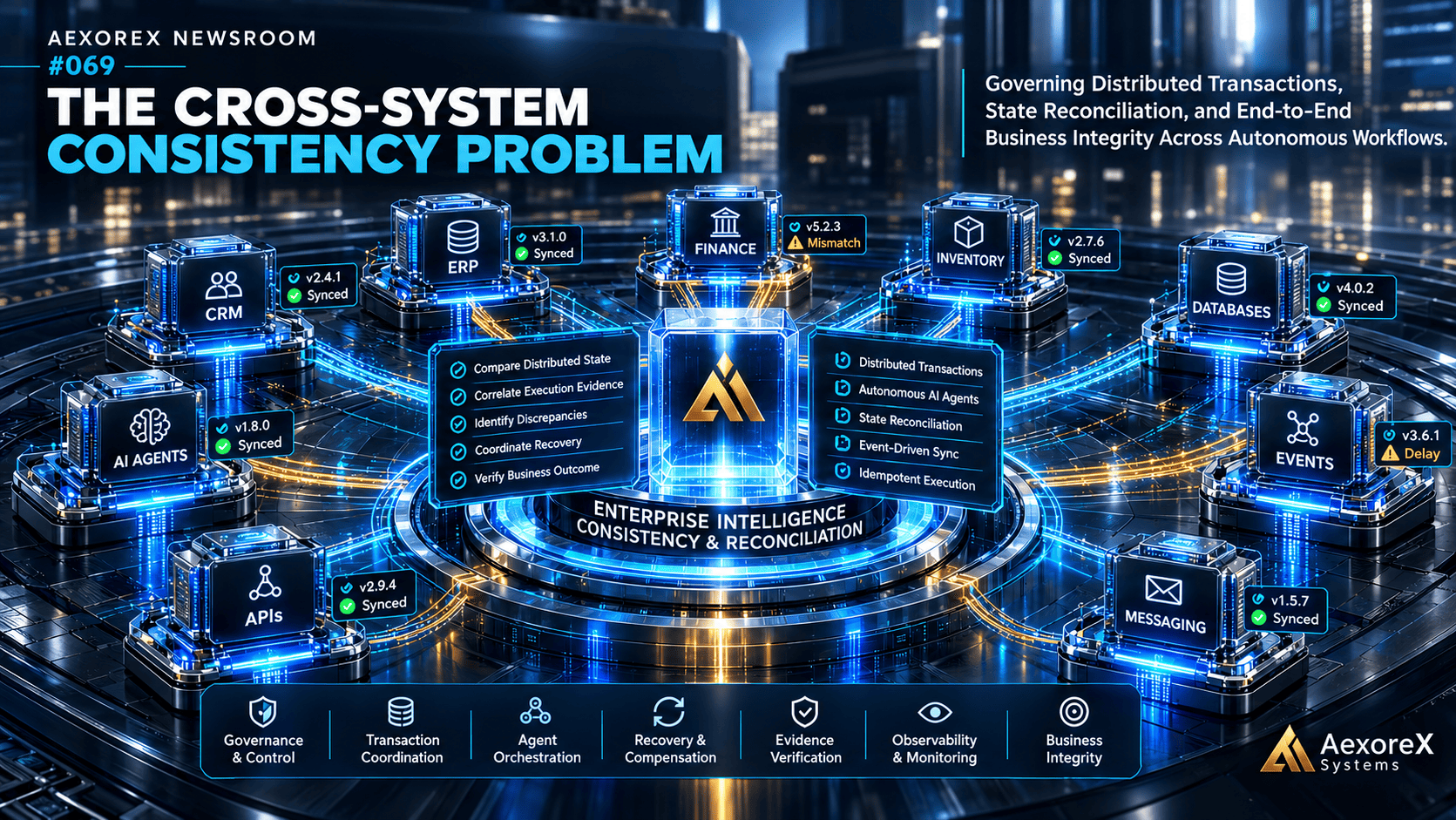
Even successful agent actions can produce conflicting enterprise state due to the cross-system consistency problem, requiring explicit architectural governance.
Opinion · AI-assisted, human edited
Executive Summary
An enterprise workflow can report successful actions while leaving the business in an inconsistent state. For instance, a customer record might be updated in a CRM, an order created in an ERP, and a payment request accepted by a payment service. Yet, the inventory system could still display the old quantity, a downstream service might process an outdated event, or a second execution could create a duplicate record.
While each system may appear to have completed its assigned task, the enterprise-wide outcome could be incomplete, contradictory, or incorrect. This challenge—maintaining and verifying coherent business state when a workflow spans independently managed systems, services, databases, APIs, and autonomous agents—is known as the cross-system consistency problem.
This problem is not new. Distributed systems have long contended with partial failures, delayed messages, concurrent updates, duplicated requests, and inconsistent data views. Established architectural patterns such as sagas, compensating transactions, idempotency, transactional outbox, and reconciliation address various aspects of this challenge. However, they do not eliminate every failure mode, nor do they automatically confirm that an entire business process has achieved its intended outcome.
Autonomous agents introduce an additional governance concern. An agent may be authorized to initiate an action, but authorization alone does not guarantee that the resulting state is correct, complete, or consistent with the enterprise's other systems. Therefore, reliable autonomous operations require more than just successful tool calls. They demand explicit workflow coordination, controlled authority, durable execution records, cross-system verification, and defined procedures for resolving discrepancies.
This article examines the problem and proposes an architectural approach for governing cross-system business integrity in autonomous enterprises.
The Difference Between Successful Actions and Consistent Business Outcomes
Enterprise workflows rarely operate within a single database or application. A typical process might involve:
- A CRM holding customer and sales information.
- An ERP managing orders, fulfillment, and financial records.
- An inventory service tracking available stock.
- A payment provider processing payment operations.
- An identity platform managing access and authorization.
- Integration services moving data between applications.
- An autonomous agent initiating or coordinating approved actions.
Each of these components maintains its own state, interfaces, processing rules, and failure behavior.
Consider an order workflow. The CRM confirms a customer request, the ERP records the order, the inventory service reserves stock, a payment provider processes a payment operation, and a fulfillment service prepares the next step. Suppose the inventory reservation succeeds, but the corresponding event is delayed. The ERP may show the order as confirmed, while another service continues to display the previous inventory state.
The individual operations may have succeeded within their respective boundaries, but the overall business process has not yet reached a verified, consistent outcome. This distinction can be expressed as follows:
- **Action success:** A particular operation reports that it completed.
- **Local state correctness:** The relevant system records a valid result within its own rules.
- **Cross-system consistency:** Related systems agree on the business facts that must remain coherent.
- **Business outcome integrity:** The end-to-end result satisfies the intended business rules and can be independently verified.
These conditions are related but not interchangeable. A successful API response does not necessarily mean a downstream system has processed the change. A locally committed transaction does not automatically establish that every dependent service has converged on the intended state. Consequently, enterprise architecture must define what successful completion means for the entire business process, not merely for each individual operation.
Why Cross-System Inconsistency Occurs
Several mechanisms can lead to conflicting enterprise state.
Partial completion
A distributed workflow often consists of multiple operations that commit independently. If an early operation succeeds and a later one fails, the workflow can remain partially completed. Unlike a single database transaction, the entire sequence may not be capable of being rolled back atomically. The system must determine whether to retry the failed operation, compensate for earlier work, continue through a recovery path, or escalate the situation for human intervention.
Delayed and out-of-order events
Event-driven systems communicate via messages that can be delayed or processed at different times. A consumer might temporarily hold an older view of a record. In some circumstances, events may be observed out of order or processed more than once. Without appropriate event identification, ordering rules, version checks, or reconciliation, an older update could overwrite newer information or produce an incorrect downstream decision.
Duplicate execution
Network interruptions create uncertainty. A caller might send a request, the receiving service might complete it, but the response could be lost before reaching the caller. The caller cannot necessarily distinguish a completed operation with a lost response from an operation that never completed. If the caller retries without appropriate safeguards, the operation may be repeated. While this might be harmless for a read operation, duplication can have significant business consequences for payment requests, order creation, or inventory reservations. AWS recommends idempotent handling of mutating operations and describes how idempotency tokens can help services recognize repeated requests. However, this protection must be specifically designed into the relevant service interactions; it cannot be assumed across an entire workflow. (AWS Well-Architected Framework: Make mutating operations idempotent.)
Concurrent changes
Two workflows may attempt to modify the same business entity simultaneously. For example, one workflow might update an order while another changes its fulfillment status. If the systems do not apply appropriate concurrency controls, version checks, or business rules, one update could overwrite another or leave related records inconsistent. This is not merely a messaging problem; it also concerns how concurrent business operations are coordinated.
Conflicting interpretations of state
Different systems may use different status definitions. For example, one system might classify an order as submitted, another as accepted, and a third as ready for fulfillment. These statuses may represent different stages rather than actual contradictions. The architecture must therefore distinguish between legitimate differences in lifecycle state and genuine conflicts over the same business fact. Without an explicit model of these meanings, a reconciliation process could incorrectly treat valid differences as errors—or overlook real inconsistencies.
Established Patterns and What They Actually Solve
No single architectural pattern addresses every cross-system consistency problem. The appropriate design depends on transaction boundaries, failure modes, business constraints, and recovery requirements.
Saga: Coordinating distributed business steps
The saga pattern coordinates a business transaction as a sequence of local transactions across multiple services. Each participant completes its local operation and triggers a subsequent step through an event or message. If a later step fails, the workflow may invoke compensating transactions for earlier steps that can be compensated.
Microsoft's Azure Architecture Center documents saga as an approach to managing distributed transactions while maintaining data consistency across services. It also identifies challenges involving debugging, concurrency, and compensating operations. (Microsoft: Saga Design Pattern.)
A saga can make the progress and recovery logic of a distributed workflow explicit. However, it does not make every intermediate state immediately consistent.
**Architectural implication:** A saga needs observable workflow state, explicit failure handling, and a defined completion condition. A workflow that has started—or completed several steps—should not automatically be represented as a fully successful business outcome.
Compensating transactions: Managing effects that have already occurred
A compensating transaction performs a business operation intended to counteract the effect of an earlier operation. For example, a workflow might release a reservation if a subsequent step cannot proceed. A payment-related workflow might require an appropriate reversal or refund process, subject to the provider's capabilities and applicable business rules. Compensation is not necessarily an exact reversal.
Microsoft's documentation explains that compensation must account for concurrent changes and that it may not restore the system to precisely the state that existed before the original operation. Compensation can also fail and require its own recovery process. (Microsoft: Compensating Transaction Pattern.)
**Architectural implication:** Every compensable operation should have a documented recovery policy. Irreversible operations, compensation failures, and situations requiring human approval must be identified before autonomous execution is permitted.
Idempotency: Making repeated requests safer
Idempotency means that repeating the same operation under defined conditions does not produce additional effects beyond those of the original operation. An API can use an idempotency key to recognize a repeated request and return the previously recorded result rather than performing the same mutation again. This is especially useful when network failures leave the caller uncertain whether an earlier request completed.
However, idempotency is not synonymous with end-to-end consistency. A request can be processed idempotently by one service while a downstream system remains delayed, unavailable, or inconsistent.
**Architectural implication:** Idempotency keys, operation identifiers, and duplicate-detection rules should be carried through the relevant execution chain wherever supported. Their scope and retention must also be defined.
Transactional outbox: Reducing the gap between data changes and messages
The transactional outbox pattern addresses a common reliability problem: a service updates its database but fails to publish the event needed by downstream systems—or publishes a message even though the corresponding database transaction does not commit. With an outbox, the service records the business change and the message to be published within the same local database transaction. A separate process subsequently delivers the recorded message to the message broker.
The pattern reduces the risk of losing the connection between a committed local change and its corresponding event. Nevertheless, a message relay can publish the same message more than once, so consumers must still handle duplicates appropriately. (Microservices.io: Transactional Outbox.)
**Architectural implication:** Reliable publication and reliable consumption are separate responsibilities. A robust design must consider both.
Reconciliation: Detecting and resolving state differences
Reconciliation compares relevant business records or states across systems to determine whether they agree with defined business rules. Depending on the domain, reconciliation may identify:
- An order present in one system but missing from another.
- A payment status that does not match the associated order.
- An inventory reservation that no longer corresponds to a valid order.
- An event that has not produced the expected downstream change.
- A record whose version or status conflicts with an authoritative business rule.
Reconciliation is not simply another retry mechanism. It is a way to discover discrepancies that may remain after the original workflow has stopped, timed out, or reported partial success. The resolution might be an automated correction, a retry, a compensating action, a request for additional evidence, or a human review.
**Architectural implication:** Reconciliation needs explicit rules about which states should agree, which differences are acceptable, how conflicts are resolved, and when automated correction must stop.
Strong Consistency Has a Defined Scope
Distributed systems do not all provide the same consistency guarantees. Some databases support strong transaction guarantees within a defined data boundary. For example, Google Cloud Spanner documents external consistency for transactions within Spanner, including ordering guarantees that preserve the relationship between transactions and the order in which they are observed. (Google Cloud: Spanner, TrueTime, and External Consistency.)
That is an important capability, but it should not be generalized beyond its documented scope. If a workflow also depends on an independent CRM, payment provider, inventory service, or external API, a database's consistency guarantee does not automatically extend across all those systems. Cross-system consistency must therefore be evaluated against the actual boundaries of the architecture.
A design should identify:
- Which data is authoritative for each business fact.
- Which operations share a transactional boundary.
- Which updates are asynchronous.
- Which temporary inconsistencies are acceptable.
- Which conditions must be resolved before the business process can be declared complete.
- Which discrepancies require escalation rather than automatic correction.
The objective is not to impose one universal consistency model on every component. It is to make the guarantees, limitations, and recovery behavior of the complete workflow explicit.
A Proposed Architecture for Cross-System Business Integrity
The following six-layer model is an AexoreX Systems architectural proposal for autonomous enterprise workflows. It is not a claim that AEOS QUANTUM has already implemented or independently validated these capabilities.
Layer 1 — Business Intent and Invariants
Define the intended business outcome before execution begins. A workflow should identify its required end state, relevant business rules, constraints, and conditions for successful completion. For example, an order workflow may require a valid order record, an acceptable payment status, a valid inventory allocation, and an authorized fulfillment decision. The architecture should distinguish mandatory invariants from conditions that may temporarily differ while asynchronous processing continues. Without this definition, the system has no reliable basis for deciding whether its final state is correct.
Layer 2 — Bounded Agent Authority
The agent should receive only the permissions required for its approved task. Its authority should define:
- Which systems and operations it may access.
- Which business entities it may modify.
- Which actions require additional approval.
- Which limits and policy conditions apply.
- When execution must stop or escalate.
The central principle is: Capability does not equal authority, and authority does not establish a correct outcome. An agent may be technically capable of calling an API, but that capability should not be treated as permission to perform every available operation. Even an authorized operation must still satisfy the workflow's business rules.
Layer 3 — Durable Workflow Coordination
The workflow coordinator should maintain a durable record of execution progress. Depending on the use case, this may include:
- A unique workflow and operation identifier.
- The current workflow state.
- Completed and pending steps.
- Retry and timeout information.
- Compensation status.
- Relevant dependencies.
- Approval and escalation decisions.
The coordinator should distinguish between states such as pending, in progress, completed locally, awaiting verification, compensation required, and reconciliation required. The exact state model will vary by domain, but the distinction matters: a completed local operation should not automatically move the entire workflow into a verified-success state.
Layer 4 — Reliable System Integration
Integration components should handle the failure behavior of APIs, databases, event brokers, and external services. Appropriate mechanisms may include:
- Idempotency and duplicate detection.
- Transactional outbox.
- Controlled retries and timeouts.
- Event identifiers and version checks.
- Concurrency controls.
- Explicit treatment of irreversible operations.
- Dead-letter handling and recovery procedures where appropriate.
These mechanisms should be selected according to the actual failure modes. Adding more integration technology does not necessarily improve reliability if the underlying business rules and recovery paths remain undefined.
Layer 5 — Cross-System Evidence
The architecture should collect sufficient information to determine what happened across the workflow. Depending on the operation, useful evidence may include:
- The original business intent.
- The applicable authorization decision.
- Operation and correlation identifiers.
- Requests and responses, subject to appropriate privacy and security controls.
- Relevant event identifiers and timestamps.
- Confirmed state changes.
- Downstream acknowledgments.
- Compensation and reconciliation results.
Observability technologies such as OpenTelemetry can help standardize and correlate telemetry across services. They provide useful operational visibility, but telemetry alone does not prove that a business outcome is correct. (OpenTelemetry: Semantic Conventions.) The architecture must therefore connect operational evidence to explicit business acceptance criteria.
Layer 6 — Reconciliation and Outcome Verification
Before the workflow is classified as complete, the system should evaluate whether the relevant business invariants hold. This layer compares the observed state against the required outcome and determines what happens next. Possible results include:
- **Verified:** The required conditions are satisfied.
- **Pending:** Required downstream changes or confirmations have not yet arrived.
- **Inconsistent:** Relevant records or business facts conflict.
- **Recoverable:** A defined retry or compensation path remains available.
- **Escalated:** The discrepancy requires human judgment or additional authorization.
These are proposed status categories, not a universal standard. The critical design requirement is that the system must not silently convert uncertainty into success. The completion decision should be based on defined business conditions and sufficient evidence—not merely on an agent's report that it finished the task.
Evaluating the Architecture
A consistency architecture should be evaluated through controlled testing, including failures and unexpected execution sequences. A useful evaluation framework would examine the following areas:
| Evaluation area | Example question | | :---------------- | :------------------------------------------------------------------------------------------------- | | Duplicate handling | Does repeating the same request create unintended additional effects? | | Partial failure | Can the workflow identify which steps completed before a failure? | | Event delivery | Can delayed or duplicated messages be detected and handled safely? | | Concurrent updates | Can conflicting modifications be detected without silently losing valid changes? | | Compensation | Can failed compensation be identified, retried safely, or escalated? | | Reconciliation | Can the system find a mismatch even when the original workflow no longer appears active? | | Evidence quality | Can an independent reviewer determine what occurred and why the workflow was classified as successful? | | Authorization | Are actions restricted to the approved scope, including during recovery? | | Recovery | Can the workflow reach a valid state after interruption without creating new inconsistencies? | | Human control | Can the system pause or escalate when the result cannot be verified safely? |
Testing should include network interruptions, timeouts, delayed events, duplicate delivery, concurrent changes, unavailable dependencies, and failed compensation. Where appropriate, tests should also cover ambiguous outcomes: cases in which a request may have completed but the caller did not receive confirmation.
The purpose is not to prove that failures will never occur. It is to determine whether the architecture detects, contains, explains, and recovers from the failures within its defined operating requirements. These evaluation criteria are proposed engineering guidance. They should not be interpreted as evidence that any particular platform has passed such tests.
What Autonomous Agents Change
Autonomous agents do not create the underlying distributed-systems problem. They change how business operations may be initiated, coordinated, and repeated. An agent may interpret a request, select a tool, call an API, inspect a response, and initiate another action. A workflow may also involve several agents operating across different systems.
Without explicit controls, this can complicate the relationship between business intent and resulting state. For example, an agent that receives an ambiguous response may retry an operation. Another component may independently retry the same task. A downstream service may process a delayed event after the workflow has already moved into a recovery state.
The resulting problem is not simply whether the agent selected the correct tool. It is whether the complete system preserved the intended business rules through every action, retry, state transition, and recovery path. Autonomous enterprise architecture should therefore enforce several distinctions:
- Authorization is not execution evidence.
- Execution evidence is not proof of business correctness.
- Local success is not necessarily enterprise-wide consistency.
- A retry is not automatically safe.
- Compensation is not necessarily a perfect reversal.
- A workflow report is not a substitute for independent verification.
These distinctions are especially important when agents can modify financial records, customer data, inventory, contractual workflows, or other high-impact business state. For such operations, autonomy should be bounded by explicit policies, risk-sensitive approval requirements, reliable recovery mechanisms, and clear conditions for human intervention.
Implications for AEOS QUANTUM
AEOS QUANTUM is being developed as a proposed enterprise intelligence and operations architecture intended to connect, coordinate, govern, and activate enterprise systems. Within that architectural direction, cross-system consistency is not simply an integration feature. It is a governance concern that connects business intent, authority, execution, evidence, and outcome verification.
The proposed architecture can be expressed as: Connect → Contextualize → Govern → Orchestrate → Authorize → Execute → Optimize. Evidence should operate across the sequence rather than being treated as an isolated final step.
For cross-system workflows, this means the architecture should be designed to answer five questions:
- **Intent:** What business outcome is required?
- **Authority:** Which actions are permitted, and under what conditions?
- **Execution:** Which operations actually occurred across the participating systems?
- **Consistency:** Do the relevant systems satisfy the required business invariants?
- **Verification:** What evidence supports the decision that the workflow has reached a valid outcome?
The proposed six-layer model in this article provides one way to organize those responsibilities. It also reinforces the principle of vendor independence by design: the architecture should define its required controls and guarantees without assuming that any single vendor supplies all of them. That does not mean every integration can provide identical semantics or guarantees. Each connector, API, database, and external service must be evaluated according to its actual capabilities, limitations, and contractual behavior.
For AEOS QUANTUM, these are architectural objectives and design directions—not claims of completed implementation, proven performance, or independent validation.
Open Engineering Questions
Several issues require further investigation and domain-specific design.
- **Defining authoritative business state.** When systems disagree, which source is authoritative for the disputed business fact? The answer may differ between customer identity, payment status, inventory availability, and fulfillment.
- **Handling irreversible actions.** Some operations cannot be meaningfully undone. Architectures must identify these boundaries and define appropriate approval, sequencing, and recovery requirements.
- **Establishing evidence sufficiency.** What evidence is necessary to declare a business workflow complete? The answer depends on the operation's risk, its acceptance criteria, and the reliability of the participating systems.
- **Balancing consistency and availability.** Stronger coordination may introduce latency or reduce the ability to proceed during certain failures. The appropriate trade-offs depend on business requirements and the guarantees offered by the underlying systems.
- **Governing multi-agent execution.** When multiple agents can initiate or retry operations, the architecture must preserve operation identity, enforce authority boundaries, and prevent duplicate or conflicting actions.
- **Defining escalation thresholds.** Not every discrepancy should trigger automatic correction. Some cases require human judgment because the available evidence is incomplete, the business consequences are significant, or multiple valid interpretations exist.
These are not problems that can be resolved by choosing a single workflow engine or observability platform. They require explicit business semantics, system contracts, and governance decisions.
Conclusion: Consistency Must Be Governed, Not Assumed
Enterprise automation cannot be evaluated solely by counting successful API calls or completed agent tasks. A workflow may execute its individual operations successfully while leaving related systems in conflicting states. Distributed transaction patterns, idempotency, reliable messaging, compensation, and reconciliation each address important aspects of the problem, but none should be treated as a universal guarantee of end-to-end business integrity.
The architecture must define the intended outcome, establish appropriate authority, preserve execution history, handle partial failure, reconcile discrepancies, and verify the relevant business conditions before declaring success. For autonomous enterprises, the governing principle is straightforward: A successful action is an execution result. A valid business outcome is a condition that must be established and verified.
The distinction matters because enterprise autonomy is not merely the ability to act across systems. It is the ability to operate within defined authority while maintaining trustworthy, recoverable, and verifiable business state. The objective is not to assume that every system will always agree. It is to make disagreements detectable, recovery deliberate, and successful outcomes independently verifiable. That is the foundation of cross-system business integrity.
Sources and attribution
- AI-generated editorial visual, created for AexoreX Newsroom #069. · statement link
About the author
The editorial desk of AexoreX Newsroom, the publication of AexoreX Systems LLC.
More from AexoreX Newsroom Editorial Desk →Related stories
- THE ENTERPRISE AUTHORITY ARCHITECTURE
- THE ENTERPRISE AGENT PROTOCOL AND IDENTITY SUBSTRATE
- The Non-Human Authorization Crisis: Re-Architecting Identity, Governance, and Execution for Autonomous Enterprise Systems
- The Autonomous Enterprise: From Intelligence to Governed Action
- The Cryptographic Authority Layer: Dynamic Attenuation and Provenance in Multi-Agent Enterprise Architectures
- The Non-Human Identity Control Plane: Dynamic Authority and Traceable Delegation for Autonomous Enterprise Operations
- Enterprise Intelligence Infrastructure and Governed Autonomy: The Architectural Foundation for the Autonomous Enterprise
- THE AUTONOMOUS ENTERPRISE CONTROL PLANE
- From Agent Interoperability to Governed Execution: Why Enterprise AI Needs an Authority Layer
- AFTER REVOCATION: THE SAFE-STATE PROBLEM IN AUTONOMOUS ENTERPRISE EXECUTION
- The Evidence Sufficiency Problem: From Trustworthy Records to Verifiable Enterprise Outcomes