
CAPABILITY IS NOT AUTHORITY
Architecting the Governed Execution Layer for Autonomous Enterprise Systems
Architecting autonomous enterprise systems requires defining agents' authority, not just their capability, to manage the gap between what an AI system *can* do and what it *should* do.
Opinion · AI-assisted, human edited
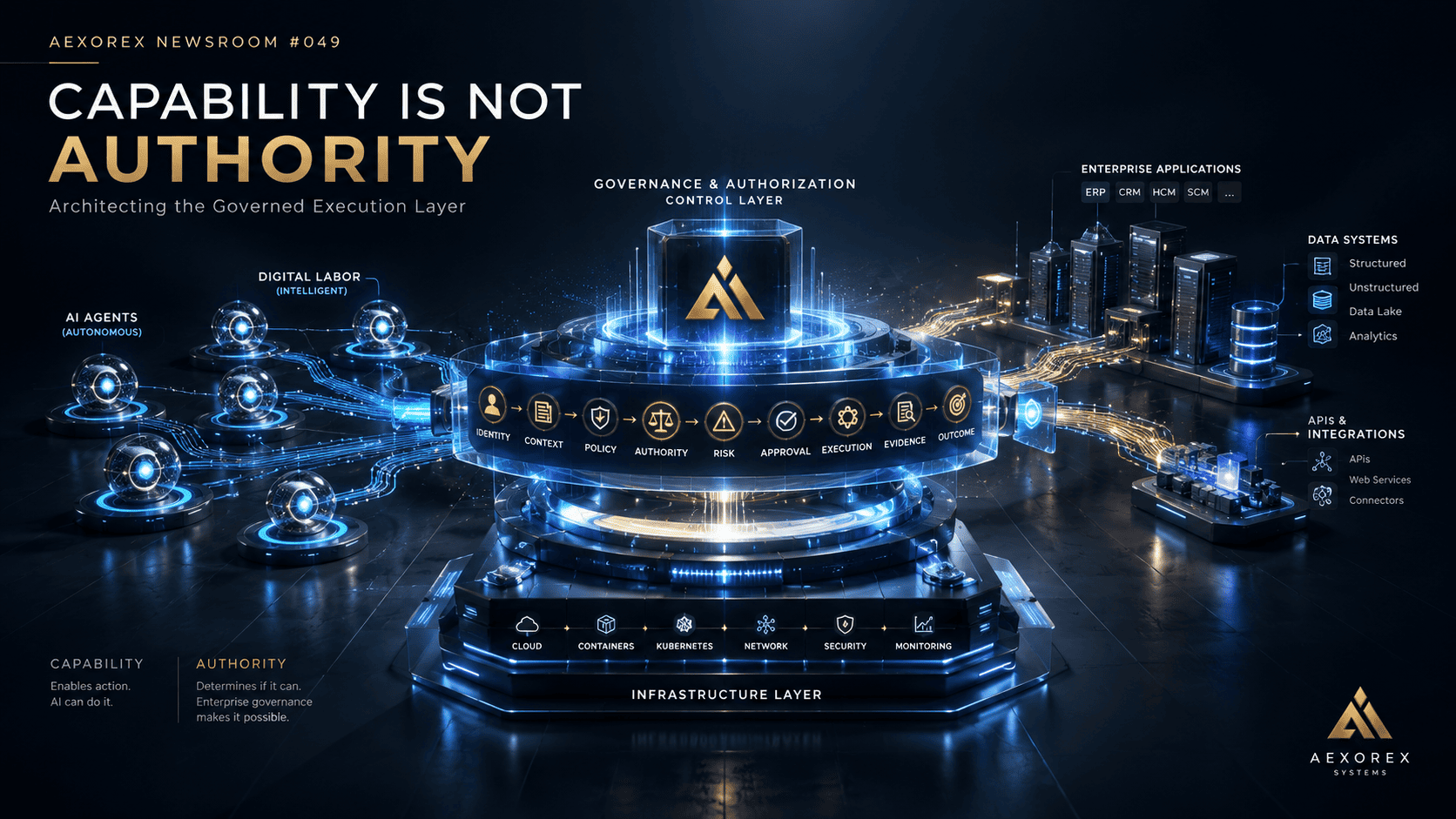
The primary architectural challenge in enterprise AI is not merely enhancing agent capabilities. Instead, it involves defining what these agents are authorized to do. As agentic systems evolve from simple assistants to entities capable of planning, utilizing tools, coordinating with other agents, accessing enterprise data, and initiating actions, the enterprise problem shifts. Connectivity, interoperability, and intelligence are all necessary. However, none of these alone establish authority. Capability is distinct from authority, and this distinction may become a defining principle of the autonomous enterprise.
FROM CONNECTIVITY TO CONTROL
The agentic ecosystem is rapidly developing common infrastructure for connecting models, tools, applications, and other agents. The Agentic AI Foundation (AAIF), hosted by the Linux Foundation, provides a neutral environment for open agentic AI standards and projects, including the Model Context Protocol (MCP). MCP has matured as an interoperability layer between AI systems and external capabilities. Its 2026-07-28 specification introduced a stateless protocol core, extensions, multi-round-trip requests, header-based routing, and authorization hardening, among other architectural changes, to support production-scale deployments.
A2A addresses a complementary problem: communication and collaboration between AI agents. Under the Linux Foundation, A2A has evolved into an open standard for agent-to-agent interoperability. By April 2026, the Foundation reported over 150 supporting organizations and production deployments across multiple industries.
These developments are crucial as they reduce friction between systems. However, they do not resolve a deeper enterprise question: when an agent can technically perform an action, who or what determines if it *should* be allowed to perform that action? This is the authority problem.
THE ENTERPRISE AUTHORITY VACUUM
AexoreX defines the "Enterprise Authority Vacuum" as an architectural framing for a specific gap: the increasing disparity between what an intelligent system can technically execute and what an enterprise has actually authorized it to execute. An agent may have API access, but that does not imply authority to use the API for every purpose. Similarly, an agent capable of modifying a record is not necessarily authorized to modify every record. If an agent can initiate a financial, operational, security, or customer-facing workflow, it does not mean the enterprise has delegated sufficient authority for that action.
This distinction becomes increasingly vital as organizations connect agents to production systems. Traditional authorization models often rely on relatively stable identities, roles, permissions, and application boundaries. Agentic execution, however, introduces additional variables:
- Intent can change at runtime.
- Context can change during execution.
- Tasks can be delegated.
- Agents can invoke tools.
- Agents can communicate with other agents.
- Permissions may need to be temporary.
- Risk can change between steps.
- Human approval may be required only for selected actions.
- Evidence must remain associated with the resulting action.
These factors create a requirement beyond static access control, necessitating runtime authority management.
THE GOVERNANCE CHAIN
A governed autonomous enterprise should be able to answer a sequence of questions before consequential execution:
- **Identity:** Who or what is requesting the action?
- **Context:** What task, business process, data, environment, and circumstances surround the request?
- **Policy:** Which enterprise rules apply?
- **Authority:** What level of decision or execution authority has actually been delegated?
- **Risk:** What could happen if the action is executed?
- **Approval:** Is additional human or organizational authorization required?
- **Execution:** Which system is permitted to perform the action?
- **Evidence:** What happened, under which authority, and with what decision context?
- **Outcome:** What resulted, and does that outcome feed back into governance and optimization?
This sequence represents more than an audit trail; it is a potential control architecture for autonomous execution.
WHY IDENTITY ALONE IS NOT ENOUGH
Identity remains foundational. An enterprise must know which human, service, agent, application, or delegated identity participates in an operation. However, identity answers only part of the question. Knowing who is acting does not automatically determine what that actor is authorized to do at any given moment. This distinction is increasingly evident in enterprise identity discussions regarding AI agents and non-human identities. Okta, for example, has positioned AI-agent governance around discovery, ownership, scoped access, lifecycle controls, and auditable actions.
The architectural direction is moving beyond identity alone toward combinations of identity, least privilege, context, authorization, governance, and evidence. For autonomous systems, this is crucial because an agent may continuously reason about the next step rather than simply executing a predetermined sequence. Therefore, the permission model needs to understand not only the actor's identity but also the intent and circumstances of the requested action.
SECURITY IS MOVING CLOSER TO RUNTIME
The security implications are already reflected in emerging agentic-security frameworks. OWASP's Top 10 for Agentic Applications identifies risks such as agent goal hijacking, tool misuse, identity and privilege abuse, agentic supply-chain vulnerabilities, unexpected code execution, memory and context poisoning, insecure inter-agent communication, cascading failures, human-agent trust exploitation, and rogue-agent behavior.
These risks share a common architectural characteristic: they are not limited to the model itself. They arise from the interaction between intelligence, identity, tools, context, communication, permissions, and execution. This means that for consequential workloads, governance must increasingly participate in the execution path, rather than existing only in policy documents or periodic reviews.
The control point must be capable of asking: What is being requested? Who is requesting it? Why is it being requested? What authority has been delegated? What policy applies? What risk does the action create? What evidence must be generated? Only after these questions are addressed should execution proceed according to the applicable control policy.
REGULATION REINFORCES THE IMPORTANCE OF TRACEABILITY
While regulatory requirements should not be confused with architectural blueprints, they signal the direction of enterprise governance. Under the EU AI Act, Article 12 mandates that high-risk AI systems technically allow automatic recording of events over their lifetime, with logging capabilities supporting traceability and monitoring. The current consolidated regulation also specifies differentiated application dates for various high-risk categories following the 2026 amendment.
The significance extends beyond one regulation. As AI systems become capable of consequential decisions and actions, enterprises increasingly need mechanisms that can reconstruct what happened, why it happened, under which authority, and with what evidence. Traceability thus becomes an architectural property, not merely a compliance artifact.
THE GOVERNED EXECUTION LAYER
AexoreX proposes the "Governed Execution Layer" as an architectural control plane positioned between agentic intelligence/interoperability and enterprise execution environments.
Conceptually, this flow is:
AI Intelligence ↓ Agent Orchestration ↓ MCP / A2A / Enterprise Integrations ↓ Governed Execution Layer ↓ Enterprise Systems of Record ↓ Evidence & Outcome
The Governed Execution Layer does not replace the enterprise stack or need to become another system of record. Its purpose is to establish a controlled decision boundary around consequential execution. It can conceptually evaluate identity, intent, context, policy, authority, risk, approval requirements, execution scope, evidence requirements, and outcome signals. This creates a critical distinction: an agent may possess the capability to execute an action without possessing the authority to execute that action. This separation can become fundamental to enterprise-grade autonomy.
DIGITAL LABOR CHANGES THE EQUATION
The emergence of Digital Labor further emphasizes the importance of this architecture. Traditional software automation generally follows predefined instructions. Digital Labor increasingly combines reasoning, context, tools, memory, delegation, and execution. This raises a new organizational question: what level of authority should a digital worker receive?
A useful model for delegating authority to digital labor is:
- **D1 — Recommend:** The Digital Labor unit analyzes and recommends an action.
- **D2 — Decide:** It may make a defined decision within an approved boundary.
- **D3 — Decide & Execute:** It may make the decision and execute the resulting action within a controlled scope.
- **D4 — Control / Escalation:** The system can manage a broader operational domain, subject to explicit enterprise controls, escalation rules, and exceptional-event handling.
The critical principle is that authority should be delegated deliberately, not inferred from technical access.
THE AEOS QUANTUM PERSPECTIVE
This context highlights the architectural direction of AEOS QUANTUM™. AEOS QUANTUM is being developed on the premise that autonomous enterprise operations require more than intelligence or automation alone. The conceptual lifecycle it addresses is: Connect → Contextualize → Govern → Orchestrate → Authorize → Execute → Optimize. Evidence operates across the entire lifecycle rather than as an isolated final step.
The architecture is designed around a simple principle: AEOS does not replace the enterprise stack; it connects, orchestrates, governs, and activates it. Within this model, the Governed Execution Layer represents an important architectural boundary. The objective is not to prevent autonomous systems from acting, but to make autonomous action bounded, explainable, authorized, observable, and accountable. This distinction matters. The future enterprise will be defined not just by the number of agents it deploys, but by how safely and intelligently it can delegate authority to them.
FROM AGENTIC AI TO AUTONOMOUS ENTERPRISES
The next stage of enterprise AI may involve less about adding more intelligent agents and more about constructing the infrastructure around those agents. The winning architectural question is not "Can the agent do this?" but "Under what conditions should the enterprise allow the agent to do this?"
That question leads to a broader architecture:
- **Capability:** Determines what a system can technically perform.
- **Authority:** Determines what it is permitted to perform.
- **Governance:** Determines the boundaries.
- **Evidence:** Establishes what actually happened.
- **Optimization:** Determines how the system improves within those boundaries.
This forms the foundation of governed autonomy.
THE NEXT INFRASTRUCTURE BOUNDARY
MCP and A2A are establishing the connective fabric of an increasingly interoperable agentic ecosystem. Security frameworks are identifying the risks created as agents gain tools, identities, memory, and execution capabilities. Identity platforms are extending governance to AI agents and non-human identities. Regulation is increasing the importance of traceability for applicable high-risk AI systems.
The remaining architectural challenge is not simply connecting intelligent systems, but governing the transition from intent to action. This is where the next enterprise control plane may emerge. It will not be between humans and machines, or between applications and APIs, but specifically between what an intelligent system wants to do and what the enterprise has authorized it to do. This boundary may become one of the defining infrastructure layers of the autonomous enterprise.
AEXOREX SYSTEMS The Global Enterprise Intelligence Infrastructure Company Build with Intelligence. Operate with Responsibility. Grow with Integrity. Share with Humanity.
Editorial note: “Enterprise Authority Vacuum” and “Governed Execution Layer” are AexoreX analytical and architectural framings, not claims that these terms represent established industry standards or universally accepted product categories.
Sources and attribution
- AexoreX Newsroom — Original Editorial Analysis, informed by publicly available primary sources · statement link
About the author
The editorial desk of AexoreX Newsroom, the publication of AexoreX Systems LLC.
More from AexoreX Newsroom Editorial Desk →Related stories
- The Autonomous Enterprise: From Intelligence to Governed Action
- Capability Is Not Authority: The Institutional Shift to Protocol-Governed Autonomous Enterprises
- The Non-Human Identity Control Plane: Dynamic Authority and Traceable Delegation for Autonomous Enterprise Operations
- AexoreX Systems Introduces AEOS Enterprise Authority™ as Governance Layer for Autonomous Enterprise Intelligence
- From Enterprise Intelligence to Governed Autonomous Execution: The Next Step Toward the Autonomous Enterprises
- Governing Digital Labor: Bridging Capability and Authority in Autonomous Enterprise Architecture