
Governing Digital Labor: Bridging Capability and Authority in Autonomous Enterprise Architecture
ahead of 2026 regulatory enforcement deadlines
As enterprise AI shifts towards autonomous execution, new architectural layers are required to bridge technical capability with organizational authority and ensure robust governance.
Opinion · AI-assisted, human edited
From AI Assistance to Digital Labor
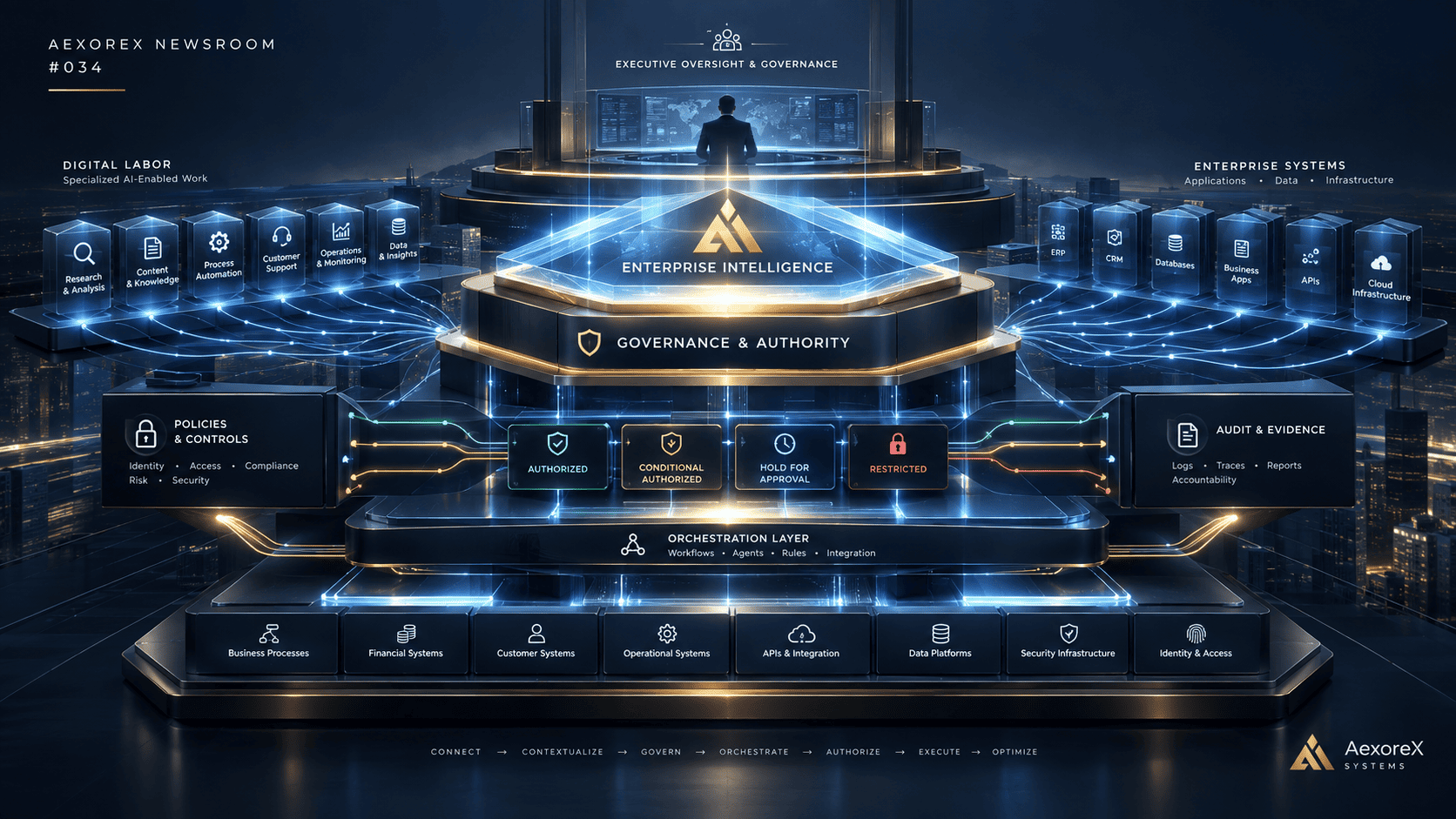
Enterprise artificial intelligence (AI) is undergoing a structural transition, moving beyond systems that generate answers or assist human users toward AI systems capable of coordinating tools, workflows, applications, and directly executing actions across enterprise environments. This evolution reshapes the core technological challenge for organizations. The primary question is no longer solely whether an AI system possesses the technical capability to perform an action, but rather whether that action is authorized by the enterprise, bounded by policy, observable, reversible where technically feasible, and attributable to an accountable enterprise process. This shift introduces a new architectural requirement: an intelligence and governance layer positioned between AI capability and enterprise execution. This layer must connect existing systems, provide business context, enforce policies, orchestrate work, delegate authority, execute approved actions, and produce auditable evidence of execution.
The New Enterprise Problem: Capability Is Not Authority
A central conceptual distinction defining this emerging landscape is that technical capability does not automatically equate to organizational authority. An AI system may possess the technical means to access an API, query a database, modify a record, create a purchase order, update a customer record, execute a workflow, invoke another AI system, or initiate a financial transaction. However, this technical prowess does not automatically grant the AI the authorization to perform such actions within an enterprise. Enterprises face the architectural challenge of clearly separating what a system *can do* from what the organization *allows it to do* and, crucially, what it is *authorized to do* in a specific business context. This problem intensifies as AI systems evolve from being mere assistants to becoming orchestrators of digital labor—AI-enabled software capabilities designed to perform defined work and interact with enterprise systems within delegated boundaries.
The Enterprise Stack Is Not Disappearing
Despite the emergence of sophisticated AI capabilities, existing enterprise systems of record—including Enterprise Resource Planning (ERP), Customer Relationship Management (CRM), IT Service Management (ITSM), Human Resources (HR) systems, financial systems, databases, Software-as-a-Service (SaaS) applications, Application Programming Interfaces (APIs), and data platforms—are not being replaced. Instead, the relationship between these foundational systems and emerging AI capabilities is evolving. New intelligence, orchestration, and execution layers are being developed to operate *above* these established systems, leveraging their data and functionalities rather than supplanting them. This approach allows enterprises to maintain their investments in core applications while integrating advanced AI-driven workflows.
The Rise of the Enterprise Intelligence Layer
An emerging infrastructure requirement is the development of an enterprise intelligence layer. This architectural concept envisions a critical intermediary that bridges AI capability with enterprise execution. It is designed to perform a sequence of functions:
- **Connect:** Integrate enterprise applications, systems, APIs, data, and tools.
- **Contextualize:** Provide the relevant business context necessary for intelligent decision-making by AI systems.
- **Govern:** Apply policies, constraints, security rules, compliance requirements, and organizational controls to AI operations.
- **Orchestrate:** Coordinate AI systems, digital labor, workflows, tools, and enterprise applications to achieve business objectives.
- **Authorize:** Determine whether a proposed action is permitted based on identity, role, policy, risk assessment, delegated authority, and required approvals.
- **Execute:** Perform authorized actions across integrated enterprise systems.
- **Optimize:** Measure outcomes, analyze evidence of execution, and continuously improve operational performance.
This conceptual sequence outlines how AI-driven digital labor can be integrated into the enterprise while maintaining control and accountability.
Open Protocols Solve Connectivity, Not Authority
Open protocols are playing an important role in enabling interoperability between AI systems and various tools or applications. For example, the Model Context Protocol (MCP), originating from Anthropic and donated to the Agentic AI Foundation, is one prominent open protocol facilitating AI-to-tool and AI-to-application interoperability. Participating organizations in the Agentic AI Foundation are contributing to its development.
However, it is crucial to understand that such protocols address *connectivity*, not *authority*. MCP and similar standards enable AI systems to discover and interact with tools and applications; they do not, by themselves, establish or enforce an enterprise’s complete business authority model. The ability to connect and technically interact with a system does not automatically grant permission or authorization for an AI to act.
Governance Becomes Runtime Infrastructure
Effective governance for AI-driven digital labor extends beyond policy documents and pre-production approvals; it increasingly requires robust runtime infrastructure. This involves moving from static, upfront approvals to continuous controls applied during active operations. Key elements of runtime governance include:
- **Runtime Policy Enforcement:** Actively applying policies and rules during the execution of AI-driven actions.
- **Dynamic Authorization:** Adjusting permissions based on real-time context, identity, role, and risk.
- **Contextual Permissions:** Granting or restricting access and actions based on the specific operational scenario.
- **Transaction Limits:** Setting monetary or volume caps for AI-initiated transactions.
- **Anomaly Detection and Continuous Monitoring:** Identifying unusual or unauthorized AI behaviors.
- **Distributed Tracing and Execution Evidence:** Logging AI actions across various systems to provide auditable trails.
- **Human Escalation:** Mechanisms to flag complex issues or policy violations for human review and intervention.
- **Rollback Mechanisms:** Where technically possible, the ability to reverse unauthorized or erroneous AI actions.
This architectural shift in governance is crucial for managing the risks associated with autonomous execution, ensuring accountability, and maintaining regulatory compliance, especially with deadlines approaching for regulations like the EU AI Act.
The Economics of Agentic Enterprise Software
The economic implications of digital labor and agentic AI are substantial, particularly concerning enterprise application spending. Gartner forecasts suggest that approximately US$234 billion of enterprise application software spending could be exposed to "agentic arbitrage" through 2030. This does not mean the spending will disappear, but rather that agentic AI capabilities may allow organizations to achieve functionalities historically provided by traditional enterprise applications in new, potentially more cost-effective ways, or to reallocate spending from traditional licenses to AI-driven solutions. This exposure will compel enterprises to re-evaluate how value is derived from application software, potentially leading to shifts in budgeting and procurement. Other economic considerations include AI infrastructure costs, token and API consumption, and the need for new methods to measure productivity and return on investment for AI-orchestrated workflows.
Why Agentic Projects Can Fail
Despite the potential benefits, agentic AI projects face significant challenges that can lead to failure. Gartner, for example, forecasts that more than 40% of agentic AI projects could be canceled by the end of 2027. This potential for failure stems from various factors, including:
- **Governance Failures:** Inadequate mechanisms for control, authorization, and oversight.
- **Lack of Human Oversight:** Insufficient human intervention points or escalation processes for complex or ambiguous situations.
- **Agent Decommissioning Challenges:** Difficulties in safely and effectively retiring or modifying agents.
- **Mismatch between Capability and Access:** Situations where an agent has technical capability but lacks the necessary or authorized access within the enterprise.
- **Integration Complexities:** Difficulties integrating agentic solutions with existing, often legacy, enterprise application software.
- **Economic Viability:** Challenges in achieving predictable costs and clear ROI, particularly at scale.
These issues highlight the need for a comprehensive architectural and governance strategy to ensure successful deployment of agentic AI.
The Architecture of Governed Digital Labor
The conceptual sequence of Connect → Contextualize → Govern → Orchestrate → Authorize → Execute → Optimize provides a framework for building governed digital labor architectures. This model outlines a structured approach for integrating and managing AI-driven workflows within complex enterprise environments. It emphasizes that each stage is interdependent: successful connection enables contextualization, which in turn facilitates effective governance, orchestration, authorization, and execution, ultimately leading to optimized outcomes. This framework acknowledges that the underlying enterprise stack remains critical, and the intelligence layer acts as an activator and orchestrator, not a replacement. For instance, AEOS QUANTUM™—The Enterprise Intelligence Operating Platform for Autonomous Enterprises, is designed to connect, orchestrate, govern, and activate the enterprise stack, rather than replacing it entirely.
What Remains Unsolved
Significant technical and operational challenges remain in the widespread adoption and governance of autonomous digital labor:
- **Prompt Injection:** The vulnerability of AI models to malicious instructions, particularly indirect prompt injection originating from documents, websites, emails, or tool outputs, remains a critical security concern.
- **Cascading Failures:** The risk of agent loops, conflicting agents, runaway execution, excessive tool calls, and resource exhaustion in multi-agent systems requires robust containment and resolution strategies.
- **Rollback Difficulties:** Reversing AI-initiated actions can be challenging, especially with legacy applications, non-transactional APIs, irreversible operations, or distributed state changes across multiple systems.
- **Auditability:** Establishing clear audit trails, reproducing non-deterministic AI reasoning, and attributing actions in distributed, multi-agent systems poses difficulties for regulatory compliance and accountability.
- **Cost Predictability:** Accurately forecasting and controlling costs associated with model usage, token consumption, API calls, tool invocations, and workflow frequency at enterprise scale remains a complex economic problem.
These unresolved issues underscore the ongoing need for research, architectural innovation, and the development of mature governance frameworks.
From Capability to Accountable Execution
The transition of enterprise AI from assistance to autonomous execution marks a fundamental shift in how organizations conceptualize and manage digital capabilities. The core challenge is no longer merely whether an AI system *can* perform a task, but whether the enterprise can effectively govern, authorize, observe, and account for that action. This requires bridging the gap between technical capability and organizational authority through robust intelligence and governance layers. The journey toward autonomous enterprises is defined not by the speed at which AI can act, but by the rigor and accountability with which it operates. The next phase of enterprise AI is less about raw intelligence and more about context, governance, orchestration, authority, execution, evidence, and ultimately, accountability.
Sources and attribution
- AexoreX Systems Research & Editorial Analysis, supported by publicly available primary sources, standards, regulatory materials, and industry research. · statement link
About the author
AexoreX Technology Desk is the newsroom's editorial desk covering enterprise technology, artificial intelligence, digital labor, automation, and emerging enterprise systems.
More from AexoreX Technology Desk →Related stories
- From Enterprise Software to Enterprise Intelligence Infrastructure: The Architecture Behind AEOS QUANTUM™
- The Non-Human Identity Control Plane: Dynamic Authority and Traceable Delegation for Autonomous Enterprise Operations
- AexoreX Systems Introduces AEOS Enterprise Authority™ as Governance Layer for Autonomous Enterprise Intelligence
- Enterprise Intelligence Infrastructure and Governed Autonomy: The Architectural Foundation for the Autonomous Enterprise
- From Digital Labor to Autonomous Enterprise Operations: Why an Intelligence Layer Matters
- Authoritative Control Planes for Autonomous Digital Labor: Identity, Authority & Verifiable Execution
- Beyond AI: Building the Enterprise Operating Model for Intelligence, Digital Labor, Governance, and Execution.
- The Infrastructure Behind the Autonomous Enterprise: Building the Foundation for Enterprise Intelligence