
Capability Is Not Authority: The Institutional Shift to Protocol-Governed Autonomous Enterprises
As open protocols standardize agent connectivity and collaboration, enterprise architecture faces a deeper question: how should authority be delegated, constrained, and evidenced when digital systems can act autonomously?
As open protocols enhance agent connectivity, enterprises must define how authority is delegated and evidenced for autonomous systems, recognizing that capability does not equate to authorization.
Opinion · AI-assisted, human edited
AexoreX Newsroom #038
Author: AexoreX Systems Technology Desk Publication: AexoreX Newsroom Editorial Position: Intelligence, Research & Institutional Publication of AexoreX Systems
The Next Enterprise Question
Enterprise AI is entering a new phase. The central question is no longer whether software can access enterprise data, invoke tools, or coordinate with other intelligent systems. Instead, a more significant question emerges: who—or what—is authorized to act?
This distinction is crucial because capability and authority are not the same. An autonomous system might technically be capable of creating a purchase order, changing a customer record, initiating a financial workflow, modifying a supply-chain instruction, or calling an enterprise API. However, this technical capability does not, by itself, grant authorization for the action within a specific business context.
This distinction is becoming increasingly important as the infrastructure for AI agents shifts toward open interoperability standards.
From Agent Frameworks to Open Protocols
The enterprise agent ecosystem is increasingly adopting open protocols that facilitate communication among intelligent systems, tools, data sources, and other agents.
The Model Context Protocol (MCP), initially introduced by Anthropic, has become a widely used protocol for connecting AI systems with external tools and data. By December 2025, the MCP project reported over 97 million monthly SDK downloads and approximately 10,000 active servers.
The protocol has continued to evolve. The July 28, 2026, MCP specification updated the protocol core to a stateless model for Streamable HTTP. This change removed protocol-level session state, allowing requests to be handled by different server instances behind conventional load-balancing infrastructure. The same release also introduced additional authorization hardening.
Concurrently, the Agent2Agent (A2A) protocol has emerged as an open interoperability layer for agent-to-agent communication. In April 2026, the Linux Foundation announced that A2A had garnered support from more than 150 organizations and was being integrated across major cloud and enterprise environments.
These developments signify an important architectural transition. MCP defines how intelligent systems interact with tools and resources, while A2A governs how intelligent systems communicate and collaborate with other agents. Together, they contribute to an emerging interoperability layer for autonomous software. However, interoperability alone does not resolve the question of business authority.
Capability Is Not Authority
Consider a basic enterprise scenario: an AI system has access to a procurement tool that allows it to create a purchase order. Technically, the system possesses the capability to perform this action.
However, the question is: should it create a purchase order? The answer depends entirely on context. This context may include factors such as:
- who initiated the request;
- which business process is involved;
- the value of the transaction;
- the supplier involved;
- the applicable procurement policy;
- the financial authority delegated to the requester;
- the current risk conditions;
- whether human approval is required;
- and whether the action can be reversed.
While an API can determine, "Can this request be executed?", enterprise governance must address the deeper question: "Should this entity be authorized to execute this action under these circumstances?" This highlights the fundamental distinction between capability and authority.
Identity Is Not Authority
The proliferation of non-human identities further emphasizes this distinction. Modern enterprise environments increasingly include software identities, service accounts, applications, automation processes, machine identities, and AI-driven systems.
OWASP's Non-Human Identities Top 10 identifies various risks associated with these identities, such as inadequate lifecycle management, credential exposure, and excessive privileges.
Identity provides a crucial foundation: it identifies who or what is acting. However, identity alone does not determine what that entity should be permitted to do right now. That requires both context and policy.
NIST's SP 800-63-4 offers an updated framework for digital identity proofing, authentication, and federation. It should be understood as an identity framework, rather than a comprehensive governance model for autonomous enterprise authority.
This distinction is important: identity identifies the actor, authorization determines the permitted action, and governance determines the conditions under which that authorization is valid.
The Contextual Authority Boundary
This raises an architectural question that gains importance as autonomous execution expands: where should enterprise authority be enforced?
Traditional enterprise architecture often distributes permissions across various components, including applications, APIs, IAM systems, databases, workflow engines, and individual business systems. This model can function effectively when human users are the primary actors, operating within relatively predictable workflows.
However, autonomous digital labor alters this operating model. An AI-driven system can potentially:
- initiate a workflow;
- call multiple tools;
- interact with multiple systems;
- delegate work to another agent;
- make decisions based on changing context;
- and continue execution without a human manually initiating every individual action.
Therefore, the authority boundary must consider more than just identity. It needs to understand the intricate relationship between:
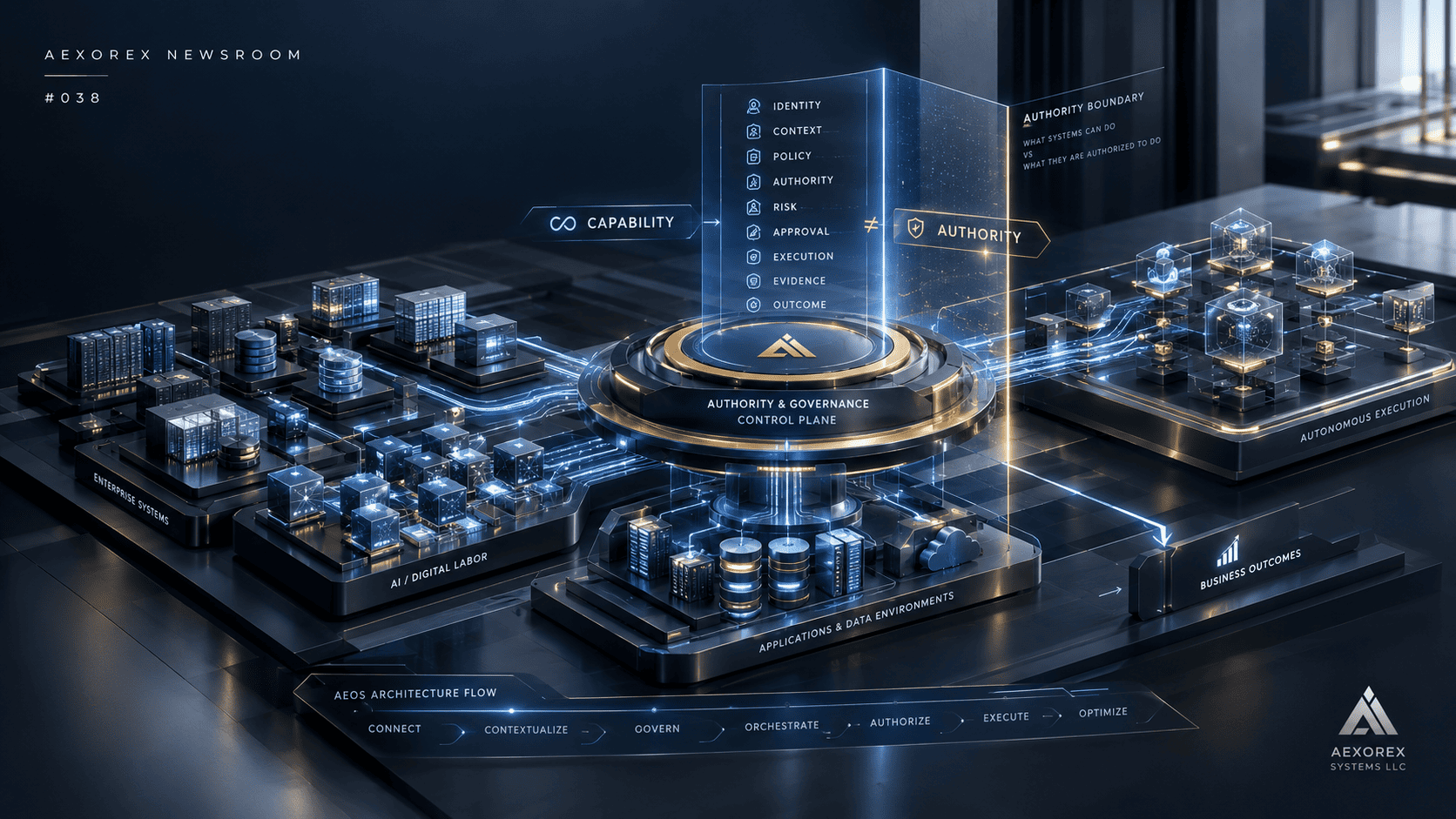
Identity → Context → Policy → Authority → Risk → Approval → Execution → Evidence → Outcome
This is referred to as the Contextual Authority Boundary.
In AexoreX architectural terminology, this is not merely another permission layer. It represents a conceptual control boundary separating what an autonomous system is technically capable of doing from what the enterprise has authorized it to do.
[AEXOREX ARCHITECTURE]
From Connectivity to Governed Execution
The emerging enterprise architecture can be conceptualized as a sequence of stages:
**Connect**: Integrate enterprise applications, data, tools, and services using appropriate integration and interoperability mechanisms.
**Contextualize**: Understand the specific business context surrounding the requested action.
**Govern**: Apply enterprise policies, identity controls, risk constraints, and governance requirements.
**Orchestrate**: Coordinate tasks across various systems and autonomous entities.
**Authorize**: Determine whether the specific action is permitted under the current context.
**Execute**: Allow the authorized action to reach the appropriate enterprise system.
**Optimize**: Capture evidence, evaluate outcomes, and use insights to improve future operations.
This sequence represents the architectural direction AexoreX Systems describes as: Connect → Contextualize → Govern → Orchestrate → Authorize → Execute → Optimize.
[AEXOREX ARCHITECTURE]
The Missing Question Is Not “Can It?”
Historically, enterprise technology has heavily emphasized capability. Questions often centered on:
Can the system connect? Can it automate? Can it predict? Can it reason? Can it call an API? Can it coordinate multiple agents?
The autonomous enterprise introduces a new set of critical questions:
Who authorized it? Under which policy? For which business context? Within what risk boundary? At what financial threshold? With what approval requirement? What evidence will remain after execution?
These questions elevate autonomous enterprise architecture beyond mere AI capability and into the realm of institutional governance.
Execution Must Produce Evidence
Autonomous execution without corresponding evidence creates an accountability problem. An enterprise should be able to determine:
- what entity initiated the action;
- what context existed at the time;
- which policy was evaluated;
- what authority was delegated;
- what risk conditions were identified;
- whether approval was required;
- what action was executed;
- which system was affected;
- what result occurred;
- and what evidence remains.
The goal is not simply to generate another log file. The broader architectural objective is to establish an accountable relationship between:
Authority → Execution → Evidence → Outcome
This is especially critical in regulated, financial, operational, and high-value enterprise workflows.
The Role of AEOS QUANTUM
[AEXOREX ARCHITECTURE]
AexoreX Systems addresses this evolving challenge through the architecture of AEOS QUANTUM™—The Enterprise Intelligence Operating Platform for Autonomous Enterprises.
AEOS QUANTUM™ is not designed as a replacement for ERP, CRM, ITSM, cloud infrastructure, security platforms, or other systems of record. Its architectural premise is distinct: AEOS does not replace the enterprise stack; rather, it connects, orchestrates, governs, and activates it.
Operating under the principle of Vendor Independence by Design™, AEOS QUANTUM™ is engineered for heterogeneous enterprise environments, not dependence on a single application vendor.
Its architectural sequence follows: Connect → Contextualize → Govern → Orchestrate → Authorize → Execute → Optimize.
Within this model, AEOS Enterprise Authority™ represents an AexoreX architectural concept that separates technical capability from delegated enterprise authority.
The conceptual authority chain is:
Identity → Context → Policy → Authority → Risk → Approval → Execution → Evidence → Outcome
This is an AexoreX architectural framework, not an industry standard or a claim of universal enterprise adoption.
Open Protocols and Enterprise Authority Are Complementary
The emergence of MCP and A2A should not be misconstrued as an indication that enterprise architecture no longer requires governance. On the contrary, an opposite architectural lesson can be drawn: as connectivity becomes easier, the importance of defining boundaries around execution increases.
MCP offers a standardized mechanism for interacting with tools and resources. A2A provides a standardized mechanism for agents to communicate. Identity systems establish who or what is acting. Policy engines determine which rules apply. Risk systems evaluate conditions. Approval systems ascertain when human intervention is necessary. Evidence systems preserve the record of execution.
These layers are complementary. The enterprise challenge lies in connecting them into a coherent operating model.
From Digital Labor to Delegated Authority
The rise of digital labor transforms the meaning of enterprise workforce governance. A human employee receives authority through organizational structures, role definitions, policies, approvals, and accountability mechanisms. An autonomous digital worker requires a similar governance model, but one capable of operating at machine speed and across interconnected systems.
This does not imply treating software identically to a human employee. Instead, it recognizes that autonomous execution creates a new governance object: the delegated authority of a non-human operational entity.
Therefore, the enterprise needs to differentiate between:
**Capability**: What the system can technically do. **Identity**: Which entity is acting. **Authority**: What the enterprise has permitted that entity to do. **Context**: Under which circumstances that authority applies. **Risk**: What could happen if the action is executed. **Evidence**: What proves what happened.
This distinction becomes fundamental to autonomous enterprise architecture.
What Is Verified
Several observable developments support this architectural discussion:
MCP has achieved substantial ecosystem adoption and continues to evolve its protocol architecture. A2A has transitioned to Linux Foundation governance, demonstrating broad industry participation and documented enterprise adoption. OWASP has established a dedicated Non-Human Identities Top 10 framework to address risks associated with machine and application identities. NIST SP 800-63-4 represents a current government framework for digital identity proofing, authentication, and federation.
These are independently verifiable developments. Their broader architectural implications remain an active area for analysis.
What Is Interpretation
[INTERPRETATION]
AexoreX Systems interprets these developments as evidence of a significant architectural transition. The industry is increasingly standardizing the mechanisms through which intelligent systems can connect and communicate. The next architectural challenge is to ensure that this increased connectivity does not equate to unrestricted authority.
In other words: Interoperability increases capability. Governance defines boundaries. Authority determines permission. Evidence establishes accountability.
This distinction becomes increasingly important as autonomous execution progresses from isolated experimentation to widespread enterprise operating environments.
What AexoreX Is Building
[AEXOREX ARCHITECTURE / IN DEVELOPMENT]
AexoreX Systems is developing the AEOS QUANTUM™ architecture around the broader concept of enterprise intelligence infrastructure. Its long-term architecture aims to connect enterprise systems, provide contextual intelligence, govern digital labor, coordinate autonomous workflows, authorize actions, activate execution, and continuously optimize outcomes.
Capabilities are being addressed according to their actual maturity, rather than being presented as completed enterprise deployments. The development philosophy is: Build → Deploy Internally → Operate → Observe → Measure → Learn → Improve → Productize.
This reflects an important principle: a capability becomes a stronger candidate for external productization after it has been thoroughly understood through actual operational use and supporting evidence.
[AEXOREX ARCHITECTURE / FUTURE DIRECTION]
The Emerging Autonomous Enterprise
The autonomous enterprise should therefore not be defined merely as an enterprise with more AI agents. A more meaningful definition is an enterprise where intelligent digital labor can operate across business systems within explicitly governed authority boundaries, with observable execution and accountable outcomes.
This requires more than just intelligence; it requires:
Identity. Context. Policy. Authority. Risk control. Approval. Execution. Evidence. Outcome management.
The transition is therefore not simply: Human Workforce → AI Workforce. It is: Manual Operations → Automated Operations → Intelligent Operations → Governed Autonomous Operations.
What Comes Next
The next phase of enterprise architecture will necessitate organizations examining autonomous execution as an operating-model issue, rather than solely an AI implementation issue. Enterprise leaders will need to ask:
1. Which digital entities can currently act? 2. Which systems can they access? 3. Which actions can they perform? 4. Which actions require contextual approval? 5. What financial or operational limits apply? 6. How are permissions revoked? 7. How is delegated authority recorded? 8. How is execution evidenced? 9. How are exceptions escalated? 10. How are outcomes evaluated?
These questions lay the foundation for responsible autonomous operations.
Conclusion
The enterprise AI conversation is evolving beyond simply whether intelligent systems can act. Open protocols are making it increasingly practical for agents to connect, communicate, and interact with enterprise capabilities. This development is significant.
However, capability alone does not establish authority. An agent may be technically capable of executing an action without being authorized to execute that action within a specific business context. This distinction may become one of the defining architectural questions of the autonomous enterprise.
Therefore, the next generation of enterprise infrastructure demands more than just connectivity and intelligence. It requires a governed relationship between:
Identity → Context → Policy → Authority → Risk → Approval → Execution → Evidence → Outcome
This is the architectural space AexoreX Systems is exploring through AEOS QUANTUM™.
Because the central question of autonomous enterprise operations is no longer simply: "Can the system do it?"
It is: "Under whose authority, under what conditions, with what controls, and with what evidence?"
And that is where capability transitions into enterprise authority.
Sources and attribution
- AexoreX Newsroom — AexoreX Systems LLC · statement link
About the author
AexoreX Technology Desk is the newsroom's editorial desk covering enterprise technology, artificial intelligence, digital labor, automation, and emerging enterprise systems.
More from AexoreX Technology Desk →Related stories
- Governing Autonomous Execution: Enterprise Control Planes and the Shift to Digital Labor
- The Non-Human Identity Shift: Why Enterprise Autonomy Demands a Governed Control Plane
- AexoreX Systems Introduces AEOS Enterprise Authority™ as Governance Layer for Autonomous Enterprise Intelligence
- AexoreX Systems Advances AEOS QUANTUM™ as Enterprise Intelligence Operating Platform for Autonomous Enterprises
- Enterprise Intelligence Infrastructure and Governed Autonomy: The Architectural Foundation for the Autonomous Enterprise
- From Enterprise Intelligence to Governed Autonomous Execution: The Next Step Toward the Autonomous Enterprises
- Authoritative Control Planes for Autonomous Digital Labor: Identity, Authority & Verifiable Execution
- The Infrastructure Behind the Autonomous Enterprise: Building the Foundation for Enterprise Intelligence
- Governing Digital Labor: Bridging Capability and Authority in Autonomous Enterprise Architecture
- #025 — The Enterprise AI Inflection Point: From AI Agents to Governed Autonomous Operations