
Execution, Evidence & Optimization
When AI Moves From Intelligence to Action
Enterprise AI is shifting from providing recommendations to performing actions, necessitating three integrated capabilities: Execution, Evidence, and Optimization.
Opinion · AI-assisted, human edited
Over the past several years, enterprise AI has primarily been evaluated by its ability to understand language, discover information, summarize documents, generate content, and assist human decision-making. This focus is now evolving.
The central question is no longer just, "What can AI answer?" Instead, it is increasingly, "What can AI do—and how can an enterprise prove that the action was correct?"
This shift signifies a major change in enterprise architecture. AI is moving beyond merely assisting users to systems capable of performing tasks, interacting with multiple systems, calling tools, modifying data, triggering workflows, and completing work within defined boundaries.
Gartner projects that 40% of enterprise applications will incorporate task-specific AI agents by the end of 2026, a significant increase from less than 5% in 2025. Furthermore, Gartner anticipates that by 2027, one-third of agentic AI implementations will combine agents with different capabilities to support more complex tasks.
However, the capacity for AI to act introduces a new requirement. While AI providing recommendations primarily produces informational output, AI that executes work generates operational consequences. Consequently, enterprise AI capable of action necessitates three interconnected capabilities: Execution, Evidence, and Optimization.
AI must be able to perform work, the enterprise must be able to prove what transpired, and the system must be able to use those outcomes to improve future operations.
From Recommendation to Execution
Generative AI has transformed how individuals interact with software. Yet, in many early implementations, humans remained the crucial link between an AI recommendation and the actual business action. This process typically involved AI providing a recommendation, a human reviewing it, opening the relevant application, performing the action, and then verifying the result.
Agentic AI introduces a different architectural possibility. An agent can be empowered to plan a task, select tools, call APIs, retrieve information from enterprise systems, and execute a sequence of actions within predefined constraints. The fundamental difference is not merely the ability to generate text, but the capacity to perform work through connected systems.
For instance, the Model Context Protocol (MCP) was developed as an open standard to connect AI models with external data sources and tools. Its ongoing development highlights a growing focus on enterprise workflows, security, authorization, and operational use cases. Similarly, Google's Agent2Agent Protocol (A2A) enables agents built with different frameworks and from various vendors to communicate, exchange information, and coordinate within enterprise environments.
The trend is clear: AI is no longer confined to operating within a single application. It can become an integral part of a network encompassing systems, tools, workflows, and other agents. However, with greater ability to act comes a greater need to control those actions.
Execution Requires Authority
Providing an AI access to tools is distinct from granting it unrestricted authority. Within an enterprise, the technical ability to perform an action must be separated from the authorization to do so. An agent might technically be able to access a database but lack authorization to modify its records. It might be able to call a payment API but not be authorized to initiate a financial transaction. An agent could potentially modify a system configuration, yet the action itself may require human approval.
Therefore, agentic enterprise architecture requires a control layer to determine: - Who or what is executing the action. - Which actions are permitted. - Which systems may be accessed. - Which data may be used. - What financial and operational limits apply. - When human approval is required. - When execution must be stopped. - How the activity can be reviewed afterward.
Salesforce's Agentforce Builder, for example, utilizes a graph-based engine to create more structured and predictable agent workflows, separating conversational and workflow components. This illustrates a key principle: autonomy without control is not enterprise autonomy. True enterprise autonomy demands bounded authority—authority that is explicitly delegated, measurable, constrained, and revocable.
Evidence: Every Action Needs a Trace
When AI solely generates text, an error typically manifests as an incorrect answer. However, when AI begins executing actions, an error can escalate into an operational event.
Consider an AI agent processing an order cancellation. It might need to verify order status, determine eligibility under cancellation policy, confirm payment status, initiate a refund, update the ERP system, and notify the customer. If this process fails, the enterprise needs to ask not just "What did the AI answer?" but rather, "What did the AI actually do?" Further questions arise: "Which data did it use?" "Under whose authority?" "Which tools were called?" "When did each action occur?" and "What was the result of every step?"
This highlights why Evidence is a fundamental architectural capability. Modern observability provides a foundation for connecting activity across distributed systems through traces, spans, metrics, and logs. OpenTelemetry has developed GenAI semantic conventions that cover attributes related to agents, models, inputs, outputs, data sources, and evaluations. The goal is not merely to collect more logs, but to structure telemetry to enable organizations to understand the relationships between operations. A trace can reveal how a user request evolves into a sequence of actions, such as: User Request → Agent → Tool Call → Database → External API → Result. This allows an enterprise to pinpoint where, when, and under what conditions a failure occurred, moving beyond simply knowing that "something failed."
Evidence Is Also a Governance Layer
Evidence serves a purpose beyond debugging; it is an integral part of governance. In enterprise systems, AI activity must be traceable so organizations can investigate incidents, manage risk, evaluate system behavior, and, when applicable, support regulatory compliance and audit processes.
Regulation is also increasing the importance of traceability and human oversight. The EU AI Act, for instance, does not have a single universal compliance date; different obligations apply based on system classification and regulatory scope, with varied implementation timelines for different categories of high-risk AI systems. The European Commission's framework provides the current structure and milestones.
For enterprises, the practical implication is significant: AI category dictates risk, which in turn defines obligations, timelines, and required evidence. In highly regulated environments, the ability to reconstruct system activity can become a crucial component of operational governance. Ultimately, evidence transforms an AI action from an isolated event into an accountable enterprise event.
The Reliability Problem
Another challenge often overshadowed by agentic AI demonstrations is the reliability of multi-step workflows. The longer a workflow, the more opportunities there are for failure.
Consider a simplified mathematical example where each independent step has a 95% probability of success: - 1 step: 95% - 10 steps: 0.95¹⁰ ≈ 59.9% - 20 steps: 0.95²⁰ ≈ 35.8%
While this is a simplified reliability model and doesn't imply that every real-world AI agent has 95% accuracy per step, or that enterprise workflow steps are always independent, the underlying principle is crucial: multi-step workflows demand substantially higher reliability than individual interactions. A single failure can halt a workflow, trigger a retry, necessitate human escalation, or create a state requiring recovery.
Therefore, agentic AI development cannot focus solely on improving the quality of an individual model response. It must optimize the reliability of the complete workflow.
Optimization: Learning From What Actually Happened
Execution generates actions, and evidence produces data about those actions. However, neither is sufficient on its own to drive continuous improvement; that is the role of Optimization.
An enterprise needs to understand: - Which actions succeeded and which failed. - Which tools generate the most failures. - Which steps lead to human escalation. - Which workflows are unnecessarily expensive. - When an agent requires excessive retries. - When human intervention is necessary. - Whether the final outcome delivers actual business value.
Modern optimization involves several layers: - **Tool Design:** Tool descriptions, parameters, schemas, and permissions must be clear enough for agents to select and use tools correctly. - **Workflow Design:** Unnecessary steps can be removed, simplified, or redesigned. - **Permission Design:** Agent access can be tightened according to task requirements and risk. - **Evaluation:** Workflows can be tested against representative scenarios before and after changes. - **Process Analysis:** Execution traces can reveal bottlenecks, repeated actions, failures, and deviations from expected processes. - **Economic Optimization:** Model costs, tool calls, latency, infrastructure consumption, and operational outcomes can be evaluated together.
Optimization, therefore, means more than just "making the AI smarter"; it means "making the entire system work better."
Execution → Evidence → Optimization
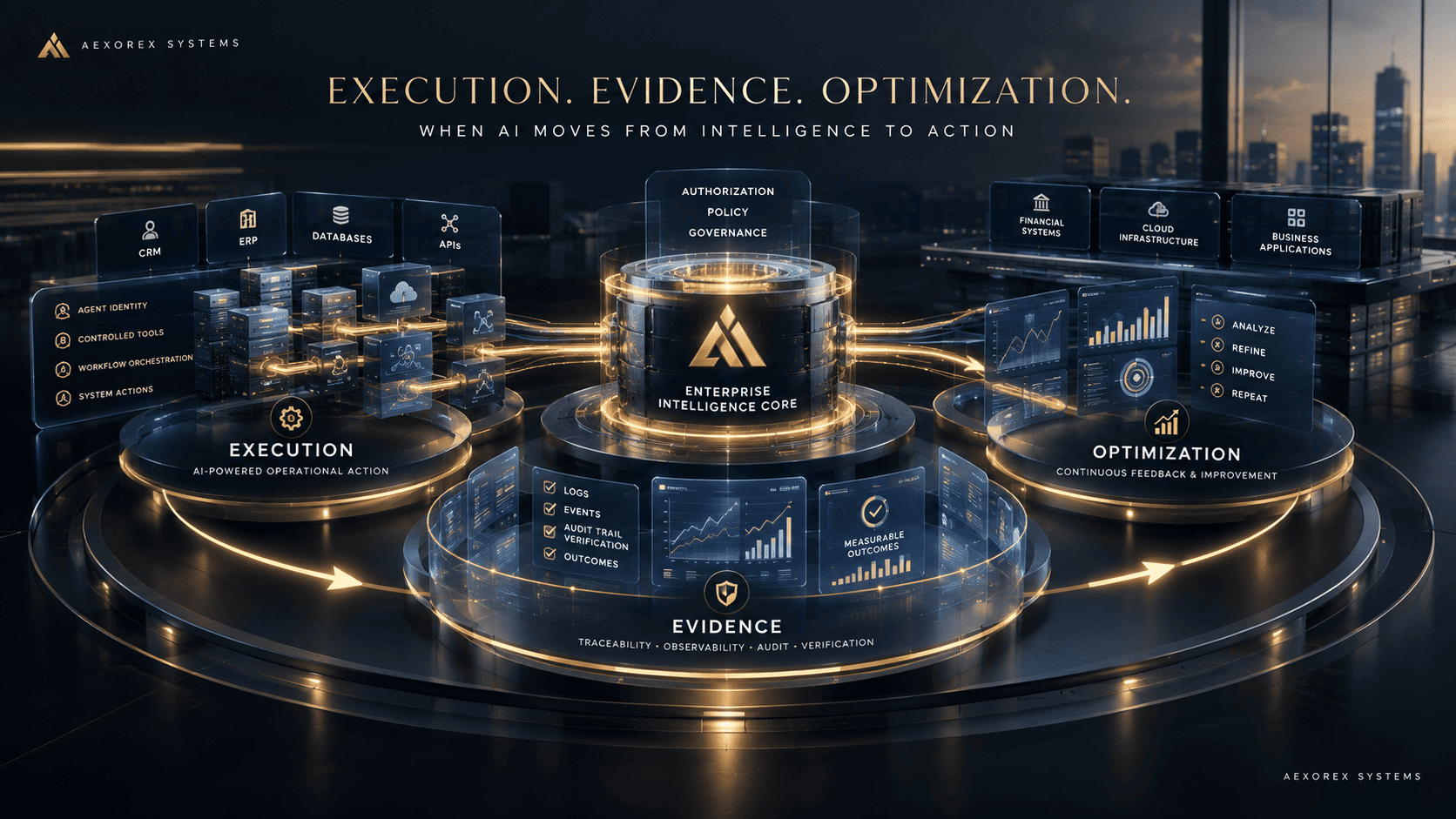
These three pillars form a continuous operational cycle: - **EXECUTION:** AI performs the work. - **EVIDENCE:** The system records what happened and the results. - **OPTIMIZATION:** The enterprise analyzes those results and improves the system. - **EXECUTION:** Those improvements are applied to future workflows.
This can be understood as a closed-loop operational intelligence system. Without Execution, AI remains primarily a recommendation layer. Without Evidence, the enterprise lacks sufficient visibility into what the AI actually did. Without Optimization, the same problems can persist. Therefore, these three components must be designed as a single, integrated system.
| Pillar | Core Question | | :----------- | :--------------------------------------------------------------- | | Execution | What did the AI do? | | Evidence | What proves that it happened, under what authority, and with what result? | | Optimization | What should change based on the outcome? |
In this model, AI does not merely generate an output; it becomes an integral part of the enterprise operating loop.
The Industry Is Building the Control Layer
The enterprise technology landscape increasingly shows that companies are not only competing to make AI agents more capable, but also to build mechanisms to control, observe, secure, evaluate, and measure those agents.
ServiceNow, for example, has expanded its AI Control Tower to help enterprises discover, observe, govern, secure, and measure AI deployed across various enterprise environments. Salesforce continues to develop Agentforce around structured agent workflows, including Agentforce Builder and the Atlas Reasoning Engine.
Meanwhile, interoperability initiatives like MCP and A2A point toward a more connected agent ecosystem where AI systems can interact with tools, enterprise data, applications, and other agents. However, increased interoperability also introduces more connections that must be secured, authorized, monitored, and governed. The growth of agentic AI is therefore not just a model problem; it is an enterprise architecture problem.
The Reality Check
Gartner has cautioned that over 40% of agentic AI projects could be canceled by the end of 2027 due to rising costs, unclear business value, or inadequate risk controls, also identifying integration complexity with legacy systems as a major challenge. Gartner has also warned that enterprises might downgrade or deactivate autonomous AI agents as governance gaps become apparent through production incidents.
These warnings do not indicate the failure of agentic AI. Instead, they highlight a different reality: the technical ability to make an agent act does not automatically create the organizational capability to operate that agent safely, reliably, and economically. This is the fundamental difference between an AI demonstration and an enterprise system.
A demonstration asks, "Can AI do this?" An enterprise asks, "Can AI do this consistently, safely, measurably, accountably, and with demonstrable business value?" The second question is considerably more complex.
From AI Capability to Enterprise Capability
Enterprise AI is increasingly shifting from model-centric thinking toward system-centric thinking. While the model, reasoning, and context remain important, each is merely one component of a larger operating system.
An enterprise AI operating environment requires: - **Intelligence** to understand. - **Context** to know the situation. - **Authority** to determine what may be done. - **Orchestration** to coordinate work. - **Execution** to perform actions. - **Evidence** to establish what happened. - **Optimization** to improve outcomes.
From this perspective, the future of enterprise AI will not be solely determined by increasingly capable models. It will also depend on how organizations build systems capable of converting intelligence into governed action.
The AexoreX Perspective
For AexoreX Systems, this development reinforces a principle increasingly crucial in the journey toward autonomous enterprises: intelligence alone is insufficient. An enterprise can possess highly capable AI models yet still lack autonomous operations. Autonomy demands more than reasoning; it requires authority, orchestration, execution, evidence, and continuous optimization.
This conceptual direction underpins AEOS QUANTUM™, an Enterprise Intelligence Operating Platform designed around the connection of enterprise context, intelligence, authority, Digital Labor, orchestration, execution, governance, evidence, and optimization. The principle is straightforward: AI should not merely know what to do; it should operate within what the enterprise authorizes it to do. Actions with operational consequences should be able to: Execute. Prove. Improve.
Conclusion — The Next Enterprise AI Test
Enterprise AI is entering a phase where the ability to generate answers is no longer the sole measure of progress. The more significant question is whether AI can help execute real work without sacrificing human oversight, governance, security, traceability, and accountability.
Execution provides the ability to act. Evidence provides the ability to know what happened. Optimization provides the ability to improve. Together, they form a continuous cycle: Execution → Evidence → Optimization. When this cycle is integrated with intelligence, authority, context, and orchestration, AI begins to transition from software that assists work to infrastructure that enables intelligent work execution.
The journey toward the autonomous enterprise is therefore not simply about making AI more autonomous. It is about making autonomy governable.
Sources and attribution
- AexoreX Systems — Original Editorial Visual · statement link
About the author
Intelligence desk of AexoreX Newsroom.
More from AexoreX Intelligence Desk →Related stories
- From Enterprise Intelligence to Governed Action
- AexoreX Systems Advances AEOS QUANTUM™ as Enterprise Intelligence Operating Platform for Autonomous Enterprises
- From Enterprise Intelligence to Governed Autonomous Execution: The Next Step Toward the Autonomous Enterprises
- Beyond AI: Building the Enterprise Operating Model for Intelligence, Digital Labor, Governance, and Execution.
- The Infrastructure Behind the Autonomous Enterprise: Building the Foundation for Enterprise Intelligence
- #025 — The Enterprise AI Inflection Point: From AI Agents to Governed Autonomous Operations