
Financial Authority: Governing Autonomous Spending in the Agentic Enterprise
From Execution-Time Authorization to Governed Financial Autonomy
As AI agents gain financial execution capabilities, enterprises require a distinct governance layer, termed Financial Authority, to ensure actions are authorized, bounded, and attributable.
Opinion · AI-assisted, human edited
Executive Summary
Enterprise artificial intelligence is shifting from systems that primarily generate information to those capable of taking action. AI agents can increasingly interact with enterprise applications, retrieve information, invoke tools, coordinate workflows, communicate with external systems, and participate in more consequential operational processes. In financial environments, this evolution raises a question deeper than whether an AI system can technically execute a transaction: What gives that system the authority to cause enterprise money to move?
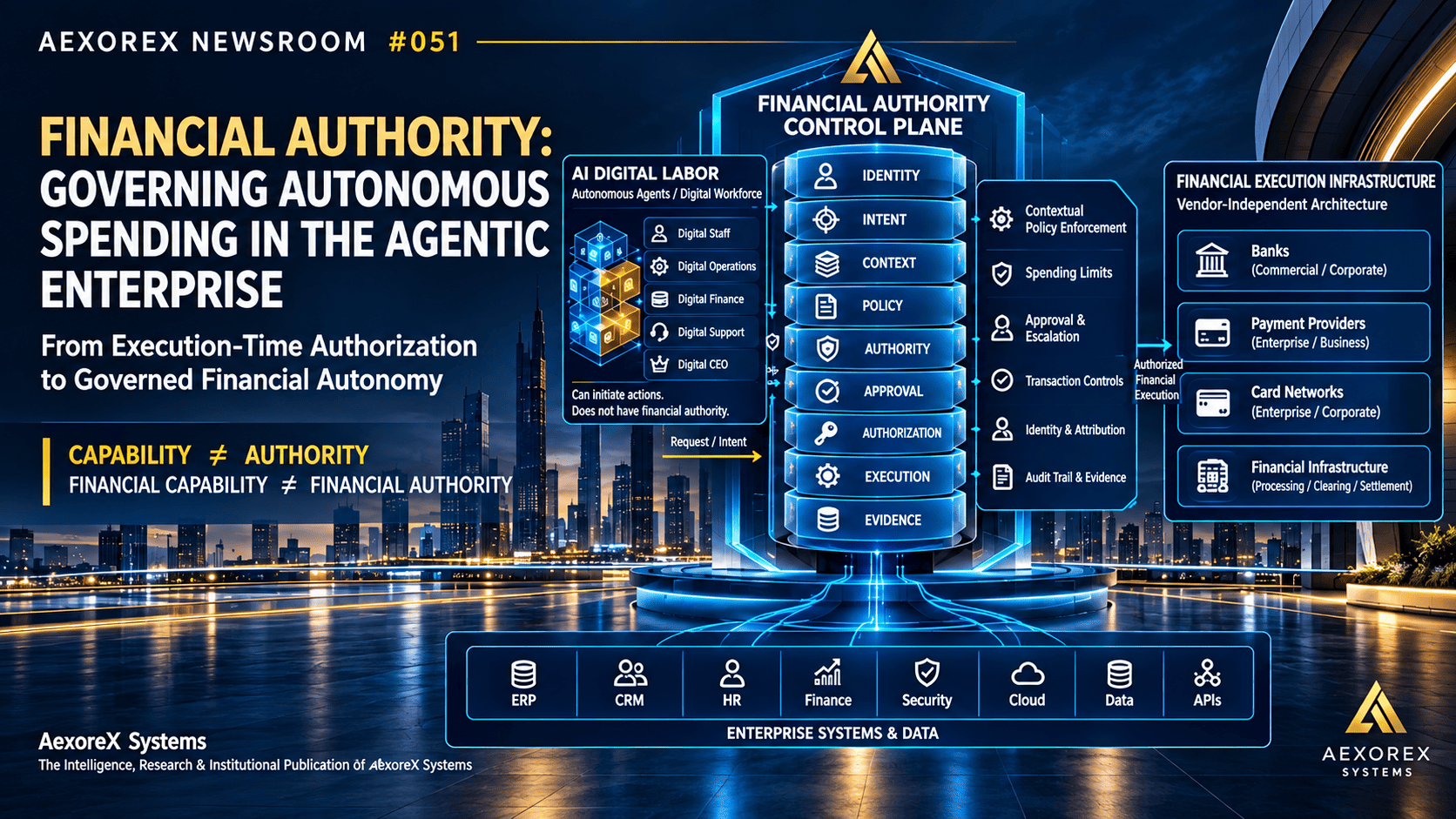
The distinction matters. An AI agent may possess an API credential or access to a procurement system, an expense platform, a virtual card, a payment endpoint, or another financial service. However, technical capability alone does not establish that a particular financial action is authorized within the enterprise context. This creates an architectural distinction that will become increasingly important as Digital Labor becomes more operational: Capability ≠ Authority, and specifically, Financial Capability ≠ Financial Authority.
AexoreX Newsroom #050 examined this problem through the concept of Execution-Time Authority Attenuation, where delegated authority must remain bounded, attributable, and verifiable as an action moves through execution chains. #051 extends that principle into financial operations.
The central proposition explored in this research is that autonomous financial execution requires an explicit governance layer capable of evaluating identity, delegated authority, purpose, context, policy, limits, approval, escalation, evidence, and revocation before a consequential financial action is executed. AexoreX refers to this conceptual layer as Financial Authority.
This is not presented as an established industry-standard term, but as an AexoreX architectural framework for examining an emerging problem at the intersection of enterprise intelligence, agentic systems, governance, and financial infrastructure. The objective is not to replace banks, payment processors, card networks, or financial infrastructure, but to question whether enterprise authority should remain independent from the infrastructure through which financial execution ultimately occurs.
The New Authority Problem
For decades, enterprise software has relied on familiar mechanisms for controlling access, including usernames and passwords, roles, permissions, service accounts, API keys, OAuth credentials, application roles, approval workflows, and transaction limits. These mechanisms remain important.
However, agentic systems introduce a different operational model. A conventional application generally performs actions according to deterministic application logic. An AI agent, in contrast, can interpret changing context, select tools, formulate intermediate objectives, call multiple systems, and potentially delegate or coordinate actions across other agents. The result is a new chain: Intent → Reasoning → Tool Selection → Delegation → Execution.
When that chain eventually reaches a financial system, a conventional permission model may answer only one question: Can this credential perform this API operation? Enterprise governance requires additional questions: Should this actor perform it? On whose behalf? For what purpose? Under which policy? Within what financial boundary? Under the current context? With what evidence? And what happens if the transaction exceeds that authority? The difference between these two groups of questions is the beginning of the Financial Authority problem.
From Execution-Time Authority to Financial Authority
AexoreX Newsroom #050 established a foundational principle: Authority must not become broader merely because execution is delegated downstream. That principle becomes more consequential when the final action has a direct financial effect.
Consider a simplified enterprise chain: Human Principal → Digital Labor → Procurement System → Payment System → Financial Infrastructure → Money Movement. At each transition, authority can potentially become obscured. The original human instruction may have been: “Purchase the approved software subscription within the existing department budget.” But downstream systems may see only: “Create payment.” The payment infrastructure may see only: “Authorize transaction for amount X.” The financial rail may know whether the credential is valid, but not necessarily why the enterprise believes the transaction should exist.
This creates a structural separation between technical permission and institutional authority. The purpose of Financial Authority is to make that distinction explicit.
Capability Is Not Authority
An AI system can have capability without authority. A service account can have permission without being the appropriate principal for a particular transaction. A virtual card can be valid while a particular purchase is outside the intended business purpose. A payment API can be available while the transaction violates an enterprise policy.
This distinction is consistent with a broader security principle identified by the OWASP GenAI Security Project. OWASP's 2025 guidance identifies LLM06:2025 Excessive Agency as a risk arising when an AI system has excessive functionality, permissions, or autonomy. Its recommended mitigations include minimizing available functionality and permissions, applying authorization in downstream systems, and maintaining monitoring and rate limits. The implication for financial systems is straightforward: Giving an agent the ability to pay is not the same as determining that the agent should pay. Financial authority therefore requires a separate evaluation.
What Is Financial Authority?
Within the AexoreX conceptual framework, Financial Authority is a governed, contextual, attributable permission to cause a financial action within explicitly defined enterprise boundaries. The definition deliberately contains several dimensions. It is:
- Governed: because enterprise policy determines the permitted boundary.
- Contextual: because authority may depend on the circumstances surrounding the transaction.
- Attributable: because the enterprise must be able to determine who or what acted and under whose authority.
- Bounded: because authority must have explicit limits.
- Revocable: because authority must be capable of being withdrawn.
- Execution-specific: because possessing general access should not automatically authorize every transaction.
The question therefore changes from: Can the agent pay? to: Is this specific financial action authorized under the current enterprise context?
The Twelve Dimensions of Financial Authority
AexoreX proposes a conceptual framework consisting of twelve dimensions:
1. **Actor:** Which Digital Labor, service identity, employee, or automated process is initiating the action? 2. **Principal:** On whose behalf is the action being performed? 3. **Purpose:** What legitimate business objective does the transaction serve? 4. **Scope:** Which categories of financial action are permitted? 5. **Limit:** What monetary, frequency, cumulative, or exposure limits apply? 6. **Context:** What relevant conditions exist at the time of authorization? This may include budget status, project state, vendor status, transaction timing, or other enterprise context. 7. **Policy:** Which enterprise policies and control rules govern the action? 8. **Approval:** Does the transaction require human approval, multiple approvals, or another authorization threshold? 9. **Evidence:** What evidence demonstrates that the transaction satisfied the required conditions? 10. **Escalation:** What happens when the transaction exceeds the delegated boundary? 11. **Revocation:** How can authority be suspended, withdrawn, or invalidated? 12. **Attribution:** Can the enterprise establish a defensible relationship between the transaction, the acting system, the delegated authority, and the responsible principal?
Together, these dimensions provide a conceptual foundation for moving from generic access control toward contextual financial authorization. This framework is an AexoreX conceptual model, not an assertion of an existing industry standard.
Financial Authority as a Control Plane
The architectural implication is significant. Financial authority should not necessarily be embedded entirely inside the payment rail. Instead, an enterprise can conceptually separate two planes:
**Financial Authority Control Plane:** Responsible for: - identity resolution - authority mapping - delegation - business context - policy evaluation - spending limits - approval - escalation - evidence - revocation - attribution
**Financial Execution Plane:** Responsible for: - payment processing - card network execution - account ledgering - clearing - settlement - regulated financial services - applicable financial controls
This separation does not mean that financial infrastructure becomes untrusted or irrelevant. It means the enterprise's business authority model can remain distinct from the infrastructure used to execute a transaction. The architecture becomes: Enterprise Intent → Financial Authority → Authorization → Financial Infrastructure → Execution → Evidence.
This separation can support vendor independence while allowing enterprises to use different financial providers according to geography, capability, regulatory requirements, cost, or business need.
The Rise of Agentic Payment Infrastructure
The industry is already beginning to address portions of this problem. Google's Agent Payments Protocol (AP2), for example, introduces typed mandates designed to establish verifiable authorization and transaction guardrails. Google describes an IntentMandate for defining constraints such as merchants and spending limits, a PaymentMandate tied to a specific transaction, and a payment receipt that closes the audit trail. Google's broader Universal Commerce Protocol (UCP), introduced in 2026, is designed to support agentic commerce across businesses, consumers, and payment providers and is designed to work with AP2 for agentic payment support.
These developments are important because they demonstrate an emerging industry pattern: agentic execution increasingly requires explicit authorization artifacts and verifiable transaction boundaries. But enterprise financial authority is a larger problem. A payment protocol can help establish authorization for a transaction. An enterprise still needs to determine: whether the agent was allowed to initiate that transaction; whether the business purpose was legitimate; whether the spending belongs to the correct budget; whether the vendor is permitted; whether another enterprise system contains contradictory information; whether the agent exceeded delegated authority elsewhere; whether escalation is required; and whether the entire chain can later be reconstructed. That is the architectural territory explored by Financial Authority.
Digital Labor Has No Intrinsic Authority
AexoreX uses the term Digital Labor to describe software-based autonomous or semi-autonomous workers operating within enterprise processes. Within the AexoreX architectural model, Digital Labor has no intrinsic authority. Its authority must come from explicit delegation. That delegation should remain bounded, contextual, attributable, policy-controlled, monitored, and revocable.
This becomes particularly important in multi-agent environments. Agent A may delegate a task to Agent B. Agent B may invoke Agent C. Agent C may ultimately interact with a payment system. The architectural question is therefore not simply: “Does Agent C have permission?” It is: “What authority, if any, was legitimately delegated from the original principal through the chain to Agent C?”
Non-Expansion of Delegated Authority
This leads to another AexoreX principle: Delegation may transfer authority, but it must not silently create greater authority. A downstream agent should not acquire broader financial authority merely because it has access to a more powerful tool.
For example: Principal authority: Approved software purchases up to a defined limit. ↓ Agent A: Procurement selection. ↓ Agent B: Vendor coordination. ↓ Agent C: Payment execution.
Agent C should not suddenly acquire authority to purchase unrelated products simply because the payment API permits it. The execution capability of the downstream system must remain subordinate to the original authority boundary. This is the financial extension of the execution-time authority principle developed in #050.
Human + Digital Labor Delegation
AexoreX's conceptual delegation model uses four authority levels:
- **D1 — Recommend:** Digital Labor analyzes and recommends; Human executes.
- **D2 — Decide:** Digital Labor prepares or determines an action; Explicit authorization required before execution.
- **D3 — Decide & Execute:** Digital Labor acts within defined boundaries; Bounded autonomous execution.
- **D4 — Control & Escalate:** Supervisory authority; Monitor, intervene, escalate, revoke.
These levels are not intended to suggest that every enterprise should adopt the same hierarchy. They provide an architectural vocabulary for describing different degrees of delegated authority. The critical distinction is between autonomy and authority. An agent can be highly autonomous in how it performs a task while remaining tightly constrained in what it is permitted to do. That is the foundation of governed autonomy.
Governed Financial Autonomy
A reference architecture for governed financial autonomy can therefore be expressed as:
1. **Intent:** A human or Digital Labor proposes a financially consequential action. 2. **Identity Resolution:** The system identifies the actor and the relevant principal. 3. **Contextualization:** The enterprise determines the business context surrounding the request. 4. **Policy Evaluation:** Applicable financial, procurement, security, and organizational policies are evaluated. 5. **Authority Evaluation:** The system determines whether the proposed action falls within delegated authority. 6. **Approval or Escalation:** Transactions outside the permitted boundary are routed to the appropriate authority. 7. **Authorization:** A bounded authorization is generated for the permitted action. 8. **Execution:** The transaction is passed to the appropriate external financial infrastructure. 9. **Evidence:** The authorization and resulting execution are recorded as attributable evidence. 10. **Monitoring:** The enterprise monitors subsequent behavior and exceptions. 11. **Revocation:** Authority can be suspended if conditions change or risk increases. 12. **Optimization:** Operational results can inform future policy refinement without automatically expanding authority.
The essential ordering is: Authorization precedes execution.
Evidence Is Not an Afterthought
A financial control architecture cannot rely exclusively on post-transaction reporting. Evidence should exist throughout the authorization lifecycle. A meaningful evidence chain may need to establish: Who acted? What did they request? What did the system understand the purpose to be? Which policies were evaluated? Which authority boundary applied? What approval occurred? What authorization was issued? Which financial infrastructure executed the transaction? What was the resulting outcome?
This is particularly important as enterprise systems become increasingly distributed. Without attributable evidence, an enterprise may know that money moved without being able to reconstruct the complete authority chain that permitted it.
Security: Reducing the Blast Radius
Agentic financial systems introduce familiar security risks in new combinations: - **Excessive Agency:** An agent possesses more functionality, permissions, or autonomy than its task requires. - **Prompt Injection:** Malicious or manipulated information influences agent behavior. - **Tool Misuse:** A legitimate tool is used outside its intended operational purpose. - **Privilege Abuse:** A downstream identity possesses permissions broader than necessary. - **Delegation Drift:** Authority changes as a task moves between agents and systems. - **Runaway Automation:** A system repeatedly performs transactions because an exception or feedback loop is not properly controlled.
The appropriate response is not simply “add a human.” Human approval is valuable, but approval processes can themselves become bottlenecks or create approval fatigue. The stronger architectural approach is layered: least privilege, policy enforcement, contextual authorization, transaction limits, monitoring, escalation, revocation, and human accountability where appropriate.
OWASP's guidance specifically emphasizes downstream authorization, least privilege, monitoring, and rate limiting as mechanisms for reducing the impact of excessive agency. The objective is not to eliminate autonomy; it is to constrain its blast radius.
Financial Autonomy and Treasury
The Financial Authority question extends beyond procurement and corporate cards. It can eventually include accounts payable, accounts receivable, expense management, treasury operations, liquidity management, foreign exchange, subscription management, procurement, supplier payments, and working-capital optimization.
Research from the Bank for International Settlements has already examined generative-AI agents in intraday liquidity management and found that experimental agents could reproduce aspects of established cash-management practices under simulated conditions, while also emphasizing the need for safeguards and policy consideration. This illustrates an important direction: AI may increasingly assist with decisions involving money. But decision capability does not remove the need for authority architecture. The more consequential the action, the more important the boundary between intelligence and authorization becomes.
Regulatory Reality
Financial autonomy operates inside an existing regulatory environment. The relevant obligations differ by jurisdiction, institution, activity, and role. No single global regulatory framework governs every AI-enabled financial action. In the European Union, the Digital Operational Resilience Act (DORA) establishes requirements concerning ICT risk and operational resilience for covered financial entities and has generated implementing and delegated measures covering areas such as ICT-related incident reporting and critical ICT third-party arrangements.
AI governance, payment regulation, cybersecurity, outsourcing, operational resilience, identity, fraud prevention, and financial-sector requirements can therefore intersect. The architectural lesson is broader than compliance: Financial autonomy requires accountable control boundaries, even when the precise regulatory obligations vary by jurisdiction. A responsible architecture must therefore distinguish regulatory responsibility from technical capability, from enterprise authority, from payment execution. No AI system should be treated as a substitute for the legal or regulatory responsibilities of the organization operating it.
The Emerging Architectural Boundary
The market is increasingly populated by specialized systems: - AI models and agent frameworks provide intelligence and tool interaction. - Enterprise applications provide business processes and systems of record. - Identity platforms provide authentication and access management. - Financial infrastructure provides accounts, cards, payment processing, settlement, and related services. - Payment protocols can establish transaction-level interaction and authorization mechanisms. - Governance and security platforms provide monitoring, controls, and risk management.
The architectural question is therefore changing. It is no longer simply: “Which system can execute the payment?” It becomes: “Which system determines whether the enterprise should authorize the payment in the first place?” This distinction creates an opportunity for a dedicated enterprise authority layer. That is the problem space Financial Authority is designed to explore.
AEOS QUANTUM and the Authority Layer
AexoreX Systems approaches this problem from the enterprise intelligence layer. AexoreX Systems positions itself as "The Global Enterprise Intelligence Infrastructure Company." Within that direction, AEOS QUANTUM is "The Enterprise Intelligence Operating Platform for Autonomous Enterprises." Its architectural principle remains: AEOS does not replace the enterprise stack. AEOS connects, orchestrates, governs, and activates it.
Financial Authority therefore does not imply that AEOS QUANTUM becomes a bank, card network, payment processor, or regulated financial institution. Instead, the conceptual architecture places AEOS between enterprise intent and the infrastructure used to execute that intent. The broader AEOS operating sequence remains: Connect → Contextualize → Govern → Orchestrate → Authorize → Execute → Optimize, with Evidence operating across the lifecycle. Financial Authority can therefore become a specialized authority capability within the larger AEOS governance model.
The Future AEOS QUANTUM Financial Ecosystem
As a future architectural direction under active development, AexoreX is exploring how Financial Authority could extend into dedicated financial execution surfaces: - **AEOS QUANTUM Card™:** A future card-oriented execution surface designed around governed spending authority, contextual limits, and enterprise policy. - **AEOS QUANTUM Wallet™:** A future wallet-oriented capability designed to provide governed control over financial balances and permitted use. - **AEOS QUANTUM Pay™:** A future payment orchestration capability designed to translate enterprise-authorized financial actions into execution requests across appropriate external financial infrastructure.
These concepts are intentionally separated from the underlying regulated financial infrastructure. The architectural objective is: Enterprise Authority → AEOS QUANTUM → Financial Authority → Card / Wallet / Pay → External Financial Infrastructure → Financial Execution.
This preserves Vendor Independence by Design™, meaning the underlying infrastructure can evolve without requiring enterprise authority to become permanently coupled to a single financial provider. These capabilities represent future architectural directions under active development, not claims of currently available regulated financial products or services.
The Broader Implication
Financial Authority should not be understood only as a payment-control mechanism. It represents a broader shift in enterprise architecture. As Digital Labor becomes capable of acting across more systems, organizations will increasingly need to distinguish between what the system can do and what the system is authorized to do.
That distinction applies to money, data, procurement, contracts, infrastructure, customer operations, security, communications, and enterprise resources. Financial execution simply makes the problem particularly visible because the consequence is measurable. Money moves. A transaction settles. A budget changes. A liability is created. The enterprise therefore needs an authority model that can withstand the transition from intelligence to action.
From Autonomous Execution to Governed Autonomy
The next generation of enterprise AI will not be defined solely by how intelligent an agent becomes. It will also be defined by how precisely an organization can govern the actions that intelligence is allowed to cause. The architecture of autonomous enterprises therefore requires more than models, tools, APIs, workflows, and payment infrastructure. It requires an explicit relationship between Identity → Authority → Intent → Context → Policy → Authorization → Execution → Evidence. That relationship becomes particularly important when execution can move money. The central principle is therefore simple: Capability does not create authority. And for financial operations: Financial capability does not create financial authority.
Conclusion
The transition from assistive AI to executable Digital Labor changes the architecture of enterprise control. When an AI system can recommend a purchase, the primary concern may be accuracy. When it can negotiate with a supplier, the concern expands to delegation and accountability. When it can initiate a payment, the organization must answer a more fundamental question: Who authorized the money to move?
That question cannot be answered reliably by API capability alone. It requires a contextual authority model connecting the actor, principal, purpose, scope, limits, policy, approval, evidence, escalation, revocation, and attribution. This is the problem that AexoreX defines through the concept of Financial Authority.
The objective is not to prevent autonomy; it is to make autonomy governable. The objective is not to replace financial infrastructure; it is to place enterprise authority above the execution infrastructure. And the objective is not to give Digital Labor unrestricted power; it is to enable Digital Labor to operate within explicit, measurable, attributable boundaries.
As enterprise systems evolve toward greater autonomy, the critical architectural question may therefore no longer be: “What can the agent do?” It may increasingly become: “What is the enterprise willing to authorize the agent to do?” That is the transition from execution capability to governed financial autonomy, and it may represent one of the foundational control problems of the autonomous enterprise.
Sources and attribution
- AexoreX Intelligence & Institutional Research · statement link
About the author
Intelligence desk of AexoreX Newsroom.
More from AexoreX Intelligence Desk →Related stories
- Governing Autonomous Execution: Enterprise Control Planes and the Shift to Digital Labor
- The Non-Human Identity Control Plane: Dynamic Authority and Traceable Delegation for Autonomous Enterprise Operations
- The Identity-to-Execution Seam: Governing Non-Human Identities and Dynamic Delegation in Autonomous Enterprise Operations
- AexoreX Systems Defines the Enterprise Intelligence Control Plane for the Autonomous Enterprise
- AexoreX Systems Introduces AEOS Enterprise Authority™ as Governance Layer for Autonomous Enterprise Intelligence
- Enterprise Intelligence Infrastructure and Governed Autonomy: The Architectural Foundation for the Autonomous Enterprise
- Authoritative Control Planes for Autonomous Digital Labor: Identity, Authority & Verifiable Execution
- Governing Digital Labor: Bridging Capability and Authority in Autonomous Enterprise Architecture