
Protocol-Governed Enterprise Authority
The Architectural Transition from Autonomous Capability to Institutional Execution
Enterprise AI architecture is transitioning from autonomous capability to institutionally governed execution, necessitating a clear distinction between what an agent can do and what it is permitted to do.
Opinion · AI-assisted, human edited
Editorial Position
Between late 2024 and September 2026, enterprise AI architecture underwent a significant transformation. It evolved from isolated generative assistance to systems capable of interacting with tools, applications, data, and other software agents.
This transition was facilitated by open interoperability initiatives such as the Model Context Protocol (MCP) and Agent2Agent (A2A), alongside advancements in enterprise identity, authorization, security, and governance mechanisms.
However, interoperability introduces a fundamental architectural distinction:
Capability is not authority.
An agent may possess the technical capability to invoke a tool or API without necessarily having the institutional authority to perform the resulting action.
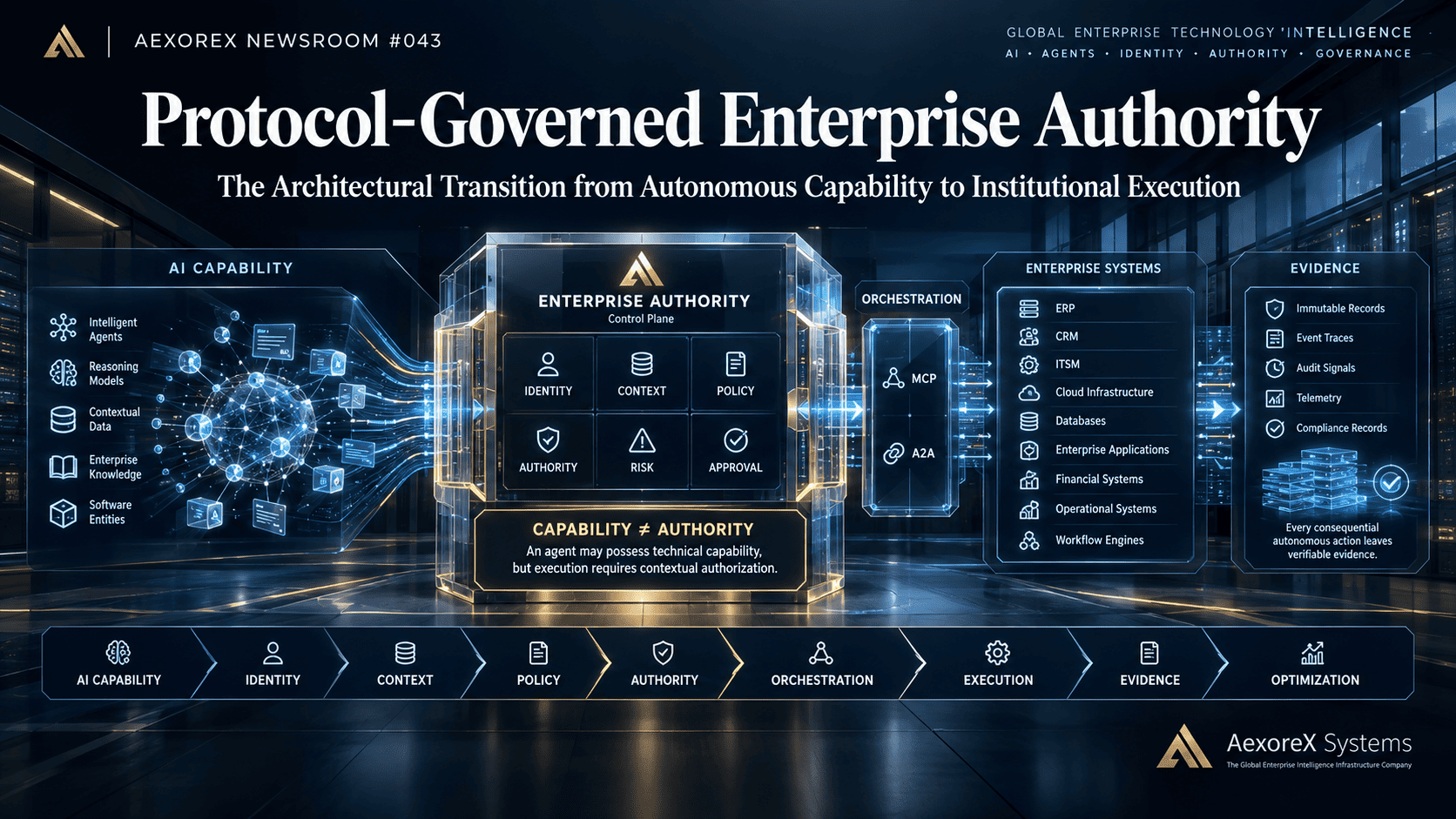
Therefore, successful enterprise execution demands more than just model intelligence or API connectivity. It requires an architecture that can establish identity, interpret context, evaluate policy, determine authority, control execution, produce evidence, and continuously optimize outcomes.
This distinction forms the central analytical premise of AexoreX Newsroom #043.
From Capability to Authority
AI agents are increasingly able to perform actions once restricted to human operators. They can retrieve information, invoke tools, manipulate structured data, initiate workflows, communicate with other agents, and, in appropriately configured environments, modify enterprise state.
However, the ability to perform an action does not confirm that the action is authorized.
Consider an agent connected to an enterprise procurement system. While the API might technically allow the agent to:
- create a purchase order;
- modify supplier information;
- initiate a workflow;
- approve or route a transaction.
Enterprise authorization necessitates additional questions:
- Who or what initiated the request?
- Which organization and business unit are involved?
- What is the transaction value?
- Is the supplier approved?
- Does the action comply with segregation-of-duties requirements?
- Does the agent possess sufficient authority?
- Is additional approval required?
- What is the operational risk?
- Can the action be reversed?
- What evidence must be retained?
Consequently, the architectural problem shifts from:
“Can the agent call the system?”
to:
“Under what conditions is the agent permitted to change enterprise state?”
What Changed in the Interoperability Layer
Model Context Protocol
Anthropic introduced MCP on November 25, 2024, as an open protocol designed to connect AI applications with external data sources and tools. Anthropic subsequently donated MCP to the Agentic AI Foundation under the Linux Foundation in December 2025.
The July 28, 2026, MCP specification introduced a stateless protocol core. This design was intended to improve scalability and simplify deployment behind ordinary HTTP infrastructure, allowing requests to be routed to different server instances without relying on protocol-level session state.
An important architectural distinction remains: MCP provides an interoperability mechanism but does not, by itself, constitute an enterprise authority model. MCP can make an enterprise capability accessible to an agent. Separate identity, authorization, policy, risk, and governance controls determine whether that capability should be exercised.
Agent2Agent
A2A represents the complementary agent-to-agent interoperability layer.
The Linux Foundation reported in April 2026 that A2A had reached its one-year milestone, with support from over 150 organizations and deployments across multiple enterprise environments.
Accordingly, the architectural relationship can be expressed as:
- A2A → agent-to-agent collaboration
- MCP → agent-to-tool/resource interaction
Neither should be interpreted as a complete enterprise governance or authority framework.
The Rise of Non-Human Identity
The expansion of autonomous software actors necessitates identity models capable of representing non-human workloads.
Microsoft Entra Agent ID is a significant enterprise implementation in this direction. Microsoft announced the general availability of the Entra Agent ID platform in April 2026, describing it as an identity and authorization framework specifically for AI agents operating in enterprise environments.
This development illustrates an important architectural transition: AI agents increasingly require explicit identity rather than being treated merely as extensions of human accounts or generic application credentials.
However, identity alone does not solve authority. Identity answers:
Who or what is acting?
Authority answers:
Is that actor permitted to perform this action in this context?
These are related but distinct control problems.
The AEOS Enterprise Authority Model
AexoreX Newsroom models enterprise authority as a decision chain:
Identity → Context → Policy → Authority → Risk → Approval → Execution → Evidence → Outcome
Each stage addresses a different question:
| Stage | Question | | :--------- | :------------------------------------------ | | Identity | Who or what is acting? | | Context | What is happening and where? | | Policy | What rules apply? | | Authority | Is this actor permitted to act? | | Risk | What could happen if the action proceeds? | | Approval | Does the action require additional authorization? | | Execution | What enterprise state is being changed? | | Evidence | What actually happened? | | Outcome | What resulted from the action? |
This model is an AexoreX analytical and architectural framework, not an established ISO, IEEE, NIST, or other industry-standard reference architecture.
The Eleven-Layer Enterprise Agent Architecture
At a broader systems level, AexoreX Newsroom uses an eleven-layer model:
1. Systems — systems of record and transactional applications 2. Data — structured and unstructured enterprise information 3. Intelligence — foundation and specialized models 4. Context — organizational knowledge and institutional memory 5. Identity — human and non-human identity 6. Policy — deterministic rules and controls 7. Authority — contextual execution rights 8. Orchestration — workflow and multi-agent coordination 9. Execution — tool invocation and state mutation 10. Evidence — execution lineage and audit records 11. Optimization — operational intelligence and continuous improvement
This model explicitly separates what an agent can technically do from what the enterprise permits it to do. This separation becomes increasingly important as enterprises move from individual AI assistants toward networks of interacting digital workers.
Authority Is a Control Boundary
A contextual authority boundary can evaluate multiple dimensions before allowing an enterprise state change:
Actor Attribution
Identify the human, agent, service, or delegated sub-agent responsible for the request.
Context
Determine the relevant organization, business unit, transaction, resource, time, environment, and operational state.
Policy
Evaluate deterministic organizational and regulatory rules.
Risk
Determine whether the requested action exceeds established risk thresholds.
Approval
Determine whether the action requires human or higher-level authorization.
Reversibility
Determine whether the resulting state change can be reversed or compensated.
This creates a critical separation:
Intelligence proposes. Authority governs. Execution changes state. Evidence records the result.
Identity Standards Are Evolving — but Not Yet Complete
The ecosystem is developing rapidly, but no single universal agent-identity architecture currently resolves every cross-organizational scenario.
NIST's AI Agent Standards Initiative explicitly focuses on industry-led standards, open-source protocols, security, and identity research for AI agents.
The IETF ecosystem is also exploring how existing workload identity and OAuth mechanisms can be applied to AI agents. The July 2026 "draft-klrc-aiagent-auth-03" proposed best practices for AI-agent authentication and authorization using existing standards rather than creating an entirely new authentication protocol. The document was later replaced by a newer draft and should therefore be cited as work in progress, not as a finalized standard.
Meanwhile, W3C Verifiable Credentials 2.0 reached Recommendation status in May 2025, providing a standardized mechanism for machine-verifiable credentials with cryptographic integrity and privacy considerations.
These developments suggest an emerging foundation for cross-domain trust, but they should not be presented as evidence that universal agent authority federation has already been solved.
Government Guidance Is Not the Same as Regulation
This distinction is important.
NIST's AI Agent Standards Initiative is an initiative for standards, research, and guidance. NIST describes its guidelines as voluntary.
Singapore's Cyber Security Agency published its Securing Agentic AI addendum on June 17, 2026, to support system owners and opened it for public consultation. The publication should therefore be characterized as government security guidance rather than a universal legal mandate.
For enterprise architecture, the practical implication is still significant: government and standards organizations are increasingly treating agent identity, security, interoperability, and autonomous action as distinct architectural concerns.
The Central Architectural Transition
The enterprise AI architecture can therefore be represented as a progression:
Model Intelligence ↓ Tool Connectivity ↓ Agent Collaboration ↓ Non-Human Identity ↓ Policy Enforcement ↓ Contextual Authority ↓ Governed Execution ↓ Evidence ↓ Outcome Optimization
The transition is not simply from “AI that talks” to “AI that acts.” It is from:
AI capability
to:
institutionally governed digital execution.
AexoreX / AEOS QUANTUM™ Perspective
AEOS QUANTUM™ is positioned by AexoreX Systems as an Enterprise Intelligence Operating Platform intended to connect, orchestrate, govern, and activate existing enterprise software rather than replace systems of record.
Within the #043 analytical framework, the strategic distinction is:
- Systems provide capabilities.
- AI provides intelligence.
- Identity establishes actors.
- Policy establishes constraints.
- Authority determines permitted action.
- Orchestration coordinates work.
- Execution changes state.
- Evidence establishes what occurred.
- Optimization determines what should happen next.
This architecture supports the broader AEOS principle:
AEOS does not replace the enterprise stack. AEOS connects, orchestrates, governs, and activates it.
The specific implementation status of AEOS QUANTUM™ must continue to be represented transparently as: Available Today → In Development → Planned → Vision, rather than presenting future architecture as currently deployed production functionality.
The Core Principle
The central proposition of AexoreX Newsroom #043 can therefore be stated as:
Capability enables an agent to act. Identity establishes who or what is acting. Policy defines what is permitted. Authority determines whether the action is permitted in context. Execution changes enterprise state. Evidence establishes what occurred. Optimization determines what should happen next.
And the shortest expression is:
Capability Is Not Authority.
That distinction may become increasingly important as enterprise systems evolve from isolated AI assistants toward networks of autonomous digital labor.
Conclusion
The next phase of enterprise AI is not defined solely by whether models can reason, use tools, or collaborate with other agents.
The more consequential architectural question is whether enterprises can establish reliable boundaries around autonomous execution.
Interoperability protocols such as MCP and A2A address important connectivity and collaboration problems. Identity platforms address the emergence of non-human actors. Standards organizations and security communities are developing frameworks for agent security, authentication, authorization, and interoperability.
Yet these components do not automatically constitute a complete enterprise authority architecture.
The emerging challenge is to connect them into an institutional control model in which every consequential action can be: identified, contextualized, constrained, authorized, executed, evidenced, and optimized.
That is the architectural transition from autonomous capability to institutional execution.
Sources and attribution
- AexoreX Research Desk — Primary Research & Institutional Analysis · statement link
About the author
The editorial desk of AexoreX Newsroom, the publication of AexoreX Systems LLC.
More from AexoreX Newsroom Editorial Desk →Related stories
- The Non-Human Identity Shift: Why Enterprise Autonomy Demands a Governed Control Plane
- Capability Is Not Authority: The Institutional Shift to Protocol-Governed Autonomous Enterprises
- From Enterprise Software to Enterprise Intelligence Infrastructure: The Architecture Behind AEOS QUANTUM™
- The Non-Human Identity Control Plane: Dynamic Authority and Traceable Delegation for Autonomous Enterprise Operations
- AexoreX Systems Introduces AEOS Enterprise Authority™ as Governance Layer for Autonomous Enterprise Intelligence
- Enterprise Intelligence Infrastructure and Governed Autonomy: The Architectural Foundation for the Autonomous Enterprise
- Governing Digital Labor: Bridging Capability and Authority in Autonomous Enterprise Architecture