
The Great Agentic Realignment
From AI Agents to Enterprise Agent Control
Enterprise AI is shifting focus from agent capability to controlled authority, emphasizing security, governance, and accountability for autonomous systems.
Opinion · AI-assisted, human edited
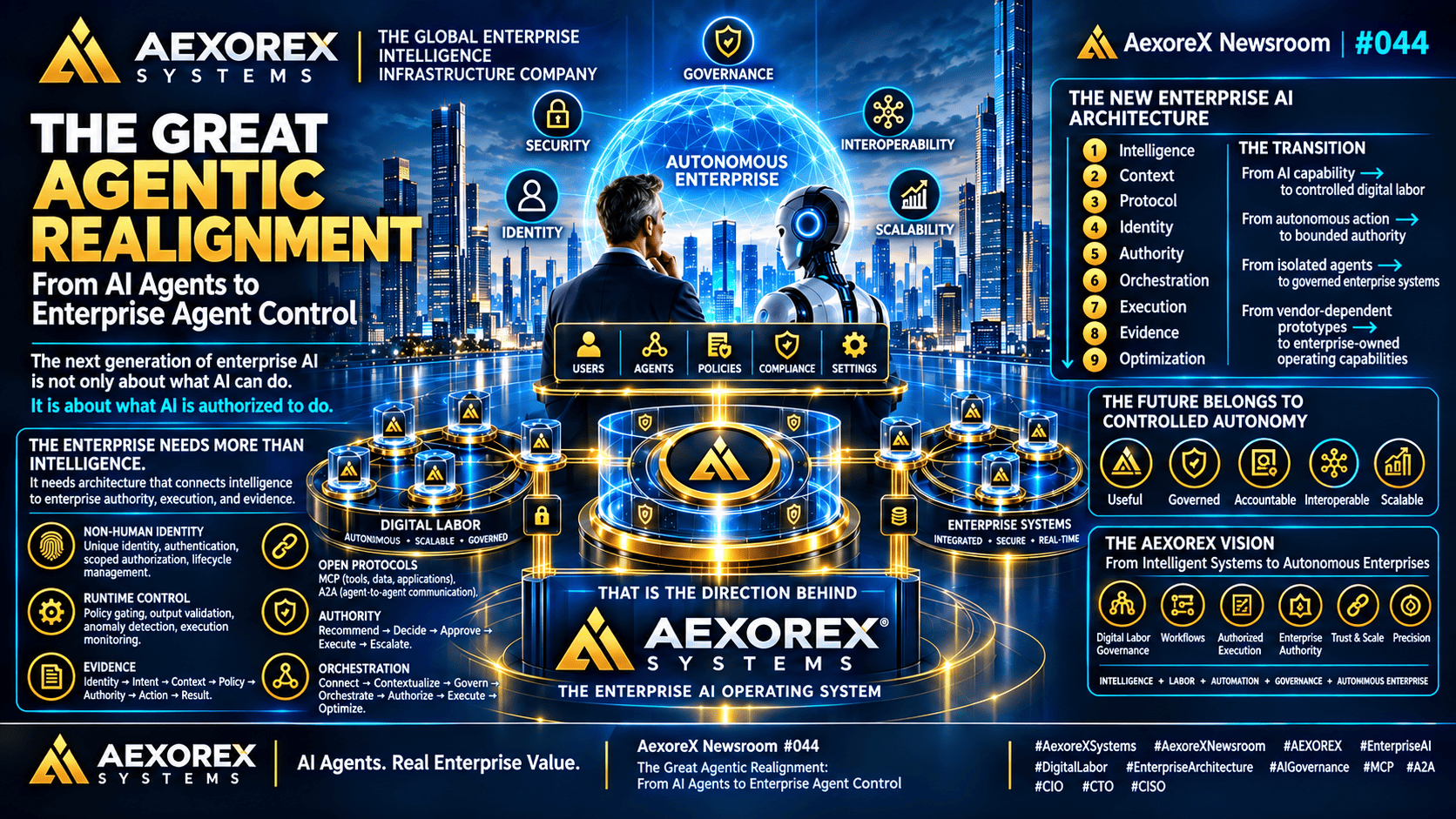
The enterprise AI conversation is evolving. For several years, the focus was on whether AI models could achieve sufficient capability for increasingly complex work. In 2026, this question is being replaced by a more critical one: Can enterprises grant AI systems the authority to act, while maintaining control over identity, policy, security, accountability, and evidence?
This shift is driving a new phase of enterprise architecture. Open protocols are gaining importance, and agent-to-tool connectivity is now distinct from agent-to-agent collaboration. Non-human identities are emerging as a specific enterprise security concern, and runtime policy enforcement is moving closer to execution. Technology leaders are increasingly confronting a reality that industry enthusiasm for autonomous agents sometimes obscured: An agent capable of acting is not necessarily an agent that can be trusted to act. The emerging enterprise architecture is therefore shifting focus from agent capability to agent control.
The End of the Prototype Mindset
Enterprise adoption of agentic AI initially benefited from highly customized implementations. Vendors could provide dedicated engineers to customers, integrate proprietary systems, build specialized workflows, and quickly demonstrate business value. This model accelerated experimentation, especially for enterprises lacking internal expertise to integrate emerging AI capabilities.
However, experimentation and sustainable infrastructure present different challenges. On September 29, Gartner forecasted that 70% of enterprises will abandon agentic AI applications built through vendor forward-deployed engineering (FDE) by 2028. Gartner attributed this risk to soaring costs and organizations' inability to independently evolve these systems. Gartner emphasized governance, ownership, knowledge transfer, and exit planning as critical elements for a successful FDE engagement.
The significance extends beyond a single delivery model. It suggests that enterprise buyers are beginning to differentiate between building an AI capability and building an enterprise capability that can endure without its original creator. This distinction could become one of the defining architectural questions of the agentic era.
From Model-Centric AI to System-Centric AI
The initial wave of enterprise AI was largely model-centric. Organizations evaluated: - model intelligence - benchmark performance - context windows - inference costs - reasoning capabilities - multimodal capabilities
The emerging agentic architecture introduces an additional dimension: operational control. An enterprise agent does more than just generate text. It may: - retrieve confidential information - invoke APIs - modify records - create transactions - communicate with customers - execute code - delegate tasks - interact with other agents - operate continuously
This changes the security model. A model can be primarily evaluated by the quality of its outputs. An autonomous enterprise system must also be evaluated through its: identity → context → policy → authority → risk → approval → execution → evidence → outcome. Therefore, the critical asset is no longer solely the model. It is the controlled execution environment surrounding the model.
MCP and A2A: Two Different Problems
One of the most important developments in the evolving agent ecosystem is the maturation of open interoperability protocols. The Model Context Protocol (MCP) addresses the connection between AI applications and external tools, data, and resources. The Agent2Agent (A2A) protocol addresses a different problem: communication and delegation between independent agents.
The distinction is important.
**MCP**
Agent → Tool / Data / Resource
MCP provides a standardized interface for connecting agents and AI applications to capabilities beyond the model itself. The July 28, 2026, MCP specification introduced a stateless protocol core, multi-round-trip requests, header-based routing, authorization hardening, and other changes designed to make the protocol more suitable for scalable infrastructure. The specification explicitly moves protocol-level state out of the connection itself. Applications requiring persistent state can instead use explicit task- or application-level handles. This is a significant architectural change, allowing MCP infrastructure to function more like conventional scalable web infrastructure rather than requiring the transport layer to maintain persistent protocol sessions.
**A2A**
Agent → Agent
A2A addresses the horizontal layer. Instead of requiring every agent framework to understand the internal implementation of every other agent, agents can expose standardized descriptions of their capabilities and communicate across framework or vendor boundaries. A2A's integration into the Agentic AI Foundation places it alongside the broader open agent ecosystem and reinforces the architectural distinction between vertical capability integration and horizontal agent collaboration. Together, these protocols point toward an ecosystem where the underlying AI model becomes increasingly decoupled from the enterprise systems it can access. This separation could prove strategically important.
Interoperability Is Not Governance
However, an important misconception must be avoided: open protocols do not automatically create secure autonomous enterprises. A protocol can standardize communication, but it does not automatically determine: - whether an agent should be allowed to perform an action - whether the requested action is appropriate - whether the data being accessed is authorized - whether the agent's reasoning is correct - whether an instruction originated from a trusted source - whether a tool invocation creates unacceptable business risk
This creates an architectural distinction between interoperability and authority. MCP can define how an agent connects to a capability, and A2A can define how agents communicate. Neither, by itself, answers the enterprise question: "Should this agent be allowed to do this?" That decision belongs to the control layer.
The Rise of the Non-Human Identity
The enterprise identity model was designed primarily around people and applications. Agentic systems introduce another category: non-human digital workers. An autonomous agent may require: - a unique identity - authentication - authorization - scoped permissions - credentials - lifecycle management - policy enforcement - session controls - monitoring - auditability - revocation
The key difference is that an agent may execute actions dynamically and at machine speed. This alters the meaning of least privilege. Traditional access management asks: "Who is this user?" Agentic infrastructure increasingly needs to ask: "What is this digital worker, what is it authorized to do, under whose authority, against which resources, under which policy, and for what duration?" This represents a substantially richer control problem.
Authority Becomes an Infrastructure Primitive
The emergence of agentic systems therefore creates a new architectural boundary: Capability ≠ Authority. An agent may technically possess the capability to perform an action without possessing the authority to perform it. Consider a procurement agent. It may have access to: - supplier databases - pricing systems - inventory platforms - purchase-order APIs - financial systems
Technical connectivity does not imply unlimited authority. A mature enterprise architecture could instead establish boundaries such as: Read → Recommend → Request Approval → Execute → Escalate. The agent's technical capability remains broad enough to perform useful work, while its authority remains deliberately constrained. This distinction becomes especially important as agents begin operating across multiple systems.
Runtime Control Becomes More Important
Traditional enterprise security often assumes that access is granted before an application performs an action. Agentic systems make that model more dynamic. An agent can: - receive a goal - interpret context - select a tool - construct parameters - retrieve information - generate another instruction - delegate to another agent - execute an external action
Every transition can create a new risk boundary. Consequently, enterprise control is shifting toward runtime enforcement. Potential control points include: - identity verification - policy evaluation - tool authorization - data classification - transaction thresholds - human approval - anomaly detection - output validation - network controls - immutable execution logging
The objective is not to prevent agents from acting, but to ensure that autonomous action remains bounded, attributable, observable, and reversible where possible.
Autonomy Does Not Remove Accountability
The regulatory discussion is evolving alongside the technology. On September 25, FTC Chairman Andrew Ferguson stated he would resist characterizing AI agents as autonomous actors with independent wills or desires. Reuters reported that Ferguson's position was that developers and users remain responsible for how these tools are instructed and deployed. This is significant, not because it creates a new universal liability regime by itself, but because it illustrates the direction of regulatory thinking: autonomy at the software layer does not automatically create legal autonomy.
For enterprise architects, this distinction has practical consequences. An organization deploying autonomous software should be able to establish: - who authorized the agent - what instructions governed it - what resources it could access - what policies applied - which tools it invoked - what information it retrieved - what decisions occurred - what actions were executed - what approvals were obtained - what happened afterward
The execution record is therefore becoming more than an observability feature; it is becoming part of the enterprise's accountability architecture.
Evidence Becomes a First-Class Layer
Most enterprise systems already maintain logs. Agentic systems require something more structured. A useful agent execution record may need to connect: Identity → Intent → Context → Policy → Authority → Action → Result. This is fundamentally different from simply recording that an API request occurred. The enterprise needs to understand: "Why did the system perform this action?" And: "Under whose authority did it perform it?" This is where evidence becomes a cross-cutting architectural layer. Without evidence, autonomous execution becomes difficult to reconstruct. With evidence, enterprises can begin to establish a verifiable chain between human intent, system policy, agent behavior, tool execution, and business outcome.
The New Enterprise Control Plane
The emerging architecture is therefore beginning to resemble a layered control system.
**Layer 1 — Intelligence** Foundation models and reasoning systems provide intelligence.
**Layer 2 — Context** Enterprise data, retrieval systems, memory, and application context provide situational awareness.
**Layer 3 — Protocol** MCP and A2A provide standardized communication pathways.
**Layer 4 — Identity** Human and non-human identities establish who or what is acting.
**Layer 5 — Authority** Policies define what each digital worker is permitted to do.
**Layer 6 — Orchestration** Agents coordinate tasks and delegate work.
**Layer 7 — Execution** Authorized actions are performed against enterprise systems.
**Layer 8 — Evidence** The organization records what happened and why.
**Layer 9 — Optimization** Telemetry, evaluation, and operational feedback continuously improve the system.
This architecture changes the strategic role of enterprise AI. The model is no longer the entire product. The controlled system around the model becomes the product.
The Economics of Agentic AI Are Also Changing
The shift toward open protocols may also alter enterprise software economics. If organizations can connect multiple models, agents, tools, and applications through standardized interfaces, the cost of replacing one underlying component may decline. That could create greater architectural optionality. An enterprise may increasingly be able to change: - foundation models - agent frameworks - specialized agents - application providers - infrastructure providers without rebuilding every integration from the ground up.
This does not eliminate vendor dependency; it changes where dependency exists. Instead of being locked primarily into a proprietary integration layer, enterprises may increasingly compete on: - data - governance - workflow design - proprietary context - domain expertise - decision authority - execution infrastructure
The strategic advantage may therefore migrate upward from the model itself toward the enterprise operating architecture.
The FDE Question Is Really an Ownership Question
Gartner's FDE forecast should not be interpreted as a declaration that all forward-deployed engineering is obsolete. Deep technical collaboration can remain valuable where: - the technology is immature - the integration is unusually complex - specialized vendor knowledge is essential - rapid deployment has strategic value
The more important question is what happens after implementation. - Who owns the architecture? - Who owns the operational knowledge? - Who controls the agent logic? - Who can modify the system? - Who owns the data? - Who can replace the model? - Who can terminate the relationship? - Who can operate the system without the original vendor?
These questions transform FDE from a services question into an enterprise sovereignty question. A successful engagement should therefore leave the enterprise more capable, not permanently dependent.
The Multi-Agent Paradox
Multi-agent systems promise specialization. One agent can research, another can analyze, another can execute, another can verify, and another can monitor. But decomposition introduces another risk: error propagation. An incorrect assumption at the beginning of a chain can influence downstream agents. A system can therefore become more sophisticated while becoming more difficult to predict. This establishes a fundamental principle for enterprise architecture: More agents do not automatically produce more intelligence. They can also produce more coordination overhead, more identity relationships, more authorization decisions, more failure points, and more opportunities for cascading errors. The objective should therefore not be maximum autonomy, but appropriate autonomy under explicit control.
From Agent Adoption to Digital Labor Architecture
This is perhaps the most important strategic transition. The enterprise is beginning to move from asking: "Where can we use an AI agent?" to: "How should digital labor operate inside the enterprise?" That is a much larger question. Digital workers require: - identity - role - context - authority - supervision - escalation - performance measurement - evidence - lifecycle management
In other words, enterprises need something closer to a workforce operating model for software. The difference is that digital workers can operate continuously, replicate rapidly, and interact with systems at machine speed. That makes governance an operational requirement rather than a documentation exercise.
What CIOs and CTOs Should Watch
The next phase of enterprise agentic AI will likely be defined by several measurable developments. 1. **Open protocol adoption:** Watch whether MCP and A2A become default integration primitives across enterprise platforms. 2. **Non-human identity management:** Watch whether agent identity becomes integrated into mainstream Identity and Access Management (IAM) and zero-trust architectures. 3. **Runtime authorization:** Watch whether enterprise platforms increasingly evaluate agent actions before execution rather than relying solely on static permissions. 4. **Agent observability:** Watch for richer telemetry connecting identity, intent, tool invocation, policy decisions, and outcomes. 5. **Procurement changes:** Watch enterprise contracts for requirements around: IP ownership, knowledge transfer, interoperability, data portability, auditability, and exit rights. 6. **Model independence:** Watch whether enterprises increasingly separate their agent architecture from any single foundation-model provider. 7. **Regulatory evidence:** Watch how regulators and courts treat agent execution records when investigating AI-related incidents.
The Autonomous Enterprise Is Not an Agent
The distinction matters. An enterprise does not become autonomous simply because it deploys autonomous agents. Autonomy emerges when intelligence, context, governance, authority, orchestration, execution, and evidence operate together as a coherent system. That requires architecture, boundaries, and an explicit answer to the question: "Who—or what—is authorized to make which decision?" This is why the next generation of enterprise AI will increasingly be defined by control planes rather than models alone.
The AEOS QUANTUM Perspective
Viewed through an Autonomous Enterprise architecture, the emerging realignment maps naturally to seven operational stages: - **Connect** — establish interoperable access to enterprise systems and capabilities. - **Contextualize** — provide the relevant business context, data, memory, and operational state. - **Govern** — establish identity, policy, security, and lifecycle controls. - **Orchestrate** — coordinate agents, applications, workflows, and digital labor. - **Authorize** — determine what an agent is permitted to decide or execute. - **Execute** — perform the approved action through controlled enterprise infrastructure. - **Optimize** — continuously evaluate performance, reliability, risk, cost, and outcomes.
Across all seven stages sits one requirement: Evidence. Evidence connects intention to execution and execution to outcome. That principle becomes increasingly important as enterprises move from AI assistants toward autonomous digital labor. AEOS QUANTUM's architectural premise is therefore aligned with a broader industry shift: the enterprise AI challenge is no longer simply connecting intelligence to software. It is establishing controlled authority between intelligence and execution.
The Great Agentic Realignment
The agentic AI market is entering a different phase. The question is no longer whether enterprises will experiment with autonomous systems; they already are. The more consequential question is whether those experiments can become durable enterprise infrastructure. That requires a transition: - from proprietary integrations to interoperable protocols - from application credentials to governed non-human identities - from static permissions to runtime authorization - from opaque automation to observable execution - from autonomous capability to bounded authority - from vendor-dependent prototypes to enterprise-owned operating capabilities
MCP and A2A do not solve these problems by themselves. They provide pieces of the infrastructure. The control layer determines how those pieces can safely operate. And the enterprise that ultimately succeeds with digital labor will not necessarily be the enterprise with the most autonomous agents. It will be the enterprise that can make autonomy useful, governed, accountable, interoperable, and scalable. That is the real agentic realignment. The industry is moving from AI that can act toward enterprise systems that know when, why, and under whose authority AI is allowed to act.
AEXOREX NEWSROOM EXECUTIVE SIGNAL
The defining enterprise AI challenge of the next phase is control—not capability alone. As agentic systems move closer to production, enterprise architecture is expanding beyond models and applications toward protocols, non-human identity, authority management, runtime policy, execution evidence, and operational ownership. For CIOs and CTOs, the strategic question is no longer simply: "Which AI agent should we deploy?" It is: "What enterprise architecture will allow digital labor to operate at scale without surrendering control?" That question will define the next generation of autonomous enterprise infrastructure.
Sources and attribution
- AexoreX Research Desk + cited primary/authoritative sources · statement link
About the author
Research desk of AexoreX Newsroom.
More from AexoreX Research Desk →Related stories
- Protocol-Governed Enterprise Authority
- Governing Autonomous Execution: Enterprise Control Planes and the Shift to Digital Labor
- The Non-Human Identity Shift: Why Enterprise Autonomy Demands a Governed Control Plane
- From Enterprise Software to Enterprise Intelligence Infrastructure: The Architecture Behind AEOS QUANTUM™
- The Non-Human Identity Control Plane: Dynamic Authority and Traceable Delegation for Autonomous Enterprise Operations
- Enterprise Intelligence Infrastructure and Governed Autonomy: The Architectural Foundation for the Autonomous Enterprise