
Orchestration & Digital Labor
From Governed Intelligence to Coordinated Enterprise Work
Enterprises need orchestration to coordinate intelligence, systems, people, and Digital Labor for effective operational outcomes, moving beyond isolated AI agents.
Opinion · AI-assisted, human edited
When Intelligence Needs a Workforce
Enterprise intelligence delivers significant value when it transcends mere analysis and actively participates in coordinated operational work. For years, businesses have accumulated software systems, data platforms, workflows, automation tools, and increasingly sophisticated artificial intelligence. However, the presence of these technologies alone does not automatically create an autonomous enterprise.
The critical missing component is coordination. An enterprise may possess intelligence capable of understanding a business situation and governance mechanisms to determine permissible actions. Yet, between understanding and execution lies a vital requirement: orchestration. Orchestration defines how intelligence, systems, people, Digital Labor, permissions, workflows, and actions collaborate to achieve a desired business outcome. This is where the concept of Digital Labor becomes increasingly important.
Beyond the AI Agent
Current discussions around AI often concentrate on individual agents. An agent might possess the ability to reason, use tools, retrieve information, or perform a specific task. However, an enterprise does not function as a collection of isolated tasks; its operations are inherently interconnected.
For instance, a procurement decision can impact finance. A customer issue can affect service operations. A supply-chain event can influence inventory, production, logistics, and revenue. A financial decision may require authorization before execution. Therefore, the enterprise challenge is not simply to create more capable AI agents, but to establish a governed system capable of coordinating Digital Labor across all enterprise operations.
In this context, Digital Labor refers to software-based operational workers assigned defined responsibilities within controlled enterprise environments. Their roles can vary from providing recommendations to performing authorized operational actions, depending on the enterprise's policies, permissions, risk controls, and human oversight.
Orchestration as the Coordination Layer
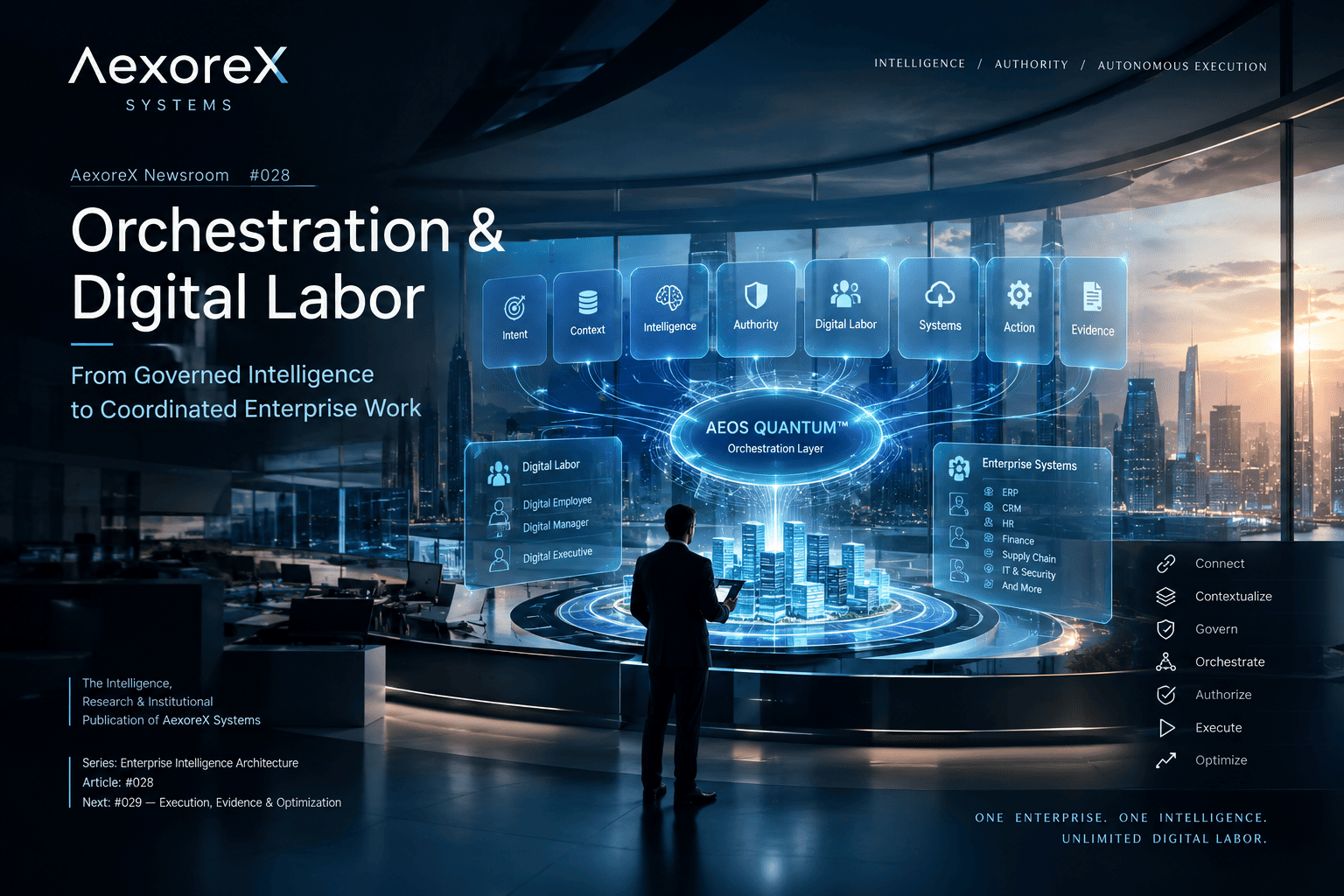
Orchestration provides the mechanism for different capabilities to work together. Conceptually, an enterprise orchestration layer might coordinate the following sequence:
- Intent
- Context
- Intelligence
- Authority
- Digital Labor
- Systems
- Action
- Evidence
Each component has a distinct responsibility. Intent establishes the enterprise's objective. Context provides relevant business information and the operational state. Intelligence interprets the situation and suggests possible courses of action. Authority determines what is permitted. Digital Labor performs defined responsibilities within these boundaries. Systems provide the operational environments where actions occur. Action represents the execution of an authorized operation. Evidence records what happened, serving as a basis for subsequent review and optimization.
This framework highlights an important distinction: orchestration is not simply automation. It is the coordination of intelligence, authority, systems, and work.
From Individual Agents to Digital Labor
Enterprises may eventually require diverse forms of Digital Labor, rather than relying on a single general-purpose AI system. For example, an enterprise could conceptually assign Digital Labor to:
- Finance operations
- Procurement workflows
- Customer operations
- Sales operations
- IT operations
- Security operations
- Human resources processes
- Supply-chain coordination
- Data and intelligence workflows
- Executive reporting
These Digital Labor functions would not necessarily operate independently; they could be coordinated through an enterprise-level orchestration architecture. One Digital Labor function might identify an issue, another could analyze its financial implications, and a third could prepare an operational recommendation. A governed authority mechanism would then determine if the proposed action is permitted. An authorized Digital Labor function could then execute the approved operation via connected enterprise systems. The result is not merely an AI conversation, but coordinated digital work.
Digital Labor Needs Boundaries
Increased autonomy does not diminish the need for control; instead, it amplifies it. A Digital Labor workforce operating within an enterprise environment requires clearly defined boundaries, which may include:
- **Defined** — specifying its responsibilities.
- **Scoped** — indicating where those responsibilities apply.
- **Policy-Bound** — adhering to relevant enterprise policies.
- **Permissioned** — detailing accessible systems and capabilities.
- **Budget-Controlled** — outlining any delegated financial authority.
- **Risk-Aware** — identifying actions requiring additional controls.
- **Auditable** — requiring evidence production for activities.
- **Human-Governed** — retaining human review or approval requirements.
- **Revocable** — enabling withdrawal of authority.
This establishes a fundamental principle for autonomous enterprise architecture: Digital Labor should operate within authority delegated by the enterprise; it does not inherently possess that authority.
Orchestration Creates an Enterprise Workforce Model
Traditional enterprise automation typically focuses on predefined workflows: a process is designed, a trigger occurs, a sequence of actions follows, and automation performs the prescribed steps. Digital Labor introduces a different possibility. Instead of solely executing predefined sequences, software-based workers can potentially interpret context, coordinate tasks, interact with enterprise systems, and adapt their actions within defined boundaries.
This does not imply unrestricted autonomy. Instead, it suggests a transition from workflow automation toward governed Digital Workforce orchestration. The distinction is crucial because enterprise work is rarely completely deterministic. Real-world operations involve exceptions, changing conditions, incomplete information, competing priorities, and authorization requirements. An orchestration layer can provide the structure to manage these conditions.
The Role of AEOS QUANTUM
The architectural direction of AEOS QUANTUM™ is designed around this broader enterprise requirement. Rather than positioning AI as an isolated assistant, AEOS QUANTUM is being developed as an Enterprise Intelligence Operating Platform for Autonomous Enterprises. Its conceptual architecture integrates enterprise systems, context, knowledge, memory, intelligence, authority, Digital Labor, orchestration, execution, governance, and evidence.
The objective is to provide an environment where enterprise intelligence can be connected to governed operational work. The architecture can be understood through a progression:
- **Connect.** Unify enterprise systems, data, applications, and operational environments.
- **Contextualize.** Understand the business context surrounding an event, request, decision, or objective.
- **Govern.** Apply policies, authority, risk controls, and human oversight.
- **Orchestrate.** Coordinate Digital Labor, systems, workflows, and responsibilities.
- **Authorize.** Determine whether an action is permitted.
- **Execute.** Perform the authorized operation through connected systems.
- **Optimize.** Learn from outcomes, evidence, and operational performance.
This progression moves the enterprise from disconnected intelligence to coordinated operational capability.
The Emerging Digital Labor Economy
As AI capabilities mature, enterprises may increasingly evaluate digital workers similarly to how they assess organizational roles. The question may shift from "What can this AI model do?" to "What work can this Digital Labor perform, under what authority, with what controls, and with what evidence?" This change could have significant implications for enterprise architecture.
Digital Labor may become another operational resource alongside software applications, cloud infrastructure, human employees, and external services. However, unlike traditional software automation, Digital Labor can potentially interpret context and perform multi-step work across connected systems. This creates both opportunity and responsibility. Therefore, the enterprise needs infrastructure capable of governing not only what AI knows, but also what AI is authorized to do.
Toward the Autonomous Enterprise
Autonomy should not be understood merely as removing humans from business processes. A more practical enterprise interpretation is the ability to delegate appropriate operational responsibilities to software-based intelligence while maintaining enterprise control. Some activities may remain human-led. Others may be assisted by Digital Labor. Some may be delegated for decision-making within predefined boundaries. Certain low-risk operations may eventually be executed automatically.
The level of autonomy can therefore vary according to business context, risk, authority, and organizational policy. This creates a spectrum rather than a binary condition:
Human Decision → AI-Assisted Decision → Governed Digital Decision → Governed Digital Execution
The architecture surrounding Digital Labor determines where an enterprise can safely operate on that spectrum.
From Orchestration to Execution
Orchestration alone does not create business value. Its ultimate purpose is to coordinate work toward measurable outcomes, which requires execution. And execution requires evidence. An enterprise must be able to understand:
- What happened?
- Why did it happen?
- Who or what initiated it?
- What authority was used?
- Which systems were affected?
- What action was performed?
- What was the result?
- What should happen next?
These questions directly lead into the next layer of the enterprise intelligence architecture: Execution, Evidence & Optimization. That is the focus of AexoreX Newsroom #029.
AexoreX Perspective
The emergence of Digital Labor represents a potential shift in how enterprises conceptualize software. Historically, software provided tools, and automation offered predefined processes. AI then introduced increasingly capable intelligence. The next architectural challenge is to integrate these capabilities under enterprise authority and coordinate them as operational work.
The objective is not merely to create more AI agents, but to establish an enterprise environment where intelligence can be governed, Digital Labor can be coordinated, actions can be authorized, and operational work can be executed with evidence. That is the foundation of the emerging Orchestration & Digital Labor layer, and it may become one of the defining architectural components of the autonomous enterprise.
Sources and attribution
- AexoreX Systems · statement link
About the author
Intelligence desk of AexoreX Newsroom.
More from AexoreX Intelligence Desk →Related stories
- From Digital Labor to Autonomous Enterprise Operations: Why an Intelligence Layer Matters
- From One Digital Labor to a Digital Workforce
- From Enterprise Intelligence to Governed Autonomous Execution: The Next Step Toward the Autonomous Enterprises
- Beyond AI: Building the Enterprise Operating Model for Intelligence, Digital Labor, Governance, and Execution.
- The Infrastructure Behind the Autonomous Enterprise: Building the Foundation for Enterprise Intelligence
- #025 — The Enterprise AI Inflection Point: From AI Agents to Governed Autonomous Operations