
The Authority Drift Problem: When Runtime Enforcement No Longer Matches Business Intent
Why autonomous enterprise systems must keep their permissions aligned with changing business needs, risks, and decisions.
FINAL PUBLICATION DRAFT — AEXOREX NEWSROOM #073 The Authority Drift Problem: When Runtime Enforcement No Longer Matches Business Intent Subtitle: Why autonomous enterprise systems must keep their permissions aligned…
Opinion · AI-assisted, human edited
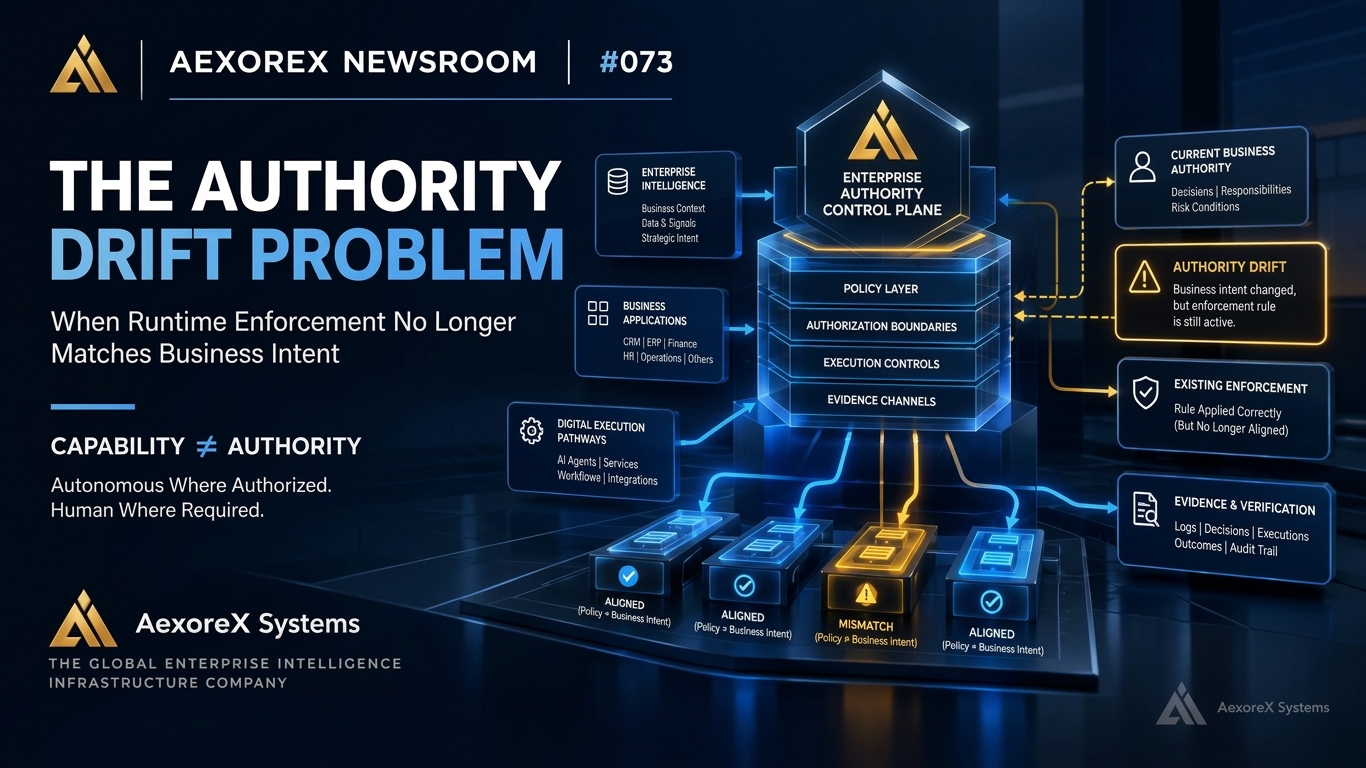
The Authority Drift Problem: When Runtime Enforcement No Longer Matches Business Intent Subtitle: Why autonomous enterprise systems must keep their permissions aligned with changing business needs, risks, and decisions. Executive Summary Enterprise AI systems can check permissions before they act. They can also apply rules during an action. These controls are important, but they do not solve every problem. A rule can be enforced correctly and still be wrong for the current situation. For example, a digital agent may have permission to approve a business request. Later, the company changes its approval process. If the agent's permissions are not updated, it may continue to follow an old rule. The system may be working as designed. Yet its actions may no longer match the company's current decisions. This article calls that gap the Authority Drift Problem. Authority drift occurs when the authority given to a person, system, or AI agent no longer matches the current business rules, responsibilities, risks, or approved intent. The term is a proposed analytical definition for this article. It is not presented as an established industry standard. The central point is simple: Enforcing a rule is not enough. The rule must also remain correct for the situation in which it is used. To manage this problem, enterprises need more than access controls. They need clear ownership of decisions, timely policy updates, checks before important actions, reliable records, and a way to stop or review actions when authority becomes uncertain. This matters as enterprises give AI agents more responsibility across business applications and services.
1. Beyond Runtime Authority In enterprise systems, access and authority are related, but they are not the same. Access means that a person or system can reach a resource. Authority means that it is allowed to perform a particular action under defined conditions. An AI agent may have access to a financial application. That does not mean it should be allowed to approve every payment. A digital worker may be able to update customer records. That does not mean it should change every record without review. The Runtime Authority Problem asks an important question: Is the action allowed at the moment it is performed? This question matters because permissions granted earlier may not be enough to justify an action later. However, another question follows: Is the rule being enforced still correct? A system can check a permission successfully while using a rule that no longer reflects the company's current decision. This is where the Authority Drift Problem begins. Runtime enforcement checks whether a rule is followed during an action. Authority alignment checks whether that rule still matches the approved business decision. Both are important.
2. What Is the Authority Drift Problem? For this article, authority drift means a growing gap between the authority assigned to a system and the authority it should have under current business conditions. This gap can develop when: A company's approval process changes. A person's role or responsibility changes. A project ends, but its permissions remain active. A business risk increases, but the rules remain unchanged. An AI agent moves into a new task without a clear review of its authority. A policy changes in one application but not in other connected systems. An earlier approval is used after the situation has changed. These examples describe possible failure scenarios. They do not mean that every enterprise system has these weaknesses. Authority drift can happen even when individual controls appear to work correctly. Consider a simple example. A company allows an AI agent to prepare and submit routine supplier orders. At first, the agent must ask a human to approve orders above a defined limit. Later, the company changes its purchasing policy because of a new financial risk. The policy is updated in one system, but another connected application still uses the old rule. The agent continues to submit orders under its earlier permission. The agent may not have bypassed a control. The control itself may be enforcing outdated instructions. The main failure is not necessarily a lack of enforcement. It is a failure to keep authority aligned with current decisions.
3. Why Existing Security Controls Still Matter Authority drift does not make existing security controls less important. It shows why those controls must work together. Identity and access management Identity controls help establish who or what is requesting access. Access rules help limit which resources a user or system can reach. These controls provide an essential starting point. However, an identity or permission alone does not answer every question about whether a specific action remains appropriate. Zero Trust NIST SP 800-207 describes Zero Trust Architecture as an approach that does not grant trust simply because a user or system is inside a network or belongs to an organization. Access decisions focus on users, devices, resources, and the conditions for access. This is an important foundation for enterprise security. Authority alignment adds a related design question: when business rules change, how does the enterprise ensure that connected systems apply the correct rules? Zero Trust and authority alignment address related but distinct concerns. One should not be treated as a replacement for the other. Token revocation and token checks IETF RFC 7009 describes a method for revoking OAuth tokens. RFC 7662 describes a method for checking a token's active state and related information. These mechanisms can help manage access and token status. However, a token check does not by itself prove that every business rule behind an action is still correct. An enterprise must also manage the policies and decisions that define what the token holder is allowed to do. AI risk management The NIST AI Risk Management Framework provides guidance for organizations that design, develop, deploy, or use AI systems. It helps organizations identify and manage AI-related risks. Authority drift can be treated as a risk that an organization should assess within its own governance and control processes. This article does not claim that the NIST framework formally defines Authority Drift as a separate risk category. The lesson is straightforward: identity, access, runtime checks, and AI risk management are important, but they must be supported by clear and current business decisions.
4. How Authority Drift Can Develop Authority drift does not always begin with a major system failure. It may grow through small changes that are not fully reflected across the enterprise. Step 1: Authority is granted A human or system receives permission to perform a task. The permission may be appropriate at the time it is granted. Step 2: The business situation changes A role changes, a process is updated, a new risk appears, or an approval is withdrawn. The original permission may no longer be suitable. Step 3: The change does not reach every relevant system Some applications receive the new policy. Others continue to use earlier instructions. This can happen when systems have separate policy settings, different update schedules, or unclear ownership. Step 4: An action is checked against an outdated rule The system checks the permission it has been configured to use. The check may succeed, even though the rule no longer reflects the current business decision. Step 5: The action creates a business effect The action may change a record, submit a request, update a workflow, or affect another connected service. The result may be valid from the system's point of view but wrong from the enterprise's current point of view. This example shows why enterprises should not measure control quality only by whether a rule was enforced. They should also ask whether the correct rule was in place when the action occurred.
5. A Practical Model for Keeping Authority Aligned Enterprises can reduce the risk of authority drift by designing clear steps for managing changes in authority. The following model is a proposed design approach, not a formal standard. 1. Define the authority State what the person or system may do. The definition should identify the permitted actions, limits, conditions, and any required human approval. Broad permission such as “manage purchasing” may be too unclear for sensitive actions. More specific rules are easier to review. 2. Identify the decision owner Every important authority rule should have a clear owner. The owner is responsible for approving the rule and deciding when it must change. Without clear ownership, different teams may make conflicting assumptions about who can approve an action. 3. Record the reason for the authority The enterprise should record why the permission exists, who approved it, and which business need it supports. This helps reviewers decide whether the permission remains appropriate. 4. Check authority before important actions Before an action takes place, the system should check the relevant rules and conditions. For high-impact actions, the check may need to consider the latest approved policy, the current status of the request, and whether any required approval has been withdrawn. The exact checks will depend on the business process and the available technology. 5. Apply changes across connected systems When a rule changes, every system that depends on it must be considered. Enterprises should know which applications use the rule and how changes reach them. If a system cannot confirm that it has the current rule, the enterprise should define what happens next. For sensitive actions, that may mean holding the action for review. 6. Keep reliable records The enterprise should record the rule used, the relevant approval, the action taken, and the result. These records help investigators understand what happened and whether the action followed the approved process. Records are useful only when they are accurate, protected, and detailed enough to support a review. 7. Review and remove unnecessary authority Permissions should not remain active forever simply because they were once approved. Enterprises can review authority when a role changes, a project ends, a risk level changes, or a policy is updated. They should also define how to suspend or remove authority when required. Together, these steps help connect business decisions with technical enforcement.
6. Why Policy Updates Are Not Enough Updating a policy is important, but an update alone does not guarantee that every related action will follow the new rule. An enterprise may need to answer several questions: Which systems use this policy? How quickly must a change reach them? Can an action continue while a system still has the old rule? How does the enterprise know that the update was applied? What happens if the update fails? Who decides whether an action should continue or wait for review? These questions become more important when one AI agent can interact with several applications. A rule may be correct in one application but outdated in another. A permission may be removed in one place while a related session or workflow continues elsewhere. The exact risks depend on the system design. They should be tested rather than assumed. For this reason, policy management should include not only the approval of new rules but also evidence that important changes have reached the systems that need them. A policy change is a decision. Applying and verifying that change is an operational task. Both need clear responsibility.
7. Human Oversight Without Removing Useful Autonomy Autonomous systems can help enterprises complete routine work faster. The goal should not be to require human approval for every action. Instead, the enterprise should decide which actions can proceed automatically and which require a person to review them. For example: Low-risk, routine actions may proceed within clearly defined limits. Actions outside those limits may require additional checks. High-impact or unclear actions may need human approval. Actions with uncertain authority may be held until the uncertainty is resolved. This approach allows autonomy within approved boundaries. A human review should also have a clear purpose. The reviewer needs enough information to understand the action, the applicable rule, the reason for concern, and the possible result. A system should not treat a human approval as permanent authority for every future action. The approval may apply only to one request, one period, or one set of conditions. The enterprise must define that scope. The guiding principle is: Autonomy should depend on clear authority, not on the assumption that a system can act simply because it has the technical ability to do so.
8. How Enterprises Can Measure Authority Alignment An enterprise cannot manage authority drift well if it has no way to detect it. The following measures may help organizations assess their own controls. They are proposed measures for operational use, not official metrics defined by NIST or IETF. Policy update coverage How many systems that depend on a changed policy have received the update? Time to apply a change How long does it take for an approved authority change to reach the systems that need it? Unreviewed authority How many important permissions have not been reviewed within the organization's required period? Actions using outdated rules How many actions were found to have used rules that were no longer approved? Revocation effectiveness When authority is withdrawn, can the enterprise confirm that the relevant permissions or tokens have been revoked where required? The answer depends on the architecture and the type of authority being withdrawn. Revoking a token is not the same as stopping every action already in progress. Evidence completeness Can the enterprise reconstruct the decision behind an important action? Useful records may include the policy version, approval, action time, system response, and final result. Human review outcomes How often do reviews identify outdated rules, unclear ownership, or actions that should have been held? These measures can help an organization find weaknesses and track improvement over time. No single metric proves that authority is always correct. A useful review combines technical evidence with an understanding of the business rules.
9. The Importance of Safe Handling When Authority Is Unclear Not every authority problem can be resolved immediately. A system may be unable to confirm which policy is current. A connected application may be unavailable. An approval may be missing or unclear. A rule change may still be in progress. The enterprise should define what the system must do in these situations. For some low-risk tasks, it may be acceptable to continue within a limited scope. For sensitive actions, the safer choice may be to hold the action, request a fresh decision, or send the case to a human reviewer. This is not a universal rule that every system must stop whenever any uncertainty appears. The response should match the possible impact and the organization's approved risk limits. The important point is that uncertainty must have a defined response. A system should not treat missing information as automatic permission. It should also not claim that an action was stopped unless there is evidence that the relevant execution path was actually stopped or contained. That distinction matters because issuing a stop request and confirming its effect are not necessarily the same thing.
10. What This Means for Enterprise Intelligence Infrastructure Enterprise intelligence infrastructure must do more than connect applications and enable AI agents to perform tasks. It must help enterprises control what those agents can do, under which conditions, and with what evidence. This article presents five design goals: Clear authority: Each important action has defined limits. Current rules: The rules reflect the latest approved business decisions. Consistent application: Connected systems apply relevant changes as intended. Controlled execution: Actions are checked against the required rules before they take place. Verifiable evidence: The enterprise can review what was allowed, what happened, and what result followed. These are design goals, not a claim that one product automatically provides all five. For AexoreX Systems, they connect with the broader architectural principle that Capability ≠ Authority. A system may have the technical ability to perform an action. That ability does not automatically give it permission to do so. The related principle is equally important: Authority must remain aligned with the approved decision that gives it meaning. AEOS QUANTUM™ is positioned around enterprise intelligence, orchestration, governance, and controlled action. Within that proposed architecture, authority alignment is a design concern that requires careful definition, implementation, and testing. This article does not claim that AEOS QUANTUM has already implemented or independently validated every control described here. The value of an architecture must ultimately be assessed through its actual design, operating behavior, test results, and evidence.
11. Limits and Open Questions Authority drift is a useful way to examine a possible gap between technical enforcement and current business decisions. However, several questions remain open. How quickly must authority changes take effect? The answer may differ between a routine task and a high-impact financial or operational action. Who owns authority across several systems? A business process may involve multiple teams and applications. The enterprise needs a clear way to resolve conflicting rules and responsibilities. How can an organization prove that a rule change reached every relevant system? A successful update in one application does not prove that all connected applications have received and applied it. What should happen to actions that have already started? Removing permission may prevent new actions, but an action already in progress may need separate handling. The correct response depends on the system and the type of operation. How should authority be reviewed as AI systems change? An agent may receive new tools, tasks, or connections. The enterprise should assess whether these changes require a new authority review. These questions need practical testing, clear responsibility, and evidence from real systems. Further research should examine how enterprises can measure authority alignment across multiple applications and how they can confirm that policy changes have the intended effect.
Conclusion: Correct Enforcement Must Follow Correct Authority Enterprise AI systems need strong identity controls, clear permissions, and checks during execution. These remain essential parts of secure operation. But a system can enforce an outdated rule correctly. That is the central concern behind the Authority Drift Problem. As business needs, roles, risks, and decisions change, enterprise systems must keep their authority rules aligned with those changes. They must also show whether the rules were applied and what happened as a result. This requires clear ownership, timely policy updates, checks before important actions, suitable human review, and reliable evidence. The goal is not to eliminate autonomy. It is to make autonomy dependable within approved limits. For autonomous enterprises, the next challenge is not only deciding whether a system may act. It is ensuring that the authority behind that action is still valid, appropriate, and supported by the current business decision. Capability enables action. Authority permits action. Evidence helps the enterprise verify what happened. Together, these principles provide a foundation for more controlled and accountable enterprise automation.
References and Further Reading 1. National Institute of Standards and Technology (NIST) Zero Trust Architecture — NIST SP 800-207 (2020) https://csrc.nist.gov/pubs/sp/800/207/final Supports the discussion of access decisions and the principle that trust should not be based only on network location or ownership. 2. National Institute of Standards and Technology (NIST) Artificial Intelligence Risk Management Framework (AI RMF 1.0, 2023) https://www.nist.gov/itl/ai-risk-management-framework Provides guidance for identifying and managing risks related to AI systems. It does not establish “Authority Drift” as a formal category in this article. 3. Internet Engineering Task Force (IETF) RFC 7009: OAuth 2.0 Token Revocation (2013) https://www.rfc-editor.org/rfc/rfc7009 Describes a method for revoking OAuth tokens. 4. Internet Engineering Task Force (IETF) RFC 7662: OAuth 2.0 Token Introspection (2015) https://www.rfc-editor.org/rfc/rfc7662 Describes a method for checking an OAuth token's active state and related information. 5. AexoreX Newsroom The Runtime Authority Problem: From Granted Permissions to Enforced Execution Boundaries https://news.aexorex.com/news/the-runtime-authority-problem-from-granted-permissions-to-enforced-execution-boundaries Related AexoreX research on permissions, runtime checks, and control at the point of execution. Confirm the series number in the newsroom archive before publication.
Editorial Metadata Article number: #073 — confirm numbering against the newsroom archive Title: The Authority Drift Problem: When Runtime Enforcement No Longer Matches Business Intent Subtitle: Why autonomous enterprise systems must keep their permissions aligned with changing business needs, risks, and decisions. Publication: AexoreX Newsroom Author: AexoreX Research Desk Content type: Enterprise Technology Research Suggested section: Enterprise Intelligence / Autonomous Enterprise Suggested slug: the-authority-drift-problem Suggested excerpt: A system can enforce a rule correctly even when that rule is no longer right for the business. This article examines authority drift and explains how enterprises can keep AI permissions aligned with current decisions, risks, and responsibilities. Suggested tags: Enterprise Intelligence, AI Governance, Enterprise Security, Runtime Authority, Access Control, Autonomous Enterprise, Digital Labor, Policy Management Editorial note: This article presents Authority Drift as a proposed analytical term. Examples are illustrative, and the architectural recommendations are not claims of proven implementation by AexoreX Systems or AEOS QUANTUM.
Sources and attribution
- AexoreX Research Desk; NIST; IETF · statement link
About the author
Research desk of AexoreX Newsroom.
More from AexoreX Research Desk →Related stories
- From Enterprise Intelligence to Governed Action
- The Infrastructure Behind the Autonomous Enterprise: Building the Foundation for Enterprise Intelligence
- From Agent Interoperability to Governed Execution: Why Enterprise AI Needs an Authority Layer
- From Access Grants to Executable Authority: Closing the Transaction-Boundary Gap in Agentic Enterprises
- The Runtime Enforcement Gap: From Authorized Intent to Verifiable Execution
- The Reconciliation Authority Problem
- The Runtime Authority Problem: From Granted Permissions to Enforced Execution Boundaries
- The Agent Factory Problem: Governing AI Systems That Create and Evolve Other Agents