
From Agent Interoperability to Governed Execution: Why Enterprise AI Needs an Authority Layer
Why Enterprise AI Needs an Authority Layer
As enterprise AI advances from interoperability to autonomous action, a critical authority layer is needed to govern what actions AI systems are permitted to perform under specific conditions.
Opinion · AI-assisted, human edited
Executive Opening
Enterprise AI is entering a new phase. The initial challenge involved enabling AI to comprehend information, followed by equipping it to utilize enterprise tools. Now, a critical question arises: When an AI system connects to another, how is it determined whether the system is authorized to perform a specific action?
This distinction is crucial. Interoperability facilitates communication between systems, and authentication establishes identity. Authorization dictates whether a request can proceed. However, real-world enterprise execution often involves more than just a credential, a permission, or an API endpoint.
A true enterprise action can depend on a multitude of factors, including: - Who or what initiated the action. - The relevant enterprise context. - The active policy. - The extent of delegated authority. - The risk associated with the action. - Whether approval is necessary. - What the agent is attempting to modify. - Whether the requested authority is appropriate at execution time. - What evidence must be retained. - What outcome actually occurred.
This leads to an important architectural distinction: Interoperability allows agents to connect, but enterprise authority determines their permissible actions. Governed execution then ensures that this authority is enforced at the point of action. This is not an argument against open agent protocols; rather, it advocates for an enterprise control layer that becomes increasingly vital as these protocols simplify autonomous system connections.
From Agent Connectivity to Enterprise Execution
The evolution of enterprise AI can be understood as a progression. It began with models, then applications built around these models, followed by tools, APIs, retrieval systems, memory, workflows, and increasingly autonomous agents. Now, open interoperability standards are fostering communication between different systems through common protocols.
Two developments are particularly significant: - **Model Context Protocol (MCP)**: This provides a standardized method for AI applications to connect with external tools, resources, and capabilities. - **Agent2Agent (A2A)**: This offers an open interaction model for communication and collaboration between independent AI agents.
The architectural implications are substantial. Instead of each agent framework requiring custom integration with every tool or other agent, standardized interfaces can reduce redundant integration work and enhance system composability. However, increased connectivity transforms the problem. Once an agent can access more systems, the question shifts from "Can this agent connect?" to "Under what conditions should this agent be permitted to act?" This marks the emergence of the enterprise authority problem.
Interoperability Is Not Authority
Precision is important here. MCP is not merely an unauthenticated tool connector. The July 28, 2026, MCP specification introduced a stateless protocol core, while also strengthening authorization features such as issuer validation, credential isolation, and other OAuth-aligned security improvements. The specification further includes an Enterprise Managed Authorization extension.
Similarly, A2A incorporates authentication and authorization mechanisms. Its specification outlines server-side authorization based on authenticated identity and server policies, potentially considering skills, actions, data-access policies, and OAuth scopes.
Therefore, the more accurate distinction is not that MCP/A2A lack authorization. Instead, the distinction is that protocol-level security and authorization are not necessarily equivalent to a comprehensive enterprise authority model for every autonomous action. This difference is fundamental. An organization may need to determine not just whether an agent can call a service, but whether that specific action is appropriate *now*, given the particular business context, risk level, delegation chain, transaction value, approval status, and applicable policy.
The New Enterprise Question: “Who Authorized This Action?”
Traditional enterprise security typically centers on identifiable principals, applications, services, credentials, roles, permissions, and resources. Autonomous systems complicate this model. An action might originate from a user request, be planned by one model, delegated to another agent, executed via a tool, and ultimately result in a change within an external enterprise system.
The execution chain can conceptually resemble: Human Intent → AI Reasoning → Agent Delegation → Tool Invocation → Enterprise State Change.
Each step introduces a potential control boundary. Consider a simple example: a finance employee asks an AI assistant to "Handle this supplier payment." The AI may be capable of: - Retrieving supplier information. - Inspecting invoices. - Determining an amount. - Calling a financial service. - Initiating a payment. - Receiving confirmation.
The existence of technical access does not automatically grant the AI permission to complete every step. The enterprise might require: - Transaction limits. - Approved suppliers. - Separation of duties. - Fraud checks. - Human approval above a certain threshold. - Geographic restrictions. - Time-based restrictions. - Evidence retention. - Escalation when risk changes.
The question, therefore, is not simply, "Does this identity have access?" It becomes, "Does this specific action have sufficient authority under the conditions existing at the moment of execution?"
Permission Is Not the Same as Execution-Time Authority
This distinction warrants particular attention. A static permission might establish a baseline capability. For example, "Agent A may access financial system B." However, that statement does not necessarily answer: "May Agent A initiate transaction X, for amount Y, for beneficiary Z, under context C, at time T, without additional approval?" The second question is considerably richer.
Enterprise authority can thus require contextual evaluation. A conceptual model is: Identity + Context + Policy + Authority + Risk + Approval → Permitted Execution. This does not replace Identity and Access Management (IAM), which remains foundational. OAuth, Role-Based Access Control (RBAC), Attribute-Based Access Control (ABAC), scopes, credentials, service identities, and policy engines remain crucial components of enterprise security. The point is that autonomous execution may require these mechanisms to be combined with additional runtime controls, rather than constituting the entire authority model.
The Rise of Excessive Agency
This issue is not merely theoretical. The OWASP GenAI Security Project identifies Excessive Agency as a significant risk for LLM-based systems. OWASP describes this risk as arising when AI systems are granted excessive functionality, permissions, or autonomy, leading to harmful actions due to unexpected, ambiguous, or manipulated model outputs.
The architectural lesson is important: granting an AI system more capability does not automatically mean that granting it more authority is safe. An enterprise may therefore need to separate: Capability from Authority. An agent can technically possess the ability to call a tool without possessing unrestricted authority to use that capability. This reinforces a principle increasingly relevant to autonomous enterprise architecture: Capability ≠ Authority.
Why the Evidence Layer Matters
There is another problem. When an autonomous system changes enterprise state, organizations may need to reconstruct not only what happened, but also *why* the action was permitted. A conventional application log might inform an organization that "API X was called at 10:32." However, enterprise governance may need to understand: - Which identity initiated the process. - Which agent made the decision. - What context was available. - Which policy was evaluated. - What authority was delegated. - What risk assessment occurred. - Whether approval was required. - Who or what approved it. - Which tool executed the action. - What parameters were used. - What result occurred. - Whether the resulting state matched the intended outcome.
This represents an important distinction between activity logging and decision/execution evidence. Neither MCP nor A2A should be characterized as an enterprise-wide compliance framework. Their protocols provide mechanisms relevant to secure communication and authorization, while the broader architecture for evidence, governance, retention, monitoring, and compliance remains an implementation and organizational responsibility. For autonomous enterprise systems, application logs alone may therefore be insufficient to reconstruct the complete authorization context of a consequential action.
Governed Execution Infrastructure
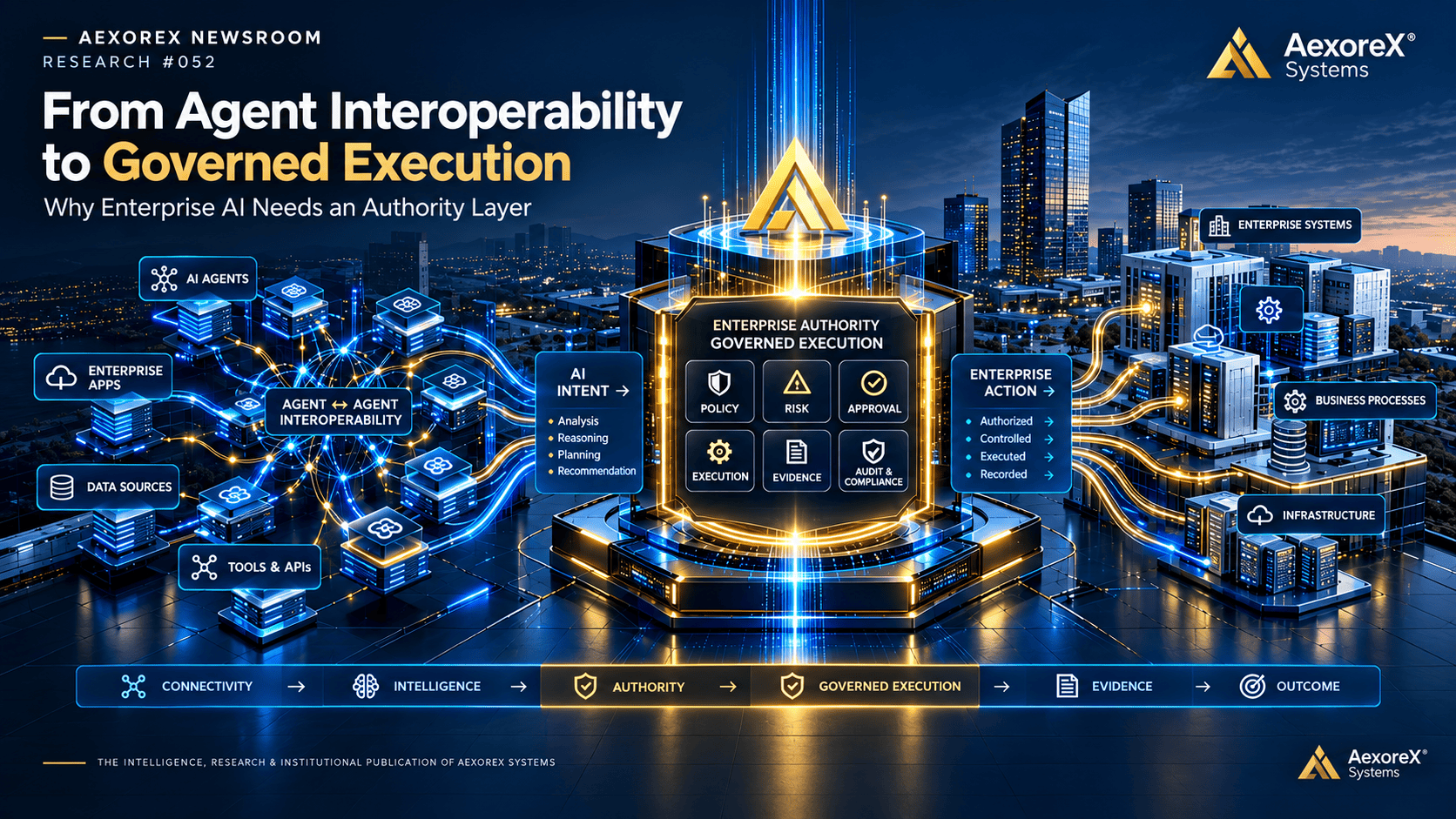
This leads to a broader architectural concept: Governed Execution Infrastructure. This can be understood as the control layer situated between AI intent and enterprise state change. Its purpose is not to replace: - IAM. - APIs. - ERP. - CRM. - Payment infrastructure. - Databases. - Workflow systems. - Existing security platforms. - Agent protocols.
Instead, it coordinates the conditions under which autonomous or human-directed actions can safely reach those systems. A conceptual architecture can be expressed as: Identity → Context → Policy → Authority → Risk → Approval → Execution → Evidence → Outcome. Each stage answers a different question:
- **Identity**: Who is acting?
- **Context**: What situation surrounds the action?
- **Policy**: Which organizational rules apply?
- **Authority**: What is this actor permitted to decide or execute?
- **Risk**: What could happen if the action is wrong?
- **Approval**: Does the action require additional authorization?
- **Execution**: Which system should actually perform the action?
- **Evidence**: What information must be retained to reconstruct the decision and execution?
- **Outcome**: What actually happened after execution?
This model is presented as an architectural framework for reasoning about governed autonomous execution, not as a protocol standard.
MCP and A2A Make the Question More Important
The emergence of open interoperability protocols should not be interpreted as revealing a defect in those protocols; quite the opposite. Their value lies precisely in reducing friction between systems. The MCP's 2026-07-28 specification, for example, introduced a stateless protocol core designed to improve scalability and routing, while also strengthening authorization. A2A 1.0 provides a standardized interaction model for independent agents, including discovery, task collaboration, authentication, and authorization.
However, as interoperability increases, the number of possible execution paths can also expand. This creates a strategic consequence: the easier it becomes for agents to connect, the more important it becomes to govern what those connections are allowed to accomplish. This is why interoperability and authority should be viewed as complementary architectural layers rather than competing approaches.
The Enterprise Authority Problem
The phrase "Enterprise Authority Vacuum" can be a useful analytical concept, but it should not imply that enterprises lack authorization systems. Most enterprises already possess extensive security infrastructure. The emerging issue is narrower and more specific: existing authorization mechanisms may not, by themselves, express the full contextual authority required for increasingly autonomous, multi-step, multi-agent execution.
This is particularly relevant when: - Agents act across multiple applications. - Authority is delegated dynamically. - Actions have financial or operational consequences. - Approval requirements depend on context. - Multiple agents participate in one workflow. - External agents interact with internal systems. - Policies change during execution. - Risk changes between planning and execution. - Organizations need to reconstruct the complete decision chain afterward.
The problem, therefore, is not the absence of security. It is the challenge of coordinating security, policy, authority, risk, approval, execution, and evidence around autonomous action.
From Financial Authority to Enterprise Authority
Financial workflows highlight this problem especially well. Consider a future autonomous enterprise where Digital Labor can: - Request a virtual card. - Initiate a purchase. - Pay an approved vendor. - Manage subscriptions. - Reconcile transactions. - Request additional spending authority. - Escalate unusual financial activity.
Such a system requires more than payment connectivity. It needs a way to determine: - Who may spend? - What may they spend on? - How much may they spend? - For what purpose? - Under which policy? - When is approval required? - What happens when the risk changes? - What evidence must be retained?
That is the essence of Financial Authority. This same principle extends beyond finance. Procurement, HR, customer operations, IT administration, supply chain, compliance, and other enterprise functions can require their own authority models. Financial Authority is therefore one domain-specific expression of a broader concept: Enterprise Authority.
The AEOS QUANTUM Perspective
AexoreX Systems addresses this problem through the architectural model of AEOS QUANTUM™—the Enterprise Intelligence Operating Platform for Autonomous Enterprises. AEOS QUANTUM is designed around a simple principle: AEOS does not replace the enterprise stack; it connects, orchestrates, governs, and activates it.
Within the AEOS QUANTUM architectural model, enterprise systems remain the systems of record and systems of execution. External infrastructure, protocols, models, applications, and services can continue to perform their respective functions. AEOS's proposed control role is different. It is intended to coordinate: Connect → Contextualize → Govern → Orchestrate → Authorize → Execute → Optimize, with Evidence treated as a cross-cutting requirement rather than a final afterthought.
Within this architecture, the Enterprise Authority concept is designed to help answer: What is this Digital Labor or human actor allowed to do, under which conditions, and with what level of authority? The model also distinguishes Digital Labor authority levels: - **D1 — Recommend** - **D2 — Decide** - **D3 — Decide & Execute** - **D4 — Control-Escalation**
These levels represent an architectural authority model, not a claim that every capability is currently production-ready.
AEOS QUANTUM Status Discipline
AexoreX Systems deliberately separates architectural intent from demonstrated production capability. For this reason, AEOS QUANTUM capabilities should be understood through explicit status categories: - **Available**: Currently available and usable. - **In Development**: Actively being built. - **Designed**: Architecturally defined but not necessarily implemented. - **Planned**: Intended future development. - **Vision**: Longer-term strategic direction. - **Proven**: Supported by demonstrated evidence appropriate to the claim.
This distinction is particularly important in autonomous enterprise infrastructure. A diagram is not a deployment. A design is not a production capability. A planned control is not an implemented control. And a technical possibility is not evidence of operational performance. For AEOS QUANTUM, governance credibility depends on maintaining these distinctions.
What Changes for Enterprise Leaders?
For CIOs, CTOs, CISOs, Chief Risk Officers, and enterprise architects, the strategic question may increasingly shift from "Which AI agent platform should we choose?" toward "How will we govern the actions of every AI system operating across our enterprise?" This leads to several practical architectural questions:
1. **Identity**: Can every agent, service, and human actor be identified? 2. **Delegation**: Can the enterprise determine who or what delegated authority to the acting agent? 3. **Context**: Can policy decisions incorporate relevant business context? 4. **Authority**: Can authority be limited according to action, scope, amount, resource, or purpose? 5. **Risk**: Can higher-risk actions receive stronger controls? 6. **Approval**: Can human or system approvals be required dynamically? 7. **Execution**: Can the final action be governed at the point where enterprise state changes? 8. **Evidence**: Can the organization reconstruct why an action was allowed and what actually happened? 9. **Outcome**: Can the system determine whether the intended business result was achieved?
These questions define a different category of enterprise infrastructure: not merely AI infrastructure, not merely integration infrastructure, but governed execution infrastructure.
The Strategic Shift
The economic potential of generative AI is already significant. McKinsey has estimated that generative AI could deliver approximately $2.6 trillion to $4.4 trillion in annual economic benefits across 63 use cases. Its later work on agentic AI emphasizes both the opportunity and the novel risks created when autonomous systems can reason, plan, act, and adapt.
The strategic opportunity, therefore, is not simply to make AI more autonomous, but to make autonomy operationally governable. That distinction may become increasingly important as enterprises transition from AI assistants toward AI systems capable of executing multi-step business processes. The competitive question may consequently evolve from: Who has the best model? → Who has the best agent? → Who has the best agent ecosystem? → Who can govern autonomous execution at enterprise scale?
The final question may prove to be the most consequential.
What Comes Next?
Several developments are likely to shape this architecture:
- **Runtime authority**: Organizations may increasingly require authority decisions to be evaluated closer to the point of execution, rather than relying exclusively on permissions established earlier in the workflow.
- **Delegation-aware security**: Multi-agent systems may require stronger visibility into how authority moves from humans to agents and from agents to other agents.
- **Policy-aware interoperability**: Protocols may increasingly operate alongside enterprise policy systems capable of applying organizational constraints.
- **Evidence-aware execution**: Autonomous systems may need to produce richer evidence around decisions, approvals, actions, and outcomes.
- **Financial Authority**: As Digital Labor interacts with financial infrastructure, spending authority may become a distinct governance layer.
- **Cross-enterprise governance**: As organizations increasingly interact with external agents and agentic services, authority boundaries may extend beyond a single enterprise's internal identity perimeter.
These developments remain areas of active evolution and should therefore be treated as architectural trajectories rather than guaranteed outcomes.
Conclusion
The rise of agent interoperability is not the end of enterprise AI architecture; it is the beginning of a more difficult question. Open protocols can make it easier for agents to discover capabilities, exchange information, collaborate, and invoke tools. However, enterprise autonomy requires another layer of thinking.
An agent may possess a capability without having authority. A credential may establish identity without establishing contextual permission. A successful API call may prove execution without proving that the action was appropriate. And an application log may record an event without fully explaining the authorization chain behind it.
The next generation of enterprise AI therefore requires a clear separation between: - Connectivity - Identity - Authorization - Authority - Execution - Evidence - Outcome
The central principle is simple: Interoperability enables agents to connect. Enterprise authority determines what they are allowed to do. Governed execution ensures that authority is enforced at the point of action. This is the architectural territory that AexoreX Systems is exploring through AEOS QUANTUM™ and the concept of Governed Execution Infrastructure. It is not a replacement for the enterprise stack, but a control architecture intended to help enterprises connect intelligence to action without disconnecting action from authority.
Capability is not authority. Connectivity is not permission. Execution is not governance. As enterprise AI becomes increasingly autonomous, the organizations that can govern the transition from intelligence to action may ultimately be best positioned to operate autonomous enterprises responsibly.
Sources and attribution
- AexoreX Newsroom Editorial Research, supported by primary technical and industry sources · statement link
About the author
The editorial team behind AexoreX Newsroom, the official corporate publication of AexoreX Systems LLC.
More from AexoreX Systems Editorial Team →Related stories
- Protocol-Governed Enterprise Authority
- Why Enterprise AI Needs an Operating Layer, Not Another Copilot
- Capability Is Not Authority: The Institutional Shift to Protocol-Governed Autonomous Enterprises
- The Identity-to-Execution Seam: Governing Non-Human Identities and Dynamic Delegation in Autonomous Enterprise Operations
- AexoreX Systems Introduces AEOS Enterprise Authority™ as Governance Layer for Autonomous Enterprise Intelligence
- AexoreX Systems Advances AEOS QUANTUM™ as Enterprise Intelligence Operating Platform for Autonomous Enterprises
- Enterprise Intelligence Infrastructure and Governed Autonomy: The Architectural Foundation for the Autonomous Enterprise
- From Enterprise Intelligence to Governed Autonomous Execution: The Next Step Toward the Autonomous Enterprises
- Financial Authority: Governing Autonomous Spending in the Agentic Enterprise
- #025 — The Enterprise AI Inflection Point: From AI Agents to Governed Autonomous Operations