
The Runtime Enforcement Gap: From Authorized Intent to Verifiable Execution
Examining the Runtime Enforcement Gap Between Authorized Intent and Verifiable Execution in Autonomous Enterprise Systems.
This report examines the runtime enforcement gap, where authorized intent may deviate from verifiable execution in autonomous enterprise systems, highlighting the need for continuous control and independent verification.
Opinion · AI-assisted, human edited
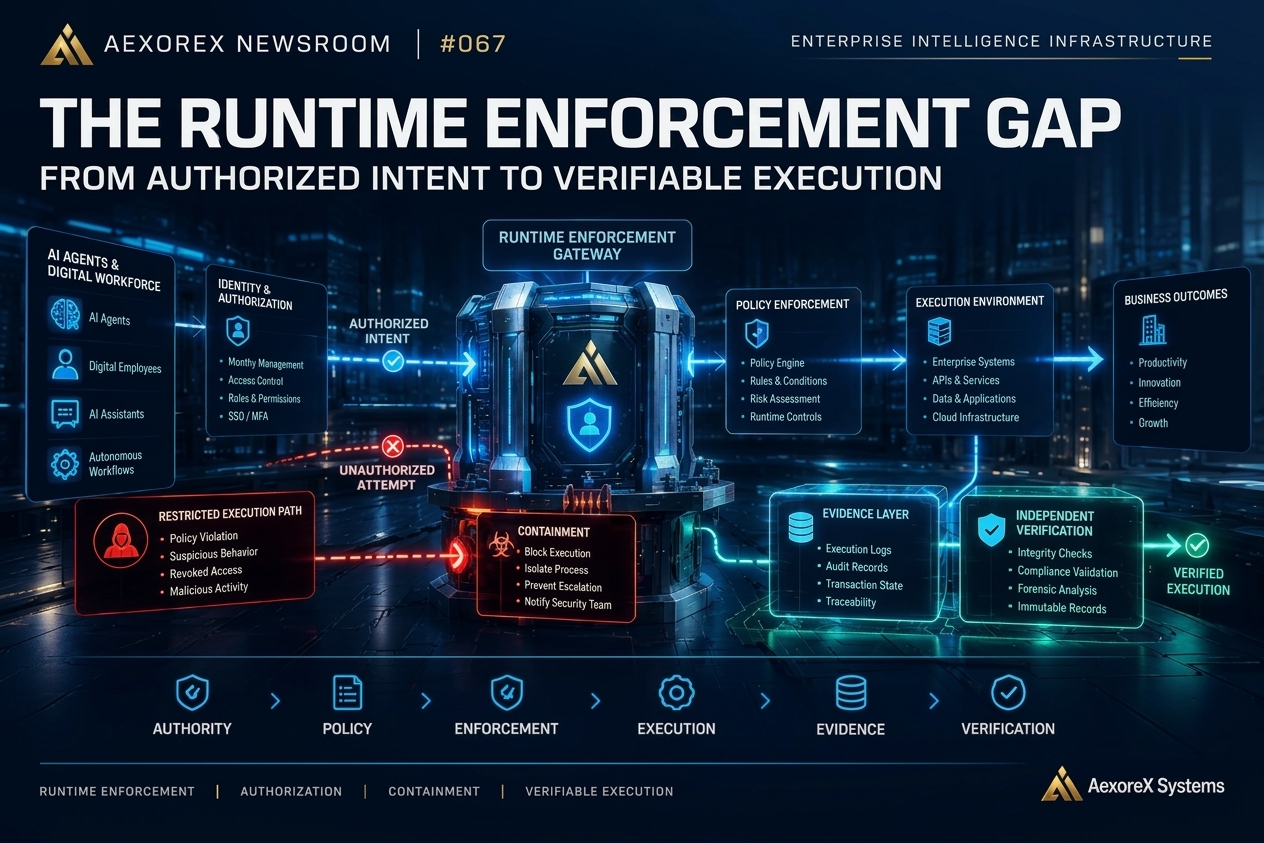
The Runtime Enforcement Gap
As artificial intelligence (AI) agents increasingly integrate with enterprise systems—accessing APIs, modifying records, and initiating workflows—a fundamental security question emerges: How can an organization ensure that authorized intent remains within authorized boundaries throughout execution?
Granting access does not guarantee that every subsequent action will be appropriate. An agent may receive legitimate permissions but use them in an unintended context. A workflow may be approved, but its underlying conditions might change. A credential may be revoked while an operation is in progress. An execution log may report success without independently proving the resulting state.
These challenges highlight a critical distinction between authorization and runtime enforcement. Authorization determines whether an action is permitted under defined conditions. Runtime enforcement applies those conditions when actions are attempted and executed. Verification establishes whether the resulting behavior and outcomes are supported by sufficient evidence.
For enterprises adopting AI agents, these functions must work together. Access controls alone cannot guarantee containment, and an agent's self-report cannot independently establish that an action was executed correctly.
This article examines the runtime enforcement gap, explains its implications for autonomous enterprise operations, and presents architectural principles for maintaining control, limiting unauthorized actions, and verifying execution. The central principle is straightforward: Authorized intent must be continuously constrained by runtime controls and supported by verifiable evidence.
The Emerging Problem: Authorization Is Not Execution Control
Traditional enterprise security often begins with identities, roles, permissions, and access policies. These controls remain essential. However, AI agents introduce additional complexity because they can interpret instructions, select tools, invoke APIs, and initiate sequences of operations.
An agent may have permission to access a business application without possessing unrestricted authority to perform every action available through that application. For example, an enterprise agent might be permitted to retrieve supplier records and prepare payment instructions, but that permission should not automatically authorize the agent to approve and execute every payment.
This distinction becomes more important when an agent can initiate multiple operations without requiring a person to review every intermediate step. A system may correctly authenticate an agent and accept its credential while still failing to enforce the business conditions that should govern a particular transaction.
Consequently, enterprise security must distinguish among three questions: - Is the identity authenticated? - Is this specific action authorized under the applicable conditions? - Can the organization verify what actually happened?
These questions are related but not interchangeable. Authentication establishes identity. Authorization evaluates permission. Runtime enforcement constrains attempted actions. Verification evaluates available evidence about execution and outcomes. A robust architecture must address all four functions.
The Runtime Enforcement Gap
The runtime enforcement gap exists when an organization defines acceptable behavior but cannot reliably ensure that every relevant operation remains within those boundaries while it is being executed. This gap can arise from several conditions.
Permissions That Are Broader Than the Task
An agent may receive a credential that grants access to more resources or operations than its immediate task requires. Even when the original access decision is legitimate, the credential may provide opportunities for actions beyond the intended scope. The principle of least privilege addresses this risk by limiting permissions to what is necessary. However, effective implementation also requires enforcement at the systems where actions occur.
Authorization Decisions That Become Stale
A decision may be valid when first issued but become inappropriate after relevant conditions change. Examples include: - A user's approval is withdrawn. - A transaction exceeds an approved limit. - A supplier's payment details change. - A credential expires. - A policy changes while a workflow remains active.
A system that relies exclusively on an earlier authorization decision may fail to recognize that the conditions governing execution have changed.
Execution Across Multiple Systems
Enterprise workflows frequently cross application boundaries. An AI agent might read information from one system, prepare an instruction in another, and initiate a transaction through a third. Each system may enforce its own access controls, while the overall workflow depends on assumptions that no individual system can fully evaluate. This creates a coordination problem: an action permitted by one component may violate a business constraint defined elsewhere.
Insufficient Evidence of Enforcement
A system may report that an operation was approved or completed without providing sufficient evidence to establish whether all relevant controls were applied. An approval record does not necessarily prove that the approved parameters were preserved during execution. Similarly, an execution log may establish that an API request was submitted without proving that the intended business outcome occurred. The resulting problem is not simply missing logs. It is a potential mismatch between the organization's security requirements and the evidence available to demonstrate compliance with them.
Capability, Authority, Intent, and Execution
A useful enterprise architecture distinguishes four concepts that are frequently treated as though they were equivalent.
- **Capability**: What a system can technically do. This does not establish whether it is permitted to do it.
- **Authority**: What a system is permitted to do under defined conditions. This does not establish whether it intends to do it.
- **Intent**: What an agent or workflow is attempting to accomplish. This does not establish whether the action is authorized or completed.
- **Execution**: What a system actually performs. This does not establish whether the result satisfies every business requirement.
These distinctions have direct security implications. An agent may possess the technical capability to modify a financial record. Its authority may permit modifications only within a defined scope. Its intent may be to update a particular supplier. Its execution may nevertheless differ from that intent because of an incorrect parameter, a changing record, or an unexpected system response.
A secure enterprise architecture must therefore avoid treating technical capability as proof of authority or declared intent as proof of successful execution. The governing principle is: Capability ≠ Authority. Authority ≠ Intent. Intent ≠ Valid Execution. Each relationship requires its own controls and evidence.
The Time-of-Check to Time-of-Use Problem
An important challenge is the time-of-check to time-of-use problem, commonly abbreviated as TOCTOU. It occurs when a system checks a condition and later acts on the assumption that the condition remains valid.
Consider an illustrative workflow: 1. An agent checks whether a transaction is permitted. 2. The transaction passes the authorization check. 3. A relevant condition changes. 4. The agent submits the transaction using the earlier decision. 5. The receiving system processes the request without adequately re-evaluating the changed condition.
The original authorization decision may have been correct at the time it was made. The problem is that the decision was relied upon after its underlying assumptions had changed. This risk is not unique to AI. It is a long-standing issue in software security and distributed systems. However, AI-driven workflows can increase the number of decisions, tools, and system boundaries involved in an operation.
Mitigations may include: - Re-evaluating important conditions at execution time. - Using short-lived, narrowly scoped credentials. - Binding approvals to specific actions and parameters. - Enforcing limits at the receiving system. - Using transactional safeguards where supported. - Rejecting requests when required authorization evidence is missing or stale. - Recording policy versions and relevant decision context.
No single mitigation eliminates every TOCTOU risk. Controls must reflect the capabilities and failure modes of the systems involved.
Delegated Authority and the Expanding Execution Chain
Enterprise AI agents rarely operate entirely in isolation. An agent may call a tool, which invokes an API, which triggers another service, which initiates a downstream workflow. This creates a chain of delegated execution.
For example: Human instruction → AI agent → Integration service → Business API → Downstream workflow
Each transition introduces questions about authority: - Who initiated the original task? - Which permissions were delegated? - What restrictions apply to the next operation? - Can the receiving system identify the relevant actor and delegation context? - Does the downstream action remain within the original authorization? - What happens if the original permission is revoked?
OAuth 2.0 Token Exchange, specified in RFC 8693, provides a standardized mechanism for exchanging one security token for another in appropriate scenarios. It can support architectures involving delegated access, but token exchange alone does not solve every problem associated with business authorization, execution containment, or evidence. A token should not be treated as unlimited authority merely because it is valid.
A sound delegation architecture should preserve relevant identity and authorization context, constrain permissions at each boundary, and prevent downstream services from gaining broader authority than the operation requires. Where supported, delegation chains should also make it possible to establish which identity or service initiated an action and under what authority it proceeded. The design objective is not simply to propagate access. It is to propagate bounded, attributable, and enforceable authority.
Blocking, Limiting, Stopping, and Verifying
These four functions address different stages of control and should not be treated as interchangeable.
- **Blocking**: Purpose is to prevent an unauthorized operation from proceeding (e.g., rejecting a request that violates policy). Limitation: Does not establish what happened before the request was blocked.
- **Limiting**: Purpose is to restrict the permitted scope or impact (e.g., allowing access only to specified records). Limitation: Depends on whether restrictions are enforced throughout the execution path.
- **Stopping**: Purpose is to interrupt or prevent further activity (e.g., canceling a workflow or disabling a credential). Limitation: Cannot necessarily reverse actions already completed.
- **Verifying**: Purpose is to establish what occurred using appropriate evidence (e.g., comparing an approved transaction with authoritative records). Limitation: Depends on evidence quality, completeness, and independence.
An enterprise control plane may coordinate these functions, but their implementation often depends on enforcement mechanisms within individual applications, APIs, identity providers, and infrastructure components. A command to stop an agent does not automatically terminate every downstream process it has initiated. Similarly, disabling a credential may prevent new authenticated requests while leaving previously accepted jobs or active sessions unaffected.
Verification is also distinct from stopping. A system may successfully stop further activity but still need to determine whether earlier operations completed. Therefore, an enterprise must define what each control guarantees, where that guarantee applies, and which limitations remain.
Revocation Is Not the Same as Containment
Revocation is an important security control, but it should not be confused with complete containment. Revocation withdraws or invalidates a permission, credential, token, or authorization under the relevant system's rules. Containment concerns whether the associated activity and its effects remain within acceptable boundaries. These functions may differ because enterprise operations can involve several independently managed components.
Suppose an agent's access is revoked while a workflow is in progress. Depending on the implementation: - New requests may be rejected. - Existing sessions may remain active for some period. - Previously accepted jobs may continue. - A downstream service may already have received an instruction. - A transaction may already have reached a point where it cannot be canceled. - The final business state may remain uncertain until it is checked.
These outcomes are implementation-dependent. Revocation behavior varies by protocol, provider, service configuration, and application design. A robust architecture should therefore define revocation behavior across the relevant execution path.
Useful questions include: - Which credentials and permissions are invalidated? - How quickly do relevant enforcement points recognize the change? - Are existing sessions and active jobs affected? - Can downstream operations continue using previously accepted instructions? - What happens to operations that cannot safely be canceled? - How is the resulting state verified?
A practical revocation design should also specify the required response when immediate termination is impossible. Depending on the operation, that response might involve preventing additional actions, placing a workflow on hold, restricting downstream access, escalating to a human operator, or reconciling the final state. The objective is not to promise that every operation can be reversed. It is to define the controls and recovery procedures available when authority changes during execution.
Revocation withdraws authority. Containment limits activity and impact. Verification establishes what remains true after the change. These are separate responsibilities.
Why Agent Self-Reports Are Not Sufficient Evidence
AI agents can produce summaries of their actions, describe tool calls, and report whether a task appears complete. Such reports can be useful for operational visibility. However, they should not automatically be treated as independent evidence.
An agent's report may be incomplete, inaccurate, based on a misleading tool response, or unable to observe downstream effects. For example, an agent might report that a supplier record was updated after receiving a successful API response. That response may establish that a request was accepted, but it may not independently prove that every intended field was persisted or that subsequent processing used the correct values.
A stronger verification process uses evidence appropriate to the claim being made. Depending on the system, that evidence might include: - Authoritative records from the receiving application. - API responses combined with subsequent state checks. - Transaction identifiers and timestamps. - Policy decision records. - Identity and delegation information. - Independent audit records. - Reconciliation results from a separate control process.
Not every operation requires every evidence source. Evidence requirements should be proportionate to the operation's risk and the consequences of failure. For a low-risk information retrieval task, a tool response may be sufficient for the intended purpose. For a high-impact financial or administrative operation, stronger verification may be necessary.
The key distinction is between evidence that an agent says something happened and evidence that supports the conclusion that it actually happened. Self-report is an observation. It is not automatically independent proof.
Designing for Verifiable Execution
A practical runtime enforcement architecture should connect policy decisions, enforcement mechanisms, operational monitoring, and evidence collection. The following conceptual model describes one possible approach. It is an architectural reference, not a claim that any particular product implements every layer.
- **Layer 1 — Human and Organizational Authority**: Defines who may authorize an operation, which approvals are required, and which decisions must remain under human control. Examples include financial approval limits, administrative privileges, and separation-of-duties requirements.
- **Layer 2 — Identity and Delegation**: Establishes the identity of the initiating actor and the relevant delegated authority. This layer may involve identity providers, authentication systems, scoped tokens, and delegation records.
- **Layer 3 — Policy Decision**: Evaluates whether a requested action is permitted under the applicable policy and context. Relevant conditions may include the resource, operation, actor, approval status, transaction limit, and environmental state.
- **Layer 4 — Runtime Enforcement**: Applies the authorization decision at the point where the operation is attempted. Depending on the architecture, enforcement may occur in an API gateway, application, service, integration layer, or another component capable of controlling the action.
- **Layer 5 — Execution Gateway**: Provides a controlled boundary between AI agents and enterprise systems. It may apply action-specific restrictions, validate parameters, require approvals, and reject operations outside the permitted scope. A centralized gateway is not sufficient by itself if downstream systems remain accessible through alternative paths that bypass the same restrictions.
- **Layer 6 — Revocation and Containment**: Coordinates responses to changing authority, policy violations, and suspected compromise. This layer should define how credentials, sessions, jobs, and downstream operations are handled, while recognizing that not every in-flight action can be canceled.
- **Layer 7 — Evidence and Audit**: Collects relevant records of authorization decisions, attempted actions, execution responses, state changes, and control outcomes. Evidence should be protected against unauthorized modification and retained according to applicable requirements.
- **Layer 8 — Independent Verification and Reconciliation**: Checks whether the resulting state matches the authorized intent. Where appropriate, verification should use authoritative records or a separate control path rather than relying exclusively on the agent that initiated the operation.
The result is a layered model: Authority → Identity → Policy → Enforcement → Execution → Containment → Evidence → Verification. These layers may be implemented through different products and services. Their separation is conceptual and functional; it does not require eight separate software systems. The essential requirement is that the organization can identify where each responsibility is implemented and what evidence supports its effectiveness.
Illustrative Scenario: An AI Agent Initiates a Supplier Payment
Consider an enterprise using an AI agent to assist with supplier payments. The agent can retrieve supplier information, prepare payment instructions, and submit requests through approved business systems. Actual payment execution remains subject to the enterprise's configured controls.
A payment request is initially approved under a defined set of conditions. Before execution, the supplier's bank details change. If the workflow relies entirely on the original approval, the payment may proceed using information that no longer matches the approved context.
A stronger design would address the problem at several points: - **Before execution**: The system verifies that the requested payment matches the approved supplier, amount, destination, and applicable policy conditions. - **At the enforcement point**: The payment service checks whether the current request is permitted. A material change to the approved details may require renewed approval. - **During execution**: The system records the transaction identifier, relevant authorization context, and execution response. - **If authority changes**: The system follows its defined revocation and containment procedures. It does not assume that canceling the agent automatically cancels every downstream operation. - **After execution**: The organization checks authoritative payment records to determine whether the payment was initiated, accepted, completed, rejected, or left in an uncertain state.
This example illustrates why authorization, runtime enforcement, containment, and verification must be considered together. It does not imply that every payment platform provides the same controls or that all payment operations can be stopped or reversed. The appropriate implementation depends on the enterprise's payment systems, risk requirements, and operational procedures.
Zero Trust and Runtime Enforcement
Zero Trust Architecture provides a relevant foundation for understanding this problem. NIST Special Publication 800-207 describes Zero Trust as an approach that avoids granting implicit trust solely because a user or system is located within a particular network or has previously been authenticated. Instead, access decisions should be based on relevant identity, resource, policy, and contextual considerations.
For AI-driven enterprise workflows, this principle supports several design objectives: - Authenticate the relevant identity. - Evaluate authorization for the requested resource and action. - Apply least-privilege permissions. - Enforce policy at appropriate points. - Reassess relevant conditions when required. - Monitor activity and investigate deviations. - Maintain evidence suitable for audit and incident response.
However, Zero Trust should not be interpreted as a guarantee that every action will be safe or that every policy decision will remain valid throughout execution. The practical challenge is translating access policy into enforceable controls across the complete operation. An enterprise may have strong identity management and still lack adequate controls over downstream jobs, long-running workflows, or operations already accepted by another system. Zero Trust is therefore a useful architectural foundation, but its effectiveness depends on the actual enforcement mechanisms, system coverage, and operational processes.
Implications for Vendor-Independent Enterprise Architecture
Enterprise organizations often use multiple providers for AI models, identity, integration, security, business applications, and observability. A vendor-independent architecture should not assume that one provider controls every relevant part of an operation. Different components may expose different permissions, token lifetimes, logging capabilities, cancellation mechanisms, and policy interfaces. Consequently, an orchestration layer should not be treated as the sole source of enforcement merely because it initiates or coordinates the workflow.
A practical architecture should identify: - Which component evaluates authorization. - Which component enforces the decision. - Which systems can execute actions independently. - Which component handles revocation. - Which records establish what occurred. - Which controls verify the resulting state. - Which responsibilities remain with the underlying service provider.
The architecture should also account for failure scenarios. A policy service may be unavailable. An integration may time out after submitting a request. A downstream application may accept an operation but fail to return a definitive response. In these situations, the system should not automatically interpret an ambiguous result as successful completion. Depending on the risk, the appropriate response may be to retry safely, check the authoritative state, hold the workflow, or escalate the issue. Idempotency mechanisms, transaction identifiers, bounded retries, and reconciliation processes can help reduce uncertainty when supported by the underlying systems.
Vendor independence does not mean eliminating dependencies. It means making dependencies, enforcement responsibilities, and failure boundaries explicit enough that the enterprise can govern them.
What AEOS QUANTUM Should Consider
For AEOS QUANTUM™, the runtime enforcement gap provides an architectural design consideration: coordinating enterprise activity is not equivalent to owning or enforcing every permission within every connected system. The following principles describe a proposed architectural direction. They should not be interpreted as confirmation that these capabilities are already implemented or independently validated.
Separate Orchestration from Enforcement
An orchestration layer may coordinate agents, tools, workflows, and business applications. However, high-impact operations should also be subject to enforceable controls at appropriate execution boundaries. AEOS QUANTUM should distinguish between deciding which operation to request and ensuring that the relevant systems permit only authorized operations.
Make Authority Explicit
Digital labor should not receive unrestricted authority simply because it can perform a task. Permissions should be scoped to the task, relevant resources, approved conditions, and required duration. Where human approval is necessary, the architecture should preserve that requirement rather than treating the agent's own decision as a substitute.
Treat Revocation as a Lifecycle Problem
Revocation should be considered across identities, credentials, sessions, integrations, and downstream workflows. The architecture should document which effects can be stopped, which cannot be reversed, and which require subsequent reconciliation.
Separate Operational Claims from Evidence
A dashboard or agent summary can improve visibility, but it should distinguish between an action that was requested, an action that was accepted, an action that was completed, and an outcome that was independently verified. These states should not be collapsed into a single generic "success" indicator.
Preserve Vendor Independence Through Defined Interfaces
Where feasible, AEOS QUANTUM should use clearly defined interfaces for policy evaluation, action authorization, execution, evidence collection, and verification. The design should avoid assuming that all vendors provide equivalent capabilities. Integration contracts should specify the information required, the guarantees provided, and the failure behavior expected from each component.
Preserve Human Control for High-Impact Decisions
Autonomy should operate within explicitly defined boundaries. Financial commitments, sensitive administrative changes, destructive operations, and other high-impact actions may require stronger authorization, human approval, additional verification, or mandatory escalation. The correct control depends on the risk and the organization's requirements. The architectural objective is not unrestricted autonomy. It is autonomy within enforceable authority, defined limits, and verifiable outcomes.
Questions Enterprise Leaders Should Ask
Before deploying AI agents into consequential business workflows, enterprise leaders should ask the following questions.
Authority - Are agent permissions limited to the tasks they need to perform? - Can approvals be tied to specific actions, parameters, and conditions? - Is responsibility for each authorization decision clear?
Runtime Enforcement - Where is authorization enforced? - Can an agent bypass the intended enforcement point? - Are relevant conditions checked again when necessary?
Delegation - Can the enterprise trace which identity initiated an action? - Are delegated permissions appropriately restricted? - Can downstream services exercise more authority than the initiating actor was granted?
Revocation and Containment - What happens when permissions are withdrawn during execution? - Are active jobs and existing sessions addressed? - Which operations cannot be canceled or reversed?
Evidence - Does the system distinguish requested, accepted, completed, and verified actions? - Can execution claims be checked against authoritative records? - Are audit records protected and sufficiently complete for the intended purpose?
Recovery - What happens when an operation times out after submission? - How does the system determine whether the operation actually succeeded? - Which conditions trigger a hold, reconciliation, or human escalation?
If these questions cannot be answered clearly, the organization may have an authorization model without a sufficiently defined runtime enforcement and verification model.
Limitations and Open Questions
Runtime enforcement is not a single feature that can be enabled uniformly across every enterprise system. Its effectiveness depends on the architecture, implementation, policy quality, integration boundaries, and behavior of the underlying services. Several limitations deserve particular attention.
First, not every application exposes sufficient controls to enforce fine-grained policies at execution time. Second, revocation cannot necessarily undo an action that has already completed or reached an irreversible stage. Third, logs and telemetry may be incomplete, delayed, or insufficient to establish a particular outcome. Fourth, independent verification can itself fail if the evidence source is unreliable, compromised, or disconnected from the authoritative business state. Fifth, excessive enforcement complexity can introduce operational delays, false denials, and difficult recovery scenarios. Finally, a layered architecture does not automatically guarantee security. Each layer must be implemented, tested, monitored, and maintained.
These limitations make precise claims essential. Organizations should document which controls are implemented, which have been tested, which remain planned, and which risks cannot yet be eliminated. Future work should examine measurable enforcement latency, revocation propagation, containment guarantees, evidence integrity, and the consistency of policy decisions across distributed enterprise systems. The relevant question is not whether an architecture claims to be autonomous. It is whether the organization can demonstrate that autonomy remains within defined boundaries under normal conditions, changing conditions, and failure conditions.
Conclusion: From Permission to Verifiable Control
AI agents are changing how enterprise software interprets instructions and performs work. As these systems gain access to more applications and operational tools, organizations must look beyond initial authorization decisions.
A permission may be legitimate while a later action is inappropriate. An approval may become stale. A revoked credential may not stop every in-flight operation. An agent may report success without proving the final business outcome. These are distinct problems that require coordinated controls.
A resilient enterprise architecture should connect identity, authorization, runtime enforcement, delegation, revocation, containment, evidence, and verification. It should also distinguish what a system can do from what it is permitted to do, what it intends to do, what it actually executes, and what the available evidence establishes.
For AEOS QUANTUM and other enterprise intelligence platforms, these distinctions provide a foundation for designing governed autonomy across heterogeneous systems. The long-term objective is not merely to authorize AI agents to act. It is to ensure that their actions remain bounded by legitimate authority, that changes in authority are handled predictably, and that consequential outcomes can be verified. The defining challenge of autonomous enterprise operations is not simply granting authority. It is enforcing authority at runtime and proving what happened afterward.
Key Takeaways
- Authorization alone does not guarantee that an action remains permitted throughout execution.
- Runtime enforcement must apply relevant restrictions at appropriate execution boundaries.
- Delegated authority should remain bounded and traceable across connected systems.
- Revocation, containment, and verification are distinct security responsibilities.
- Agent self-reports should not automatically be treated as independent evidence.
- Enterprise systems should distinguish requested, accepted, completed, and verified actions.
- Vendor-independent architectures should define enforcement responsibilities and failure behavior across providers.
- Governed autonomy requires explicit authority, effective controls, and evidence proportionate to the risk.
Conceptual Architecture
- Human and Organizational Authority
- ↓
- Identity and Delegation
- ↓
- Policy Decision
- ↓
- Runtime Enforcement
- ↓
- Execution Gateway and Enterprise Systems
- ↓
- Revocation and Containment
- ↓
- Evidence and Audit
- ↓
- Independent Verification and Reconciliation
This is a conceptual reference architecture. It does not represent a confirmed implementation or certification of AEOS QUANTUM.
Source Register
The following sources provide foundational context for the article. Standards, published guidance, and draft documents should be identified according to their actual publication status.
- NIST SP 800-207 — Zero Trust Architecture. National Institute of Standards and Technology. Relevance: Provides foundational guidance on Zero Trust principles and access decisions.
- NIST SP 800-207A — A Zero Trust Architecture Model for Access Control in Cloud-Native Applications in Multi-Location Environments. National Institute of Standards and Technology. Relevance: Extends Zero Trust considerations to access control in cloud-native application environments.
- RFC 8693 — OAuth 2.0 Token Exchange. Internet Engineering Task Force. Relevance: Defines a standardized mechanism for exchanging OAuth tokens, relevant to selected delegation and identity architectures.
- NIST IR 8596 — Cybersecurity Framework Profile for Artificial Intelligence. National Institute of Standards and Technology. Relevance: A source to consult for emerging cybersecurity risk-management considerations involving AI. Check the publication page for the document's current status before describing it as a final publication.
- Delegation Chain for OAuth 2.0 — Internet-Draft. Internet Engineering Task Force. Relevance: Relevant to the discussion of delegated authority and delegation chains. An Internet-Draft should not be described as a finalized standard unless its publication status changes.
- AuthZEN Binding for OAuth 2.0 Token Exchange — Internet-Draft. Internet Engineering Task Force. Relevance: Relevant to the relationship between authorization evaluation and OAuth token exchange. Confirm its current status before publication.
- OWASP Top 10 for Agentic Applications. OWASP GenAI Security Project. Relevance: Provides additional context for security risks associated with agentic applications.
Editorial note: The article uses these sources as technical context, not as proof that every described risk occurs in every implementation. The conceptual architecture and AEOS QUANTUM implications are editorial analysis, not claims of deployed capabilities.
Sources and attribution
- NIST SP 800-207 (Zero Trust Architecture); NIST SP 800-207A; IETF RFC 8693 (OAuth 2.0 Token Exchange); NIST IR 8596; OWASP Top 10 for Agentic Applications; relevant IETF Internet-Drafts. See the article's Source Register for references and publication status. · statement link
About the author
The editorial desk of AexoreX Newsroom, the publication of AexoreX Systems LLC.
More from AexoreX Newsroom Editorial Desk →Related stories
- Governed Execution Architecture
- The Non-Human Authorization Crisis: Re-Architecting Identity, Governance, and Execution for Autonomous Enterprise Systems
- The Runtime Authority Control Plane: Why Enterprise AI Needs More Than Identity and Permissions
- AexoreX Systems Introduces AEOS Enterprise Authority™ as Governance Layer for Autonomous Enterprise Intelligence
- Authoritative Control Planes for Autonomous Digital Labor: Identity, Authority & Verifiable Execution
- From Agent Interoperability to Governed Execution: Why Enterprise AI Needs an Authority Layer
- AFTER REVOCATION: THE SAFE-STATE PROBLEM IN AUTONOMOUS ENTERPRISE EXECUTION
- The Evidence Sufficiency Problem: From Trustworthy Records to Verifiable Enterprise Outcomes