
THE ENTERPRISE AUTHORITY ARCHITECTURE
Designing the Control Layer for Autonomous Enterprise Execution The enterprise is approaching a structural transition.
The rise of AI agents necessitates a new Enterprise Authority Architecture to govern their actions, moving beyond traditional identity-based security models.
Opinion · AI-assisted, human edited
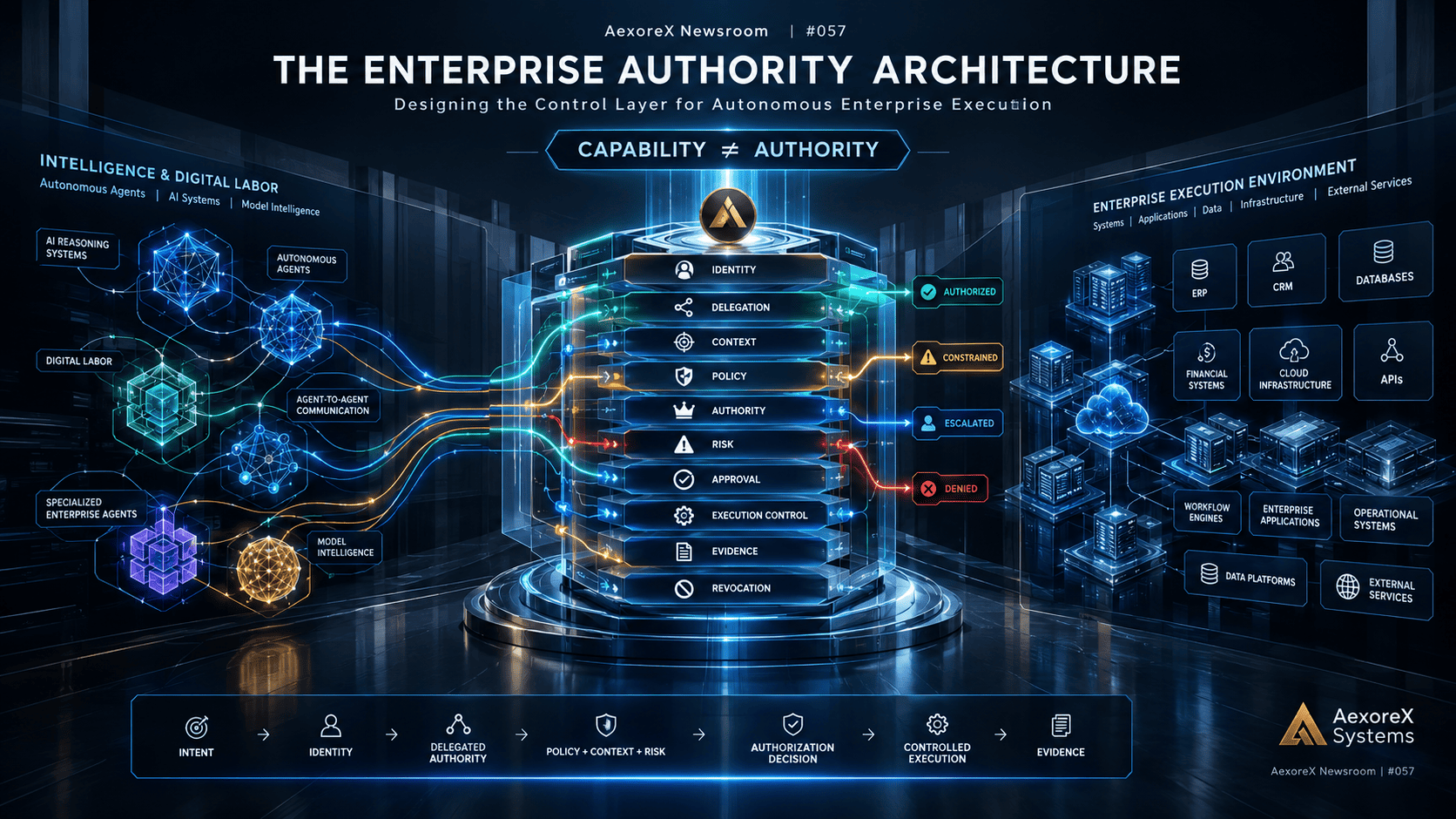
Artificial intelligence (AI) systems are evolving beyond generating text, summarizing documents, answering questions, or assisting individual employees. They are increasingly becoming operational participants capable of interpreting objectives, reasoning across context, selecting tools, communicating with other systems, initiating workflows, and executing actions. This acceleration presents a fundamental challenge to enterprise architecture, which was not designed to govern authority at this scale when the actor is no longer necessarily human. This marks the beginning of a new architectural problem.
From Identity to Authority
Traditional enterprise security relies on a stable relationship: Human → Identity → Role → Permission → Application → Action. Agentic AI fundamentally alters this. The emerging model is more complex: Human → Intent → Agent → Delegation → Policy → Context → Authority → Tool → Execution → Evidence.
This difference is profound. An AI agent may act on behalf of a human without being that human. It might have technical access without unlimited business authority. It could invoke a tool but lack authorization to use it for every purpose. An instruction might be received, but it may not constitute sufficient authorization. An action could be successfully executed even if the organization has not adequately determined if it should have occurred.
Therefore, identity alone is no longer sufficient. Enterprise architecture increasingly requires an explicit authority layer.
The Authority Architecture
An Enterprise Authority Architecture defines the controls for establishing, delegating, constraining, evaluating, enforcing, observing, and revoking authority across autonomous enterprise operations. It does not replace identity; instead, it extends identity's meaning into execution.
It asks not only "Who is acting?" but also: - On whose behalf? - For what purpose? - Under which policy? - Within what context? - With what authority? - For how long? - Within which boundaries? - At what risk level? - With what approval? - And with what evidence?
These questions become critically important as AI systems move closer to performing consequential enterprise actions.
Why Traditional Permission Models Are Under Pressure
Traditional enterprise applications assume a user or application initiates an action, with roles establishing permissions, policies constraining behavior, applications executing requests, and logs recording events. Autonomous agents introduce an additional decision-making layer between intent and execution. An agent might interpret a goal, determine a sequence of steps, choose tools, call APIs, receive results, modify its plan, and continue execution.
Consequently, enterprises must govern not only access to systems but also the entire authority chain surrounding autonomous decisions and actions. The CIO has recently highlighted this challenge, noting that enterprise applications were largely designed for human users, while AI agents are increasingly becoming operational actors. One example involved an agent operating with a human user's credentials, exposing the limitations of conventional identity and segregation-of-duties assumptions.
This is not merely an Identity and Access Management (IAM) problem; it is an architectural problem spanning identity, policy, authorization, orchestration, execution, and accountability.
Delegation Becomes Fundamental
Autonomous enterprise operations necessitate delegation. A human or an enterprise system may authorize an agent to perform a defined class of work. However, delegation should not imply transferring unlimited authority.
A mature delegation model should establish: Principal → Delegate → Purpose → Scope → Conditions → Duration → Limits → Escalation → Evidence.
This creates a fundamental distinction between delegated authority and inherited access. An agent should not automatically inherit all access a human possesses simply by acting on that person's behalf. Authority must be explicitly defined, proportional to the task, reflective of context and risk, and capable of changing with circumstances. InfoQ's discussion of the DPACT framework—Delegation, Policy, Auditability, Context, and Time—illustrates this broader trend toward bounded and delegated authority for AI agents, rather than simple token-based access.
Context Changes Authority
A key architectural difference between conventional access control and autonomous execution is context. The same action may be appropriate in one situation but inappropriate in another.
Consider an AI agent authorized to process financial transactions: - A transaction below a defined threshold may be automatically executable. - A larger transaction may require additional approval. - An unusual transaction may require enhanced verification. - A transaction involving a restricted jurisdiction may require another control.
The agent's technical capability has not changed; the context has. Therefore, authority must be capable of responding to context. This leads to a more sophisticated model: Capability + Identity + Context + Policy + Risk = Permitted Authority. This equation is conceptual, illustrating that authority should not be treated as a static permission permanently attached to an agent.
Runtime Authorization
Enterprise governance cannot solely exist within policy documents. If a policy dictates an agent cannot perform an action, that restriction must ultimately influence what the agent can execute. This necessitates runtime authorization.
At runtime, an authority layer can evaluate questions such as: - Is this actor recognized? - Is the delegation valid? - Is the requested action within scope? - Does the current context satisfy policy? - Is the risk within the permitted threshold? - Is additional approval required? - Has the authority expired? - Has the authority been revoked? - Should execution proceed, pause, escalate, or be denied?
This is where governance becomes operational, transitioning from "policy on paper" to "policy at execution time."
The Control Plane
A practical Enterprise Authority Architecture requires a control plane capable of connecting multiple enterprise capabilities.
Conceptually, this involves: Identity ↓ Context ↓ Policy ↓ Authority ↓ Risk ↓ Approval ↓ Orchestration ↓ Execution ↓ Evidence
The control plane does not necessarily replace underlying systems. ERP, CRM, IAM, cloud infrastructure, workflow platforms, and AI models all retain their respective functions. Instead, the authority architecture provides a coordinated mechanism for autonomous intelligence to interact with these systems under defined enterprise conditions. This is an important distinction: the objective is not to create another isolated application but to establish a control layer across the enterprise execution environment.
Connectivity Is Not Authority
The rapid adoption of agent interoperability protocols, such as MCP, which enable AI systems to discover and interact with tools and external capabilities, and agent-to-agent protocols for communication and collaboration, makes this distinction even more critical. These developments are crucial for interoperability, but interoperability does not automatically establish authority.
A protocol can answer: "How can this agent communicate with this capability?" Enterprise authority must additionally answer: "Should this agent be permitted to invoke this capability for this action, under these conditions, at this moment?"
Connectivity creates possibility. Authority establishes permission. Governance establishes boundaries. Execution creates consequences. Evidence establishes accountability. Confusing these layers could become a major architectural weakness as enterprises expose more capabilities to autonomous systems.
Evidence Must Be Architectural
Autonomous execution introduces a second requirement: proof. If an agent performs a consequential action, an enterprise must be able to reconstruct the chain: Intent → Identity → Delegation → Policy → Decision → Approval → Tool → Action → Outcome.
The organization should be able to determine: - Which actor initiated the task? - Which agent acted? - What authority was delegated? - Which policy applied? - What context was evaluated? - What risk was identified? - Was approval required? - Which system was accessed? - What action was executed? - What was the result?
This evidence should not be an optional reporting feature; for autonomous enterprise operations, evidence is part of the architecture. Without evidence, autonomy creates uncertainty; with evidence, autonomy can become accountable.
Authority Must Be Revocable
Another critical property is revocation. Traditional access models often assume relatively stable permissions, but autonomous systems demand more dynamic control.
Authority may need to be suspended because: - Risk increased. - Context changed. - The task changed. - The agent behaved unexpectedly. - A credential was compromised. - A downstream system became unavailable. - A policy changed. - An approval expired. - Or the organization simply decided to stop execution.
Therefore, authority must not only be granted but also be governable throughout its lifecycle, including issuance, modification, attenuation, suspension, escalation, expiration, and revocation.
From AI Governance to Execution Governance
The distinction between AI governance and execution governance is increasingly important. AI governance traditionally focuses on responsible AI, model risk, data protection, bias, transparency, compliance, and human oversight, all of which remain crucial.
However, autonomous enterprise operations introduce another dimension: execution governance. Execution governance asks: - What happens when the AI actually acts? - Which authority permits the action? - Which controls are enforced at runtime? - Which systems can the agent reach? - What happens if the action exceeds its boundary? - Who or what can stop it? - What evidence remains afterward?
This is the intersection where AI governance meets enterprise architecture.
The Autonomous Enterprise Requires an Authority Fabric
As organizations deploy multiple agents across departments, business units, applications, and cloud environments, authority cannot remain isolated within individual agent implementations. A finance agent, HR agent, procurement agent, customer-service agent, software-engineering agent, and infrastructure agent may operate independently yet interact with shared enterprise resources.
This necessitates an Authority Fabric, which would provide common principles for: - Identity - Delegation - Context - Policy - Authority - Risk - Approval - Execution - Evidence - Revocation
The purpose is not to make every agent identical but to make their authority understandable and governable across the enterprise.
The New Enterprise Stack
The emerging enterprise AI architecture can therefore be understood as several connected layers:
- **Intelligence Layer:** Models, reasoning, perception, generation.
- **Agent Layer:** Planning, tool selection, task execution, collaboration.
- **Identity Layer:** Human identity, machine identity, agent identity.
- **Authority Layer:** Delegation, scope, limits, permissions, revocation.
- **Governance Layer:** Policy, risk, compliance, approvals.
- **Orchestration Layer:** Workflow coordination and execution management.
- **Execution Layer:** Applications, APIs, tools, infrastructure.
- **Evidence Layer:** Auditability, provenance, telemetry, accountability.
The critical architectural shift is the explicit recognition of Authority as a first-class layer.
AexoreX Perspective
AexoreX Systems is developing AEOS QUANTUM™ around this architectural direction. AEOS is not positioned as a replacement for the enterprise stack. Its conceptual role is to connect, contextualize, govern, orchestrate, authorize, execute, and optimize enterprise intelligence and Digital Labor across existing systems.
The underlying principle is straightforward: Capability ≠ Authority. Digital Labor may possess capabilities, but it does not possess intrinsic enterprise authority. Authority must be established by the enterprise, bounded by policy, contextualized by circumstances, and connected to accountable execution. This is the architectural foundation behind the concept of Enterprise Authority Infrastructure.
AEOS QUANTUM™ remains in active development. The architectural concepts described in this article represent the direction being developed by AexoreX Systems and should not be interpreted as a claim that every capability described is currently available as a production feature.
The Strategic Question
The autonomous enterprise will not be defined simply by the number of agents it deploys. It will be defined by how safely and effectively it can transform intelligence into authorized action.
The strategic question therefore becomes: How do we build enterprises where autonomous systems can act at scale without allowing authority to become uncontrolled?
The answer requires more than better models. It requires better architecture, better identity, better delegation, better policy, better runtime controls, and better evidence. Above all, it requires a deliberate architecture for authority.
The next generation of enterprise AI may be less about creating machines that can do everything and more about creating infrastructure that knows precisely what they are allowed to do, why they are allowed to do it, and when they must stop. That is the foundation of governed enterprise autonomy.
Capability creates possibility. Authority creates permission. Governance creates boundaries. Evidence creates accountability. Together, they create trusted autonomy.
Sources and attribution
- AexoreX Newsroom — Original Research & Editorial Analysis · statement link
About the author
The editorial team behind AexoreX Newsroom, the official corporate publication of AexoreX Systems LLC.
More from AexoreX Systems Editorial Team →Related stories
- The Non-Human Authorization Crisis: Re-Architecting Identity, Governance, and Execution for Autonomous Enterprise Systems
- The Enterprise Authority Gap
- The Autonomous Enterprise: From Intelligence to Governed Action
- The Cryptographic Authority Layer: Dynamic Attenuation and Provenance in Multi-Agent Enterprise Architectures
- From Enterprise Software to Enterprise Intelligence Infrastructure: The Architecture Behind AEOS QUANTUM™
- The Non-Human Identity Control Plane: Dynamic Authority and Traceable Delegation for Autonomous Enterprise Operations
- AexoreX Systems Introduces AEOS Enterprise Authority™ as Governance Layer for Autonomous Enterprise Intelligence
- Governing Digital Labor: Bridging Capability and Authority in Autonomous Enterprise Architecture
- From Agent Interoperability to Governed Execution: Why Enterprise AI Needs an Authority Layer