
The Enterprise Authority Gap
Why AI Agents Are Becoming More Capable Faster Than Enterprises Can Authorize Them
The rapid advancement of AI agents creates an enterprise authority gap as their capabilities outpace organizations' ability to authorize and govern their actions securely.
Opinion · AI-assisted, human edited
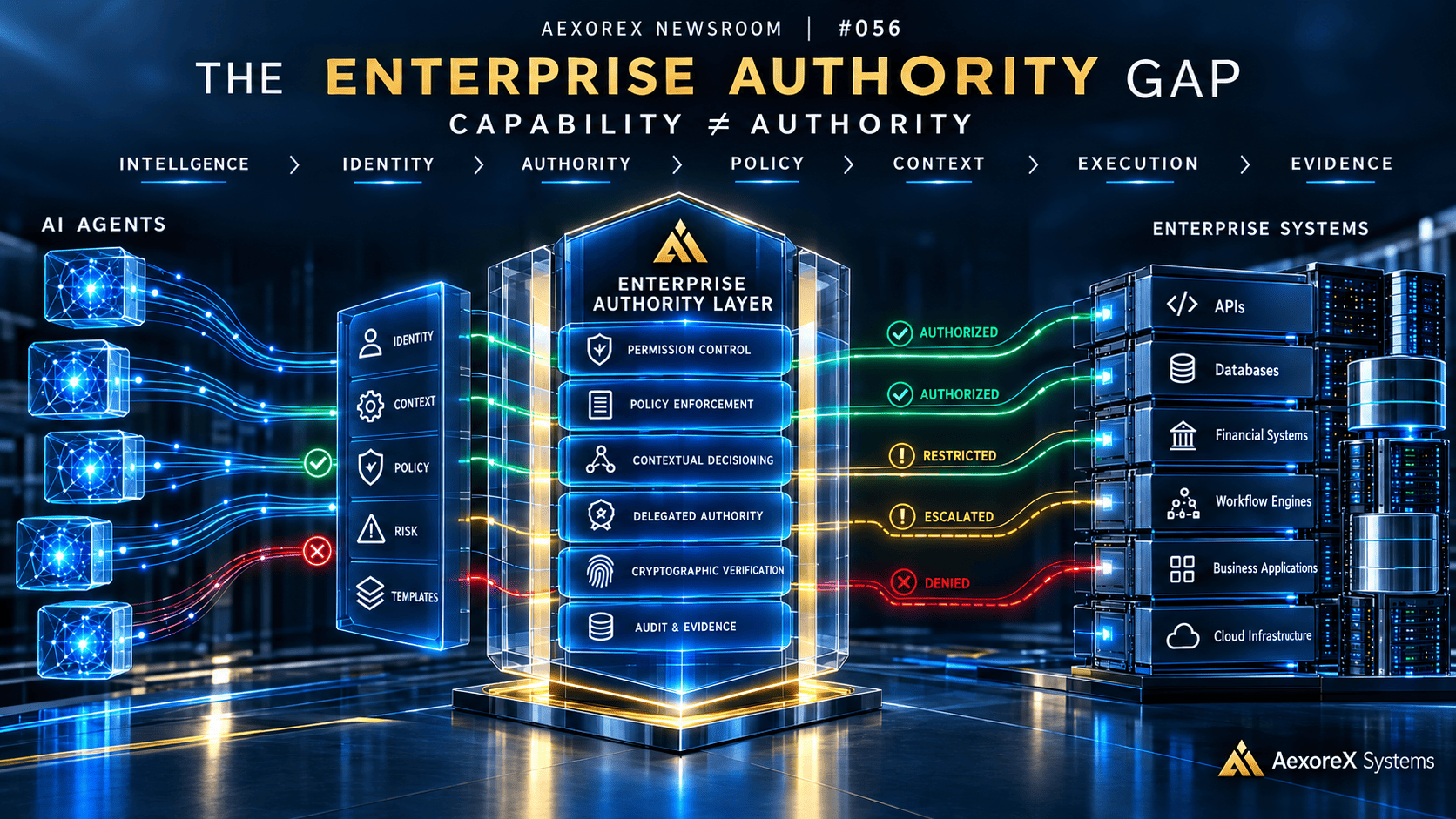
The enterprise AI conversation is entering a fundamentally different phase. For years, the central question revolved around whether artificial intelligence could understand information, generate useful outputs, or assist employees with complex tasks. This question is rapidly becoming less important. The more consequential question is now: What is an AI agent actually authorized to do?
This distinction matters because enterprise AI is moving from systems that primarily recommend toward systems that can increasingly act. Agents can interpret context, select tools, initiate workflows, interact with enterprise applications, access data, and execute multi-step operations. As their capabilities increase, the distance between an AI-generated recommendation and a real enterprise action becomes smaller. This creates a new infrastructure problem.
Capability Is Not Authority
An AI system may technically be capable of performing an action without being authorized to perform it. This sounds obvious, yet much of the existing enterprise technology stack was designed around a simpler assumption: establish an identity, assign permissions, and allow the system to operate within those permissions.
Autonomous agents complicate that model. A credential can identify an agent without explaining whether a particular action is appropriate. A role can define broad permissions without understanding the business context surrounding an individual transaction. A static access policy can determine what an identity generally may access without determining whether the identity should perform a specific action at a particular moment.
This creates a critical distinction:
- **Authentication** answers: Who is acting?
- **Authorization** answers: What may this actor do?
However, autonomous enterprise operations increasingly require a third question:
- **Authority** answers: Why, under which conditions, and within what boundaries may this action occur?
This is the emerging enterprise authority gap.
The Identity Problem Is Only the Beginning
*CIO* recently highlighted a growing concern about AI agents borrowing human credentials and the inadequacy of traditional human-oriented identity models for autonomous agents. The issue is not simply that an agent needs an identity; it's that enterprises need to understand the relationship among human intent, delegated authority, agent identity, and subsequent execution.
This is why treating every AI agent as merely another software account is increasingly insufficient. An enterprise may need to know:
- Who initiated the work?
- Which agent is acting?
- On whose behalf?
- For what purpose?
- Which authority was delegated?
- What policy permitted the action?
- What contextual conditions were present?
- What limits applied?
- Was additional approval required?
- Can the authority be revoked immediately?
- What evidence proves what happened?
And ultimately: Who owns the consequence? *CIO* recently framed precisely this accountability problem: organizations may know who owns an AI system without clearly defining who has the authority to reject, override, or accept the consequences of an AI-driven decision.
From Human-in-the-Loop to Authority-in-the-Loop
Another misconception worth challenging is that governance necessarily means putting a human in front of every AI action. That would simply replace automation with a new administrative bottleneck. The objective should instead be appropriate authority at the appropriate decision point.
Some actions can be executed automatically. Some require deterministic policy validation. Some require additional system-level controls. Some require another authorization service. The highest-impact actions may require human approval.
*CIO* recently argued that high-impact agent actions involving money, data, access, or authority may require a second decision before execution. This second decision does not always need to be another human; it can be an independent policy engine or deterministic control that the initiating agent cannot bypass or modify.
This represents an important architectural shift. The future is not necessarily:
Human → AI → Action
It is increasingly:
Intent → Identity → Authority → Policy → Context → Decision → Execution → Evidence
Delegated Authority Is Becoming a Core AI Security Primitive
*InfoQ*'s recent discussion of the DPACT framework (Delegation, Policy, Auditability, Context, and Time) illustrates how the security conversation is evolving beyond simple token-based access toward bounded and delegated authority for AI agents. This evolution is significant.
An autonomous agent should not automatically inherit unlimited authority merely because a human or system invoked it. Authority should be:
- Delegated.
- Bounded.
- Contextual.
- Time-aware.
- Auditable.
And, where necessary:
- Revocable.
This creates a new architectural requirement for enterprises operating fleets of AI agents.
The Enterprise Agent Fleet Changes Everything
The problem becomes substantially harder when organizations move from one AI assistant to hundreds or thousands of agents. *CIO* has already reported enterprises deploying large numbers of internally created agents, with organizations confronting the resulting challenges of access control, credentials, sandboxing, governance, and cost.
At that scale, manual governance becomes impossible. Enterprises need infrastructure capable of continuously answering:
- Which agents exist?
- What can they do?
- Who authorized them?
- What authority do they currently possess?
- Where are they operating?
- What systems can they reach?
- What actions have they taken?
- Which policies constrained those actions?
- What happens when their authority must change?
This is no longer simply an AI model problem; it is an enterprise operating architecture problem.
The Next Enterprise Control Layer
The emerging opportunity is therefore not another model, chatbot, or agent framework. It is the control layer between intelligence and execution.
- AI models provide intelligence.
- Agents provide action.
- Enterprise applications provide capabilities.
- Identity establishes who is acting.
- Policy establishes constraints.
- Authority determines what may actually be done.
- Execution creates operational consequences.
- Evidence establishes accountability.
The enterprise increasingly needs infrastructure capable of connecting these elements without forcing the organization to replace its existing technology stack. This is where a new category may emerge: Enterprise Authority Infrastructure.
Such infrastructure would not attempt to replace every identity system, enterprise application, AI model, agent framework, or workflow platform. Instead, it would establish an interoperable authority layer across them. The objective would be simple to state but difficult to engineer: Allow autonomous systems to act without allowing autonomy to become uncontrolled authority.
The Strategic Implication
The competitive advantage of enterprise AI may therefore shift. The next generation of enterprise leaders may not win because they have the largest number of agents. They may win because they can deploy autonomous digital labor with greater precision, accountability, and control.
The question will no longer be: How many AI agents do we have? It will become: How much trusted autonomous work can our enterprise safely authorize? That is a fundamentally different metric. It points toward a future in which enterprise autonomy is measured not simply by capability, but by the organization's ability to establish, delegate, constrain, observe, revoke, and prove authority at runtime.
A New Enterprise Principle
The principle may ultimately be as important as least privilege became for traditional cybersecurity: Capability does not constitute authority.
- An agent may be capable of doing something, but that does not mean it should be allowed to do it.
- An agent may possess access, but that does not mean the access should remain valid for every context.
- An agent may receive an instruction, but that does not mean the instruction is sufficient authorization.
- An agent may successfully execute an action, but that does not mean the enterprise can explain why the action was permitted.
The enterprise authority gap exists precisely between these assumptions. Closing that gap may become one of the defining infrastructure challenges of the autonomous enterprise. The future of enterprise AI will not be determined only by how intelligently machines can act, but also by how intelligently enterprises can authorize them to act.
Sources and attribution
- AexoreX Newsroom — Original Research & Editorial Analysis · statement link
About the author
The editorial team behind AexoreX Newsroom, the official corporate publication of AexoreX Systems LLC.
More from AexoreX Systems Editorial Team →Related stories
- Protocol-Governed Enterprise Authority
- The Non-Human Authorization Crisis: Re-Architecting Identity, Governance, and Execution for Autonomous Enterprise Systems
- CAPABILITY IS NOT AUTHORITY
- The Autonomous Enterprise: From Intelligence to Governed Action
- The Cryptographic Authority Layer: Dynamic Attenuation and Provenance in Multi-Agent Enterprise Architectures
- The Non-Human Identity Control Plane: Dynamic Authority and Traceable Delegation for Autonomous Enterprise Operations
- AexoreX Systems Introduces AEOS Enterprise Authority™ as Governance Layer for Autonomous Enterprise Intelligence
- Financial Authority: Governing Autonomous Spending in the Agentic Enterprise
- Governing Digital Labor: Bridging Capability and Authority in Autonomous Enterprise Architecture
- From Agent Interoperability to Governed Execution: Why Enterprise AI Needs an Authority Layer