
The Cryptographic Authority Layer: Dynamic Attenuation and Provenance in Multi-Agent Enterprise Architectures
As enterprise AI moves from isolated tool execution toward multi-agent delegation, a new architectural question emerges: how should authority be bounded, attenuated, and evidenced across every execution hop?
As enterprise AI shifts to multi-agent delegation, AexoreX Research proposes a Cryptographic Authority Layer for dynamic attenuation and verifiable provenance in autonomous execution.
Opinion · AI-assisted, human edited
Executive Summary
Enterprise AI architecture is evolving, moving beyond simple information generation. Artificial intelligence systems are now interacting with enterprise applications, invoking tools, coordinating workflows, and delegating tasks to other software agents. This shift introduces a fundamental architectural challenge. While an AI system may possess the capability to perform an action, capability does not inherently establish authority.
This principle, "Capability ≠ Authority," established in prior AexoreX Research #053 (Governed Execution Architecture), becomes significantly more critical in multi-agent environments. An initial instruction in such an environment can be decomposed into multiple tasks, delegated across various agents, translated into tool calls, passed through services, and ultimately executed against enterprise systems.
As authority moves across these boundaries, it can potentially expand, persist longer than intended, become disconnected from its original intent, or become difficult to reconstruct after execution. The architectural problem is no longer limited to "Can this agent execute the action?" Instead, it expands to: "What authority was delegated, to whom, for what purpose, under which constraints, for how long, and how was that authority transformed at every subsequent execution boundary?"
This research proposes that enterprise agentic architectures require a dedicated Cryptographic Authority Layer. This architectural control layer is designed to bind identity, authorization, delegation, attenuation, execution context, and provenance into a continuously verifiable chain.
This paper introduces two AexoreX Research concepts: - **Execution-Time Authority Attenuation (ETAA)**: This principle states that delegated authority should be dynamically reduced and constrained at the moment of execution, based on task, context, policy, risk, and downstream requirements. - **Cryptographic Ephemeral Delegation Tokens (CEDTs)**: A proposed mechanism for expressing short-lived, narrowly scoped delegated authority in a cryptographically verifiable form.
It is important to note that these terms are AexoreX Research concepts, not established industry standards. The objective of this proposed layer is not to replace existing identity, authorization, security, orchestration, or interoperability standards, but rather to identify an architectural layer capable of connecting them.
The resulting principle is simple: authority should not merely be granted. It should be bounded, attenuated, traceable, and verifiable at every delegation boundary.
1. From Capability to Authority
The first generation of enterprise AI primarily focused on intelligence, addressing questions such as whether a model could reason, generate code, summarize information, retrieve data, call an API, or operate a tool. As AI systems become increasingly capable, these questions are no longer sufficient.
Enterprises need intelligent systems that operate within institutional boundaries, not just intelligent systems. This distinction is foundational. For example, a model may have the technical capability to access a database, but that does not mean it should have permission to do so. Similarly, an agent may be capable of sending an email, but not possess the authority to send every email. A digital worker might be capable of initiating a financial transaction, but lack the authority to execute one.
Therefore: - **Capability** describes what a system can technically do. - **Authority** describes what a system is permitted to do.
The difference between these two concepts is the starting point for governed enterprise execution.
2. The Delegation Problem
Traditional enterprise authorization models were largely designed around relatively stable principals like human users, applications, services, workloads, devices, and defined organizational roles. Agentic architectures introduce an additional dimension of complexity.
In these systems, a human may instruct an agent, which then delegates a task to another agent. This second agent might invoke a specialized service, which calls another application, ultimately leading to an operation against an enterprise resource. This structure can resemble a chain: Human → Agent → Sub-Agent → Tool → Service → Enterprise Resource.
Each boundary in this chain introduces another authorization decision, and each delegation introduces another potential loss of context. Furthermore, each execution creates another opportunity for authority to become broader than the original requirement. This leads to what can be described as an authority propagation problem, where an initial legitimate authority may result in downstream authority that is not equivalent to the original intent.
3. Authority Must Follow the Task
Consider a simplified enterprise instruction like, “Prepare the quarterly procurement analysis.” This instruction does not inherently authorize every action that might help complete that objective. An agent may need to retrieve approved procurement data, analyze historical transactions, identify anomalies, request additional information, generate a report, and submit the report for review.
Each step has different requirements. The authority needed to read procurement data differs from the authority needed to modify procurement records. Similarly, the authority to generate a recommendation differs from the authority to approve a transaction, and the authority to prepare an action differs from the authority to execute it.
Therefore, authority should not simply travel intact through an entire workflow. Instead, it should follow the task. As the task becomes more specific, the authority should become correspondingly constrained. This is the central idea behind authority attenuation.
4. Execution-Time Authority Attenuation
A static authorization decision made at the beginning of a workflow may not adequately describe what should be permitted several execution steps later. This is because the context, task, actor, resource, risk, policy, and delegation path can all change.
Consequently, execution-time authorization becomes increasingly important. AexoreX Research proposes the term: **Execution-Time Authority Attenuation (ETAA)**
ETAA describes an architectural principle where authority is evaluated and constrained at the point where an action is about to occur, rather than being treated as a permanently inherited permission. The objective is straightforward: every delegation hop should receive no more authority than is necessary to perform its specific task.
This creates a progressively constrained chain: Original Authority ↓ Delegated Authority ↓ Attenuated Authority ↓ Execution-Specific Authority ↓ Single Authorized Action
The downstream agent should not automatically inherit the complete authority of its predecessor. Instead, the authority should be transformed according to: - task scope - resource scope - action scope - temporal constraints - contextual conditions - risk - policy - organizational boundaries - approval requirements - execution state
This principle aligns closely with themes identified in NIST's 2026 work on agent identity and authorization, including ephemeral credentials, task-scoped authorization, continuous evaluation, and attenuation of permissions across delegation chains.
5. The Case for Ephemeral Authority
Long-lived credentials are increasingly problematic in highly dynamic agentic environments. An autonomous agent may exist for seconds, minutes, hours, or even longer. However, the authority required for a particular task may only need to exist for a fraction of that lifecycle.
This creates an important distinction: identity can be persistent, but authority does not necessarily need to be. A stable organizational identity can establish the trust anchor, while a short-lived credential can express the authority required for a specific task. When the task ends, the authority can expire. When the context changes, a new authorization decision can be made. When risk changes, authority can be revoked or reduced.
This separation between identity and operational authority provides a more adaptable foundation for autonomous execution. NIST's September 2026 work on token and assertion protection also emphasizes secure key management, token verification, lifecycle controls, and continuous monitoring.
6. Cryptographic Ephemeral Delegation Tokens
To operationalize the principle of ephemeral authority, AexoreX Research introduces another proposed concept: **Cryptographic Ephemeral Delegation Tokens (CEDTs)**
CEDTs are envisioned as short-lived, cryptographically verifiable representations of delegated authority. They would go beyond merely answering "Who is this agent?" to help express: "Who delegated this authority, to which agent, for what task, against which resources, under what constraints, for how long, and under which policy?"
A conceptual delegation token could bind: - originating principal - agent identity - workload identity - delegation parent - intended task - permitted actions - permitted resources - expiration - contextual constraints - policy reference - risk constraints - approval state - provenance - revocation information
The objective is not to create another credential ecosystem for its own sake, but to make delegation explicit, constrained, and traceable. NIST's 2026 public comments describe similar areas of industry interest, including signed intent, attenuated-token proposals, delegation chains, and cryptographically traceable authority. These areas remain active in standards and implementation development, rather than representing a single finalized industry architecture.
7. The Cryptographic Authority Layer
These requirements suggest a distinct architectural function. AexoreX Research proposes the concept of a: **Cryptographic Authority Layer**
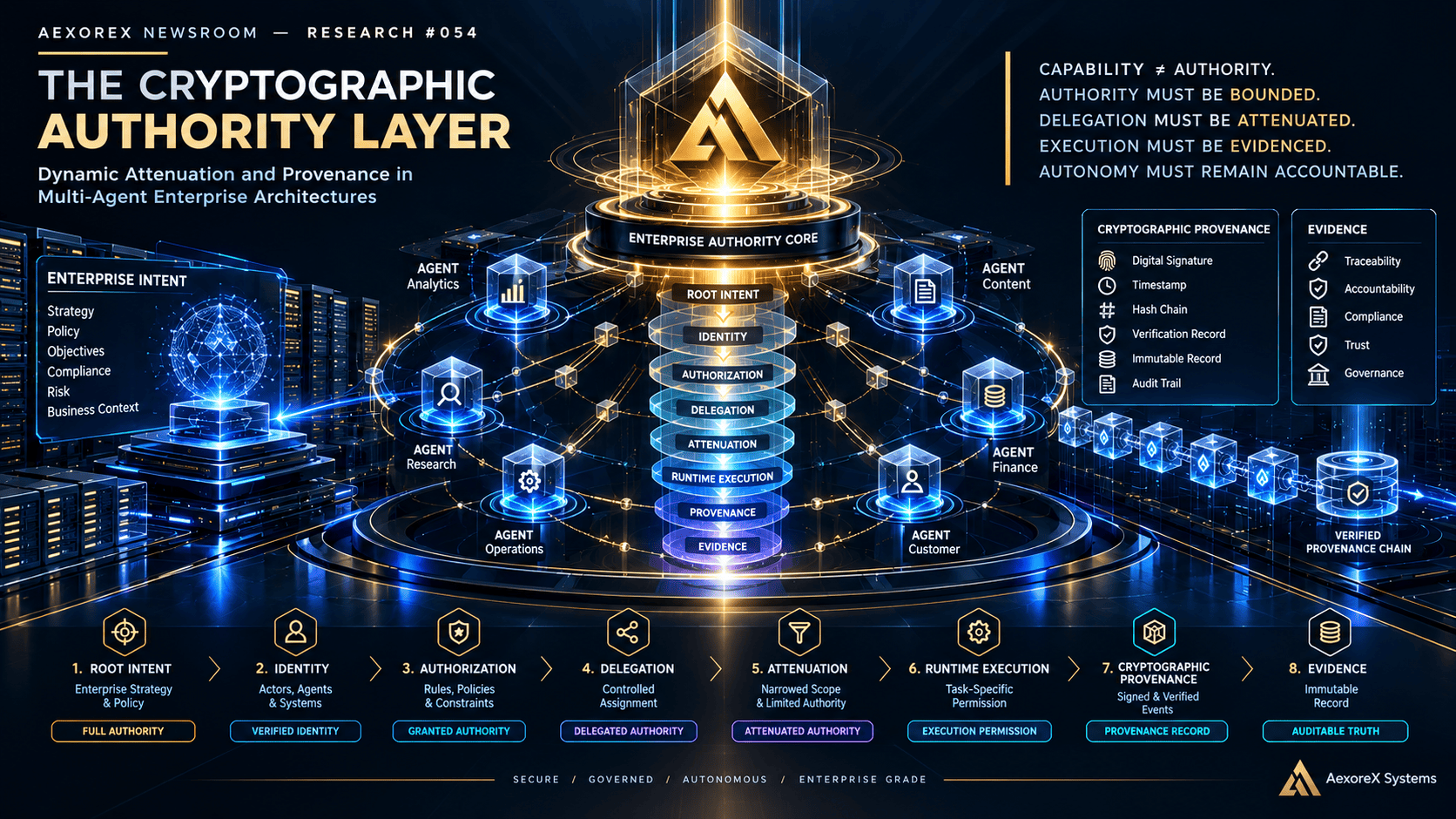
This layer would sit between enterprise identity and authorization infrastructure and the execution fabric. Its purpose would be to connect: Identity → Authorization → Delegation → Attenuation → Execution → Provenance.
Rather than replacing IAM, authorization servers, policy engines, orchestration systems, security controls, or enterprise applications, this layer would coordinate the authority relationships between them.
Conceptually: ENTERPRISE INTENT │ ▼ HUMAN / PRINCIPAL │ ▼ AI AGENT │ ┌─────────┴─────────┐ │ │ ▼ ▼ IDENTITY POLICY │ │ └─────────┬─────────┘ ▼ AUTHORIZATION │ ▼ DELEGATION │ ▼ ATTENUATION │ ▼ EPHEMERAL AUTHORITY │ ▼ RUNTIME INTERCEPTOR │ ▼ EXECUTION │ ▼ PROVENANCE │ ▼ EVIDENCE
The key architectural property is that authority becomes attached to the execution context, rather than existing as an invisible background privilege.
8. Runtime Tool Interception
Authorization cannot remain purely theoretical; it must reach the execution boundary. When an agent attempts to invoke an API, a database, a payment service, an enterprise application, a file system, a communication system, an automation platform, or another agent, the runtime should be able to evaluate the action before it occurs.
AexoreX Research therefore proposes a: **Runtime Tool Interceptor**
The interceptor would conceptually evaluate: - Who is acting? - On whose behalf? - What task is being performed? - What authority was delegated? - Has that authority been attenuated? - What resource is being accessed? - What action is being requested? - Is the authority still valid? - Does current policy permit the action? - Is additional approval required? - Can the action be evidenced?
Only when the required conditions are satisfied should execution proceed. This transforms authorization from a static configuration into an active runtime control.
9. Authority Is Not the Same as Intent
Another essential architectural distinction is that authorization determines whether an action is permitted, while intent provides context for why the action is being performed. An agent can technically possess permission while still acting outside the intended purpose. This is where agentic systems create a particularly difficult governance problem.
Consider the instruction: “Reduce unnecessary cloud expenditure.” This instruction does not necessarily authorize “Delete production infrastructure.” While the latter may technically reduce expenditure, it may violate the intent.
Therefore: Permission alone does not establish legitimate execution. The system must consider: Identity + Authority + Intent + Context + Policy + Action.
This approach creates a stronger governance model than traditional permission checking alone.
10. Preventing Authority Drift
Multi-agent systems introduce another risk: **Authority Drift**
Authority drift occurs when the effective permissions available to downstream agents gradually diverge from the authority originally intended by the principal. This can happen through inherited permissions, overly broad scopes, token exchange, credential reuse, agent-to-agent delegation, tool composition, context loss, privilege aggregation, or poorly constrained orchestration.
The original instruction may remain legitimate, yet the downstream execution may exceed its intended boundary. Authority attenuation is therefore not merely a security optimization; it becomes an architectural requirement for scalable autonomous execution.
11. The Delegation Chain Must Remain Intact
A critical requirement is traceability. Suppose Human A delegates to Agent B, which delegates to Agent C, which invokes Tool D, which modifies System E. After this action occurs, the enterprise should be able to reconstruct the entire chain.
This means not merely knowing "Tool D modified System E," but being able to reconstruct: "System E was modified by Tool D, invoked by Agent C, acting under delegated authority from Agent B, which derived its authority from Human A's original instruction, subject to policy X, constraint Y, and authorization decision Z."
This is fundamentally different from conventional activity logging. It creates a delegation provenance chain. NIST's public-comment summary specifically identifies cryptographically traceable delegation and richer evidence models—including delegation chains, policy decisions, intent records, workflow context, and execution evidence—as important areas for agentic systems.
12. Evidence Must Become a First-Class Architectural Concern
Traditional enterprise systems often treat logging as an after-the-fact activity. Agentic systems require something stronger. Evidence should be generated as part of execution.
A meaningful execution record could conceptually contain: Intent → Identity → Authorization → Delegation → Policy Decision → Context → Tool Invocation → Execution Result → Evidence → Provenance.
The purpose is not surveillance for its own sake, but accountability. An enterprise should be able to answer: - Why did this action occur? - Who initiated it? - Which agent performed it? - Which authority permitted it? - Was that authority delegated? - What constraints applied? - Which policy decision allowed it? - What data or context influenced the action? - What system was affected? - What actually happened? - Can the evidence be trusted?
Without these answers, autonomous execution can become difficult to govern at an enterprise scale.
13. From Audit Logs to Verifiable Evidence
There is an important distinction between logging an event and proving the conditions under which the event was authorized and executed. An ordinary log might simply state: "Action executed." A richer evidence model would seek to establish: "Action X was executed by Agent Y, acting under delegated authority Z, within scope S, under policy P, during validity period T, against resource R, following authorization decision D."
That difference is profound. The first describes an event; the second describes a governed execution chain. This is why evidence should not be treated merely as an observability feature, but should become part of the architecture.
14. The Eight-Stage Authority Lifecycle
AexoreX Research proposes the following conceptual lifecycle for cryptographically governed autonomous execution:
**01 — Root Intent & Identity Registration:** Establish the originating principal, organizational boundary, intent, and trusted identity context. **02 — Context & Policy Evaluation:** Evaluate task, environment, resource, risk, policy, and organizational constraints. **03 — Delegated Execution Request:** Create a specific request for an agent or workload to perform a defined task. **04 — Programmatic Authority Attenuation:** Reduce the available authority to the minimum necessary for the delegated task. **05 — Cryptographic Ephemeral Token Issuance:** Express the resulting authority through a short-lived, cryptographically verifiable authorization artifact. **06 — Runtime Tool Interception & Verification:** Validate identity, authority, scope, context, policy, and delegation before execution. **07 — Deterministic Execution & Monitoring:** Execute only the permitted action while continuously monitoring relevant runtime conditions. **08 — Immutable Evidence & Provenance Recording:** Capture the execution chain and supporting evidence in a tamper-evident, verifiable form.
The architecture therefore transforms: Intent into Bounded Authority into Controlled Execution into Verifiable Evidence.
15. The Enterprise Authority Graph
The resulting architecture can be understood as an Enterprise Authority Graph. Instead of viewing authorization as a collection of isolated permissions, the enterprise can model relationships between: - people - organizations - agents - sub-agents - workloads - services - tools - data - applications - policies - decisions - transactions - execution events
Each relationship becomes part of the authority chain. This creates a fundamentally different enterprise security model. Instead of asking only, “Does this identity have access?” the system can ask, “Why does this identity have this authority, who delegated it, what constraints apply, and what evidence proves the resulting action was legitimate?” That is a much more powerful question.
16. Existing Standards Remain Essential
The emergence of this architecture does not imply that existing enterprise security standards become obsolete; quite the opposite. The likely future is compositional. Existing technologies and standards can provide different pieces of the architecture, including: - identity and workload identity - OAuth-based authorization - policy decision and enforcement - token exchange - sender-constrained credentials - continuous access evaluation - workload attestation - interoperability protocols - provenance - transparency - security event signaling
NIST's current agent identity work explicitly recognizes the need to build on existing identity and authorization foundations while adapting them to agentic environments. Its public-comment summary also references technologies and initiatives including SPIFFE/WIMSE, OAuth, AuthZEN, MCP, A2A, SCITT, and continuous access evaluation mechanisms. The architectural opportunity is therefore not to replace the enterprise security stack, but to connect it to the new reality of autonomous delegation.
17. MCP and A2A Change the Execution Surface
Open interoperability protocols like the Model Context Protocol (MCP) and Agent-to-Agent (A2A) approaches are helping create mechanisms through which agents can interact with tools, resources, and other agents. This increases interoperability, but it also increases the number of boundaries across which identity, authorization, intent, and context must travel.
A more connected agentic ecosystem therefore creates a corresponding requirement for stronger governance. The architectural question becomes: when authority crosses a protocol boundary, does the authority context cross with it? And more importantly: does the receiving system understand the limits of that authority? If the answer is no, interoperability can create an authority gap. The more agents can communicate, the more important explicit delegation becomes.
18. The Authority Vacuum
This situation creates what AexoreX Research describes as the: **Enterprise Authority Vacuum**
The Enterprise Authority Vacuum is the architectural gap that emerges when organizations possess highly capable AI models, autonomous agents, orchestration systems, enterprise applications, APIs, identity infrastructure, security platforms, and extensive automation, but lack a unified mechanism for expressing and enforcing who or what is authorized to perform which autonomous action, on whose behalf, under which constraints, and with what evidence.
The problem is not necessarily the absence of individual security technologies, but the absence of a coherent authority fabric connecting them.
19. Why This Matters to the C-Suite
This architectural shift has significant implications for various C-suite roles:
**CIO:** The CIO must determine how autonomous systems can scale without creating uncontrolled operational authority. The strategic question becomes: How can enterprise automation scale while remaining governable?
**CTO:** The CTO must determine how identity, orchestration, AI infrastructure, applications, APIs, and execution environments can operate as a coherent architecture. The question becomes: Where does authority live within the technical architecture?
**CISO:** The CISO must address the expansion of non-human identities, dynamic delegation, token security, privilege escalation, and agentic attack surfaces. The question becomes: How do we control authority when the actor is autonomous and the execution chain is dynamic?
**COO:** The COO must understand whether autonomous execution can be trusted with increasingly consequential workflows. The question becomes: Can operational autonomy be scaled without sacrificing accountability?
**General Counsel / Risk Leadership:** Legal and risk teams need the ability to reconstruct responsibility. The question becomes: Can the organization demonstrate who authorized an action, what was delegated, what controls applied, and what actually happened? The answer increasingly depends on evidence architecture.
20. A 2026–2030 Architectural Trajectory
The evolution of enterprise agentic infrastructure may progress through several stages:
**2026 — Agent Identity:** Organizations begin formalizing identity for autonomous software agents and workloads. **2026–2027 — Runtime Authorization:** Task-scoped, contextual, and continuous authorization become increasingly important. **2027–2028 — Delegated Authority:** Agent-to-agent delegation becomes more structured, explicit, and policy-controlled. **2028–2029 — Authority Attenuation:** Enterprise architectures increasingly require delegated authority to narrow as execution chains expand. **2029–2030 — Verifiable Autonomous Execution:** Organizations increasingly demand evidence that autonomous actions were not only executed, but executed within a verifiable authority chain.
This is not a prediction of a single inevitable standard, but an architectural trajectory. The exact implementation will depend on the evolution of industry standards, protocols, identity infrastructure, policy systems, cryptographic mechanisms, enterprise requirements, and regulatory expectations.
21. What Enterprises Should Begin Preparing For
Organizations preparing for large-scale agentic adoption should consider several architectural questions now:
- **Identity:** Can every autonomous workload be uniquely identified?
- **Authority:** Can the organization distinguish capability from permission?
- **Delegation:** Can authority be explicitly delegated from a human or organizational principal to an agent and then to downstream agents?
- **Attenuation:** Can permissions become narrower as delegation progresses?
- **Ephemerality:** Can operational credentials expire automatically when their task is complete?
- **Runtime Enforcement:** Can every sensitive action be evaluated before execution?
- **Revocation:** Can authority be withdrawn without destroying the underlying identity?
- **Provenance:** Can the organization reconstruct the entire delegation chain?
- **Evidence:** Can it demonstrate why an action was permitted?
- **Accountability:** Can responsibility ultimately be traced back to the originating authority?
These questions should become part of enterprise AI architecture, not merely security reviews performed after deployment.
22. The Strategic Principle
The next generation of enterprise AI will not be defined solely by intelligence, but by controlled intelligence. Controlled intelligence requires more than model-level safety mechanisms; it requires an infrastructure capable of governing what autonomous systems are permitted to do once they leave the model and begin interacting with the enterprise.
That infrastructure must connect: Identity with Authority with Delegation with Execution with Evidence.
The deeper principle is: Capability without authority is insufficient. Authority without attenuation is dangerous. Execution without evidence is difficult to govern.
Therefore: Autonomous execution must become bounded, delegated, attenuated, traceable, and verifiable.
23. AexoreX Research Perspective
AexoreX Research proposes the Cryptographic Authority Layer as one possible architectural response to this emerging challenge. It is not presented as a finalized industry standard, nor is it a replacement for IAM, authorization systems, policy engines, orchestration platforms, enterprise security controls, or interoperability protocols.
It is a research proposition: a dedicated authority fabric may be required to connect identity, authorization, delegation, attenuation, runtime enforcement, and cryptographic provenance across increasingly autonomous enterprise execution environments.
The underlying principle is deliberately simple: - Authority must travel with context. - Authority must become narrower as delegation progresses. - Authority must expire when its purpose expires. - Authority must remain traceable to its origin. - Execution must produce evidence. - And evidence must be sufficiently trustworthy to support verification and accountability.
Conclusion
The enterprise is entering a new phase of automation. The defining challenge is no longer simply whether machines can act; they can. The challenge is whether organizations can allow machines to act with sufficient authority, insufficient excess authority, and sufficient evidence to remain accountable.
AexoreX Research #053 established "Capability ≠ Authority." AexoreX Research #054 extends this principle: authority must not merely be granted, but bounded, attenuated, delegated with context, and cryptographically traceable.
The emerging architecture therefore moves from: AI Capability to Enterprise Authority to Governed Delegation to Controlled Execution to Verifiable Evidence.
This is the foundation of a more mature model of autonomous enterprise computing. Not automation without limits, nor intelligence without accountability, but: Autonomy with Authority. Execution with Evidence. Intelligence with Governance.
And ultimately: A digital enterprise in which every consequential autonomous action can be understood, constrained, and held accountable.
Research Status
AexoreX Research Classification: Strategic Architecture Proposal Status: Emerging / Developing
- **ETAA — Execution-Time Authority Attenuation:** AexoreX Research concept
- **CEDT — Cryptographic Ephemeral Delegation Tokens:** AexoreX Research concept
- **Cryptographic Authority Layer:** AexoreX Research architectural proposal
These concepts should not be interpreted as established industry standards, finalized specifications, or claims that the proposed mechanisms are already universally deployed in production environments.
Editorial Note
This research directly builds upon AexoreX Research #053 (Governed Execution Architecture) and extends its central principle, "Capability ≠ Authority," into the domain of multi-agent delegation, runtime authorization, authority attenuation, and cryptographically traceable execution.
The research reflects the state of an evolving field. Relevant standards, protocols, architectures, and implementation practices remain under active development across industry, standards organizations, research institutions, and enterprise technology communities. NIST's 2026 work on software and AI agent identity and authorization reinforces the importance of this architectural direction, including identity, authorization, delegation, attenuation, ephemeral credentials, and richer audit evidence.
AexoreX Research does not claim that the concepts presented in this article constitute finalized standards. They are proposed as architectural research for further examination, validation, experimentation, and eventual implementation where appropriate.
Sources and attribution
- AexoreX Research Enterprise · statement link
About the author
Research desk of AexoreX Newsroom.
More from AexoreX Research Desk →Related stories
- Protocol-Governed Enterprise Authority
- THE ENTERPRISE AGENT PROTOCOL AND IDENTITY SUBSTRATE
- The Non-Human Identity Shift: Why Enterprise Autonomy Demands a Governed Control Plane
- The Non-Human Identity Control Plane: Dynamic Authority and Traceable Delegation for Autonomous Enterprise Operations
- EXECUTION-TIME AUTHORITY ATTENUATION
- AexoreX Systems Introduces AEOS Enterprise Authority™ as Governance Layer for Autonomous Enterprise Intelligence
- Enterprise Intelligence Infrastructure and Governed Autonomy: The Architectural Foundation for the Autonomous Enterprise
- THE SHIFT TO GOVERNED EXECUTION INFRASTRUCTURE
- Financial Authority: Governing Autonomous Spending in the Agentic Enterprise
- From Agent Interoperability to Governed Execution: Why Enterprise AI Needs an Authority Layer