
The Evidence Sufficiency Problem: From Trustworthy Records to Verifiable Enterprise Outcomes
Why authenticated events, successful API calls, and complete audit trails still do not prove that an enterprise achieved its intended outcome.
Modern enterprises struggle to verify intended business outcomes, even with extensive digital records, due to a gap between execution evidence and outcome evidence.
Opinion · AI-assisted, human edited
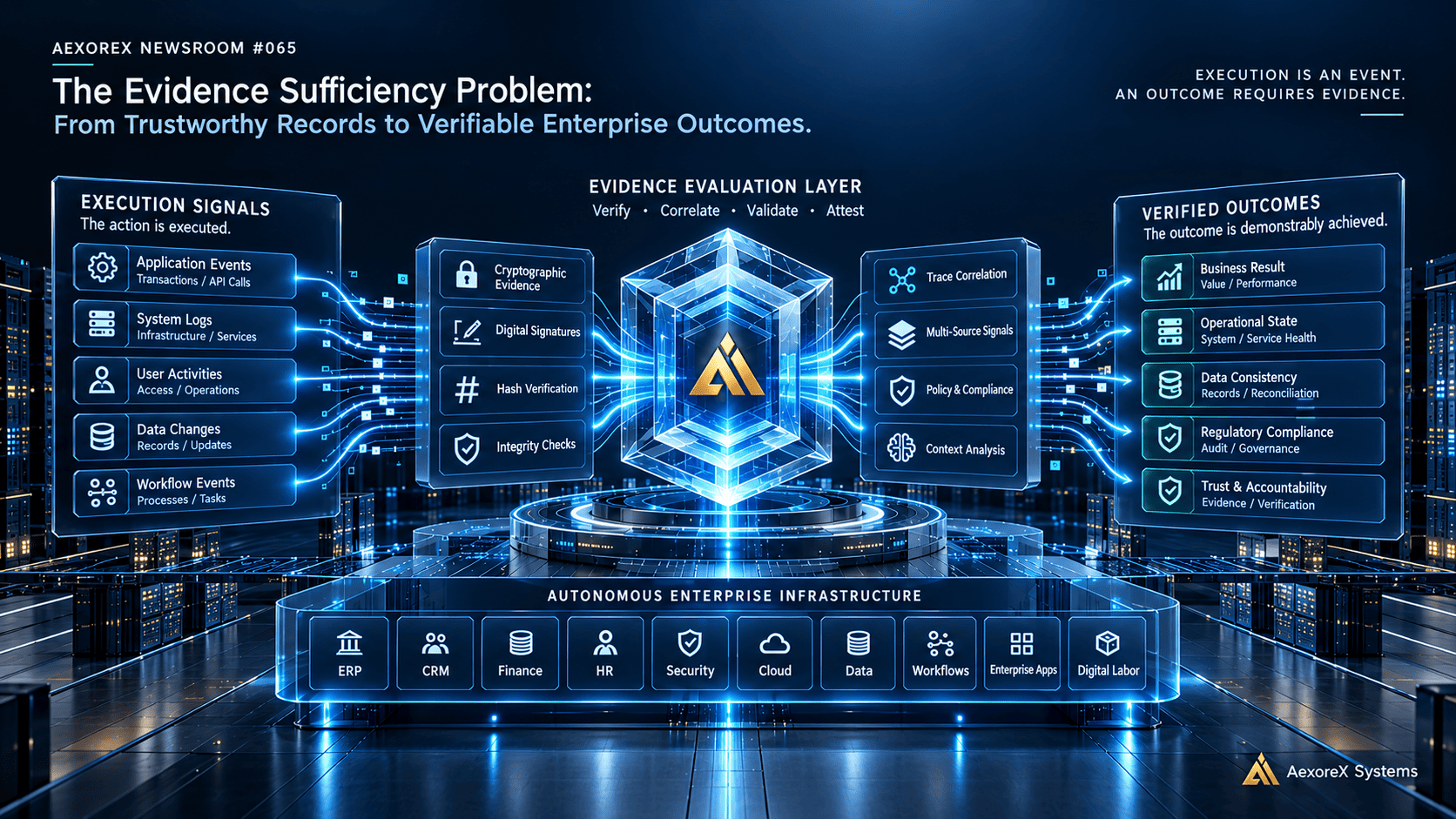
Modern enterprises increasingly use APIs, distributed applications, automated workflows, AI systems, and digital agents to handle operational tasks. These systems generate extensive records, including authenticated events, API responses, execution logs, distributed traces, security attestations, and audit trails.
Despite this, a fundamental problem persists: Evidence that an action occurred does not necessarily prove its intended business outcome was achieved. For instance, a payment API might accept a request without confirming settlement, or an access-control system might record a revocation while a process continues with prior permissions. A workflow could report successful execution even if a downstream system has not completed the intended transaction.
These issues are not solely observability problems; they concern evidence sufficiency, distributed-system coordination, and governed decision-making. An enterprise must determine if its available evidence is reliable, complete, current, and relevant enough to support a specific conclusion.
This research examines the distinction between execution evidence and outcome evidence. It identifies the limitations of common technical mechanisms and proposes a conceptual architecture for evaluating evidence before an autonomous system makes consequential decisions.
The central principle is clear: Capability ≠ Authority, Execution ≠ Outcome, and Evidence ≠ Certainty. For autonomous enterprise systems, trustworthy operations demand more than just the ability to execute tasks. They require a defensible relationship among authorized intent, actual execution, observed effects, available evidence, and the decisions made in response.
1. The Gap Between Execution and Outcome
Enterprise automation has evolved beyond simple task scheduling. Organizations now connect applications, coordinate workflows across services, deploy AI-assisted decision systems, and increasingly delegate operational responsibilities to software agents.
As interconnected systems grow, an enterprise may receive multiple records describing the same operation. These records can be authentic but remain incomplete, delayed, inconsistent, or insufficient to establish the final business result.
Consider a simple example: An enterprise instructs an automated system to process a customer payment. The payment service returns a successful response, indicating it accepted the request. The automation records this response and marks its own task as complete.
However, the payment may still require further processing. The final transaction status might not yet be available, or the external payment provider could later report a different state. The automation has evidence that a request was accepted, but not necessarily that the payment settled.
This distinction matters because downstream systems may use the reported status to release goods, update financial records, notify customers, or initiate another transaction. A conclusion based on insufficient evidence can therefore propagate beyond the original operation.
The same structural problem appears in identity management, financial operations, procurement, customer onboarding, infrastructure management, and AI-driven enterprise workflows. The question is no longer simply whether a system executed its instructions, but whether the available evidence justifies the conclusion the enterprise needs to make.
2. Trustworthy Records Are Not the Same as Sufficient Evidence
A record can be authentic without being sufficient to establish an outcome. A digitally signed event may prove that a particular system produced a message. A timestamp can help establish when an event was recorded. A trace might reveal how a request moved across services.
While valuable, these mechanisms have limited evidentiary scope. A trustworthy record does not automatically establish that: - All relevant events have been captured. - The record reflects the latest state of the operation. - Every participating system agrees on the current state. - The observed event produced the intended external effect. - The evidence is independent of the system whose behavior is being evaluated. - The evidence is strong enough to justify the proposed decision.
The World Wide Web Consortium's PROV data model provides a framework for describing data provenance, including its origin, generation process, and the relationships among entities, activities, and agents. While such provenance information improves traceability, it does not, by itself, prove a record's completeness or that a business outcome has occurred.
Reference: https://www.w3.org/TR/prov-dm/
This leads to an important distinction: Evidence integrity concerns whether evidence has been preserved and represented reliably, while evidence sufficiency concerns whether that evidence supports the conclusion being drawn. Both are crucial but solve different problems.
A system may preserve every record it receives without receiving all the records needed to determine the final outcome. Similarly, extensive telemetry collection does not guarantee that the intended business result occurred. More data does not automatically produce stronger evidence.
3. The Limitations of Execution Logs and Observability
Observability is essential for operating distributed enterprise systems. Telemetry helps operators investigate application behavior, identify failures, understand dependencies, and reconstruct execution paths. OpenTelemetry, for example, defines mechanisms for representing traces and spans that describe units of work and their relationships across systems.
Reference: https://opentelemetry.io/docs/specs/otel/trace/api/
These mechanisms enhance the ability to understand application behavior but do not independently establish that a business outcome has been achieved. Three limitations merit particular attention.
3.1 A Successful Response May Represent an Intermediate State
An API response can indicate that a request was accepted, validated, or queued. It may not indicate that the requested operation has reached its final state. For example: - A payment request has been accepted but not settled. - An order has been created but not fulfilled. - A user-access change has been requested but has not propagated across all relevant systems. - A document has been submitted but has not completed external verification.
An automation system must interpret the response according to the operation's semantics, rather than treating every successful response as proof of completion.
3.2 A Trace Can Be Useful Without Being Complete
Distributed traces can be affected by sampling, instrumentation gaps, service boundaries, missing context, or failures in telemetry delivery. Consequently, an event's absence in a trace does not necessarily mean it never occurred. Similarly, a recorded event's presence does not establish that every downstream consequence has been observed. Tracing is a mechanism for understanding execution, not a universal guarantee of complete evidence.
3.3 A Complete Local Record May Not Represent the Complete Enterprise State
A service can maintain an internally consistent record of its own activity while other systems remain in different states. This is especially relevant when an operation spans independent services, external providers, asynchronous queues, and systems with different processing schedules. A local success state may be valid within one system without being sufficient to establish the state of the overall business process.
The architectural implication is that observability must inform outcome verification, but it should not be treated as a substitute for it.
4. Evidence Sufficiency Is Contextual
There is no universally sufficient amount of evidence for every enterprise decision. The evidence required for a routine notification differs from that needed to release a large payment, grant privileged access, or make an irreversible operational change. Evidence sufficiency must therefore be evaluated in relation to the decision being considered.
This research proposes seven dimensions for that evaluation.
4.1 Freshness
Does the evidence reflect a sufficiently recent state? A record accurate several minutes ago may no longer describe the current state of a rapidly changing system. The required freshness depends on the operation, its timing requirements, and the consequences of acting on outdated information.
4.2 Provenance
Can the origin of the evidence and the process through which it was produced be established? Provenance helps an enterprise understand where information came from and how it entered the decision process.
4.3 Completeness
Does the available evidence cover the events and systems necessary to support the conclusion? Completeness is always relative to a defined scope. A system cannot reasonably claim universal completeness simply because its own logs contain no visible gaps.
4.4 Consistency
Do the available records agree on the relevant state? Conflicting records may indicate delayed updates, partial failures, independent processing timelines, or genuine inconsistencies requiring reconciliation.
4.5 Independence
Does the evidence provide meaningful confirmation beyond the original system's own claim? Independent confirmation can strengthen confidence, but independence must be evaluated carefully. Two systems may rely on the same underlying data or share the same failure mode.
4.6 Uncertainty
What remains unknown? A responsible system must distinguish confirmed facts from assumptions, unresolved conditions, stale observations, and probabilistic assessments. An unknown state should not automatically be converted into a successful or failed state simply because a workflow requires a definitive answer.
4.7 Consequence
What happens if the conclusion is wrong? The required evidence threshold should reflect the potential impact of an incorrect decision, the reversibility of the action, applicable policies, and the availability of human review.
These seven dimensions constitute a proposed analytical framework for this research, not an established scoring standard. Their purpose is to make evidence evaluation explicit rather than allowing a single success flag to conceal important uncertainty.
5. Three Enterprise Scenarios
The evidence sufficiency problem becomes clearer when examined through practical scenarios. The following examples are hypothetical illustrations of distributed-system behavior, not reports of specific incidents.
Scenario A: An Uncertain Payment Outcome
An enterprise system submits a payment request. The provider returns a response indicating the request has been accepted. The automation records the response and prepares to mark the transaction as complete.
However, the final payment status remains unavailable. The system now faces a decision: proceed, wait, verify, or escalate. Treating the initial response as proof of settlement would exceed what the evidence establishes. Immediately submitting another payment request could also be unsafe if the first request is still being processed.
A more defensible approach is to preserve the unresolved state, consult the provider's authoritative transaction-status mechanism, and reconcile the result before making a consequential downstream decision. Where supported, idempotency mechanisms can help reduce duplicate-processing risks. They do not eliminate every possible failure or replace verification of the final outcome.
Architectural lesson: An accepted request and a confirmed financial outcome are different states and should be represented separately.
Scenario B: Access Revocation During Active Operations
An enterprise administrator revokes a user's access. The identity system records the change. However, another application may still have an active session, a cached authorization decision, or an operation already in progress.
The revocation record establishes that the identity system processed a change. It does not automatically establish that every relevant access path has stopped permitting activity. The appropriate verification strategy depends on the identity architecture, token lifetimes, session management, application behavior, and the risk associated with the resource. For privileged or sensitive operations, the enterprise may require additional confirmation before considering the revocation effective across the relevant scope.
Architectural lesson: A change to authority must be evaluated against the actual enforcement points and the operations that remain in flight.
Scenario C: A Multi-System Order-to-Cash Workflow
An enterprise workflow creates an order, requests fulfillment, updates inventory, and initiates invoicing. Each system reports its own status. The order service reports success. The fulfillment service reports a delay. The inventory system has not yet updated. The invoicing system has already created a preliminary record.
A single overall success flag would conceal these differences. The workflow needs a representation of the current state across participating systems, including unresolved dependencies and conflicting observations. Distributed transaction patterns, such as sagas, can coordinate local transactions and compensating actions. However, they do not provide universal atomicity across independent services. Eventual consistency, retries, idempotency, and incomplete transaction isolation remain important design concerns.
Reference: https://docs.aws.amazon.com/prescriptive-guidance/latest/cloud-design-patterns/saga-orchestration.html
Architectural lesson: An enterprise outcome may require coordinated verification across multiple systems rather than relying on the status of the workflow orchestrator alone.
6. Why Existing Technical Mechanisms Are Necessary but Insufficient
The evidence sufficiency problem does not imply that existing enterprise technologies are inadequate or unnecessary. It means their roles and limitations must be understood correctly.
Cryptographic Attestation
The Internet Engineering Task Force's RFC 9334 describes a Remote Attestation Procedures architecture involving an Attester, a Verifier, and a Relying Party. In this model, evidence about a system is evaluated under relevant appraisal policies, and the resulting assessment can inform a relying party's decision. This provides a useful foundation for evaluating certain claims about system state.
However, attestation is not omniscience. Its value depends on what is measured, the trustworthiness of the measurement and reporting mechanisms, the appraisal policy, and the relationship between the measured state and the decision being made. A valid attestation of a system state is not automatically proof that an external business transaction succeeded.
Reference: https://www.rfc-editor.org/rfc/rfc9334.html
Zero Trust Architecture
NIST Special Publication 800-207 describes Zero Trust Architecture, emphasizing that trust should not be granted solely because of network location or asset ownership. Zero Trust supports stronger access decisions and continuous consideration of relevant context. It does not eliminate the need to verify the outcome of an enterprise transaction. Authentication, authorization, and business-result verification remain distinct concerns.
Reference: https://csrc.nist.gov/pubs/sp/800/207/final
AI Risk Management
The NIST AI Risk Management Framework provides a voluntary framework for managing risks associated with AI systems. It can help organizations structure governance, evaluation, monitoring, and accountability activities. It should not be represented as a complete technical solution for evidence sufficiency, nor does its use automatically establish that a particular autonomous operation is safe or successful.
Reference: https://www.nist.gov/itl/ai-risk-management-framework
Distributed Tracing and Workflow Orchestration
Tracing helps establish visibility into system behavior. Workflow orchestration helps coordinate activities across services. Neither mechanism independently guarantees that all relevant external effects have occurred or that the evidence is sufficient for a consequential decision. The architectural opportunity is to connect these capabilities through an explicit evidence-evaluation and governance layer.
7. A Proposed Evidence Sufficiency Architecture
This research proposes an architecture for evaluating whether the evidence associated with an enterprise operation supports the next decision. The model is conceptual. It is not an industry standard and is not a claim that every component currently exists in AEOS QUANTUM™.
1. **Authority, Intent & Policy:** Establish what the enterprise intends to achieve, which actions are authorized, what constraints apply, and what conditions require human approval. 2. **Authorized Execution:** Execute an action through an approved system or integration, within the relevant scope of authority. 3. **Effect Observation:** Collect information about the resulting state from the systems involved in the operation. 4. **Evidence Capture:** Preserve relevant records, events, responses, timestamps, identifiers, and other information needed to reconstruct the operation. 5. **Evidence Normalization & Provenance Binding:** Associate evidence with the correct operation, identify its origin, preserve relevant relationships, and distinguish observations from assumptions. 6. **Outcome Evidence Evaluation:** Evaluate whether the available evidence is sufficiently fresh, complete, consistent, relevant, and reliable for the proposed conclusion. 7. **Governance Decision:** Determine the next permitted step based on the evidence, the operation's policy, its risk, and the authority granted to the system. 8. **Accountability Record:** Preserve the decision, its supporting evidence, the applicable policy context, and any required approvals or escalations.
The sequence can be summarized as: Authorized Intent → Execution → Observed Effects → Evidence Evaluation → Governed Decision → Accountability. Evidence collection and evaluation should also operate throughout the lifecycle, rather than being limited to a final step after execution.
Possible Governance Decisions
Depending on the operation and its policy, the system may: - **Continue** when the evidence meets the applicable requirements. - **Verify** when additional confirmation is necessary. - **Reconcile** when participating systems report different states. - **Hold** when the evidence is insufficient for the next action. - **Stop** when an applicable policy or safety condition requires termination. - **Compensate** when an approved recovery action is appropriate and supported. - **Escalate** when human judgment or authorization is required.
These decisions should not be treated as interchangeable. For example, holding an operation while waiting for a final payment status differs from declaring the payment failed. Similarly, stopping further execution does not necessarily reverse an action that has already taken effect. Compensation must be governed and appropriate to the operation; it is not a universal rollback mechanism.
The goal is not to prevent all uncertainty but to prevent uncertainty from being silently converted into an unjustified conclusion.
8. Evidence Sufficiency and Autonomous Enterprise Governance
As enterprises delegate more work to digital agents and automated systems, the distinction between capability and authority becomes increasingly important. A digital agent may be capable of submitting a payment, modifying a record, creating an account, or initiating a workflow. That capability does not establish that the agent is authorized to perform every such action. Similarly, the ability to execute an authorized action does not establish that the intended outcome has occurred.
A governed autonomous system must therefore distinguish at least three questions: 1. **Authority:** Was the action permitted under the applicable policy and delegation? 2. **Execution:** Was the authorized action actually attempted or performed? 3. **Outcome:** Is the available evidence sufficient to establish the result required for the next decision?
These questions are related but not interchangeable. An operation may be authorized yet fail during execution. It may execute successfully at one service while remaining incomplete across the wider business process. It may achieve the intended result but lack enough evidence to establish that result confidently. Each condition requires a different response.
For autonomous enterprise infrastructure, governance should therefore extend beyond deciding whether an action may begin. It should also determine what evidence is required to proceed, what uncertainty can be tolerated, and when human authority must be restored. This is particularly important for financial operations, privileged access changes, contractual commitments, and other actions whose consequences may be significant or difficult to reverse.
Autonomy should be bounded not only by what a system may do, but also by what it must establish before proceeding.
9. Implications for AEOS QUANTUM™
The evidence sufficiency problem is relevant to the long-term architectural direction of AEOS QUANTUM™. AEOS QUANTUM™ is envisioned as an enterprise intelligence and governance platform that connects, orchestrates, governs, and activates enterprise systems without requiring the enterprise to replace its existing technology stack. Within that vision, evidence sufficiency represents a potential architectural capability.
The following concepts are proposed areas for future design and evaluation. They should not be interpreted as implemented or production-proven features.
Authority-Bound Execution
Actions would remain subject to explicit, scoped, and revocable authority. The system's technical capability to execute a task would remain distinct from its permission to perform that task.
Outcome Contracts
A proposed mechanism for specifying the conditions that must be satisfied before an operation can be considered complete. Depending on the use case, those conditions might include a confirmed external state, an authoritative status response, or an approved reconciliation result. An outcome contract would need to account for operations where immediate confirmation is impossible or where the outcome is inherently probabilistic.
Evidence Fabric
A proposed architectural layer for associating evidence from different enterprise systems with the operation, policy, and intended outcome to which it relates. Such a layer would need to preserve provenance and uncertainty without assuming that all sources are equally reliable or independent.
Evidence Sufficiency Evaluator
A proposed decision-support capability for assessing whether the available evidence meets the requirements defined for a particular operation. Its assessment would need to be explainable, policy-aware, and proportionate to the consequences of the decision. It should not manufacture certainty where evidence is missing or contradictory.
Governed Autonomy States
A proposed way to connect evidence conditions to permitted operational states. For example, an operation might be allowed to proceed autonomously when the required evidence is available, remain on hold while verification is pending, or require human review when conflicting evidence cannot be resolved.
Accountability Record
A proposed mechanism for preserving the relationship between authority, execution, evidence, decisions, and required approvals. Its value would depend on implementation quality, access controls, retention policies, integrity protections, and the completeness of the records captured.
Together, these concepts suggest a possible evolution from workflow automation toward evidence-aware, authority-bounded enterprise operations. The challenge is not merely to create more autonomous systems but to create systems whose actions and conclusions remain defensible.
10. Limitations and Open Research Questions
Evidence sufficiency cannot be reduced to a universal score without losing important context. Several limitations must remain explicit.
First, independent confirmation is not always available. Some systems have only one authoritative source for a particular state. The absence of a second source does not automatically make the evidence unusable, but it may affect the confidence and permitted scope of the decision.
Second, evidence can become stale. A state confirmed at one moment may change before a dependent action occurs. The architecture must account for timing, state transitions, and the interval between verification and action.
Third, reconciliation has operational costs. Additional verification can introduce latency, increase integration complexity, and delay legitimate business activity.
Fourth, more telemetry can create false confidence. A large quantity of records may still reflect the same underlying source or omit the same critical event.
Fifth, compensating actions are not universal reversals. A distributed workflow may require corrective business operations rather than a true rollback, and some external effects may be irreversible.
Sixth, human escalation does not eliminate risk. Human reviewers also need relevant evidence, sufficient context, clear responsibilities, and appropriate authority.
Seventh, the evidence threshold must reflect the decision. A universal threshold could either permit unsafe actions or unnecessarily prevent legitimate automation.
These limitations lead to several research questions: - How should an enterprise define minimum evidence requirements for different classes of operations? - How can provenance and evidence independence be evaluated across multiple providers? - How should systems represent unresolved and conflicting states without forcing premature conclusions? - How can evidence requirements adapt to the reversibility and consequence of an action? - How can enterprises verify that revocation, cancellation, or other control decisions have taken effect across distributed systems? - How should autonomous systems explain why they consider evidence sufficient—or insufficient—for a particular decision?
These questions require further research, architecture design, and empirical validation. A proposed model should not be treated as effective merely because its components can be described conceptually. Its effectiveness would need to be assessed against real operational requirements, defined threat models, failure scenarios, and measurable outcomes.
11. Conclusion: Do Not Confuse a Recorded Action With a Verified Outcome
Enterprise systems can produce authentic records, successful API responses, detailed traces, and extensive audit trails while leaving the actual business outcome unresolved. This is not a reason to abandon automation or observability. It is a reason to define more carefully what those mechanisms establish and what remains uncertain.
A trustworthy enterprise architecture must distinguish the authority to act from the ability to execute, and distinguish execution from evidence of the intended result. The required evidence will vary according to the operation, its dependencies, the applicable policy, and the consequences of an incorrect conclusion.
For autonomous enterprise systems, this distinction becomes especially important because decisions may trigger further actions without immediate human intervention. The next stage of enterprise intelligence therefore requires more than automation that reports success. It requires governance that evaluates whether success has been established to the degree necessary for the next decision.
For AexoreX Systems, this research identifies evidence sufficiency as a potential area for further architectural development within the broader vision of governed enterprise autonomy. The objective is not to promise perfect certainty. It is to make evidence, uncertainty, authority, and accountability explicit parts of enterprise operations.
Do not conclude an enterprise outcome merely because execution succeeded. Conclude it only when the evidence is sufficient for the consequence.
Research References
The following sources provide technical context for the concepts discussed in this article. Each source should be interpreted within its original scope; none should be understood as endorsing AexoreX Systems or AEOS QUANTUM™.
1. World Wide Web Consortium (W3C) — PROV-DM: The PROV Data Model https://www.w3.org/TR/prov-dm/
2. OpenTelemetry — Trace API https://opentelemetry.io/docs/specs/otel/trace/api/
3. Internet Engineering Task Force (IETF) — RFC 9334: Remote ATtestation procedureS (RATS) Architecture https://www.rfc-editor.org/rfc/rfc9334.html
4. National Institute of Standards and Technology (NIST) — SP 800-207: Zero Trust Architecture https://csrc.nist.gov/pubs/sp/800/207/final
5. National Institute of Standards and Technology (NIST) — AI Risk Management Framework https://www.nist.gov/itl/ai-risk-management-framework
6. Amazon Web Services (AWS) — Saga Orchestration https://docs.aws.amazon.com/prescriptive-guidance/latest/cloud-design-patterns/saga-orchestration.html
7. Amazon Web Services (AWS) — Saga Patterns https://docs.aws.amazon.com/prescriptive-guidance/latest/cloud-design-patterns/saga-patterns.html
Editorial and Scope Note
This article presents a conceptual analysis and a proposed architectural approach to enterprise evidence sufficiency. The proposed architecture and terminology should not be interpreted as an established industry standard or as a representation of currently implemented AEOS QUANTUM™ capabilities. The referenced frameworks, standards, and technical specifications retain their original scope and limitations. The scenarios presented are illustrative examples, not reports of actual incidents.
Publication status: Conceptual research. Technical references and final editorial details should be checked before publication.
Sources and attribution
- Original research and editorial synthesis informed by official technical documentation from W3C, IETF, OpenTelemetry, NIST, and AWS. · statement link
About the author
The editorial team behind AexoreX Newsroom, the official corporate publication of AexoreX Systems LLC.
More from AexoreX Systems Editorial Team →Related stories
- The Non-Human Authorization Crisis: Re-Architecting Identity, Governance, and Execution for Autonomous Enterprise Systems
- From Autonomous Execution to Enterprise Evidence
- AexoreX Systems Defines the Enterprise Intelligence Control Plane for the Autonomous Enterprise
- AexoreX Systems Introduces AEOS Enterprise Authority™ as Governance Layer for Autonomous Enterprise Intelligence
- Enterprise Intelligence Infrastructure and Governed Autonomy: The Architectural Foundation for the Autonomous Enterprise
- The Infrastructure Behind the Autonomous Enterprise: Building the Foundation for Enterprise Intelligence
- Identity & Context: The First Layer of Enterprise Intelligence
- AFTER REVOCATION: THE SAFE-STATE PROBLEM IN AUTONOMOUS ENTERPRISE EXECUTION