
The Runtime Authority Control Plane: Why Enterprise AI Needs More Than Identity and Permissions
As AI agents and Digital Labor move from assistance to execution, enterprises must translate delegated authority into continuously evaluated, policy-enforced, transaction-bound, revocable, and auditable action rights across systems, workflows, and infrastructure.
As AI agents transition from assistance to execution, enterprises need a Runtime Authority Control Plane to manage continuously evaluated, policy-enforced action rights across all systems.
Opinion · AI-assisted, human edited
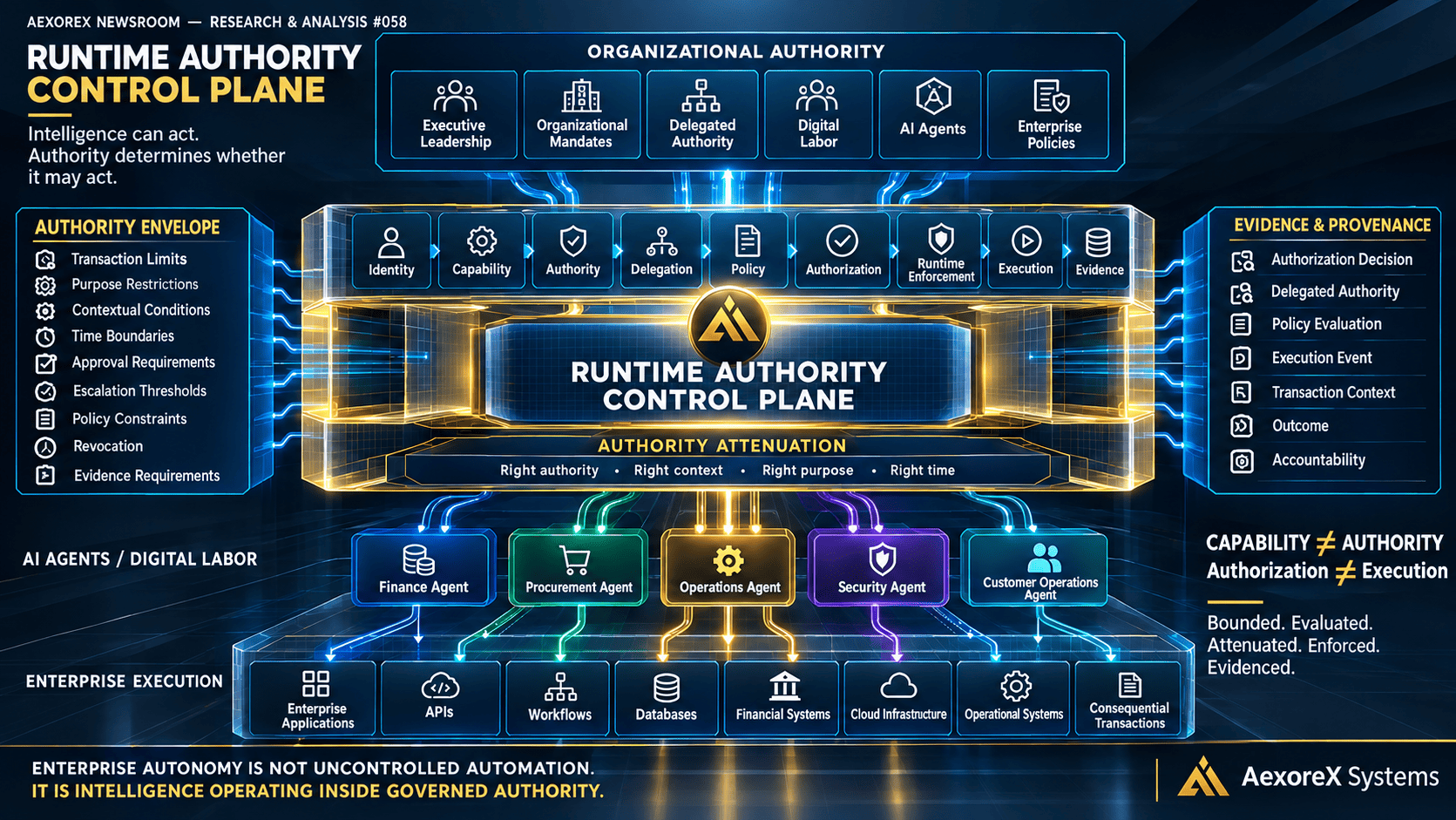
Executive Summary
Enterprise AI is entering a new phase. The central question is no longer merely whether an AI system can perform a task. Instead, it asks whether an enterprise can determine, in real time, what that system is *allowed* to do, why, under whose authority, within what limits, against which resources, for how long, and with what evidence. This distinction is crucial as AI agents, Digital Labor, software workloads, APIs, and automated workflows increasingly execute actions rather than just generating recommendations.
While traditional enterprise security provides foundational elements like identity, authentication, access management, roles, permissions, policy, and enforcement, autonomous execution introduces a more dynamic challenge. An AI agent might possess a valid identity, the technical ability to call an API, and even authorization. However, these factors, individually or collectively, do not inherently establish that the agent should be permitted to perform a specific transaction at a particular moment, in a given context, for a defined purpose.
This scenario defines what AexoreX Newsroom terms the Runtime Authority Problem. The architectural solution proposed in this analysis is the Runtime Authority Control Plane: a conceptual enterprise control layer that continuously evaluates delegated authority at the point of execution. This layer translates organizational intent into constrained, enforceable, revocable, and auditable action rights. AexoreX Newsroom uses this term as a conceptual synthesis, not implying that an established industry-standard architecture with this exact name currently exists. This distinction is important: the future autonomous enterprise will be governed not just by equipping machines with more capabilities, but by controlling which capabilities become authorized actions, under what conditions, and with what accountability.
1. From Enterprise Authority to Runtime Authority
In #057, "The Enterprise Authority Architecture," we explored the fundamental question: "Who or what has authority to act, and under what mandate?" This question defines the architecture of enterprise authority. However, authority defined solely at the organizational level is insufficient. The moment an AI agent attempts an action, a new question arises: "How is that authority actually enforced at runtime?" This is where enterprise architecture encounters a novel control problem.
Consider an AI agent authorized to manage procurement. Its capabilities might include searching approved suppliers, comparing prices, creating purchase requests, submitting purchase orders, communicating with vendors, and updating procurement systems. Yet, capability does not equate to unrestricted authority. The enterprise may impose rules such as: - Purchases below a specific threshold may be executed automatically. - Purchases exceeding that threshold require human approval. - Only approved suppliers are permitted. - Certain categories are prohibited. - Purchases must adhere to a defined budget. - The agent may negotiate but not finalize specific contracts. - Authority expires after a set period. - Unusual transactions necessitate escalation.
Thus, the agent does not receive a single, permanent permission. Instead, it operates within a bounded authority envelope. This envelope must account for the realities of the enterprise environment, addressing the runtime authority problem.
2. The Critical Distinctions
Autonomous enterprise architecture becomes significantly clearer by distinguishing several key concepts.
Identity ≠ Authority
Identity answers, "Who or what is this?" Authority answers, "What is this entity legitimately permitted to cause?" A workload identity system, such as SPIFFE/SPIRE, can authenticate a specific software workload. However, verified identity does not automatically confer business authority. Knowing an agent is "Agent-Procurement-07" does not inform the enterprise whether it may approve a $500,000 purchase. Identity establishes a subject, while authority establishes a mandate.
Capability ≠ Authority
A system may be technically capable of performing an action without being authorized to do so. An API might permit `POST /payment`, but this doesn't mean every caller should be allowed to initiate every payment. Similarly, an AI agent may possess tools to send email, modify records, issue refunds, deploy software, transfer funds, or change configurations. Technical capability represents potential; authority determines whether that potential can translate into an actual enterprise action. This principle is central to autonomous enterprise design: Capability describes what a system *can* do, whereas authority determines what it *may legitimately* do.
Authorization ≠ Execution
Authorization determines whether an action is permitted. Execution determines whether the action actually occurs. This distinction is subtle but strategically important. A centralized authorization service might approve an action, but the enforcement point must still ensure: - The correct subject performs the action. - The approved resource is targeted. - The action has not changed. - The authorization remains valid. - Required contextual conditions are still met. - Transaction limits have not been exceeded. - The action has not been revoked. - The execution generates sufficient evidence.
Therefore, authorization cannot be a static decision made early in a workflow. For autonomous systems, authority must extend to the point where consequences unfold.
3. Why Traditional IAM Alone Is Not Enough
Identity and access management (IAM) remains fundamental and should not be discarded. The challenge is that autonomous systems introduce dimensions of authorization that are difficult to represent solely through identity and coarse-grained permissions. A traditional permission model might state, "Agent A can access System B." A runtime authority model asks much more: "Agent A, acting on behalf of Business Unit X, may perform Action Y against Resource Z, for Purpose P, within Transaction Boundary T, until Time E, subject to Policy Set Q, provided Risk Context R remains acceptable." This constitutes a significantly richer authorization statement.
This direction aligns with developments in modern authorization architecture. For instance, IETF RFC 9396, OAuth 2.0 Rich Authorization Requests, defines a mechanism for carrying fine-grained authorization data and illustrates transaction-specific information like payment amount and recipient. The architectural significance is that authorization can increasingly describe not merely "who can access what," but "what exact action is being authorized, against which resource, under which transaction-specific conditions." This distinction becomes particularly important for AI agents.
4. The Runtime Authority Control Plane
A Runtime Authority Control Plane can be understood as a logical control layer situated between enterprise authority and enterprise execution. It does not replace IAM, API gateways, policy engines, workflow systems, or enterprise applications. Instead, it coordinates these mechanisms around a more fundamental question: "Should this specific action be allowed to occur now?"
A conceptual architecture for this control plane can include the following components:
1. Authority Registry
This component defines the authority relationships and mandates within the enterprise. It can represent human, organizational, Digital Labor, delegated, temporary, conditional, and emergency authority.
2. Identity and Attestation Layer
This layer establishes the identity and relevant attributes of humans, agents, workloads, services, applications, devices, and infrastructure components. Identity provides the subject against which authority can be evaluated.
3. Delegation Service
This service records how authority moves from one principal to another, for example: Board → Executive → Department → Digital Labor → Task Agent. A critical requirement is that delegation should not automatically transfer unlimited authority, but rather preserve constraints.
4. Capability Registry
This describes what each system or Digital Labor component is technically capable of doing. This is deliberately separate from authority. A capability registry answers "What can this component technically perform?" It does not answer "What is this component allowed to perform?"
5. Policy Decision Service
This evaluates the proposed action against enterprise policy. Inputs may include identity, delegated authority, requested action, resource, transaction value, business purpose, environment, time, location, risk, data classification, organizational policy, previous actions, and current system state. The output may be: Allow, Deny, Allow with constraints, Require approval, or Escalate.
6. Runtime Enforcement Layer
A policy decision has little value without enforcement. The enforcement layer operates as close as practical to the actual action. It may function through API gateways, service meshes, application controls, workflow engines, transaction services, database controls, infrastructure policy enforcement, and agent tool interfaces. NIST's Zero Trust Architecture already highlights the importance of policy enforcement points that enable, monitor, and terminate access paths based on policy decisions. The Runtime Authority Control Plane extends this conceptual question from network/resource access to delegated autonomous action.
7. Transaction and Intent Boundary
This is a crucial addition. An enterprise should increasingly differentiate between general permission and permission to perform a specific transaction. For instance, "The agent may manage procurement" is less precise than "The agent may purchase up to $10,000 from approved suppliers for approved categories during this procurement cycle." The second statement is closer to executable authority, binding authority to intent, purpose, transaction, resource, limits, and context.
8. Human Oversight and Escalation
Not every action should be automated. The control plane should be able to recognize when an action exceeds the Digital Labor authority envelope. Instead of simply denying the action, it may pause execution, package the relevant context, identify the required authority level, request human approval, resume only after approval, and record the decision. This transforms human oversight from a generic organizational principle into an executable control mechanism.
9. Evidence and Provenance Layer
Every consequential autonomous action should generate sufficient evidence to answer: What happened? Which entity acted? On whose authority? What was the intended action? What policy was evaluated? What decision was made? Which constraints applied? Which system enforced the decision? What changed? Was human approval involved? What was the final outcome? This becomes essential as enterprises transition from AI experimentation to operational autonomy.
10. Lifecycle and Revocation Service
Authority cannot be permanent simply because a token, role, or credential remains valid. Authority may need to change if an employee leaves, a project ends, a budget changes, risk increases, an agent is compromised, a delegated task expires, a policy changes, a transaction becomes abnormal, or an enterprise system changes state. Therefore, authority must be revocable as a first-class enterprise capability.
5. Authority Propagation and Attenuation
The most challenging aspect might not be granting authority, but controlling its propagation through multiple systems. Consider the chain: Human → Enterprise Agent → Specialist Agent → Workflow → API → Transaction. If the original human has authority to approve a transaction, should every downstream component automatically inherit that authority? Clearly not. This introduces the concept of authority attenuation. Authority should typically become narrower as delegation extends deeper into an execution chain.
For example: - **Human Principal:** Authority: Manage procurement. - **↓** - **Procurement Digital Labor:** Authority: Create and negotiate approved purchase orders. - **↓** - **Supplier Negotiation Agent:** Authority: Communicate with approved suppliers within defined negotiation limits. - **↓** - **Purchase Execution Service:** Authority: Submit approved purchase order within transaction constraints.
Each layer receives only the authority required for its specific role. This establishes a security principle for autonomous enterprises: Delegation should transfer purpose and bounded authority, not unrestricted power.
6. Continuous Authorization
Static authorization assumes that the conditions surrounding an action remain relatively stable. Autonomous systems challenge this assumption. Imagine an agent receives permission to execute a financial transaction. Between authorization and execution, the amount changes, the recipient changes, the risk score increases, the user's authority is revoked, the transaction exceeds a threshold, a fraud signal appears, or the target system changes state. Should the original authorization automatically remain valid? In a high-assurance autonomous enterprise, the answer may be no.
The control plane should therefore be capable of re-evaluating authority when material context changes. This creates a model of Authorize → Observe → Re-evaluate → Enforce → Evidence, rather than Authorize → Execute → Forget. This aligns with the broader principle of continuous risk management found in NIST's AI RMF, which structures AI risk management around Govern, Map, Measure, and Manage functions and emphasizes ongoing monitoring throughout the AI lifecycle.
7. The Authority Envelope
A useful conceptual model is the Authority Envelope. An Authority Envelope defines the maximum legitimate action space available to an autonomous entity. It may contain dimensions such as: - **Principal:** CFO - **Delegate:** Finance Digital Labor - **Purpose:** Invoice processing - **Resources:** Approved AP systems - **Actions:** Review, reconcile, prepare payment - **Transaction limit:** $25,000 - **Data boundary:** Financial records - **Time boundary:** 30 days - **Risk threshold:** Medium - **Approval requirement:** Human above threshold - **Geographic boundary:** Approved jurisdictions - **Escalation:** Finance Controller - **Evidence requirement:** Full transaction record - **Revocation:** Immediate
This is significantly more expressive than a conventional role like `finance_manager = true`. The role identifies a category; the Authority Envelope defines executable boundaries.
8. From Roles to Action Rights
Enterprise authorization has historically relied heavily on concepts such as users, groups, roles, permissions, and resources. Autonomous enterprises require an additional abstraction: action rights. An action right is not merely permission to access something; it represents permission to cause a specific state change. Examples include: approve a purchase, modify a customer record, issue a refund, deploy a production release, rotate infrastructure credentials, initiate a financial transaction, publish an external communication, or change a security policy.
The difference is fundamental. A read permission exposes information. An action right can change reality. As AI systems become increasingly capable of execution, action rights become the critical unit of enterprise control.
9. Why Execution Is the New Security Boundary
Historically, security architecture primarily focused on protecting networks, identities, applications, databases, and endpoints. These remain essential. However, autonomous enterprise architecture introduces another boundary: the moment an intelligent system causes a consequential state change. This could mean money moving, a contract being accepted, production infrastructure changing, customer information being modified, an employee action being initiated, a security control being altered, or a communication being sent externally.
The execution point is therefore not just the final step in an automation; it is a governance boundary. The enterprise needs to know whether the action is permitted, bounded, contextualized, enforceable, reversible where possible, and attributable.
10. Digital Labor Changes the Operating Model
The emergence of Digital Labor introduces a category that traditional workforce models do not fully address. A Digital Labor worker may operate continuously, process thousands of transactions, interact with multiple systems, delegate subtasks, make decisions within policy, execute actions without human initiation, and operate across organizational boundaries. This raises a fundamental governance question: What does it mean to employ an autonomous digital worker?
A sufficient answer is not simply to assign the Digital Labor a service account. Instead, enterprises need to define its identity, purpose, capabilities, authority, delegation boundaries, operating conditions, escalation requirements, evidence requirements, revocation mechanism, and accountability chain. This transforms Digital Labor from "software with credentials" into an enterprise-governed operational actor.
11. The Enterprise Authority Stack
The emerging architecture can therefore be represented as a layered stack: - **Layer 1 — Identity:** Who or what is acting? - **Layer 2 — Capability:** What can it technically do? - **Layer 3 — Authority:** What is it legitimately empowered to cause? - **Layer 4 — Delegation:** From whom did that authority originate? - **Layer 5 — Policy:** Under what rules may it be exercised? - **Layer 6 — Authorization:** Is this specific action permitted? - **Layer 7 — Execution:** Can the action actually be enforced at the point of consequence? - **Layer 8 — Evidence:** What proves what happened? - **Layer 9 — Accountability:** Who or what remains responsible for the outcome?
The strategic insight is that these layers should not collapse into a single concept called "access." Access is only one part of the architecture. Autonomous enterprises require governed action.
12. A Reference Runtime Flow
A conceptual runtime sequence might look like this: 1. **Intent:** An AI agent proposes an action. 2. **Identity:** The system verifies the acting workload and relevant principal. 3. **Delegation:** The system determines whose authority the agent is exercising. 4. **Capability:** The requested action is checked against the agent's technical capabilities. 5. **Authority:** The enterprise determines whether the agent possesses the necessary delegated authority. 6. **Policy:** Contextual policies are evaluated. 7. **Transaction Boundary:** The exact resource, action, value, purpose, and constraints are evaluated. 8. **Risk Evaluation:** Current context and risk signals are considered. 9. **Decision:** Allow / Deny / Constrain / Escalate. 10. **Enforcement:** The action is permitted or blocked at the execution point. 11. **Evidence:** The decision and outcome are recorded. 12. **Continuous Monitoring:** Material changes can trigger re-evaluation or revocation.
This represents the essential difference between a permission system and an authority control system.
13. Where Existing Enterprise Technologies Fit
The Runtime Authority Control Plane should not be interpreted as a demand for another isolated technology stack. Existing enterprise technologies remain valuable: - **IAM:** Provides identity and access foundations. - **Zero Trust:** Provides a model in which trust is not implicitly granted and policy enforcement remains central. NIST's Zero Trust Architecture explicitly separates policy decision and policy enforcement functions. - **OAuth:** Provides standardized mechanisms for delegated authorization. - **Rich Authorization:** Enables authorization requests to express more detailed, transaction-specific requirements than coarse scopes alone. - **Workload Identity:** Systems such as SPIFFE/SPIRE provide mechanisms for establishing workload identities through registration and attestation. - **Policy Engines:** Evaluate rules and contextual conditions. - **API Gateways:** Provide enforcement and control at service boundaries. - **Workflow Engines:** Coordinate execution. - **Observability Platforms:** Provide monitoring and operational telemetry. - **SIEM and Security Analytics:** Correlate events and identify anomalies.
The missing architectural question is how these capabilities are coordinated around delegated authority and runtime execution. The Runtime Authority Control Plane is therefore better understood as an architectural control concept rather than a single product.
14. The Difference Between Policy and Authority
Policy is often treated as synonymous with authorization, but they are related yet not identical. A policy may state: "Purchases above $50,000 require executive approval." - **Authority** determines: Which executive possesses the legitimate authority to provide that approval? - **Execution** determines: How is the transaction prevented from completing until that authority is exercised? - **Evidence** determines: How can the enterprise later prove that the correct authority approved the transaction?
This creates a chain: Authority → Policy → Authorization → Execution → Evidence. Breaking any link weakens the overall governance model.
15. The New Control Problem: Agent-to-Agent Delegation
Single-agent systems are just the beginning. Enterprise architectures are increasingly likely to contain networks of specialized agents. One agent may delegate to another, which might invoke a third. The resulting chain could look like: Executive Agent → Finance Agent → Procurement Agent → Supplier Agent → Payment Service.
The enterprise must answer: - Which authority originated the chain? - Which authority was delegated? - Which constraints were inherited? - Which constraints were narrowed? - Can a downstream agent exceed the original mandate? - Can authority be revoked halfway through execution? - Can every action be traced back to the originating principal? - Can the enterprise reconstruct the delegation chain afterward?
This is where authority provenance becomes as important as identity provenance. A future enterprise may need to establish not only "This workload is authentic," but also "This action can be traced through an authenticated chain of delegated authority back to a legitimate organizational principal."
16. Authority Should Attenuate, Not Amplify
A dangerous architectural pattern would allow every downstream agent to inherit the full authority of its upstream principal, leading to authority amplification. A safer model dictates that authority can be delegated downward, but constraints should remain attached.
For example: - **Original authority:** Approve procurement up to $1 million. - **Delegated authority:** Negotiate purchases up to $100,000. - **Further delegation:** Prepare purchase orders up to $25,000. - **Execution authority:** Submit only pre-approved purchase orders.
The authority envelope progressively narrows. This principle can be expressed as: Delegation should preserve legitimacy while reducing unnecessary power. This is the foundation of least-authority architecture for autonomous systems.
17. Revocation Must Become Runtime-Native
Traditional credentials often have lifecycles. Autonomous authority requires more. Imagine an agent authorized to operate a process for seven days. On day three, the business strategy changes, the budget is frozen, the agent exhibits anomalous behavior, a critical system is compromised, or the delegating executive loses authority. The enterprise cannot simply wait for the original credential to expire. It must be able to revoke or attenuate authority immediately. This makes revocation a runtime capability rather than merely an administrative function. A mature architecture therefore requires: Grant → Monitor → Modify → Attenuate → Revoke → Evidence.
18. Evidence Is Not an Afterthought
An autonomous action that cannot be reconstructed poses an organizational risk. Consider a high-impact transaction. Six months later, an auditor asks: "Why did the system perform this action?" A mature enterprise should be able to reconstruct: - The original intent. - The identity of the agent. - The human or organizational principal. - The delegated authority. - The applicable policies. - The authorization decision. - The contextual inputs. - The enforcement point. - The actual execution. - The result. - Any human approval. - Any subsequent intervention.
This demonstrates why evidence must be designed into the runtime architecture. It should not depend entirely on application logs assembled afterward.
19. The Control Plane as an Enterprise Institution
There is a deeper implication. The Runtime Authority Control Plane should not be viewed solely as cybersecurity infrastructure. It can become an institutional mechanism for expressing organizational decision rights in executable form. Human organizations already operate through mandates, policies, approvals, spending limits, separation of duties, escalation paths, delegated responsibilities, and accountability. Autonomous enterprises need these same principles translated into machine-enforceable structures. The objective is therefore not to "make AI safer" in isolation, but to make organizational authority executable without it becoming uncontrolled.
20. A New Enterprise Design Principle
The architecture suggests a broader principle: No autonomous capability should become enterprise authority merely because the system can technically exercise it. Instead, Capability → Authority → Authorization → Enforcement → Evidence must remain distinguishable. This creates an architectural discipline for autonomous enterprises. A system may be highly capable while remaining tightly constrained. This is not a weakness; it is the foundation of trustworthy autonomy.
21. What the Autonomous Enterprise Actually Needs
The next generation of enterprise AI infrastructure should therefore move beyond a simple model of Identity + Access + AI, toward: Identity + Capability + Authority + Delegation + Policy + Authorization + Execution + Evidence + Accountability. This is a much larger architectural model. It recognizes that autonomous systems do not merely consume information; they increasingly cause changes in enterprise state. Once AI can execute, authority becomes an infrastructure concern.
22. Implications for CIOs, CTOs, CISOs and Chief AI Officers
For enterprise leadership, the strategic questions are evolving: - **CIO:** Can autonomous systems operate within clearly defined organizational mandates? - **CTO:** Can authority be enforced consistently across heterogeneous applications, APIs, workflows, and infrastructure? - **CISO:** Can autonomous identities be distinguished from the authority they possess, and can that authority be constrained or revoked? - **Chief AI Officer:** Can AI agents move from experimentation to production without creating an uncontrolled decision and execution layer? - **Enterprise Architect:** Where does authority reside, where is it evaluated, and where is it enforced? - **Risk and Compliance Leadership:** Can the organization demonstrate why an autonomous action was permitted and who was accountable for it?
These are not merely AI questions; they are enterprise architecture questions.
23. Toward an Authority-Native Enterprise
The ultimate transition may be from identity-centric enterprise architecture to authority-aware enterprise architecture. Identity remains fundamental, but identity alone cannot express organizational intent. The enterprise of the future may increasingly treat authority as a first-class infrastructure object. Authority could become discoverable, delegated, bounded, contextual, transaction-specific, measurable, enforceable, attenuable, revocable, auditable, and attributable. This would create a more precise relationship between organizational governance and machine execution.
24. AexoreX Newsroom Perspective
AexoreX Newsroom's position is that autonomous enterprise architecture should not be defined primarily by the number of tasks an AI system can perform. The more important question is: How precisely can the enterprise control the authority under which those tasks are performed? This leads to a different definition of enterprise autonomy.
Autonomy is not the absence of control. It is the ability to operate independently within explicitly governed authority boundaries. This distinction may become one of the defining principles of the autonomous enterprise. The Runtime Authority Control Plane is therefore proposed as a conceptual architectural layer for connecting organizational authority to machine execution. It does not replace identity, authorization, policy, or enterprise applications. It connects these mechanisms at the point where authority becomes consequential: runtime execution.
25. The Architecture Ahead
The enterprise architecture journey can now be understood as a progression: - **Stage 1 — Identity:** Who are you? - **Stage 2 — Capability:** What can you do? - **Stage 3 — Authority:** What are you empowered to cause? - **Stage 4 — Delegation:** Whose authority are you exercising? - **Stage 5 — Authorization:** Is this action permitted? - **Stage 6 — Runtime Enforcement:** Can the action be controlled at the point of execution? - **Stage 7 — Evidence:** Can the action be reconstructed and proven? - **Stage 8 — Accountability:** Who or what remains responsible?
The autonomous enterprise cannot safely skip these stages simply because AI makes execution easier. In fact, AI makes the architecture more important.
Conclusion
Enterprise AI is transitioning from a world where machines primarily assist humans to one where machines increasingly act on behalf of humans and organizations. This transition fundamentally alters the meaning of enterprise authorization. The critical problem is no longer only whether an AI system has an identity or a permission. The problem is whether the enterprise can translate legitimate delegated authority into a precise, contextual, bounded, enforceable, revocable, and evidenced action right at runtime. This is the Runtime Authority Problem.
The emerging architectural answer is the Runtime Authority Control Plane. Its purpose is not to grant autonomous systems more power. Its purpose is to ensure that whatever power they receive remains intentional, bounded, contextual, enforceable, attributable, and revocable. The autonomous enterprise will not be defined by unlimited machine capability. It will be defined by its ability to govern capability with authority. Ultimately, the future of enterprise autonomy is not simply about what machines can do; it is about what the enterprise can legitimately allow them to do—and prove that it did so.
Key Takeaways
- **Identity is not authority.** Authenticating an agent does not establish what it is legitimately empowered to do.
- **Capability is not authority.** Technical ability must remain separate from organizational mandate.
- **Authorization is not execution.** Decisions must ultimately be enforced where consequential actions occur.
- **Delegated authority must be bounded.** Autonomous systems should receive only the authority required for their purpose.
- **Authority should attenuate through delegation.** Downstream agents should not automatically inherit unrestricted upstream authority.
- **Runtime context matters.** Authorization may need to be re-evaluated as transaction, risk, policy, or system state changes.
- **Revocation must be operational.** Enterprises need the ability to modify or terminate authority while autonomous work is occurring.
- **Evidence must be designed into execution.** Autonomous actions require reconstructable decision and execution trails.
- **Digital Labor requires an operating model.** It should be governed as an enterprise actor with identity, capability, authority, delegation, escalation, and accountability.
- **The Runtime Authority Control Plane is a conceptual architecture, not an established industry standard.** It represents an AexoreX Newsroom synthesis of emerging requirements across identity, authorization, zero trust, AI governance, workload identity, policy enforcement, and autonomous execution.
Editorial Position
AexoreX Newsroom's position is that autonomous enterprise architecture should not be defined primarily by the number of tasks an AI system can perform. The more important question is: How precisely can the enterprise control the authority under which those tasks are performed? This leads to a different definition of enterprise autonomy.
The term "Runtime Authority Control Plane" is used in this article as a conceptual architectural synthesis developed by AexoreX Newsroom. It is not presented as an existing formal industry standard, certification, or universally accepted architectural category. The analysis builds upon established concepts and standards in identity, authorization, zero trust, AI risk management, workload identity, policy enforcement, and autonomous-agent security, while proposing a broader architectural relationship among them. AexoreX Newsroom does not advocate replacing existing enterprise infrastructure. The objective is to examine how existing technologies may need to evolve and interoperate as AI systems increasingly acquire the ability to execute consequential enterprise actions.
Research Foundation
This analysis draws on established work including: - NIST Zero Trust Architecture and its policy decision/enforcement model. - NIST AI Risk Management Framework and its Govern, Map, Measure, and Manage functions. - NIST's 2026 AI Agent Standards Initiative, reflecting the growing standards challenge around autonomous AI agents. - IETF RFC 9396, OAuth 2.0 Rich Authorization Requests, which provides a standardized mechanism for expressing fine-grained authorization information. - SPIFFE/SPIRE workload identity and workload attestation concepts. - Emerging agentic-security work from OWASP addressing the security implications of autonomous, goal-driven AI applications.
About AexoreX Newsroom
AexoreX Newsroom is the intelligence, research, and institutional publication of AexoreX Systems. Its research examines the architectural, technological, governance, and infrastructure implications of increasingly autonomous enterprises. The objective is not simply to follow the AI industry, but to examine the infrastructure required for enterprises to operate intelligently, autonomously, responsibly, and with institutional control.
Sources and attribution
- AexoreX Newsroom Research & Analysis, informed by NIST, IETF, SPIFFE/SPIRE, OWASP, and other authoritative research and standards sources. · statement link
About the author
Intelligence desk of AexoreX Newsroom.
More from AexoreX Intelligence Desk →Related stories
- Governing Autonomous Execution: Enterprise Control Planes and the Shift to Digital Labor
- The Non-Human Authorization Crisis: Re-Architecting Identity, Governance, and Execution for Autonomous Enterprise Systems
- The Non-Human Identity Shift: Why Enterprise Autonomy Demands a Governed Control Plane
- The Non-Human Identity Control Plane: Dynamic Authority and Traceable Delegation for Autonomous Enterprise Operations
- AexoreX Systems Defines the Enterprise Intelligence Control Plane for the Autonomous Enterprise
- AexoreX Systems Introduces AEOS Enterprise Authority™ as Governance Layer for Autonomous Enterprise Intelligence
- Authoritative Control Planes for Autonomous Digital Labor: Identity, Authority & Verifiable Execution
- From Agent Interoperability to Governed Execution: Why Enterprise AI Needs an Authority Layer