
Governed Execution Architecture
Bridging the Enterprise AI Authority Gap Toward 2030
As enterprise AI moves from assistive roles to autonomous action, a Governed Execution Architecture is needed to ensure AI systems act with defined identity, clear policy, and verifiable evidence.
Opinion · AI-assisted, human edited
PART 1 — EXECUTIVE INTELLIGENCE BRIEF
Introduction to Governed Execution Architecture
Enterprise AI is transitioning from an assistive role to one of autonomous action. This shift introduces a critical challenge: ensuring that AI systems are not only capable but also authorized to act under a defined identity, within clear policy boundaries, and with verifiable evidence.
The increasing gap between enterprise AI adoption and scaled business value points toward the need for an architecture that addresses identity, authority, integration, execution, and governance. Such an architecture is essential for AI systems to operate safely within real enterprise environments.
The Evolution of Enterprise AI
The first phase of enterprise AI focused on assistance, such as content generation, information summarization, question answering, and individual task support for employees. The current emerging phase differs significantly. AI agents are increasingly expected to make decisions, invoke tools, interact with enterprise systems, coordinate workflows, and execute actions.
This transition fundamentally alters the architecture of enterprise AI. An AI system that merely recommends an action can operate within a conventional software and human-approval model. However, an AI system capable of executing an action becomes an operational actor, raising a new architectural question: How should an enterprise govern an AI system that has the capability to act but lacks inherent institutional authority?
The Enterprise AI Adoption Paradox
Current evidence suggests enterprises are moving toward agentic AI but face significant scaling challenges. McKinsey reports that 88% of surveyed organizations use AI in at least one business function, with 62% experimenting with AI agents and 23% scaling an agentic AI system.
Despite this adoption, scaling remains problematic. S&P Global reports that the proportion of companies abandoning most AI initiatives before production increased from 17% to 42%, with organizations scrapping an average of 46% of projects between proof of concept and broader adoption. Gartner forecasts that over 40% of agentic AI projects could be canceled by the end of 2027 due to escalating costs, unclear business value, or inadequate risk controls.
This does not imply that AI agents are inherently unsuccessful. Rather, it suggests that increasing AI capability does not automatically prepare an enterprise for autonomous execution. The architecture surrounding the AI model is becoming increasingly crucial.
PART 2 — THE #052 → #053 CONNECTION
Foundational Principle from #052
AexoreX Newsroom #052 established the foundational principle that "Capability ≠ Authority." An AI system may possess the technical ability to perform an action without possessing the institutional authority to do so. This distinction clarifies the difference between:
- What an AI system can technically do.
- What it has been permitted to do.
- Under whose identity it acts.
- Which policies constrain the action.
- Who is accountable for the outcome.
#052 therefore defined the conceptual problem.
Unresolved Architectural Questions
The next architectural question is: If capability is not authority, where should authority reside? Enterprise leaders must answer:
- How is an AI agent identified?
- How is its authority assigned?
- How is authority scoped?
- How is authority changed?
- How is an action evaluated before execution?
- How is excessive autonomy stopped?
- How is evidence generated?
- Who remains accountable?
These are no longer theoretical questions. NIST's 2026 work on software and AI agent identity and authorization explicitly examines identification, authorization, auditing, non-repudiation, and controls related to prompt injection.
The Focus of #053
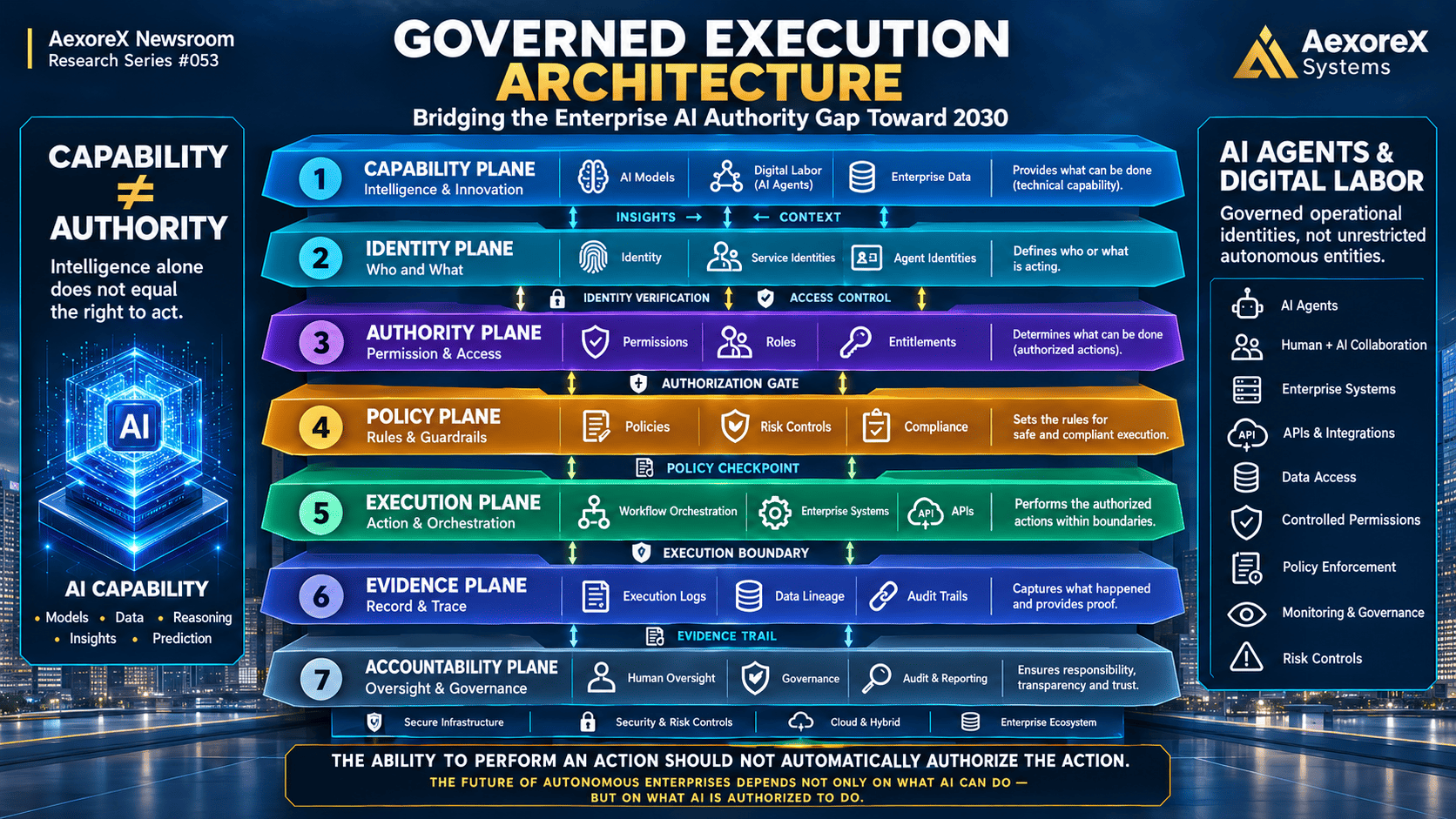
#053 advances from principle to architecture, investigating the emerging requirement for a Governed Execution Architecture. In this architecture, "Capability → Identity → Authority → Policy → Execution → Evidence → Accountability" become explicitly distinguishable architectural functions.
Logical Continuation
The intellectual sequence is: - **#052:** AI capability does not create institutional authority. - **#053:** Therefore, authority must be explicitly represented, governed, and enforced within the enterprise execution architecture.
This transforms the conversation from "How intelligent is the model?" to "How safely can the enterprise allow intelligence to act?"
PART 3 — CORE RESEARCH
1. The Enterprise AI Adoption Paradox
Enterprise AI adoption is widespread. McKinsey's 2025 State of AI research reports that 88% of respondents' organizations use AI in at least one business function. The same research indicates that 62% are experimenting with AI agents, and 23% are scaling an agentic AI system.
However, adoption does not equate to transformation. S&P Global reports an increase in AI initiative abandonment before production, with the proportion rising from 17% to 42%. The average organization in their research scrapped 46% of projects between proof of concept and broad adoption.
This evidence reveals a distinction: AI adoption is accelerating faster than enterprise-wide operationalization. This leads to the central question for #053: What prevents increasingly capable AI systems from becoming reliable enterprise operating infrastructure? One increasingly visible answer is the execution boundary.
2. From AI Assistant to Operational Actor
Traditional enterprise AI typically operated within a human-controlled loop: Human → AI → Recommendation → Human Decision → Enterprise System.
Agentic systems introduce a different possibility: Goal → AI Planning → Tool Invocation → System Action → Result → Next Action. This difference is profound. The AI system is no longer merely generating information; it actively participates in an operational process.
When an AI system can: - Create a transaction. - Modify enterprise data. - Initiate a workflow. - Communicate externally. - Move information between systems. - Invoke financial or operational tools. - Coordinate other agents.
The enterprise must govern not only its intelligence but also its authority.
3. The Non-Human Identity Expansion
The identity problem becomes more complex as software increasingly acts autonomously. Veza's 2026 identity research indicates that non-human identities (NHIs) outnumber human identities by approximately 17:1 in its dataset. This vendor research serves as an indicator of the problem's scale rather than a universal ratio.
The strategic significance outweighs the exact ratio. Enterprise environments already contain large numbers of: - Service accounts. - API credentials. - OAuth applications. - Workload identities. - Machine certificates. - Automated workflows. - Cloud principals. - Integration identities.
AI agents add another class: software that can reason about actions and dynamically invoke tools. This creates a fundamental difference. A conventional service identity generally performs a predefined function, while an AI agent can potentially determine its next action within its available authority. Therefore, identity becomes inseparable from runtime decision authority.
4. The Authority Gap
A conventional authorization model can answer: "Is this identity allowed to access this resource?" Agentic enterprise environments increasingly require additional questions:
- What is this agent allowed to decide?
- For which process?
- Within what financial or operational threshold?
- Under whose delegated authority?
- For how long?
- Under which contextual conditions?
- What happens when the action falls outside its authority?
This creates the Enterprise AI Authority Gap, which exists between technical capability and institutional permission. NIST's 2026 concept paper specifically identifies identity and authorization as emerging challenges for software and AI agents, including identification, authorization, auditing, and non-repudiation. This independently validates the architectural direction identified in #052.
5. Governed Execution Architecture
A Governed Execution Architecture separates the system that reasons about an action from the system that authorizes and executes it. A conceptual architecture consists of:
- **Capability Plane:** Foundation models and reasoning systems determine what can be proposed.
- **Identity Plane:** The system establishes who or what is attempting to act.
- **Authority Plane:** The enterprise determines what that identity is permitted to do.
- **Policy Plane:** Business rules, risk controls, regulatory constraints, and contextual conditions are evaluated.
- **Execution Plane:** Only approved actions are transmitted to enterprise systems.
- **Evidence Plane:** The execution generates verifiable records.
- **Accountability Plane:** The enterprise retains responsibility for the process, authority delegation, and outcome.
The resulting chain is: Capability → Identity → Authority → Policy → Execution → Evidence → Accountability. This architecture does not assume that the AI model itself should become the enterprise authority layer. Instead, the model becomes one component within a larger governed system.
6. Why Identity and Authority Should Not Be Implicit
A dangerous architectural assumption is: "If the agent can call the API, the agent is authorized to perform the action." This approach effectively collapses Capability = Identity = Authority = Execution into one mechanism. A more resilient architecture separates them.
For example, a Digital Worker may be technically capable of issuing a purchase order. However, authority policy may determine: - Purchases below a defined threshold can execute automatically. - Larger purchases require another digital authority. - Unusual suppliers require human review. - Restricted categories require additional controls. - Anomalous behavior triggers escalation.
The AI model does not determine these boundaries; the enterprise does.
7. Runtime Governance
Governance cannot remain entirely static because agentic systems operate dynamically. Therefore, enterprise controls increasingly need to evaluate actions at runtime. A Governed Execution Architecture can conceptually enforce:
- **Identity Validation:** Who is acting?
- **Authority Validation:** Is this actor authorized?
- **Context Validation:** Does the current situation permit the action?
- **Policy Validation:** Does the proposed action comply with enterprise rules?
- **Execution Validation:** Can the action safely reach the target system?
- **Evidence Generation:** Can the enterprise later prove what happened?
- **Escalation:** What happens when the action exceeds authority?
This represents the architectural realization of "Capability ≠ Authority."
8. The Economics of Agentic AI
The economic question is shifting from "How many employees use this AI product?" toward "How much governed operational work can this system safely complete?" While seat-based SaaS will not disappear immediately, enterprises may increasingly operate across several economic models:
- Seat-based (human access).
- Usage-based (API/compute consumption).
- Task-based (completed automated work).
- Outcome-oriented (measurable business result).
- Governed capacity (authorized operational throughput).
The economic significance is substantial. If Digital Labor becomes a meaningful operational layer, enterprises will increasingly evaluate AI systems by: - Successful task completion. - Error rates. - Exception rates. - Human intervention. - Execution latency. - Risk exposure. - Compliance. - Operational throughput. - Measurable business outcomes.
Raw model usage becomes an incomplete metric.
9. Governance as Infrastructure, Not Administration
One of the most important strategic changes is that governance can no longer be treated solely as a review function after deployment. Gartner's 2026 research explicitly identifies governance and identity infrastructure as prerequisite investments for scaling agentic AI. It also emphasizes that organizations must distinguish an agent's ability to act from the scope of access granted to it.
This reinforces a fundamental architectural principle: Governance must exist at the execution boundary, not merely in policy documents. A policy that cannot influence runtime execution is guidance; a policy that can determine whether an action executes is control infrastructure.
10. Vendor Independence by Design
Another strategic challenge is dependence on individual AI platforms. Enterprise architecture has historically experienced various forms of vendor lock-in, including infrastructure, database, application, data, and API lock-in.
Agentic AI introduces another possibility: behavioral and orchestration dependency. If business-critical workflows become tightly coupled to one model provider's prompts, agent framework, tool definitions, memory system, orchestration model, or evaluation methodology, switching providers can become operationally expensive even when data remains technically portable.
Therefore, "Vendor Independence by Design" should be treated as an architectural objective. This principle does not require eliminating vendors but prevents one vendor from becoming the unavoidable authority over enterprise context, identity, policy, execution, and evidence. A model provider can provide intelligence, but an enterprise should retain control over its institutional authority.
11. Protocols and Interoperability
Protocols such as the Model Context Protocol are increasingly relevant as they attempt to standardize how AI systems interact with tools and contextual resources. However, protocol standardization alone does not solve enterprise governance. A protocol can establish how systems communicate, but it does not automatically determine who is authorized to perform an action. Therefore, the architecture must distinguish connectivity from authority, which is another expression of the #052 principle.
PART 4 — EVIDENCE MATRIX
**Claim: Enterprise AI adoption is widespread.** *Evidence:* McKinsey reports 88% using AI in at least one business function. *Assessment:* Strong.
**Claim: Agentic AI experimentation is accelerating.** *Evidence:* McKinsey reports 62% experimenting with AI agents and 23% scaling somewhere. *Assessment:* Strong.
**Claim: AI projects face significant scaling difficulty.** *Evidence:* S&P Global reports 42% abandoning most initiatives and 46% average POC abandonment. *Assessment:* Strong, with precise wording required.
**Claim: Agentic projects face cancellation risk.** *Evidence:* Gartner predicts >40% may be canceled by end-2027. *Assessment:* Strong forecast.
**Claim: NHI proliferation is a major identity challenge.** *Evidence:* Veza reports 17:1 NHI-to-human ratio in its research. *Assessment:* Strong indicator; vendor-specific.
**Claim: AI agents require dedicated identity/authorization consideration.** *Evidence:* NIST published an agent identity and authorization concept paper. *Assessment:* Very strong primary evidence.
**Claim: Governance and identity are prerequisites for scaling agents.** *Evidence:* Gartner explicitly identifies them as prerequisite investments. *Assessment:* Strong.
**Claim: Agent governance must distinguish capability from access.** *Evidence:* Gartner explicitly makes this distinction. *Assessment:* Very strong.
**Claim: AI regulation is becoming operationally relevant.** *Evidence:* EU AI Act enforcement is progressively taking effect. *Assessment:* Very strong primary evidence.
**Claim: Agent-mediated B2B commerce may become significant.** *Evidence:* Gartner forecasts 90% of B2B buying to be AI-agent intermediated by 2028 and >$15T spend. *Assessment:* Forecast; not current fact.
PART 5 — CONTRARIAN ANALYSIS
Strongest Counterargument: Platform Consolidation
The strongest argument against an independent execution-control architecture is platform consolidation. Major cloud and enterprise software vendors may increasingly embed identity, agent orchestration, policy, tool connectivity, observability, security, and governance directly into their platforms. If one platform can govern most of an enterprise's workflows, a separate control plane may introduce unnecessary complexity. This is a legitimate architectural counterargument.
Second Counterargument: Model Reliability
AI models themselves may become sufficiently reliable that external controls become less important. However, reliability does not eliminate authority. Even a highly reliable model does not inherently know corporate delegation limits, legal authority, financial approval thresholds, organizational responsibility, segregation-of-duties requirements, or business-specific exceptions. Therefore, model reliability and enterprise authority remain distinct architectural concerns.
Third Counterargument: Vendor Consolidation Preference
Enterprise CIOs often prefer vendor consolidation, as a unified platform may reduce procurement complexity, integration costs, operational overhead, and training requirements. Therefore, independent governance infrastructure must demonstrate measurable value rather than merely introducing another architectural layer.
Conditions That Could Weaken the Thesis
The thesis would become less compelling if: - Major enterprise platforms achieve genuinely interoperable governance across heterogeneous systems. - Identity and authority become portable standards across vendors. - Enterprise policy can be enforced consistently without an independent control boundary. - Platform-native governance becomes sufficiently comprehensive and vendor-neutral. - Switching between model and orchestration providers becomes operationally trivial.
The appropriate conclusion is not that every enterprise must acquire an independent control plane. Instead, every enterprise needs a clearly defined authority and execution boundary, regardless of whether that boundary is implemented independently, natively, or through a federated architecture. This distinction significantly strengthens the thesis.
PART 6 — ENTERPRISE IMPACT
CEO
The CEO must view autonomous AI as an organizational authority issue, not merely a technology initiative. The strategic question becomes: Which decisions may be delegated to machines, and where must institutional accountability remain human?
CIO
The CIO must evolve from managing AI applications to managing enterprise intelligence infrastructure. Priority areas include identity, interoperability, policy, execution, observability, and vendor independence.
CTO
The CTO must protect architectural portability. Reasoning systems should not automatically become the owners of enterprise memory, authority, policy, execution, or evidence.
CFO
The CFO must measure AI based on economic outcomes rather than token consumption alone. Relevant metrics increasingly include cost per successful task, human intervention rate, automation yield, exception rate, operational throughput, and risk-adjusted ROI.
COO
The COO becomes responsible for redesigning workflows around a hybrid workforce of Human Labor + Digital Labor. The central question shifts to how work should be delegated, rather than merely automated.
CISO
The CISO must treat AI agents as operational identities rather than merely applications. The focus expands toward least privilege, identity lifecycle, runtime authorization, credential protection, tool restrictions, behavioral monitoring, and incident containment.
Chief AI Officer
The CAIO must move beyond model selection. The role increasingly encompasses model capability + enterprise context + governance + execution + measurable value.
Enterprise Architect
The Enterprise Architect becomes critical to defining the boundaries between Reasoning and Execution. This is where the architecture of autonomous enterprises will largely be decided.
PART 7 — DIGITAL LABOR & AUTHORITY
The emergence of Digital Labor creates a new enterprise architecture problem. A Digital Worker requires more than a model; it requires: - **Identity:** Who is it? - **Capability:** What can it do? - **Authority:** What is it allowed to do? - **Policy:** Under which conditions? - **Execution:** How does it act? - **Evidence:** How is its action recorded? - **Accountability:** Who owns the outcome?
Therefore, Digital Labor is not merely AI software with a name; it is an operational identity operating within an explicit authority boundary. This distinction becomes increasingly important as agents move from recommendation toward execution.
PART 8 — 2030 SCENARIOS
Scenario A — Controlled Fragmentation
Enterprises continue adopting AI but restrict autonomous execution to narrow use cases. Agents remain largely departmental, application-specific, and human-supervised. Governance becomes a prerequisite for expansion.
**Result:** AI improves productivity but does not fundamentally reorganize the enterprise.
Scenario B — Governed Execution Becomes Standard
Enterprises increasingly adopt architectures that separate model intelligence from enterprise authority and execution. Identity, policy, and evidence become integrated into agent infrastructure. Digital Labor becomes an accepted operational category.
**Result:** Enterprise AI evolves from isolated copilots toward governed operational capacity. This is the base-case scenario #053 considers most strategically important, without assigning an unsupported numerical probability.
Scenario C — Accelerated Autonomous Enterprise
Agent reliability, identity standards, interoperability, and enterprise governance mature rapidly. AI agents become capable of coordinating workflows, negotiating transactions, managing operational processes, supervising other digital workers, and executing across multiple enterprise systems. Human leadership increasingly focuses on strategic direction, institutional policy, capital, accountability, and exception management.
**Result:** The enterprise becomes increasingly characterized by human governance over machine-scale execution. This scenario offers enormous productivity potential but also creates systemic risks from concentration, cascading automation failures, identity compromise, correlated model behavior, and infrastructure dependency.
PART 9 — STRATEGIC IMPLICATIONS
1. **Treat AI Authority as an Architectural Layer:** Do not assume authority emerges automatically from model capability. 2. **Make AI Agents First-Class Operational Identities:** Agents that can act require identity and lifecycle controls. 3. **Separate Capability from Permission:** The ability to perform an action should not automatically authorize the action. 4. **Put Policy at the Execution Boundary:** Policies should be capable of affecting whether transactions actually execute. 5. **Maintain Evidence of Autonomous Operations:** Enterprises need verifiable records of identity, authority, policy decision, action, result, and escalation. 6. **Design for Vendor Independence:** Enterprise authority should remain portable even when models and vendors change. 7. **Measure Governed Operational Yield:** The relevant metric is not simply "How much AI did we use?" but "How much valuable, compliant, successfully completed work did the AI system produce?" 8. **Design Human-Digital Workforce Structures:** Organizations should define what work belongs to human employees, Digital Workers, Digital Managers, and human executives. 9. **Prepare Enterprise Systems for Machine Intermediation:** ERP, CRM, financial, and operational systems will increasingly need secure machine-readable interfaces. 10. **Treat Governance as Infrastructure:** Governance should become part of the runtime architecture rather than a document reviewed after deployment.
PART 10 — AEXOREX POINT OF VIEW
The enterprise AI debate has largely focused on intelligence: How capable is the model? How large is its context window? How strong is its reasoning? How autonomous is the agent? These questions are important but incomplete.
The next phase of enterprise AI requires another question: Who—or what—is authorized to act? A highly capable AI system can generate a sophisticated recommendation, but that does not make the recommendation an authorized enterprise decision. An agent may be able to execute a transaction, but that does not mean the enterprise should allow it to do so.
This is the central distinction established in #052 and extended in #053: Capability ≠ Authority. The architectural consequence is equally important. Enterprise autonomy cannot be built solely by increasing model intelligence. It requires an environment where intelligence can operate within explicit boundaries of Identity, Authority, Policy, Execution, Evidence, and Accountability.
This does not imply that every enterprise requires an identical architecture. It means that as AI moves from advising humans toward acting on behalf of organizations, authority can no longer remain implicit. The durable enterprise advantage may therefore shift from simply possessing access to powerful models toward possessing the infrastructure that allows those models to operate safely within institutional boundaries.
For AexoreX, this leads to a broader architectural proposition: The future enterprise will not be defined only by how intelligent its AI becomes, but by how precisely the enterprise can govern what that intelligence is allowed to do. That is the emerging Governed Execution Architecture.
PART 11 — FINAL ARTICLE BLUEPRINT
Opening
Begin with the paradox: AI adoption is widespread, and autonomous execution is accelerating, yet enterprise-scale value remains difficult to achieve. Use the strongest verified evidence rather than sensational failure statistics.
Section 1: From AI Assistance to AI Action
Explain the architectural transition from: Human → AI → Recommendation to: Goal → Agent → Tool → Enterprise System → Result
Section 2: The Authority Gap
Introduce "Capability ≠ Authority." Explain why an AI system's technical ability cannot be treated as institutional permission.
Section 3: The Identity Problem
Introduce the rise of Non-Human Identities (NHIs) and the need to govern AI agents as operational identities. Use NIST as the primary institutional evidence for emerging identity and authorization requirements.
Section 4: The Architecture of Governed Execution
Introduce: Capability → Identity → Authority → Policy → Execution → Evidence → Accountability. This becomes the central conceptual diagram of #053.
Section 5: Governance Moves Into the Runtime
Explain why governance cannot remain merely procedural. Use Gartner's 2026 findings on identity, governance, and the distinction between an agent's ability to act and the scope of access it receives.
Section 6: The Economics of Digital Labor
Explore the transition from human seats toward usage → task → outcome → governed operational capacity. Avoid claiming that seat-based SaaS is already obsolete.
Section 7: Vendor Independence by Design
Explain why enterprise authority, policy, and evidence should not automatically become dependent on a single model provider.
Section 8: Regulation and the 2030 Horizon
Use the EU AI Act carefully. High-risk provisions have staged application dates, including December 2, 2027, for certain Annex III high-risk systems and August 2, 2028, for high-risk AI embedded in regulated products. The regulatory trajectory reinforces the importance of governance but should not be presented as proof that one specific architecture is legally mandated.
Section 9: Three Possible Futures
Present these as scenarios, not statistical forecasts: - Controlled Fragmentation - Governed Execution Standard - Accelerated Autonomous Enterprise
Conclusion
Return to the central proposition: The next enterprise AI advantage may not come from giving machines unlimited authority. It may come from building the infrastructure that allows enterprises to delegate authority precisely. Then close the intellectual bridge: #052 established the principle; #053 establishes the architecture.
Sources and attribution
- AexoreX Newsroom — Original Research & Strategic Analysis · statement link
About the author
Research desk of AexoreX Newsroom.
More from AexoreX Research Desk →Related stories
- Protocol-Governed Enterprise Authority
- Governing Autonomous Execution: Enterprise Control Planes and the Shift to Digital Labor
- The Non-Human Identity Control Plane: Dynamic Authority and Traceable Delegation for Autonomous Enterprise Operations
- The Identity-to-Execution Seam: Governing Non-Human Identities and Dynamic Delegation in Autonomous Enterprise Operations
- EXECUTION-TIME AUTHORITY ATTENUATION
- THE SHIFT TO GOVERNED EXECUTION INFRASTRUCTURE
- From Enterprise Intelligence to Governed Autonomous Execution: The Next Step Toward the Autonomous Enterprises
- Execution Architecture at Machine Speed
- Beyond AI: Building the Enterprise Operating Model for Intelligence, Digital Labor, Governance, and Execution.
- Governing Digital Labor: Bridging Capability and Authority in Autonomous Enterprise Architecture
- From Agent Interoperability to Governed Execution: Why Enterprise AI Needs an Authority Layer