
THE SHIFT TO GOVERNED EXECUTION INFRASTRUCTURE
Bridging the Enterprise AI Authority Gap
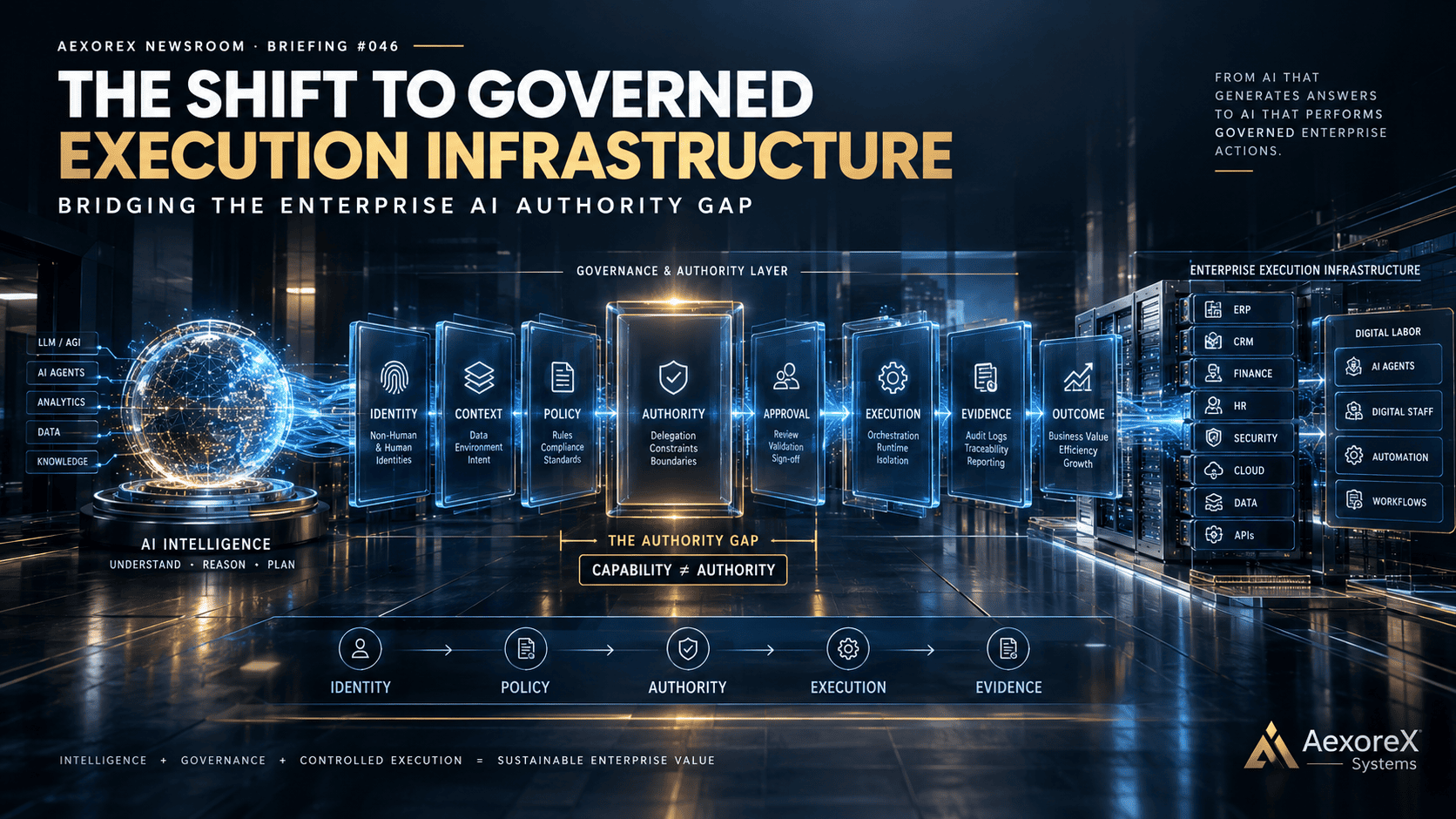
Enterprise AI is shifting from model intelligence to governed execution, addressing the Authority Gap between AI's technical capabilities and organizational authorization for action.
Opinion · AI-assisted, human edited
Executive Perspective
Enterprise artificial intelligence is entering a new phase. For the first generation of enterprise AI, the primary question was, "How intelligent is the model?" Organizations competed on model quality, reasoning capability, context windows, multimodal performance, and inference cost. While this question remains important, it is no longer sufficient.
The emerging enterprise question is increasingly, "What is the AI allowed to do — under which conditions, with whose authority, using which systems, and with what evidence?" This signifies a structural shift from merely AI intelligence to governed execution. This distinction is crucial because an enterprise AI system can be technically capable of performing an action without being organizationally authorized to perform it.
A model might be capable of approving a transaction, but that does not mean the enterprise should authorize it. Similarly, an agent may be capable of changing a production configuration, but it should not necessarily have permission to do so. An AI system might be able to access sensitive information, but access may not be appropriate in the current context. This growing disparity between technical capability and enterprise authority is becoming a defining architectural problem for agentic AI. We refer to this as the Enterprise AI Authority Gap.
The AI Value Gap
Enterprise AI investment is accelerating. KPMG's 2026 Global AI Pulse research indicates that organizations continue to commit substantial capital to AI while simultaneously increasing their focus on governance, security, accountability, and value realization. By Q3 2026, KPMG reported that 55% of surveyed organizations operated a formal AI harness layer, which includes controls and tooling positioned between AI models and business use.
This development is significant, suggesting that enterprise architecture is beginning to acknowledge that AI cannot simply be connected directly to business processes; a control layer is emerging around it. The problem is therefore no longer just, "Can we deploy AI?" It is increasingly, "Can we operate AI reliably at enterprise scale?" This distinction becomes more critical as AI systems move from experimentation toward coordinated execution.
From Answers to Actions
Traditional enterprise software generally awaits human instruction. A user opens an application, selects an action, confirms the operation, and the system executes. Agentic AI alters this interaction model. An AI system can increasingly interpret objectives, retrieve information, reason over context, select tools, invoke APIs, coordinate workflows, communicate with other agents, monitor results, and continue working across multiple steps.
This creates a new architectural category. AI is no longer solely an interface to information; it can become an interface to enterprise action. Action, in turn, introduces the need for authority. The moment an AI system can affect money, customers, employees, infrastructure, records, security controls, or operational workflows, intelligence alone is insufficient. The system requires boundaries.
The Authority Gap
Consider a straightforward example. An AI agent has access to a company's finance system. Technically, the API allows the agent to issue refunds, the model can understand the request, and the API can execute it. The integration works. However, the enterprise may define rules such as: refunds below a certain threshold may be automated; larger refunds require human approval; suspicious transactions require additional verification; certain customers or jurisdictions require additional controls; and financial actions must be recorded for audit.
The AI, therefore, possesses capability, but capability does not equate to authority. This leads to a fundamental principle: Capability ≠ Authority. A system may be able to perform an operation without being authorized to perform that operation. This distinction becomes increasingly important as AI agents gain broader access to enterprise systems.
The Emerging Control Layer
Consequently, the enterprise AI architecture is expanding. A useful conceptual model includes:
- **Model:** generates intelligence.
- **Intelligence:** reasoning and interpretation.
- **Agent:** pursues an objective.
- **Identity:** establishes who or what is acting.
- **Context:** determines the relevant situation.
- **Policy:** defines what is permitted.
- **Authority:** determines what the actor may actually do.
- **Tool:** provides access to capabilities.
- **Workflow:** coordinates activities.
- **Execution:** performs the action.
- **Evidence:** records what happened.
- **Outcome:** measures the result.
This 12-layer model is an AexoreX conceptual framework, not an industry-standard taxonomy. Its purpose is to illustrate where enterprise control requirements are increasingly appearing. The critical insight is that the model is only one component. An enterprise-grade AI architecture must connect intelligence to authority, execution, evidence, and outcomes.
MCP: Connectivity Is Not Authority
The emergence of the Model Context Protocol (MCP) demonstrates the rapid development of the connectivity layer. MCP has become a major open protocol for connecting AI applications with tools, data, and external capabilities. In December 2025, Anthropic announced that MCP was being donated to the Agentic AI Foundation under the Linux Foundation. By July 2026, the MCP specification had evolved significantly, incorporating a stateless protocol core, header-based routing, authorization hardening, an extensions framework, Tasks, and MCP Apps.
This is an important architectural development. However, MCP should not be confused with enterprise authority. MCP can help an AI system communicate with a tool, but it does not, by itself, answer: "Should this specific agent be allowed to use this tool for this specific action right now?" That question belongs to the governance and authorization architecture surrounding the protocol. This distinction will become increasingly important as organizations expose more enterprise capabilities to AI systems.
Agent-to-Agent Communication
A similar transition is occurring between agents. The Agent2Agent (A2A) protocol was created to enable communication and collaboration between distinct AI agents and was subsequently established as a Linux Foundation project. By April 2026, the Linux Foundation reported more than 150 organizations supporting the project, with integrations across major cloud platforms and enterprise production deployments.
This introduces another layer of complexity. An enterprise may no longer have just one AI agent. It may have a chain: Agent A → Agent B → Agent C → Enterprise Tool. The original user may never directly interact with Agent B or Agent C. This creates a new question: Does authority follow the task, the identity, the agent, the organization, or the delegation chain? This is not simply a model-quality problem; it is an identity, policy, authorization, risk, and governance problem.
The Non-Human Identity Frontier
Enterprise environments already contain enormous numbers of non-human identities, such as service accounts, applications, API credentials, workload identities, automation systems, bots, cloud services, and now, AI agents. As agentic architectures expand, AI becomes another participant in this non-human identity ecosystem.
The architectural challenge is therefore not merely, "Who is the human user?" It becomes: Which system is acting? On whose behalf? Under which authority? With which delegated permissions? Against which resources? For which purpose? Under which policy? This is why AI agent identity and authorization are becoming increasingly important areas of enterprise security research.
NIST's 2026 AI Agent Standards Initiative explicitly addresses areas including secure agent operation, interoperability, identity, and authorization. NIST's related work on software and AI agent identity and authorization also highlights identification, authorization, auditing, and non-repudiation as important considerations. The implication is straightforward: An AI agent needs more than intelligence; it needs an accountable identity and bounded authority.
Authentication Is Not Authorization
Two concepts are frequently confused:
- **Authentication:** Who are you?
- **Authorization:** What are you allowed to do?
For agentic systems, another question becomes important:
- **Contextual Authorization:** Are you allowed to perform this action under these conditions, at this moment, for this purpose?
Consider an employee who normally has access to a financial system. That does not necessarily mean an AI agent acting on behalf of that employee should inherit every permission the employee possesses. Delegation must be explicit, and authority must be bounded. High-impact actions may require additional approval.
The enterprise therefore needs to distinguish between:
- Human identity
- Agent identity
- Delegated authority
- Tool permission
- Action permission
- Approval state
- Risk state
- Execution state
This forms the foundation of governed digital labor.
The Evidence Layer
One of the most underestimated requirements of autonomous enterprise systems is evidence. If an AI system performs a business action, the organization must eventually be able to answer:
- Who initiated the task?
- Which agent acted?
- Which model was involved?
- What context was available?
- Which policy applied?
- Which authority was granted?
- Which tool was called?
- What approval was obtained?
- What action was executed?
- When did it happen?
- What was the result?
- What changed afterward?
This creates a distinction between AI that acts and AI that can prove how it acted. Enterprise autonomy without evidence creates operational uncertainty; enterprise autonomy with evidence creates accountability. Therefore, evidence should not be treated as a reporting feature added at the end, but as a cross-cutting architectural capability.
Security Becomes Execution Security
The attack surface is also changing. Traditional AI security focuses heavily on model attacks, prompt injection, data leakage, model misuse, and adversarial inputs. Agentic systems introduce another dimension: What happens after the model decides to act?
A compromised or poorly governed agent may have access to enterprise APIs, databases, cloud infrastructure, communication systems, financial systems, customer records, and internal applications. The risk therefore moves downstream from the model into the execution environment. Real-world incidents are already demonstrating that the surrounding tool ecosystem requires security attention. Security research into MCP implementations, for example, has identified vulnerabilities involving areas such as file operations, code injection, and Server-Side Request Forgery (SSRF) in the surveyed implementations.
These findings should not be interpreted as meaning that every MCP implementation is vulnerable. Rather, they demonstrate something more important: Connecting AI to tools creates a new security boundary. The tool layer must therefore be treated as part of the enterprise security architecture.
Regulation Is Moving Toward Accountability
Regulatory frameworks are also evolving around AI risk, human oversight, transparency, and accountability. The EU AI Act is an important example. However, regulatory interpretation requires precision. An AI system does not automatically become high-risk merely because it uses tools, APIs, MCP, or agents. Risk classification depends on the system's intended purpose and the applicable provisions of the regulation.
This distinction matters. The strategic lesson is not, "Regulation requires MCP approval." The more defensible conclusion is: As AI systems become capable of consequential actions, organizations need stronger mechanisms for human oversight, accountability, risk management, and evidence. This is consistent with the broader direction of enterprise AI governance.
The Agentic Control Plane
The emerging enterprise architecture can therefore be viewed as two interconnected domains:
**Intelligence Plane** Where AI: - reasons; - understands; - plans; - generates; - predicts; - communicates.
**Control Plane** Where the enterprise: - identifies; - contextualizes; - governs; - authorizes; - approves; - executes; - records; - evaluates; - and, when necessary, stops actions.
The intelligence plane answers: "What could be done?" The control plane answers: "What may be done?" That distinction may become one of the defining architectural separations of enterprise AI.
From AI Agents to Governed Digital Labor
The progression can now be understood more clearly:
- **Generation 1 — AI Assistant:** AI provides information.
- **Generation 2 — AI Copilot:** AI assists a human with work.
- **Generation 3 — AI Agent:** AI performs multi-step tasks.
- **Generation 4 — Digital Labor:** AI systems continuously perform defined business work.
- **Generation 5 — Governed Digital Labor:** Digital labor operates with explicit identity, context, policy, authority, risk controls, approval mechanisms, execution boundaries, evidence, and measurable outcomes.
The fifth stage is not simply about making AI more autonomous; it is about making autonomy operationally governable.
The AexoreX Architectural Lens
AexoreX frames enterprise intelligence through a connected sequence: Connect → Contextualize → Govern → Orchestrate → Authorize → Execute → Optimize, with Evidence operating across the entire lifecycle.
The architecture begins with connectivity, but connectivity is not the destination. Context determines meaning. Governance establishes rules. Orchestration coordinates work. Authorization determines permitted action. Execution performs the work. Evidence establishes what actually happened. Optimization measures and improves the system.
This creates a fundamental architectural principle: Digital Labor has no intrinsic authority. Authority must be explicitly defined, delegated, constrained, and governed by the enterprise. This is also why AEOS is not intended to replace the enterprise technology stack; its strategic role is to connect, orchestrate, govern, and activate the existing stack.
What CIOs and CTOs Should Watch
The next stage of enterprise AI should not be evaluated only through model benchmarks. Enterprise leaders should increasingly examine:
- **Identity:** Can every autonomous actor be identified?
- **Delegation:** Can authority be delegated without becoming unlimited?
- **Policy:** Can enterprise rules be expressed and enforced?
- **Authorization:** Can permissions change according to context and risk?
- **Execution:** Can actions be controlled at runtime?
- **Evidence:** Can every consequential action be reconstructed?
- **Interoperability:** Can agents and tools communicate across vendors without creating uncontrolled trust relationships?
- **Economics:** Can the organization measure the cost of autonomous execution against business value?
- **Resilience:** What happens when an agent, tool, model, integration, or downstream system fails?
- **Human Oversight:** Where should humans approve, supervise, intervene, or regain control?
These questions move enterprise AI evaluation beyond, "Which model is smartest?" toward, "Which operating architecture can safely convert intelligence into measurable enterprise outcomes?"
The Strategic Shift
The enterprise AI market is therefore entering a transition. The first competitive battlefield was model intelligence. The next battlefield is increasingly execution infrastructure. That infrastructure includes:
- Identity
- Context
- Policy
- Authority
- Risk
- Approval
- Tools
- Workflow
- Execution
- Evidence
- Outcome
Protocols such as MCP and A2A can help create interoperability. Security systems can establish identity and protect access. Policy engines can define constraints. Workflow systems can orchestrate processes. Observability platforms can provide visibility. However, the enterprise still needs a coherent architecture connecting these capabilities. That is the emerging role of the governed execution layer.
The Enterprise AI Authority Gap
The fundamental challenge can now be stated simply. AI is becoming capable faster than many organizations are redesigning their operating controls. This creates an asymmetry: capability is accelerating, and authority is catching up. Governance must close the gap.
The organizations that successfully scale autonomous systems will therefore need to solve more than model intelligence. They will need to establish a reliable relationship between: Intelligence → Identity → Context → Policy → Authority → Execution → Evidence → Outcome. This is the foundation for enterprise-grade autonomy.
Sources and attribution
- AexoreX Research & Editorial Synthesis, informed by publicly available research, technical documentation, industry publications, and official institutional sources referenced in AexoreX Newsroom Briefing #046. Visual concept and composition by AexoreX Systems. · statement link
About the author
Intelligence desk of AexoreX Newsroom.
More from AexoreX Intelligence Desk →Related stories
- Protocol-Governed Enterprise Authority
- Governing Autonomous Execution: Enterprise Control Planes and the Shift to Digital Labor
- The Non-Human Identity Shift: Why Enterprise Autonomy Demands a Governed Control Plane
- Enterprise Intelligence Infrastructure and Governed Autonomy: The Architectural Foundation for the Autonomous Enterprise
- Beyond AI: Building the Enterprise Operating Model for Intelligence, Digital Labor, Governance, and Execution.
- Governing Digital Labor: Bridging Capability and Authority in Autonomous Enterprise Architecture