
Enterprise Intelligence Infrastructure
Architectural Foundations for Governed Digital Labor and Autonomous Operations
The evolution of enterprise AI from copilots to autonomous Digital Labor demands new infrastructure for governed, authorized, and evidenced operations across complex business systems.
Opinion · AI-assisted, human edited
Executive Opening
Enterprise AI is evolving beyond the copilot era. The next phase involves systems that not only generate information but also interpret enterprise context, interact with tools, coordinate work, make decisions within defined boundaries, and increasingly execute actions across business systems.
Gartner predicts that by the end of 2026, up to 40% of enterprise applications will incorporate task-specific AI agents, a significant increase from less than 5% previously. However, Gartner also forecasts that over 40% of agentic AI projects will be canceled by the end of 2027 due to escalating costs, unclear business value, or inadequate risk controls. These two projections highlight a strategic tension: agent adoption is accelerating, but the infrastructure needed to govern agent execution is still maturing.
The challenge is no longer just about whether enterprise AI can reason. The deeper question is: How does an enterprise safely authorize, govern, execute, observe, and evidence actions produced by systems whose outputs are inherently probabilistic? This defines the emerging infrastructure problem for autonomous enterprise operations.
A key distinction is emerging: model intelligence determines what an AI system can reason about, while enterprise infrastructure determines what that system is permitted to do. The difference between these two layers may become a defining architectural boundary of enterprise AI.
From Copilots to Digital Labor
Traditional enterprise software was designed around human interaction. A person opens an application, reviews information, makes a decision, enters data, submits an action, and receives a result. AI changes this interface. An AI system can increasingly interpret a goal, retrieve context, call tools, coordinate multiple systems, and perform parts of the work, rather than a person navigating every application directly.
This transition can be described as: Software → Copilot → Agent → Digital Labor. In this context, Digital Labor refers to software-based workers capable of performing defined enterprise tasks under specified identity, authority, policy, and governance constraints.
This distinction is important. A chatbot can generate a recommendation, and an agent can potentially execute an action. However, a Digital Labor system must also answer critical questions: - Who initiated the work? - Which agent is acting? - What business context was available? - Which policy applies? - What authority was delegated? - What level of risk is acceptable? - Was human approval required? - Which system was changed? - What evidence was produced? - What was the resulting business outcome?
This is where enterprise AI intersects with infrastructure architecture. Gartner's 2026 research increasingly frames this transition in terms of delegated authority, governance, data foundations, workflow integration, and execution, rather than simple assistance. Gartner has also warned that enterprises may demote or decommission autonomous agents due to governance gaps discovered after production incidents.
The implication is significant: autonomy without controlled authority does not create an autonomous enterprise; it creates uncontrolled automation.
The Rise of Agent Interoperability
The infrastructure supporting agents is also becoming more standardized. The Model Context Protocol (MCP) has emerged as an important interoperability layer for connecting AI systems with tools, data, and applications.
In December 2025, the Linux Foundation announced the formation of the Agentic AI Foundation (AAIF), with founding project contributions from Anthropic's MCP, Block's Goose, and OpenAI's AGENTS.md. AWS, Anthropic, Block, Bloomberg, Cloudflare, Google, Microsoft, and OpenAI were among its initial platinum members. By July 2026, MCP's Tier 1 SDKs were approaching half a billion downloads per month, while its TypeScript and Python SDKs had each exceeded one billion cumulative downloads, according to the MCP project.
The significance of MCP extends beyond the number of integrations. It represents a broader architectural movement where AI systems are becoming connected to operational reality through standardized interfaces. This is strategically important.
However, interoperability is not the same as enterprise authority. MCP itself continues to evolve its security and authorization model. The July 2026 specification introduced additional authorization hardening and closer alignment with OAuth and OpenID Connect deployment practices. Therefore, the architectural question is not whether MCP provides authorization—it does. The more important question is whether protocol-level authorization alone is sufficient to govern enterprise-wide delegation across heterogeneous systems, business contexts, risk policies, approvals, execution environments, and evidence requirements. This constitutes a different problem.
Capability Is Not Authority
One of the most important distinctions in autonomous enterprise architecture is: Capability ≠ Authority. An AI agent may possess the technical capability to perform an action without possessing the organizational authority to perform it.
Consider a simple financial example. An AI system may be technically capable of creating a credit memo inside an enterprise financial system. This does not automatically mean: - the agent is authorized to issue it; - the customer account is eligible; - the amount is within policy; - the transaction is low risk; - the responsible business unit has approved it; - the action is permitted at that autonomy level.
Capability answers: Can the system do it? Authority answers: Is the system allowed to do it here, now, under these conditions, for this purpose? This distinction becomes critical as AI moves from recommendation toward execution.
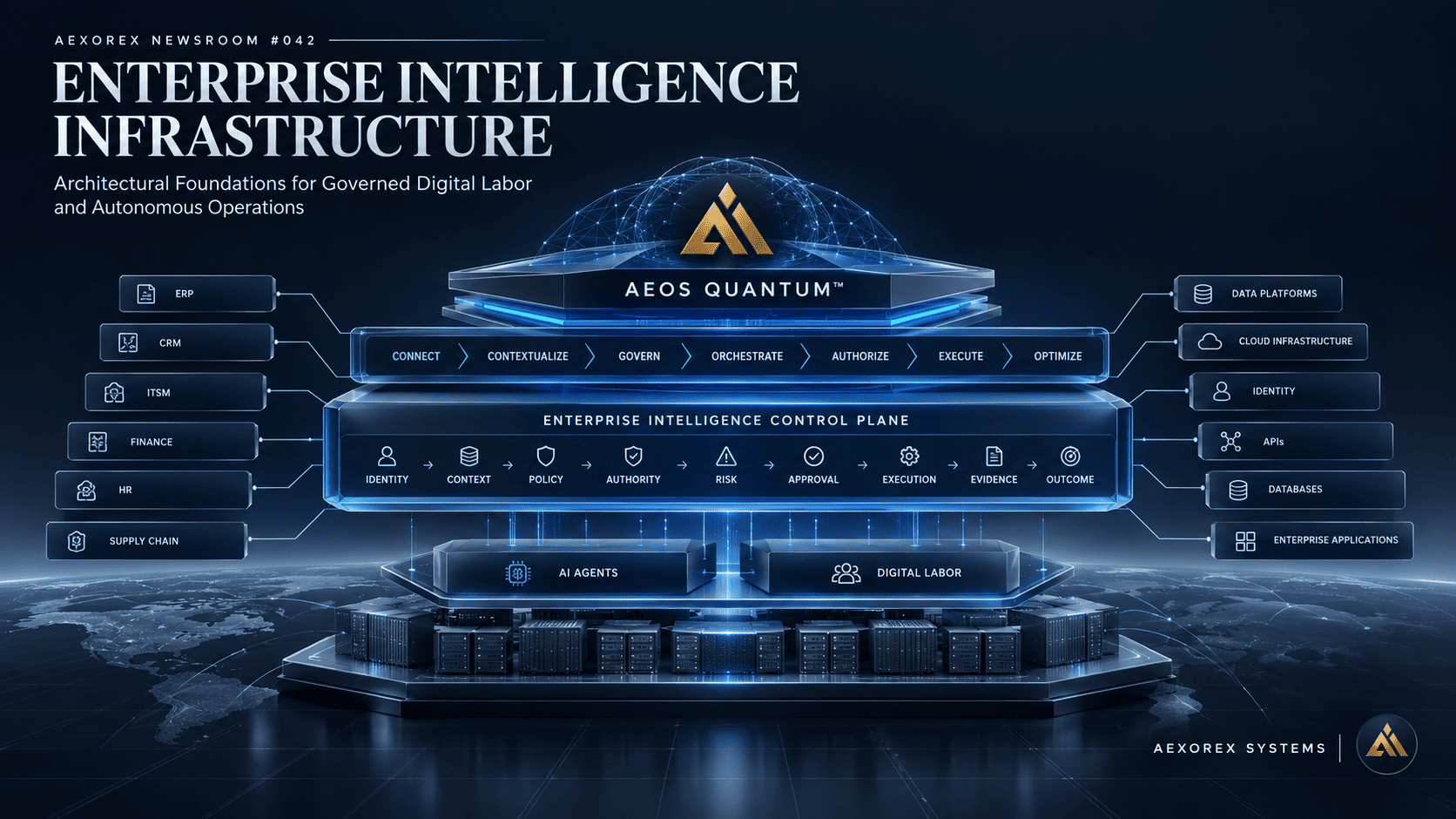
Traditional access control often begins with a relatively static relationship: Identity → Permission → Resource. Autonomous enterprise operations require a richer model: Identity → Context → Policy → Authority → Risk → Approval → Execution → Evidence → Outcome. The second model recognizes that authorization is not simply a technical permission; it is a contextual business decision.
The Identity-to-Execution Chain
A governed Digital Labor architecture can therefore be understood as a nine-stage control chain:
1. **Identity:** Identify the human principal, AI agent, service identity, workload, or non-human identity initiating the operation. 2. **Context:** Determine the business, operational, transactional, geographic, temporal, and system context relevant to the action. 3. **Policy:** Evaluate applicable enterprise rules, regulatory constraints, security policies, business policies, and operating procedures. 4. **Authority:** Determine what authority has actually been delegated to the agent. 5. **Risk:** Assess the potential impact of the requested operation. 6. **Approval:** Determine whether additional human or organizational approval is required. 7. **Execution:** Perform the authorized operation against the appropriate enterprise system. 8. **Evidence:** Capture decision-relevant execution evidence, including identity, policy decisions, approvals, tool actions, execution events, and results. 9. **Outcome:** Determine what actually happened and whether the intended business result was achieved.
This chain provides a conceptual bridge between AI intelligence and enterprise control. It also changes the definition of an AI agent. An agent should not be understood merely as: Model + Prompt + Tools. For enterprise operations, a more complete abstraction is: Agent + Identity + Context + Policy + Authority + Risk + Approval + Execution + Evidence. This is the foundation of governed Digital Labor.
Context Is Not Authority
Context is another critical distinction. Modern enterprise AI increasingly requires access to organizational context. That may include: - customer records; - financial information; - product information; - organizational structures; - policies; - contracts; - operational events; - knowledge bases; - historical transactions; - relationships between business entities.
Graph-based retrieval and enterprise knowledge representations can improve how AI systems reason over relationships and multi-hop context. But context does not itself grant authority. - Knowing that a customer qualifies for a particular commercial treatment does not mean an agent is authorized to apply that treatment. - Knowing that a payment is overdue does not mean an agent is authorized to modify the customer's financial terms. - Knowing how to create a purchase order does not mean the agent is authorized to approve one.
This creates another foundational distinction: Context tells an agent what is happening. Authority determines what the agent may do about it. This distinction should remain explicit even as enterprise knowledge graphs, retrieval systems, ontologies, and agent memory become more sophisticated.
What the Existing Enterprise Stack Already Provides
The autonomous enterprise does not begin with a blank architecture. The enterprise technology stack already contains many of the required components. - Enterprise application platforms increasingly provide embedded AI agents and workflow automation. - Identity providers are developing dedicated mechanisms for AI-agent identities and delegated access. - Hyperscalers are building agent runtimes, gateways, memory, observability, and security infrastructure. - Data platforms are developing semantic layers, ontologies, and business-context systems. - Agent frameworks are providing orchestration, tool use, multi-agent coordination, and runtime capabilities.
Examples include: - Salesforce Agentforce; - ServiceNow AI Agents and AI Agent Fabric; - Microsoft Copilot Studio and Microsoft Entra Agent ID; - AWS Bedrock AgentCore; - Google Vertex AI agent infrastructure; - OpenAI Frontier; - Databricks Genie Ontology; - SAP Knowledge Graph; - enterprise IAM and non-human identity platforms; - agent frameworks such as LangGraph, CrewAI, and AutoGen.
OpenAI Frontier, for example, now positions business context, agent execution, identity and access management, governance, explicit permissions, and auditable actions as components of an enterprise agent platform. AWS is similarly expanding its agent infrastructure around runtime, identity, gateway, memory, observability, evaluation, and optimization. ServiceNow is integrating AI agents into an enterprise workflow environment. Microsoft is developing dedicated agent identity capabilities. Databricks and SAP are building richer business-context layers.
The market is therefore not waiting for one company to invent every component; the components are already emerging. The architectural challenge is increasingly about coordination across them.
The Fragmentation Problem
The enterprise environment is heterogeneous by nature. A large organization may simultaneously operate: - SAP; - Oracle; - Salesforce; - ServiceNow; - Microsoft; - Google; - AWS; - custom applications; - databases; - data warehouses; - identity providers; - security platforms; - integration platforms; - internal APIs; - legacy systems.
An AI agent may need to cross several of these environments to complete a single business objective. That creates a potential fragmentation pattern: - Agent A → System A - Agent B → System B - Agent C → System C - Identity Platform → Identity - Data Platform → Context - Policy Engine → Policy - Integration Platform → Execution - Observability Platform → Telemetry - Security Platform → Risk
Each individual component may work correctly, yet the enterprise can still lack a coherent control model. The question becomes: Who governs the entire chain? That is the emerging Execution Control problem.
The Execution Control Void
The central architectural challenge can be described as an Execution Control Void. This does not mean that enterprise systems have no security; they do. It does not mean that IAM systems have no authorization; they do. It does not mean that AI platforms have no governance; many increasingly do.
The issue is that autonomous execution can cross organizational boundaries that were historically managed by separate systems. A single agent-driven operation may involve: - Human Principal - ↓ - Agent Identity - ↓ - Enterprise Context - ↓ - Policy - ↓ - Authority - ↓ - Risk - ↓ - Approval - ↓ - Tool / API - ↓ - System of Record - ↓ - Evidence - ↓ - Business Outcome
The more systems involved, the more important the control plane becomes. This is where the architecture of autonomous enterprise operations begins to diverge from conventional application architecture.
Evidence Is a First-Class Architectural Layer
Observability is becoming increasingly important for AI systems. OpenTelemetry's GenAI observability work provides standardized mechanisms for recording model operations, token information, tool calls, tool results, and related telemetry. OpenTelemetry is also actively developing conventions for AI-agent observability and framework interoperability. This is important infrastructure.
But telemetry is not automatically an immutable audit ledger. A mature enterprise architecture should distinguish between Observability and Evidence. Observability helps engineers understand what happened inside a system. Evidence must additionally support organizational accountability, retention, integrity, investigation, and governance requirements.
An enterprise Digital Labor architecture may therefore require: OpenTelemetry-compatible telemetry + dedicated evidence storage + policy-aware retention + integrity controls. The objective is not to expose an AI model's private chain-of-thought, but to capture decision-relevant evidence. That can include: - principal identity; - agent identity; - relevant context references; - policy evaluated; - authority level; - risk classification; - approval status; - tool invoked; - action requested; - execution result; - exception; - timestamp; - resulting state; - business outcome.
This creates an evidence chain without requiring disclosure of private internal model reasoning.
Transaction-Aware Execution
Autonomous enterprise operations introduce another important requirement: Execution must be aware of the transactional characteristics of the target system. Not every enterprise system supports distributed atomic transactions. Therefore, a generalized architecture should not assume that an action across multiple systems can always be rolled back atomically.
Instead, execution architecture should support mechanisms such as: - transaction boundaries where available; - idempotency; - precondition checks; - state verification; - compensating actions; - retry policies; - failure isolation; - reconciliation; - human escalation.
The architectural principle is: Never assume reversibility where the underlying system does not provide it. For AEOS, this means transaction-aware orchestration should respect the capabilities and constraints of each target system. Where true rollback is supported, it can be used. Where it is not, the architecture can use compensating actions and reconciliation mechanisms. This distinction becomes increasingly important when Digital Labor can operate across financial, operational, customer, supply-chain, or regulatory systems.
Regulatory Context
Enterprise AI infrastructure is also developing alongside new regulatory requirements. The EU AI Act provides an important example. The Act contains transparency requirements for certain AI systems and separate requirements for high-risk AI systems. The regulatory timeline has also evolved through subsequent amendments. Under Regulation (EU) 2026/1744, certain high-risk AI systems classified under Article 6(2) and Annex III are scheduled for the relevant requirements from December 2, 2027, while certain Article 6(1)/Annex I high-risk systems follow a different timetable.
These provisions should not be interpreted as a universal requirement that every autonomous AI transaction must simply be logged under Article 50. The broader architectural lesson is more important: As AI becomes embedded in consequential enterprise processes, traceability, accountability, transparency, risk management, and controlled authority become architectural concerns rather than optional afterthoughts. Regulation does not define the complete enterprise architecture, but it reinforces the need for organizations to understand: - what an AI system is doing; - who or what authorized it; - which policies apply; - what data and context influenced the action; - what happened during execution; - what evidence remains afterward.
The Emerging Enterprise Architecture
The autonomous enterprise therefore requires several architectural layers to work together:
- **Intelligence Layer:** Models and reasoning systems.
- **Context Layer:** Enterprise data, memory, knowledge graphs, ontologies, retrieval, and business context.
- **Identity Layer:** Human identities, service identities, non-human identities, and agent identities.
- **Policy Layer:** Business rules, security policies, regulatory constraints, and operating policies.
- **Authority Layer:** Delegated authority, autonomy levels, permissions, approval thresholds, and escalation rules.
- **Orchestration Layer:** Agent coordination, workflow management, task decomposition, and cross-system sequencing.
- **Execution Layer:** APIs, tools, integrations, enterprise applications, databases, and systems of record.
- **Evidence Layer:** Telemetry, audit records, execution evidence, state changes, and outcome records.
- **Optimization Layer:** Evaluation, performance measurement, exception analysis, learning loops, and continuous improvement.
These layers may be provided by different vendors. The strategic challenge is making them operate coherently.
AexoreX Systems and the AEOS QUANTUM™ Thesis
Against this architectural background, AexoreX Systems is developing AEOS QUANTUM™ as an Enterprise Intelligence Operating Platform for Autonomous Enterprises. AEOS is designed around a simple principle: AEOS does not replace the enterprise stack. AEOS connects, orchestrates, governs, and activates it. The objective is not to eliminate existing enterprise applications, but to provide an intelligence and control architecture capable of operating across them.
The AEOS operating model is: - **Connect:** Connect enterprise systems, identities, data, tools, events, and operational environments. - **Contextualize:** Construct the business and operational context required for intelligent action. - **Govern:** Apply enterprise policies, governance requirements, risk controls, and operating boundaries. - **Orchestrate:** Coordinate agents, Digital Labor, workflows, systems, tools, and human participants. - **Authorize:** Determine whether an action is permitted, under which conditions, and at what autonomy level. - **Execute:** Perform authorized operations against connected enterprise systems. - **Optimize:** Evaluate outcomes, identify exceptions, improve operating patterns, and strengthen the system over time.
Evidence operates across the entire model; it is not simply an eighth stage, but a cross-cutting requirement.
Digital Labor Requires Graduated Authority
Autonomous enterprise operations should not be binary, meaning an agent should not simply be allowed or blocked. Enterprise autonomy can instead be graduated. AEOS defines a conceptual Digital Labor Decision Authority model:
- **D1 — Recommend:** The system recommends an action. Human decision remains required.
- **D2 — Decide:** The system may make the decision within predefined boundaries, while execution may remain subject to additional controls.
- **D3 — Decide & Execute:** The system may make and execute defined decisions within explicitly authorized boundaries.
- **D4 — Control & Escalation:** The system can operate within a broader control envelope while escalating exceptions, high-risk events, or authority-boundary violations.
This model reflects a central principle: More capable does not automatically mean more authorized. Authority should expand according to policy, risk, context, evidence, and organizational trust.
Vendor Independence by Design™
The enterprise AI market is likely to remain heterogeneous. Organizations will use different: - models; - clouds; - identity systems; - data platforms; - enterprise applications; - integration platforms; - agent frameworks; - security products; - observability systems.
AEOS therefore follows a principle AexoreX Systems calls Vendor Independence by Design™. This does not mean refusing vendors; it means avoiding architectural dependence on any single intelligence provider where abstraction is strategically valuable. A vendor may provide the best model today, another may provide the best integration capability tomorrow, and a third may provide a stronger specialized model for a specific task. The enterprise control architecture should be capable of evolving without requiring the entire operating model to be rebuilt each time an underlying provider changes.
This creates a distinction between vendor capability and enterprise control. AEOS is designed around the latter.
From Application-Centric to Outcome-Centric Enterprise Computing
Traditional enterprise software is application-centric, with people interacting with applications. The emerging model is increasingly outcome-centric, where people express objectives, and AI systems coordinate work across applications. Gartner has described this broader transition as a move from assistive intelligence toward outcome-focused workflow, where delegated authority and policy-bound execution become increasingly important.
This does not mean applications disappear; systems of record remain essential. ERP remains ERP, CRM remains CRM, ITSM remains ITSM, and financial systems remain financial systems. The difference is the interface between the enterprise and those systems.
Instead of: Human → Application → Action, the emerging model becomes: Human → Intelligence → Authority → Orchestration → Systems → Outcome. Applications remain the operational substrate, but the intelligence and control layer becomes increasingly important above them.
Strategic Recommendations for 2026–2030
Enterprises preparing for autonomous operations should consider several architectural priorities:
1. **Establish agent identity:** Every production agent should have an identifiable security and operational identity. 2. **Separate capability from authority:** Technical ability to perform an action should never be treated as automatic authorization. 3. **Define graduated autonomy:** Establish explicit autonomy levels based on risk, business context, and authority. 4. **Build a context architecture:** Agents need controlled access to reliable enterprise context, not simply larger amounts of data. 5. **Centralize policy evaluation:** Policies should be consistently evaluated across agents and execution environments wherever practical. 6. **Make execution observable:** Agent actions should produce standardized operational telemetry. 7. **Make evidence durable:** Important decisions and execution events should be retained in an evidence architecture appropriate to the organization's governance requirements. 8. **Design for heterogeneous systems:** Assume that enterprise environments will contain multiple clouds, models, applications, identity providers, and agent frameworks. 9. **Treat exceptions as first-class events:** The most important autonomous operation may sometimes be the decision to stop and escalate. 10. **Optimize for outcomes:** Measure whether Digital Labor produces the intended business result—not merely whether an agent successfully generated a response or completed a tool call.
The Architecture of the Autonomous Enterprise
The central transformation is therefore not simply: Human + AI. It is: Enterprise + Intelligence + Authority + Execution + Evidence. An autonomous enterprise requires more than intelligent models; it requires infrastructure capable of translating probabilistic intelligence into controlled organizational action.
That infrastructure must understand: - Who - What - Why - Under which policy - With what authority - At what risk - With whose approval - Against which system - With what evidence - Producing what outcome
This is the architecture beneath Digital Labor.
Conclusion
The next generation of enterprise AI will not be defined solely by which model reasons best. It will increasingly be defined by which organizations can transform intelligence into controlled, accountable, repeatable business execution. The market is already building many of the necessary components. - Protocols such as MCP are improving interoperability. - Agent platforms are providing execution environments. - Identity platforms are developing agent-specific access mechanisms. - Data platforms are building business-context layers. - Observability frameworks are standardizing AI telemetry. - Enterprise applications are embedding agents directly into workflows.
The challenge is increasingly architectural: How do these capabilities operate as one governed system across heterogeneous enterprise environments? That is the central question behind Enterprise Intelligence Infrastructure.
For AexoreX Systems, the answer is being developed through AEOS QUANTUM™. Its architectural premise is straightforward: Connect the enterprise. Contextualize intelligence. Govern the operating environment. Orchestrate Digital Labor. Authorize action. Execute within boundaries. Optimize from evidence.
And underneath the entire model: Identity → Context → Policy → Authority → Risk → Approval → Execution → Evidence → Outcome.
This is not an argument that enterprise systems should disappear; it is an argument that the enterprise may require a new intelligence and control layer above them. A layer where AI capability is separated from authority. Where autonomy is graduated rather than binary. Where execution is observable. Where evidence is treated as infrastructure. Where vendors can evolve without dictating the enterprise's control model. And where Digital Labor can move from experimentation toward governed enterprise operations. The future of enterprise AI may not be determined by intelligence alone. It may be determined by the infrastructure that gives intelligence the right to act.
AexoreX Systems Perspective
AexoreX Systems is in foundational establishment and active development of its enterprise intelligence infrastructure vision. AEOS QUANTUM™ is being developed as The Enterprise Intelligence Operating Platform for Autonomous Enterprises. The architecture described in this article represents AexoreX Systems' evolving architectural thesis and does not imply that every capability described is currently commercially available or fully deployed.
Research. Architecture. Infrastructure. Autonomous Enterprise Operations. AexoreX Systems The Global Enterprise Intelligence Infrastructure Company
Sources and attribution
- AexoreX Newsroom — AexoreX Systems · statement link
About the author
Research desk of AexoreX Newsroom.
More from AexoreX Research Desk →Related stories
- Governing Autonomous Execution: Enterprise Control Planes and the Shift to Digital Labor
- From Enterprise Software to Enterprise Intelligence Infrastructure: The Architecture Behind AEOS QUANTUM™
- AexoreX Systems Defines the Enterprise Intelligence Control Plane for the Autonomous Enterprise
- AexoreX Systems Introduces AEOS Enterprise Authority™ as Governance Layer for Autonomous Enterprise Intelligence
- Enterprise Intelligence Infrastructure and Governed Autonomy: The Architectural Foundation for the Autonomous Enterprise
- From Digital Labor to Autonomous Enterprise Operations: Why an Intelligence Layer Matters
- Beyond the Digital Workforce: Why Enterprise Intelligence Becomes the Next Infrastructure Layer
- The Infrastructure Behind the Autonomous Enterprise: Building the Foundation for Enterprise Intelligence
- Governing Digital Labor: Bridging Capability and Authority in Autonomous Enterprise Architecture