
EXECUTABLE INTELLIGENCE INFRASTRUCTURE
From Probabilistic Generation to Governed Digital Labor
Enterprise AI is shifting from generating information to executing actions, necessitating new infrastructure for governed digital labor.
Opinion · AI-assisted, human edited
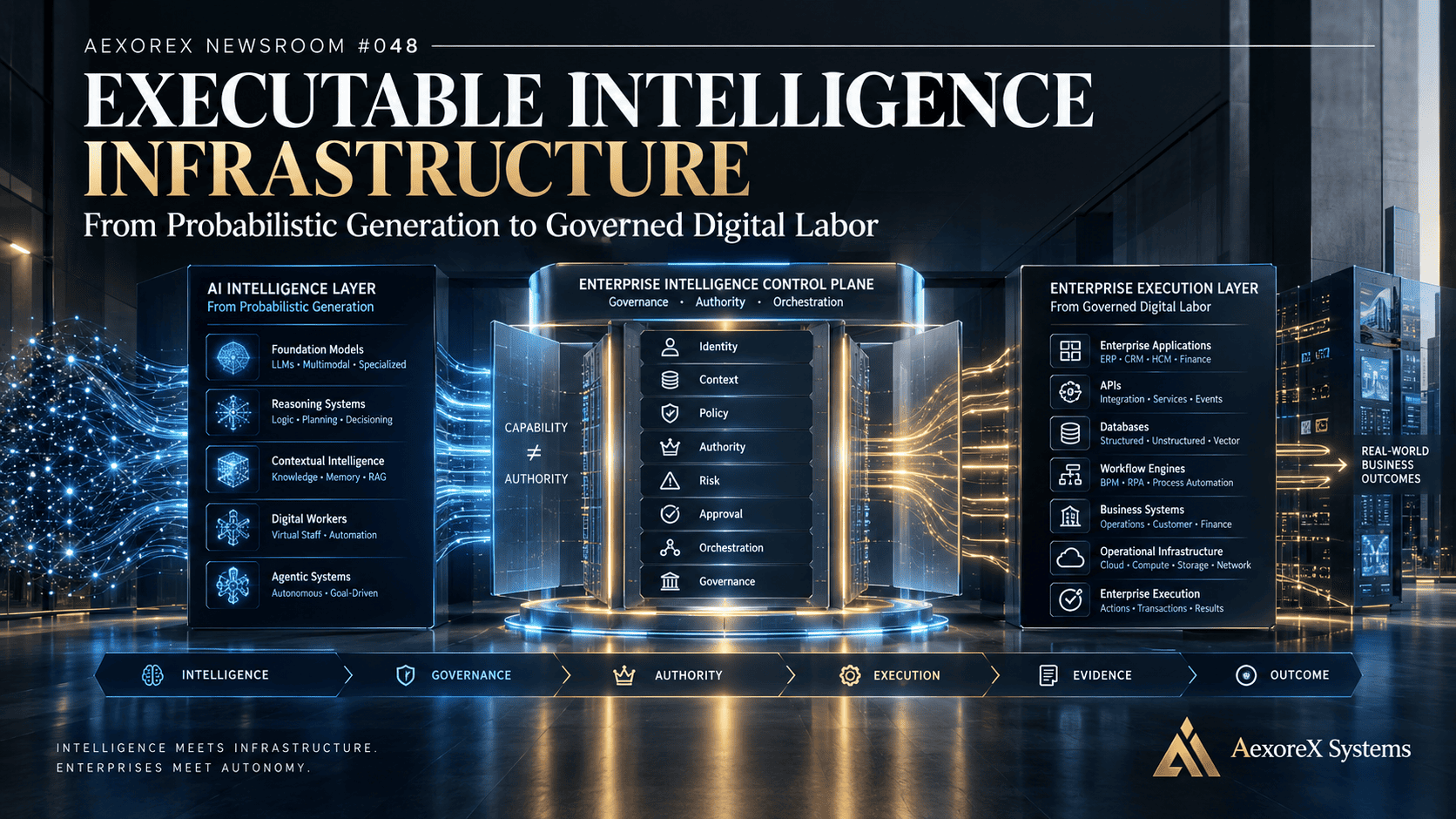
Enterprise artificial intelligence is entering a new architectural phase. Previously, the primary focus of enterprise AI was generating information such as text, code, summaries, recommendations, analysis, and conversational responses.
The current phase is different. AI systems are increasingly being connected to enterprise applications, data, APIs, workflows, and operational tools. This enables them to retrieve information, select tools, initiate workflows, coordinate tasks, and, in some environments, contribute directly to business execution.
This shift changes the central enterprise question. It is no longer only, "How intelligent is the model?" Instead, it increasingly becomes, "What is the intelligence allowed to do, under which conditions, with what authority, and with what evidence?" This marks an architectural transition from AI that primarily generates outputs to intelligence infrastructure capable of participating in execution. At the core of this transition is a foundational principle: Capability ≠ Authority.
The Shift from Generation to Execution
Generative AI has created immense value by reducing the cost of producing information. However, information generation and enterprise execution are fundamentally different architectural problems. A model can generate a recommendation without altering the enterprise state. Conversely, an agent connected to a tool can potentially create a record, update a database, initiate a workflow, communicate with another system, or trigger a business process.
The moment intelligence crosses this boundary into execution, a new control problem emerges. The enterprise must be able to determine: - Who or what is acting? - What context is being used? - Which policy applies? - What authority has been delegated? - What level of risk is involved? - Is approval required? - Which tools are permitted? - What action was actually executed? - What evidence was produced? - What was the resulting outcome?
The answers to these questions cannot reside solely within a prompt; they must be embedded within the infrastructure.
Capability Is Not Authority
A highly capable AI system may possess the ability to perform an action, but this does not imply it should be authorized to do so. This distinction is often overlooked because modern AI systems increasingly combine reasoning, memory, tool use, planning, and execution.
However, enterprise authority is not an inherent property of intelligence. Authority is a governed relationship linking an actor, a context, a policy, a resource, an action, and an accountable organization. Therefore, the architecture of enterprise AI must separate "what an AI system can do" from "what that AI system is permitted to do." This separation becomes increasingly critical as organizations integrate digital labor into real operational environments.
The New Enterprise Execution Boundary
Traditional enterprise security architectures were primarily designed around human users, applications, services, and machines. Agentic systems introduce an additional operational actor: AI-driven digital labor. These systems can dynamically select tools, construct plans, call APIs, delegate tasks, and respond to changing contexts. This creates a new execution boundary between intelligence and the enterprise state.
A useful architectural lifecycle for this new boundary can be expressed as: Identity → Context → Policy → Authority → Risk → Approval → Execution → Evidence → Outcome. Each stage addresses a distinct question: - **Identity** establishes who or what is acting. - **Context** determines relevant information. - **Policy** establishes what is permitted. - **Authority** defines the permitted scope of action. - **Risk** evaluates potential consequences. - **Approval** determines whether human or higher-level authorization is required. - **Execution** performs the action. - **Evidence** records what occurred. - **Outcome** establishes what the action produced.
This is not merely an AI workflow; it is an enterprise control architecture designed for executable intelligence.
The Rise of the Governed Execution Layer
Enterprise organizations already manage complex technology stacks, including systems of record, identity platforms, integration platforms, workflow engines, databases, security controls, observability systems, and business applications. The emergence of AI agents does not eliminate these systems. Instead, it necessitates an additional coordination and governance layer capable of connecting intelligence to enterprise execution.
This layer must operate between intelligence and enterprise action. Its responsibility extends beyond mere orchestration; it must comprehend authorization, policy, risk, execution boundaries, approvals, evidence, and outcomes. This creates the potential for a new infrastructure category: Governed Execution Infrastructure. Its purpose is to make autonomous capability operationally accountable.
Protocols Are Becoming Part of the Infrastructure
The development of open protocols is another important aspect of this transition. The Model Context Protocol (MCP) has evolved beyond a simple mechanism for connecting models to tools and contextual resources. Its July 2026 specification introduced a stateless protocol core, multi-round-trip requests, authorization hardening, a formal extensions framework, and other changes designed to support larger-scale agentic infrastructure. Consequently, the MCP ecosystem is increasingly relevant to the infrastructure layer surrounding agentic applications.
The architectural implication is significant: AI systems do not have to remain isolated within individual applications. They can increasingly interact with standardized interfaces for tools, resources, and capabilities. Concurrently, agent-to-agent interoperability is developing as another layer of the ecosystem. This creates a potential future where enterprise intelligence is not merely a collection of isolated agents but a network. Agents can communicate, delegate, and call tools, allowing workflows to span organizational and technological boundaries.
However, interoperability alone does not foster trust. Connectivity addresses "Can these systems communicate?" Governance must answer "Should they be allowed to act?"
Digital Labor Changes the Unit of Enterprise Work
The concept of digital labor represents a deeper shift than simply adding an AI assistant to an existing application. While a conventional software workflow executes predefined logic, a digital labor system can potentially interpret context, reason about objectives, select tools, coordinate activities, and adapt its execution path. This introduces a spectrum of autonomy: - **Assistive intelligence:** The system recommends actions, which a human then executes. - **Supervised digital labor:** The system prepares and executes approved actions under defined controls. - **Bounded autonomous execution:** The system can independently execute predefined classes of actions within explicit authority boundaries. - **Federated digital labor:** Multiple digital workers and systems coordinate across enterprise domains.
The crucial question is not whether higher autonomy is technically feasible, but whether autonomy can remain bounded, observable, reversible (where appropriate), and accountable.
Governance Must Become Machine-Enforceable
Traditional governance often relies on policies, procedures, human interpretation, and periodic audits. However, agentic systems operate at machine speed, creating a fundamental mismatch. If an agent can make hundreds or thousands of decisions while interacting with enterprise systems, governance cannot depend exclusively on humans reviewing events afterward.
Policies increasingly require executable representations. Examples include: - Tool allowlists and denylists - Scoped permissions - Approval thresholds - Transaction limits - Environment restrictions - Data-access boundaries - Delegation constraints - Escalation rules - Expiration conditions - Execution monitoring - Emergency suspension mechanisms
This does not eliminate human oversight but rather shifts where that oversight occurs. Instead of placing the human solely at the end of the process, organizations can strategically position humans at critical decision boundaries. The result is not "human versus AI" but "human authority governing machine execution."
Evidence Becomes a First-Class Infrastructure Layer
Autonomous execution introduces another requirement: evidence. If an AI system performs an action, the organization needs more than just the final output. It may need to establish: - The identity of the acting system - The relevant context - The applicable policy - The authority available at that moment - The approval state - The tools invoked - The execution result - The state changes produced - The exceptions encountered - The final outcome
This differentiates between merely storing logs and constructing an execution evidence chain. Enterprise evidence should be designed to support investigation, accountability, operational learning, compliance processes, and system improvement. The objective is not to expose private model reasoning but to establish a reliable record of what the system was authorized to do, what it attempted, what it executed, and what happened as a result.
The Infrastructure Gap
The AI industry has made extraordinary progress in models. However, the enterprise infrastructure challenge is increasingly shifting elsewhere. Organizations require infrastructure capable of coordinating: Models → Agents → Tools → Workflows → Systems → Enterprise. Each layer introduces distinct requirements: - A model requires evaluation. - An agent requires identity and behavioral controls. - A tool requires permission boundaries. - A workflow requires orchestration. - A system requires transaction integrity. - An enterprise requires governance, accountability, and organizational authority.
This suggests that the next infrastructure opportunity may not be another model layer, but rather the layer that makes heterogeneous intelligence operationally manageable.
Vendor Independence Becomes Strategic
The enterprise AI environment is becoming increasingly multi-model and multi-platform. Organizations may utilize various foundation models, agent frameworks, SaaS platforms, integration systems, identity providers, databases, and infrastructure providers. Therefore, a long-term enterprise architecture cannot assume that a single vendor will permanently own every layer.
This underscores the strategic importance of Vendor Independence by Design™. The principle is straightforward: enterprise intelligence should be able to connect, orchestrate, govern, and activate existing enterprise capabilities without requiring the organization to abandon its current technology investments. The objective is not to replace the enterprise stack, but to make it more intelligent, connected, governable, and executable.
Regulation and Risk Are Becoming Architectural Inputs
Governance is also moving closer to the architecture itself. Frameworks like the NIST AI Risk Management Framework and its Generative AI Profile offer structured approaches for identifying and managing AI risks. NIST describes the AI RMF as intended for voluntary use, with its Generative AI Profile serving as a companion resource for organizations addressing risks associated with generative AI. Furthermore, regulatory requirements are becoming more specific in certain jurisdictions and use cases.
The implication is significant: governance cannot be treated as documentation added after a system has been built. For increasingly autonomous systems, governance must become an architectural property. Policy must be connected to execution, risk to authority, and evidence to outcomes.
From AI Agents to Enterprise Intelligence Infrastructure
The next generation of enterprise AI may be defined less by the number of agents an organization deploys and more by how effectively those agents operate within a governed enterprise environment. The architectural question becomes: "How can intelligence become executable without becoming uncontrolled?"
This question points toward a new infrastructure model where: - Intelligence provides capability. - Context provides understanding. - Policy provides boundaries. - Authority provides permission. - Orchestration provides coordination. - Execution provides action. - Evidence provides accountability. - Optimization provides continuous improvement.
This forms the foundation for enterprise digital labor.
The AexoreX Perspective
AexoreX Systems is exploring this transition through the architecture of AEOS QUANTUM™ — The Enterprise Intelligence Operating Platform for Autonomous Enterprises. The architectural direction centers on a simple principle: AEOS does not replace the enterprise stack; it connects, orchestrates, governs, and activates it.
The intended sequence is: Connect → Contextualize → Govern → Orchestrate → Authorize → Execute → Optimize. Evidence operates across the entire lifecycle rather than as a separate final step. This perspective treats enterprise intelligence not merely as an AI application, but as infrastructure for coordinating intelligence, systems, authority, execution, and outcomes.
The underlying proposition is deliberately straightforward: One Enterprise. One Intelligence. Unlimited Digital Labor. However, the phrase "Digital Labor" should not be interpreted as unrestricted autonomy. Digital labor must operate within defined authority. Capability must remain distinct from permission. Autonomy must remain bounded by governance. Execution must remain observable. And enterprise outcomes must remain accountable.
What Comes Next
The next phase of enterprise AI will likely involve several architectural developments occurring simultaneously: - AI models will continue to improve. - Agents will become more capable. - Protocols will become more interoperable. - Enterprise systems will expose more machine-accessible capabilities. - Digital labor will become more operational. - Identity and authorization will increasingly include non-human actors. - Governance will move closer to runtime execution. - Evidence will become increasingly important.
Enterprises will face a new architectural question: Who controls the boundary between intelligence and action? The answer may become one of the defining infrastructure decisions of the agentic era. The future enterprise will not simply contain AI; it will operate with intelligence. And once intelligence can act, the architecture surrounding that intelligence becomes as important as the intelligence itself.
AexoreX Systems Research Perspective: The transition from probabilistic generation to governed execution represents a broader change in how enterprise technology should be designed. The goal is not maximum autonomy, but useful autonomy under explicit authority. It is not intelligence without boundaries, but intelligence connected to context, governed by policy, bounded by authority, executed through controlled infrastructure, and measured through evidence and outcomes. This is the emerging foundation of Executable Intelligence Infrastructure.
AexoreX Systems The Global Enterprise Intelligence Infrastructure Company AEOS QUANTUM™ The Enterprise Intelligence Operating Platform for Autonomous Enterprises Build with Intelligence. Operate with Responsibility. Grow with Integrity. Share with Humanity.
Sources and attribution
- AexoreX Systems — AexoreX Newsroom · statement link
About the author
AexoreX Technology Desk is the newsroom's editorial desk covering enterprise technology, artificial intelligence, digital labor, automation, and emerging enterprise systems.
More from AexoreX Technology Desk →Related stories
- THE ENTERPRISE AGENT PROTOCOL AND IDENTITY SUBSTRATE
- Governing Autonomous Execution: Enterprise Control Planes and the Shift to Digital Labor
- THE AGENTIC PROTOCOL FABRIC
- From Enterprise Software to Enterprise Intelligence Infrastructure: The Architecture Behind AEOS QUANTUM™
- Enterprise Intelligence Infrastructure and Governed Autonomy: The Architectural Foundation for the Autonomous Enterprise
- THE SHIFT TO GOVERNED EXECUTION INFRASTRUCTURE
- Beyond AI: Building the Enterprise Operating Model for Intelligence, Digital Labor, Governance, and Execution.
- Enterprise Intelligence Infrastructure
- Governing Digital Labor: Bridging Capability and Authority in Autonomous Enterprise Architecture