
THE ENTERPRISE AGENT PROTOCOL AND IDENTITY SUBSTRATE
From Governed Execution Infrastructure to the Protocol, Identity, and Authority Layer of the Autonomous Enterprises
The autonomous enterprise is developing a new architectural layer: the Enterprise Agent Protocol and Identity Substrate, essential for governing AI agents.
Opinion · AI-assisted, human edited
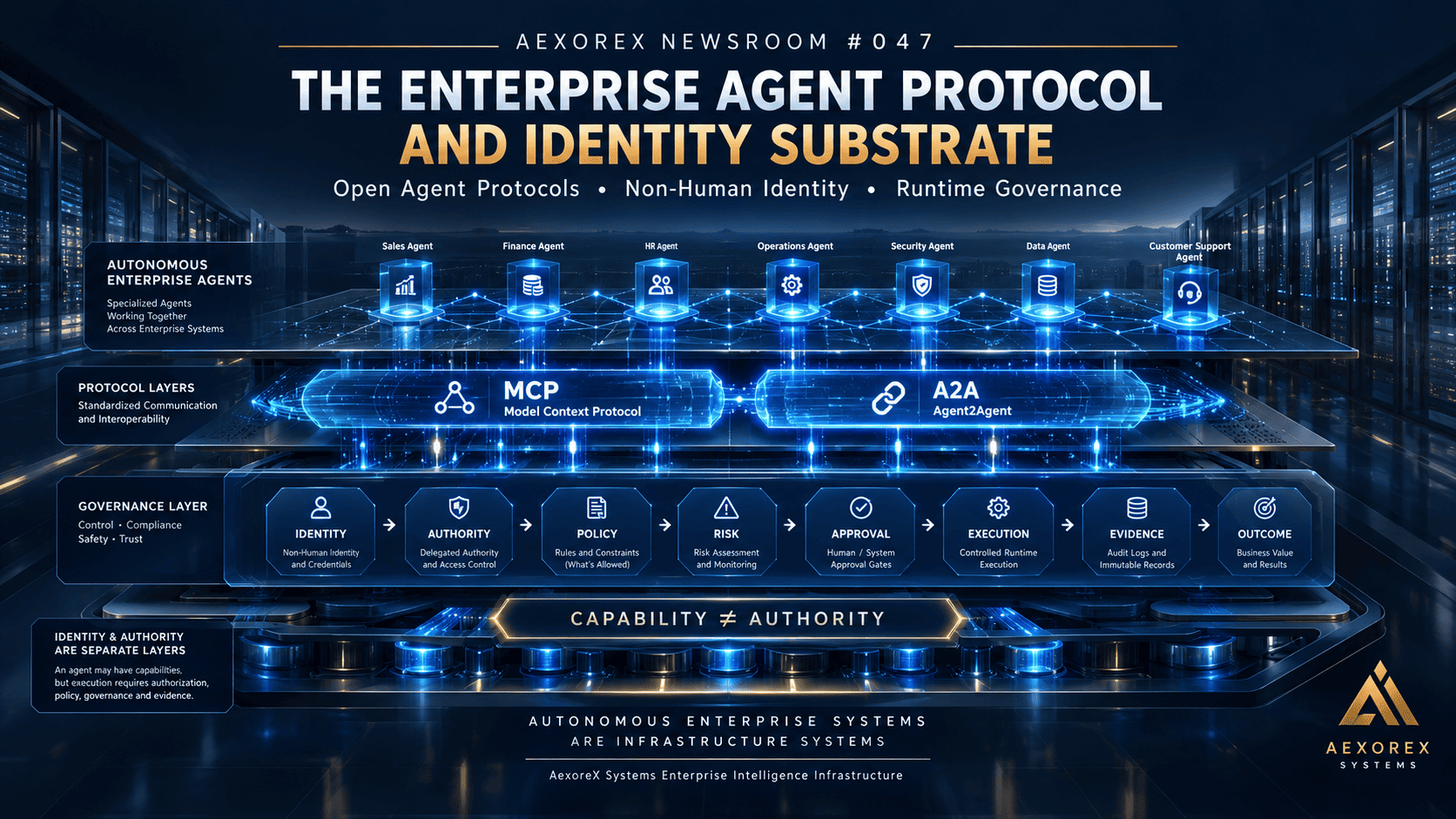
AEXOREX NEWSROOM #047
THE ENTERPRISE AGENT PROTOCOL AND IDENTITY SUBSTRATE
From Governed Execution Infrastructure to the Protocol, Identity, and Authority Layer of the Autonomous Enterprise
By AexoreX Research Desk Research · AI-assisted, human edited
---
EXECUTIVE SUMMARY
The enterprise AI architecture is entering its next structural phase.
The first question was whether AI models could understand, reason, generate, retrieve, and assist.
The next question was whether AI agents could use tools and execute workflows.
The question now is more fundamental:
How can an enterprise safely operate an expanding population of interconnected autonomous software actors?
This is the architectural problem emerging after governed execution.
As agents increasingly interact with tools, applications, data, workflows, and other agents, enterprises require infrastructure capable of establishing identity, standardizing communication, defining authority, enforcing policy, controlling execution, and preserving evidence.
A new substrate is therefore emerging beneath autonomous enterprise systems:
Protocol → Identity → Authority → Runtime Governance → Evidence
This substrate does not replace the enterprise application stack.
It provides the control and interoperability layer through which autonomous systems can operate across that stack.
Open protocols such as the Model Context Protocol (MCP) and Agent2Agent (A2A) illustrate the movement toward standardized agent communication. MCP has continued evolving toward scalable remote deployments and enterprise-oriented authorization and governance capabilities, while A2A provides an open interaction model for communication and collaboration between independent agents.
But interoperability alone does not create autonomy that an enterprise can trust.
Identity does not equal authority.
Capability does not equal authority.
And execution without evidence does not create accountability.
The autonomous enterprise therefore requires more than intelligent agents.
It requires an infrastructure capable of governing what those agents are allowed to do.
---
01 — THE NEXT STEP AFTER GOVERNED EXECUTION
The previous generation of enterprise AI concentrated primarily on intelligence.
Organizations compared models according to reasoning quality, retrieval accuracy, coding performance, multimodal capability, latency, context capacity, and cost.
Then agents changed the architectural equation.
Once an AI system can select tools, retrieve information, invoke APIs, modify records, trigger workflows, or delegate tasks, AI becomes part of the operational system.
That creates a new responsibility.
The enterprise must control not only what an AI system can understand, but also what it can cause to happen.
This is the foundation of governed execution infrastructure.
But governed execution creates another question:
What happens when there is not one agent, but hundreds or thousands of agents interacting across systems?
A single agent calling a single tool can be controlled relatively simply.
A distributed agent ecosystem is different.
One agent may delegate to another.
That second agent may invoke a third-party capability.
A tool call may cross an application boundary.
A workflow may involve several identities.
A decision may require human approval.
The final action may modify a critical enterprise system.
At that point, enterprise AI begins to resemble distributed computing.
And distributed systems require infrastructure.
---
02 — FROM AGENTS TO AGENT INFRASTRUCTURE
The autonomous enterprise is not simply an organization with more AI agents.
It is an enterprise in which software actors increasingly participate in operational processes.
That means the architectural unit is changing.
The enterprise must begin treating agents as operational participants rather than merely application features.
A meaningful autonomous actor needs to be distinguishable.
Its actions need context.
Its permissions need boundaries.
Its delegation needs traceability.
Its execution needs control.
Its outcomes need verification.
This produces a progression:
Model → Agent → Protocol → Identity → Authority → Execution → Evidence
The model provides intelligence.
The agent provides operational behavior.
The protocol provides interoperability.
Identity establishes the actor.
Authority defines what that actor may do.
Runtime governance evaluates the action.
Execution changes enterprise state.
Evidence establishes what actually happened.
The result is a fundamental shift:
AI is becoming infrastructure.
---
03 — THE PROTOCOL LAYER
Interoperability is one of the central challenges of multi-agent architecture.
If every agent framework, application, model provider, and enterprise system requires a proprietary integration mechanism, complexity increases rapidly.
Standardized protocols provide another path.
The Model Context Protocol is designed to standardize how AI applications interact with external tools, resources, and prompts.
A2A addresses a different architectural problem: communication and collaboration between independent agents.
A useful conceptual distinction is therefore:
MCP connects agents and AI applications to capabilities.
A2A connects agents to other agents.
They are complementary rather than interchangeable.
A2A v1.0 was released in March 2026 as a stable, production-ready standard for agent-to-agent communication, with capabilities including discovery, interaction negotiation, collaborative tasks, and communication across independently built agent systems.
The strategic significance is not that every enterprise must immediately adopt every protocol.
The deeper significance is architectural.
Standardized protocol boundaries can reduce dependence on individually engineered point-to-point integrations and make agent ecosystems more modular.
The architecture begins to resemble:
Agent → Protocol → Capability
and:
Agent → A2A → Agent
But protocol standardization does not eliminate enterprise complexity.
Authorization remains.
Business logic remains.
Policy remains.
Identity remains.
Observability remains.
Risk management remains.
Evidence remains.
The protocol provides the communication boundary.
The enterprise still has to govern what happens across that boundary.
---
04 — MCP ENTERS A NEW ARCHITECTURAL PHASE
MCP is particularly significant because its evolution increasingly addresses the requirements of remote and scalable deployments.
The July 28, 2026 MCP specification introduced a stateless protocol core, header-based routing, cacheable list responses, Multi Round-Trip Requests, authorization hardening, a formal extensions framework, and a defined feature lifecycle and deprecation policy.
This matters because enterprise infrastructure must scale beyond tightly coupled local execution patterns.
A stateless protocol core can make remote MCP infrastructure easier to distribute across ordinary HTTP infrastructure.
Header-based method and tool information also creates architectural opportunities for gateways to participate more directly in routing and authorization.
This enables a broader infrastructure pattern:
Agent
↓
Protocol Gateway
↓
Identity / Authorization
↓
Policy
↓
MCP Capability
↓
Enterprise System
The important distinction remains:
MCP is a protocol boundary, not an enterprise governance system by itself.
A protocol can define how communication occurs.
It does not independently determine whether a particular business action is legitimate.
That decision belongs to the enterprise control architecture.
---
05 — A2A AND THE EMERGENCE OF AGENT NETWORKS
A single agent operating inside a controlled environment is one architectural problem.
A network of agents is another.
Consider a simple enterprise scenario.
An orchestration agent receives a business request.
It delegates financial analysis to a specialized finance agent.
The finance agent requests information from another enterprise agent.
That agent uses a protocol connection to access an enterprise capability.
The capability returns information.
The finance agent evaluates the information.
The result returns to the orchestrator.
The orchestrator may then request authorization before an operational action occurs.
This creates a chain of delegation.
The enterprise must therefore be able to answer:
Who initiated the operation?
Which agent acted?
Who delegated the task?
Which identity was used?
Which authority was delegated?
Which policy applied?
What capability was invoked?
Was approval required?
What changed?
What was the final outcome?
Agent interoperability therefore creates a corresponding requirement:
Agent accountability.
A2A provides a common interaction model for independent agents, including discovery and collaborative task execution.
But interoperability must be surrounded by identity and governance.
Otherwise, the enterprise simply creates a more connected version of the same control problem.
---
06 — THE RISE OF FIRST-CLASS AGENT IDENTITY
Human identity infrastructure has existed for decades.
Workload and application identity infrastructure has matured alongside cloud computing.
The rise of autonomous agents introduces another category:
Agent identity.
An agent that can independently perform meaningful enterprise actions should not be treated merely as an anonymous API call.
The enterprise increasingly needs to establish:
- What is this agent?
- Who created it?
- Who sponsors it?
- What system owns it?
- What capabilities does it possess?
- What authority has been delegated?
- What policies govern it?
- How long should it exist?
- Who can modify it?
- Who can revoke it?
- What evidence must it generate?
Microsoft's Entra Agent ID architecture is one documented example of this direction, introducing agent-specific identity constructs and lifecycle, authorization, sponsorship, and governance relationships.
The broader architectural pattern is:
Create → Identify → Sponsor → Authorize → Operate → Monitor → Review → Revoke
This is the beginning of an identity plane for autonomous software actors.
---
07 — IDENTITY IS NOT AUTHORITY
This distinction is foundational.
An identity answers:
Who or what is acting?
Authority answers:
What is that actor permitted to do?
These are not the same question.
An agent may possess an identity.
It may possess credentials.
It may have access to a tool.
It may receive a delegated task.
None of these facts automatically establish unlimited authority.
The enterprise therefore needs to separate:
Identity Who or what is acting?
Capability What can the system technically perform?
Authority What is the system permitted to perform?
Accountability Who remains responsible for the actor and its lifecycle?
This produces the central principle of the emerging autonomous enterprise:
CAPABILITY ≠ AUTHORITY
An agent can be technically capable of executing a financial transaction without being authorized to execute it.
An agent can have access to a database without being authorized to modify every record.
An agent can call a privileged tool without possessing authority to invoke that capability in every context.
The architecture must therefore place authority between capability and execution.
---
08 — THE BLUEPRINT AND DELEGATION PROBLEM
As enterprises create larger populations of agents, reusable identity and configuration mechanisms become increasingly important.
But reusable configuration creates another governance surface.
If a template, blueprint, policy, or identity configuration establishes permissions for multiple agents, an error at the template level can propagate across many autonomous actors.
Centralization can improve consistency.
It can also increase blast radius.
This creates a new enterprise governance requirement:
The mechanism that creates agents must itself be governed.
Agent blueprints, templates, policies, credentials, delegated permissions, and identity configurations should therefore be treated as controlled enterprise assets.
They require:
- ownership
- sponsorship
- version control
- permission review
- separation of duties
- change monitoring
- lifecycle management
- auditability
- controlled deployment
- revocation mechanisms
The governance object is no longer only the agent.
It is also the infrastructure that creates and configures the agent.
---
09 — RUNTIME GOVERNANCE BECOMES THE CONTROL SURFACE
This is where #047 directly continues the architectural direction established in #046.
Static provisioning is insufficient for highly dynamic agentic systems.
An agent may choose a tool dynamically.
It may receive new information dynamically.
It may delegate dynamically.
It may encounter untrusted instructions inside data.
It may change its execution path based on runtime conditions.
Therefore, authorization cannot always be treated as a one-time decision made during provisioning.
The enterprise needs runtime evaluation.
A consequential action can be evaluated against:
Identity
↓
Context
↓
Requested Capability
↓
Target Resource
↓
Action Parameters
↓
Policy
↓
Risk
↓
Approval Requirement
↓
Execution
↓
Evidence
This turns the protocol gateway into more than a router.
It becomes a potential governance enforcement boundary.
This is the architectural bridge from:
Governed Execution Infrastructure
to:
Enterprise Agent Control Infrastructure.
---
10 — THE NEW SECURITY PERIMETER
Agentic systems create security surfaces that extend beyond conventional application boundaries.
Tool metadata.
External content.
Agent instructions.
Delegated tasks.
Credentials.
Protocol messages.
Identity inheritance.
Agent-to-agent communication.
Each can influence what an autonomous system attempts to do.
This means prompt injection should not be understood solely as a model-quality problem.
When an agent possesses operational capabilities, untrusted instructions can become an execution-control problem.
The enterprise response therefore has to be layered:
Model Safeguards
↓
Identity Controls
↓
Protocol Controls
↓
Policy Enforcement
↓
Runtime Risk Evaluation
↓
Human Approval Where Required
↓
Execution Controls
↓
Evidence
No individual layer is sufficient.
Security must move closer to the execution boundary.
---
11 — EVIDENCE BECOMES A FIRST-CLASS LAYER
Autonomous execution creates a fundamental accountability requirement:
The enterprise must be able to reconstruct what happened.
For consequential actions, organizations increasingly need to establish:
- who initiated the workflow
- which agent acted
- which identity was used
- which agent delegated the task
- which capability was invoked
- which resource was accessed
- which policy applied
- whether approval was obtained
- what action was executed
- what state changed
- what outcome resulted
This is more than conventional application logging.
It is an execution evidence chain.
The evidence architecture should connect:
Identity → Authority → Execution → Evidence → Outcome
Importantly, evidence should not be treated as an afterthought.
It should be designed into the execution architecture from the beginning.
Current MCP development itself shows that the protocol ecosystem is moving toward increasingly explicit governance and audit-related capabilities, with proposals in the broader specification process addressing areas such as tamper-evident audit records and signed execution records. These remain protocol-development directions rather than assumptions about universally available native capabilities.
That distinction matters.
The enterprise should not confuse:
protocol capability
with:
enterprise control capability.
---
12 — THE ENTERPRISE AGENT CONTROL STACK
The emerging architecture can now be represented as a complete enterprise stack.
LAYER 1 — INTELLIGENCE
Foundation models, reasoning systems, multimodal models, and specialized intelligence.
LAYER 2 — AGENT RUNTIME
Planning, memory, reasoning, tool selection, workflow execution, and task management.
LAYER 3 — PROTOCOL
MCP, A2A, and other standardized communication mechanisms.
LAYER 4 — IDENTITY
Human identity, workload identity, application identity, non-human identity, and agent identity.
LAYER 5 — AUTHORITY
Scopes, permissions, delegation, policy, approval, and decision rights.
LAYER 6 — RUNTIME GOVERNANCE
Risk evaluation, policy enforcement, intervention, isolation, execution controls, and escalation.
LAYER 7 — EVIDENCE
Audit trails, provenance, execution records, delegation history, and outcome verification.
LAYER 8 — ENTERPRISE SYSTEMS
ERP, CRM, HR, finance, security, infrastructure, data platforms, SaaS applications, and operational systems.
This creates a critical architectural insight:
The autonomous enterprise is becoming a stack, not a model.
---
13 — FROM #046 TO #047
The progression between these editions is deliberate.
#046
THE SHIFT TO GOVERNED EXECUTION INFRASTRUCTURE
The central question:
How do enterprises control what increasingly capable AI systems can execute?
#046 established the execution-control problem.
#047 moves one layer deeper.
The question becomes:
What infrastructure allows those controls to operate across interconnected autonomous actors?
That requires:
Protocol
How do agents communicate?
Identity
Who or what is acting?
Authority
What is the actor permitted to do?
Runtime Governance
Should this action be allowed under the current context?
Evidence
What proves what happened?
Therefore:
#046 = CONTROL THE EXECUTION
#047 = BUILD THE SUBSTRATE THAT MAKES CONTROL POSSIBLE
This is the architectural continuity.
---
14 — WHAT IS REAL TODAY?
Enterprise leaders should distinguish implementation reality from architectural possibility.
AVAILABLE TODAY
Organizations can already implement:
- standardized agent-to-tool interaction
- enterprise identity and authorization
- workload and non-human identity
- agent-to-agent communication standards
- runtime policy enforcement
- conventional audit systems
- human approval workflows
- controlled automation
MCP "2026-07-28" is now a released specification, while A2A v1.0 is a stable released standard.
EMERGING
The industry is rapidly developing:
- scalable remote protocol infrastructure
- agent-specific identity governance
- protocol-aware gateways
- dynamic authorization
- runtime agent governance
- standardized agent discovery
- stronger execution evidence models
MCP's current roadmap explicitly continues work around transport evolution, agent communication, governance maturation, and enterprise readiness.
STILL REQUIRING ENTERPRISE ENGINEERING
No open protocol automatically solves:
- business authorization
- organizational accountability
- risk classification
- approval thresholds
- enterprise policy
- outcome validation
- segregation of duties
- cross-system governance
These remain enterprise architecture responsibilities.
LONG-TERM POSSIBILITY
A mature autonomous enterprise may eventually support large-scale agent ecosystems in which agents discover capabilities, delegate work, negotiate execution constraints, and operate across organizational boundaries.
But these remain architectural possibilities.
They should not be confused with universally established enterprise capabilities.
---
15 — WHAT THIS MEANS FOR ENTERPRISE TECHNOLOGY LEADERS
CIO
The strategic question becomes:
How can the enterprise scale autonomous work without creating uncontrolled technology fragmentation?
Protocol standardization may become an important architectural consideration when evaluating agent platforms and integration strategies.
CTO
The architectural question becomes:
How should agent infrastructure scale as autonomous workloads become distributed systems?
This includes protocol gateways, identity-aware execution, asynchronous workflows, observability, resilience, and policy enforcement.
CISO
The security question becomes:
How do we govern software actors that can dynamically access information, invoke capabilities, and delegate work?
This extends identity and Zero Trust principles into the agent layer.
CHIEF AI OFFICER
The governance question becomes:
Which decisions may an agent recommend, which may it make, and which may it execute?
That requires explicit authority models rather than assumptions based solely on model capability.
---
16 — THE AEXOREX SYSTEMS INTERPRETATION
For AexoreX Systems, the significance of this transition is architectural.
Enterprise intelligence cannot become enterprise autonomy without enterprise control.
AEOS QUANTUM™ therefore follows a deliberate operating sequence:
CONNECT → CONTEXTUALIZE → GOVERN → ORCHESTRATE → AUTHORIZE → EXECUTE → OPTIMIZE
With Evidence operating across the lifecycle.
The emerging agent infrastructure maps naturally onto this architecture.
CONNECT
Open protocols establish standardized interfaces between intelligence, tools, agents, and enterprise systems.
CONTEXTUALIZE
Agents obtain the information required to understand the situation, task, and operating environment.
GOVERN
Enterprise policy defines the boundaries within which autonomous behavior may occur.
ORCHESTRATE
Agents, workflows, systems, and digital labor coordinate across operational processes.
AUTHORIZE
Identity, policy, delegation, risk, and approval determine whether an action is permitted.
EXECUTE
The authorized action is performed within a controlled operational environment.
OPTIMIZE
Evidence and outcomes inform continuous improvement.
This creates a fundamental AEOS principle:
Capability ≠ Authority.
The ability to perform an action must remain distinct from the authority to perform that action.
---
17 — VENDOR INDEPENDENCE BY DESIGN™
The emergence of open agent protocols also creates a strategic architectural opportunity.
If communication between agents, models, tools, and systems becomes increasingly standardized, enterprises may be able to replace individual components without reconstructing the entire integration architecture.
This does not eliminate vendor dependency.
It changes where dependency exists.
The strategic objective is to prevent the enterprise intelligence architecture from becoming inseparable from the private integration model of a single provider.
This is the architectural rationale behind:
Vendor Independence by Design™
AEOS QUANTUM™ does not need to replace the enterprise stack.
Its role is to connect, contextualize, govern, orchestrate, authorize, execute, and optimize across it.
The enterprise retains its systems.
The intelligence layer becomes more interoperable.
The control layer becomes more explicit.
The execution layer becomes more governed.
---
18 — THE EMERGING ENTERPRISE CONTROL PLANE
The industry has spent decades building identity infrastructure for people.
It has built workload identity for software.
It has standardized network communication.
It has built API gateways.
It has developed policy engines.
It has created observability and audit infrastructure.
The agentic era is now bringing these concepts together around autonomous software actors.
The resulting architecture can be represented as:
HUMAN IDENTITY
↓
AGENT / NON-HUMAN IDENTITY
↓
PROTOCOL
↓
CONTEXT
↓
AUTHORITY
↓
RUNTIME POLICY
↓
RISK
↓
APPROVAL
↓
EXECUTION
↓
EVIDENCE
↓
OUTCOME
This is more than another AI feature category.
It represents the emergence of an enterprise control plane around autonomous execution.
---
CONCLUSION — FROM INTELLIGENT SOFTWARE TO GOVERNED DIGITAL LABOR
The autonomous enterprise will not emerge simply because AI models become more intelligent.
It will emerge when intelligence can operate inside infrastructure capable of establishing identity, defining authority, controlling execution, and producing evidence.
MCP demonstrates the continuing movement toward standardized interaction between AI applications and capabilities.
A2A demonstrates the movement toward interoperable communication and collaboration between independent agents.
Agent identity infrastructure demonstrates the need to treat autonomous software actors as identifiable enterprise principals.
Runtime governance demonstrates that authorization must increasingly account for context and execution conditions.
Evidence establishes the accountability layer required after autonomous execution.
Together, these developments point toward a structural transition:
From AI applications to agent infrastructure.
From isolated agents to agent networks.
From credentials to governed identities.
From capability to explicit authority.
From execution to evidenced execution.
And ultimately:
FROM INTELLIGENT SOFTWARE TO GOVERNED DIGITAL LABOR.
The next generation of enterprise architecture will therefore not be defined solely by which model an organization deploys.
It will increasingly be defined by the infrastructure surrounding that model:
Who can act.
What they can access.
What they are authorized to do.
Under which policy.
Under whose accountability.
What happens at runtime.
And what evidence proves the result.
That is the emerging Enterprise Agent Protocol and Identity Substrate.
And as autonomous enterprise systems mature, this substrate may become one of the foundational architectural layers through which intelligence is transformed into governed, accountable, and scalable digital work.
---
AexoreX Systems Enterprise Intelligence Infrastructure
AEOS QUANTUM™ The Enterprise Intelligence Operating Platform for Autonomous Enterprises
Connect. Contextualize. Govern. Orchestrate. Authorize. Execute. Optimize.
Evidence across the lifecycle.
Capability ≠ Authority.
Vendor Independence by Design™
Sources and attribution
- AexoreX Research Desk · statement link
About the author
AexoreX Technology Desk is the newsroom's editorial desk covering enterprise technology, artificial intelligence, digital labor, automation, and emerging enterprise systems.
More from AexoreX Technology Desk →Related stories
- Protocol-Governed Enterprise Authority
- Governing Autonomous Execution: Enterprise Control Planes and the Shift to Digital Labor
- The Non-Human Identity Shift: Why Enterprise Autonomy Demands a Governed Control Plane
- The Non-Human Identity Control Plane: Dynamic Authority and Traceable Delegation for Autonomous Enterprise Operations
- The Identity-to-Execution Seam: Governing Non-Human Identities and Dynamic Delegation in Autonomous Enterprise Operations
- AexoreX Systems Introduces AEOS Enterprise Authority™ as Governance Layer for Autonomous Enterprise Intelligence
- Enterprise Intelligence Infrastructure and Governed Autonomy: The Architectural Foundation for the Autonomous Enterprise
- Governing Digital Labor: Bridging Capability and Authority in Autonomous Enterprise Architecture
- Identity & Context: The First Layer of Enterprise Intelligence