
THE AUTONOMOUS ENTERPRISE CONTROL PLANE
From Enterprise Authority to Governed Autonomous Execution Research Series #059 | Enterprise Intelligence · AI Infrastructure · Autonomous Enterprise Architecture
AexoreX proposes the Autonomous Enterprise Control Plane, an architectural synthesis to govern intelligent systems by separating AI capability from enterprise authority, ensuring accountable execution.
Opinion · AI-assisted, human edited
Executive Thesis
Enterprise artificial intelligence is entering a new architectural era. The primary challenge is no longer just whether an AI system can understand information, generate content, reason over data, or call a tool. The more difficult question is: What is an intelligent system actually permitted to do within the enterprise, and how can the enterprise continuously verify that this permission was granted?
As AI systems transition from assistants to agents, and from isolated agents to coordinated agentic systems, intelligence increasingly links to identity, authority, enterprise data, APIs, workflows, applications, infrastructure, and operational decisions. This fundamental shift redefines the architecture of enterprise AI.
A model can possess capability without possessing authority. An agent can possess identity without possessing permission. A credential can grant access without establishing business legitimacy. A permission can allow an action without proving its appropriateness in a specific context. An executed action can be technically successful without being adequately governed, observable, or accountable.
This creates a critical architectural distinction: Capability ≠ Identity ≠ Authority ≠ Permission ≠ Execution ≠ Accountability.
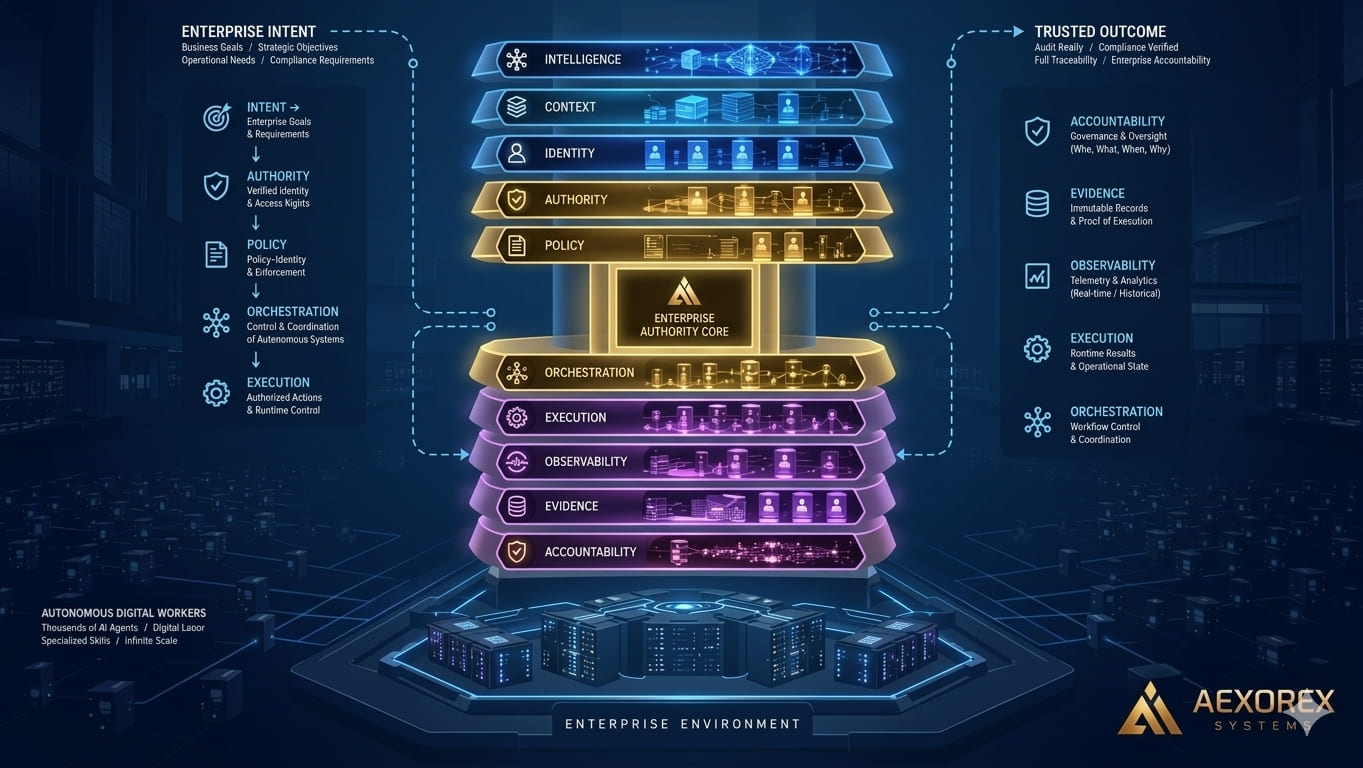
Therefore, the autonomous enterprise requires more than just intelligent models and agent frameworks. It needs a control architecture that connects: Intelligence → Context → Identity → Authority → Policy → Orchestration → Execution → Observability → Evidence → Accountability.
AexoreX Systems conceptualizes this emerging architecture as the Autonomous Enterprise Control Plane. This is not presented as an established industry standard or universally accepted product category. Instead, it is an architectural synthesis: a proposed control layer situated between enterprise intelligence and enterprise execution. Its simple purpose is to allow intelligent systems to act without allowing intelligence itself to become the authority.
01 — Why #059 Follows #058
Previous research in this series established a foundational architectural problem: The Enterprise Authority Architecture. The central realization was that enterprise AI cannot safely transition directly from capability to execution. The missing layer is authority.
AI systems may be capable of: - making recommendations; - selecting tools; - initiating workflows; - calling APIs; - coordinating other agents; - modifying records; - triggering transactions; - creating software; - managing operational processes.
However, capability alone does not establish whether these actions are legitimate. Therefore, #059 advances the discussion one architectural level further. If #058 asks, "How should enterprise authority be structured?" then #059 asks, "How does that authority become enforceable at runtime across autonomous systems?"
This distinction is crucial. Authority that exists only in documentation is insufficient for autonomous execution. Policies that cannot influence runtime behavior are merely governance intentions, not executable controls. Identity that cannot be tied to authorization is simply identification. Logging that occurs after an uncontrolled action provides evidence of what happened, but not necessarily control over what was allowed to happen.
Consequently, the autonomous enterprise requires an operational control plane capable of connecting authority with execution.
02 — The Architectural Shift
Enterprise AI has progressed through several architectural stages:
- **Stage 1 — Model Intelligence:** The system generates or interprets information.
- **Stage 2 — AI Assistance:** The system interacts with humans and provides recommendations.
- **Stage 3 — Tool-Using Agents:** The system can call tools, APIs, databases, and applications.
- **Stage 4 — Agentic Workflows:** The system can plan and execute multi-step processes.
- **Stage 5 — Multi-Agent Coordination:** Multiple agents can exchange information, delegate tasks, and coordinate activities.
- **Stage 6 — Persistent Digital Labor:** AI systems increasingly operate as continuously available digital workers.
- **Stage 7 — Autonomous Enterprise Infrastructure:** AI becomes embedded directly in operational execution.
At Stage 7, the architecture changes fundamentally. The enterprise is no longer simply deploying AI applications; it is deploying software entities capable of acting within the enterprise. This means traditional questions like "Which model should we use?" become only one part of a much larger architecture.
The enterprise must also answer: - Who is the agent? - What identity does it operate under? - Who or what delegated its authority? - What authority does it currently possess? - What policy governs the authority? - What context was considered? - Which tools can it use? - Which systems can it affect? - What actions require approval? - What actions can be autonomous? - What evidence must be generated? - How can the action be reconstructed later? - Who is accountable?
This represents the transition from AI infrastructure to autonomous execution infrastructure.
03 — The Problem With Capability-First AI
The prevailing AI architecture often begins with capability. A model becomes more capable. A framework facilitates agent creation. A tool connector grants the agent access to an application. An orchestration layer enables multi-step workflows. A credential permits access. The system can then execute. This architecture appears efficient.
However, capability-first design creates a dangerous assumption: If the system can perform an action, the system should be able to perform that action. This assumption is unacceptable for critical enterprise operations.
Consider an agent capable of: - creating purchase orders; - changing customer records; - modifying cloud infrastructure; - deploying software; - sending external communications; - approving expenses; - changing security configurations; - initiating financial processes.
The mere existence of technical capability does not establish business authority. Therefore, the enterprise needs a clear separation between what the system can technically do and what the system is authorized to do at any given moment. This is the architectural meaning of: CAPABILITY ≠ AUTHORITY.
04 — Capability, Identity, Authority, Permission, Execution and Accountability
These concepts should not be conflated into a single security object.
- **Capability:** What the system is technically able to do.
- **Identity:** Which entity, workload, agent, user, service, or delegated actor is making the request.
- **Authority:** What the enterprise has legitimately empowered that actor to decide or initiate.
- **Permission:** The specific access or operation allowed under a policy.
- **Execution:** The actual action performed against an enterprise resource.
- **Evidence:** The information required to demonstrate what happened and under what conditions.
- **Accountability:** The responsibility assigned to the human, organization, process, or governance structure behind the action.
A mature autonomous enterprise must connect all seven. Otherwise, an enterprise may know, "The API call succeeded," without being able to answer, "Why was this agent allowed to make that call?" This is not merely an observability problem; it is an authority problem.
05 — The Autonomous Enterprise Control Plane
AexoreX proposes the following ten-plane conceptual architecture:
``` ┌─────────────────────────┐ │ 10 ACCOUNTABILITY │ └────────────▲────────────┘ │ ┌────────────┴────────────┐ │ 09 EVIDENCE │ └────────────▲────────────┘ │ ┌────────────┴────────────┐ │ 08 OBSERVABILITY │ └────────────▲────────────┘ │ ┌────────────┴────────────┐ │ 07 EXECUTION │ └────────────▲────────────┘ │ ┌────────────┴────────────┐ │ 06 ORCHESTRATION │ └────────────▲────────────┘ │ ┌────────────┴────────────┐ │ 05 POLICY │ └────────────▲────────────┘ │ ┌────────────┴────────────┐ │ 04 AUTHORITY │ └────────────▲────────────┘ │ ┌────────────┴────────────┐ │ 03 IDENTITY │ └────────────▲────────────┘ │ ┌────────────┴────────────┐ │ 02 CONTEXT │ └────────────▲────────────┘ │ ┌────────────┴────────────┐ │ 01 INTELLIGENCE │ └─────────────────────────┘ ```
This diagram does not imply that every enterprise must deploy ten physically separate products. The planes represent architectural responsibilities. They may be implemented through multiple technologies, platforms, services, or integrated control mechanisms.
The fundamental relationships are: Authority flows toward execution. Evidence flows back toward accountability. Intelligence proposes. Context informs. Identity establishes who or what is acting. Authority determines what that actor may decide. Policy constrains that authority. Orchestration coordinates the work. Execution performs the action. Observability records runtime behavior. Evidence establishes what actually occurred. Accountability connects the event to responsibility. This creates a closed control loop.
06 — Plane 01: Intelligence
The intelligence plane encompasses systems responsible for reasoning, generation, planning, classification, prediction, recommendation, and decision support. This may include: - foundation models; - specialized models; - reasoning systems; - retrieval systems; - agent planners; - domain intelligence; - machine learning systems.
However, intelligence remains solely the cognitive layer. A more capable model does not automatically become a more authorized enterprise actor. This distinction becomes increasingly important as models gain the ability to plan actions rather than just generating responses. Enterprises should therefore avoid making intelligence itself the authority boundary.
07 — Plane 02: Context
Intelligence without context can lead to inappropriate actions. Context determines the conditions surrounding an action. Examples include: - user identity; - organizational role; - business unit; - transaction value; - geographic jurisdiction; - customer status; - operational state; - time; - resource sensitivity; - current risk; - previous actions; - approval status; - regulatory requirements.
Therefore, authorization cannot always be static. The same agent may be authorized to perform one action under one set of conditions and prohibited from performing the same action under another. This necessitates contextual authorization.
08 — Plane 03: Identity for Autonomous Systems
Human identity has historically been the dominant assumption for enterprise access control. Autonomous systems introduce additional identity classes. An enterprise may need to distinguish between: - human users; - service accounts; - workloads; - agents; - sub-agents; - autonomous processes; - delegated identities; - external agents; - temporary execution identities.
The challenge is not merely assigning an identifier. The enterprise must establish: Who is this entity, who does it represent, and under what delegation is it acting? NIST's 2026 work on software and AI-agent identity and authorization reflects this emerging requirement, with an implementation use case focused on identifying, authenticating, and authorizing AI agents within DevSecOps environments. Therefore, identity is becoming an infrastructure concern for agentic systems, not simply an application feature.
09 — Plane 04: Authority
Identity answers, "Who are you?" Authority answers, "What are you empowered to decide or initiate?" These are fundamentally different questions. An agent may have a valid identity while possessing no authority to approve a transaction. A service may have access to an API but no authority to modify a particular record. A user may delegate authority to an agent without transferring all of the user's own privileges.
Authority therefore needs explicit representation. A mature authority model should be able to express: - scope; - purpose; - duration; - delegation; - limits; - conditions; - risk thresholds; - approval requirements; - escalation rules; - revocation; - accountability.
This is where the architecture moves beyond conventional access control.
10 — Plane 05: Policy
Policy translates enterprise intent into enforceable constraints. Traditional policies are often written for humans, such as "Purchases above a certain amount require approval." Autonomous infrastructure requires policies that can influence machines.
For example: ``` IF actor = procurement-agent AND purchase.category = approved AND amount <= delegated_limit AND supplier = approved AND risk = acceptable
THEN authorize execution
ELSE escalate for approval ```
The important architectural transition is from policy as documentation to policy as executable control. This does not mean every enterprise policy can or should be reduced to machine-readable rules. Human judgment remains necessary for ambiguous, strategic, or high-impact decisions. However, wherever deterministic controls are possible, policy should increasingly become machine-enforceable.
11 — Governance Must Become Executable Infrastructure
AI governance traditionally emphasizes: - principles; - documentation; - risk assessments; - responsible AI frameworks; - model evaluations; - human oversight.
These aspects remain important. However, autonomous execution introduces an additional requirement: Governance must be able to influence runtime behavior. A governance system that discovers an unauthorized action only after execution is primarily a detection mechanism. A stronger architecture can prevent, constrain, approve, redirect, or revoke actions before or during execution.
This leads to a more operational model: Governance → Policy → Decision → Enforcement → Observation → Evidence → Review. The enterprise therefore begins moving from governance as a static discipline toward governance as runtime infrastructure. This is one of the most significant architectural shifts in autonomous enterprise computing.
12 — Policy-as-Code
Policy-as-code provides an important bridge between governance and execution. The principle is straightforward: If a rule must consistently control machine behavior, the rule should be represented in a form machines can evaluate.
Examples include: - access control; - resource boundaries; - data classification; - deployment restrictions; - spending limits; - environment restrictions; - geographic controls; - approval thresholds; - escalation conditions.
However, policy-as-code is not equivalent to governance itself. Code can enforce a rule, but it cannot by itself establish whether the rule is ethically, legally, or strategically appropriate. Therefore, the architecture needs both human-defined governance and machine-enforced policy.
13 — Plane 06: Orchestration
Autonomous enterprise work rarely consists of a single action. A task may involve: - receiving an objective; - interpreting context; - selecting an agent; - selecting tools; - obtaining authority; - executing multiple actions; - handling exceptions; - requesting additional authorization; - coordinating another agent; - producing evidence.
Orchestration determines how these activities are coordinated. This is where agent frameworks, workflow engines, event systems, APIs, task queues, and enterprise automation platforms can participate. However, orchestration should not accidentally become the authority boundary. An orchestration engine can coordinate an action without being the ultimate source of authority. That authority should remain governed independently.
14 — Plane 07: Controlled Enterprise Execution
Execution is where abstract intelligence translates into real-world consequences. The agent may: - call an API; - update a database; - invoke a workflow; - deploy software; - modify infrastructure; - create a business transaction; - communicate externally; - trigger another agent.
This is the point at which autonomous systems become operationally significant. Therefore, the execution layer should enforce the decisions made by the authority and policy layers. A useful conceptual model is: Intelligence proposes. Authority permits. Policy constrains. Execution acts. This prevents a model, agent framework, or tool connector from becoming an accidental authority system.
15 — Runtime Authority
Static permissions are increasingly insufficient for autonomous systems. An agent may require authority that changes dynamically based on: - task; - context; - risk; - time; - resource; - transaction value; - organizational state; - human approval; - current security posture.
This creates the concept of runtime authority. A conceptual authorization decision can be expressed as:
Authorization = Identity + Delegated Authority + Context + Policy + Risk + Resource + Action + Evidence Requirements
The result should not simply be ALLOW / DENY. It may also be: - allow; - allow with limits; - allow with additional approval; - allow only for specific resources; - allow temporarily; - redirect; - escalate; - deny; - revoke.
This represents a more realistic control model for autonomous enterprise systems.
16 — Plane 08: Observability
Traditional application observability asks: Is the service healthy? What was the latency? What failed? What was the error rate? Agentic systems introduce additional questions: - What did the agent attempt? - Which model was invoked? - Which tools were selected? - Which tool calls occurred? - What information influenced the action? - Which agent delegated the task? - How long did the reasoning/execution chain take? - Where did the workflow deviate? - Which authorization decision permitted execution?
OpenTelemetry's ongoing GenAI work illustrates this transition. Current semantic conventions cover GenAI operations and telemetry such as model calls, token usage, traces, and tool interactions, while agent observability conventions continue to evolve. This is important because autonomous systems require observability not only of infrastructure but also of behavioral execution chains.
17 — Plane 09: Evidence
Observability answers, "What happened?" Evidence must go further: "What can we prove about what happened?" Enterprise evidence may include: - actor identity; - authorization decision; - policy version; - context; - tool invocation; - input/output metadata; - timestamps; - approval records; - execution results; - system state; - delegation chain; - relevant telemetry; - integrity information.
Evidence becomes particularly important when autonomous systems perform consequential actions. The objective is not to record everything indiscriminately. The objective is to preserve the information necessary to reconstruct and validate important decisions and actions. This distinction matters. Telemetry is not automatically evidence. Evidence is telemetry organized around accountability, verification, and future reconstruction.
18 — Plane 10: Accountability
The final question is not, "Did the system work?" It is, "Who is accountable for the action?" Autonomous execution does not eliminate accountability; instead, it makes accountability architecture more crucial. A mature system should be capable of answering: - Which entity acted? - Under whose authority? - Under which policy? - With which delegation? - Based on which context? - Against which resource? - With what result? - What evidence was generated? - Which human or organizational owner was responsible?
The answer may not always be a single person. Accountability can exist at multiple levels: human → organization → process → agent → execution event. The architecture must preserve these relationships.
19 — Authority Down. Evidence Up.
This is one of the most important architectural principles in the model. Authority flows downward: Enterprise intent becomes Governance → Policy → Authority → Orchestration → Execution. Evidence flows upward: Operational activity becomes Execution → Observability → Evidence → Accountability. The two flows meet at runtime.
``` ENTERPRISE GOVERNANCE │ ▼ POLICY │ ▼ AUTHORITY │ ▼ ORCHESTRATION │ ▼ EXECUTION │ ▼ OBSERVABILITY │ ▼ EVIDENCE │ ▼ ACCOUNTABILITY ```
This creates a closed-loop autonomous enterprise. Without the downward control path, the enterprise cannot reliably govern execution. Without the upward evidence path, the enterprise cannot reliably prove what occurred.
20 — Security Implications
Agentic systems expand the attack surface. The risk is no longer limited to compromising a model. An attacker may attempt to influence: - prompts; - context; - tools; - credentials; - delegated authority; - agent-to-agent communication; - orchestration; - execution pathways; - supply-chain components.
OWASP's 2026 Top 10 for Agentic Applications explicitly treats agent goal hijacking, tool misuse, identity and privilege abuse, agentic supply-chain vulnerabilities, and unexpected code execution among the major risks associated with autonomous systems. This reinforces a broader architectural conclusion: Agent security is inseparable from identity, authority, execution, and observability. Security cannot remain isolated around the model. The security boundary must follow the agent through its entire execution lifecycle.
21 — Zero Trust Becomes Relevant to Autonomous Execution
Zero Trust architecture has already established a powerful principle: Access should be continuously evaluated rather than implicitly trusted based solely on network location. Autonomous agents extend the importance of this idea. An agent should not receive unlimited trust merely because: - it is inside the corporate network; - it uses an approved model; - it has an enterprise account; - it previously completed legitimate work.
The relevant question becomes: Is this specific action authorized under the current conditions? That naturally aligns autonomous execution with: - policy decision points; - policy enforcement points; - identity and access management; - continuous evaluation; - least privilege; - risk-aware controls.
The autonomous enterprise therefore does not replace Zero Trust; it extends its logic into machine-driven execution.
22 — Emerging Protocols and Standards
The autonomous enterprise will not be built by one protocol. Several emerging standards and initiatives address different parts of the architecture.
- **Model Context Protocol (MCP):** MCP focuses on connecting AI systems with tools and external context. Its 2026 specification continues to evolve around authorization, routing, stateless operation, and extensibility. MCP is highly relevant to the connectivity and tool-interaction layer, but it is not, by itself, an enterprise-wide authority architecture.
- **Agent2Agent (A2A):** Agent-to-agent protocols address interoperability between autonomous systems. They can help agents discover, communicate, and coordinate with one another. However, interoperability does not automatically establish authorization. An agent may be able to communicate with another agent without being authorized to perform a consequential operation.
- **Agent Identity:** NIST's 2026 agent identity and authorization work indicates that identity infrastructure is becoming an explicit research and implementation area for AI agents.
- **Observability:** OpenTelemetry is developing common conventions for GenAI and agent telemetry, providing an important foundation for interoperable observability.
- **Security:** OWASP is developing agent-specific security guidance and controls.
The industry is therefore assembling the components, but these components do not yet constitute one universally accepted autonomous enterprise control plane. That gap is strategically important.
23 — The Emerging Infrastructure Gap
The market already contains many categories: AI models, agent frameworks, workflow automation, IAM, PAM, API gateways, policy engines, SIEM, observability, governance platforms, security platforms, enterprise integration, and cloud infrastructure. The problem is that autonomous execution crosses all of them.
The enterprise therefore faces an architectural integration problem: - Who connects intelligence to identity? - Who connects identity to authority? - Who converts authority into runtime policy? - Who controls execution? - Who observes the complete chain? - Who creates evidence? - Who establishes accountability?
This is the potential role of the autonomous enterprise control plane. It is not another AI model, another workflow engine, another IAM system, or another observability dashboard. Rather, it is a coordinating control architecture that connects these capabilities around autonomous execution.
24 — Competitive Technology Landscape
The emerging landscape can be viewed through architectural responsibilities rather than vendor categories.
**Architectural Responsibility** | **Existing Technology Domains** ------------------------------- | -------------------------------- Intelligence | Foundation models, reasoning models, ML Context | RAG, data platforms, memory systems Identity | IAM, workload identity, agent identity Authority | Delegation, access control, authorization Policy | Policy engines, policy-as-code Orchestration | Agent frameworks, workflow engines Execution | APIs, automation, RPA, enterprise applications Observability | OpenTelemetry, APM, security analytics Evidence | Audit, logs, provenance, telemetry Accountability | Governance, risk, compliance, human oversight
The strategic opportunity does not necessarily belong to the company with the most components. It may belong to the architecture that can connect these responsibilities coherently without creating another closed ecosystem.
25 — Vendor Independence as an Architectural Requirement
Autonomous enterprise infrastructure will likely involve many providers. Different enterprises will use different: - models; - clouds; - identity systems; - ERP platforms; - CRM systems; - automation platforms; - databases; - security systems; - observability platforms.
A viable control plane therefore cannot assume that one vendor owns the entire enterprise. This leads to another strategic principle: Vendor Independence by Design. The control plane should govern capabilities across the enterprise stack rather than replacing the enterprise stack. The architectural objective is interoperability. The enterprise should be able to change models, tools, applications, and infrastructure without losing its authority model.
26 — Adoption Barriers
The transition toward autonomous enterprise infrastructure will not be primarily limited by model intelligence. Major barriers include: 1. **Identity fragmentation:** Agents may operate across multiple systems with different identity models. 2. **Authority ambiguity:** Enterprises may lack formal models for delegated machine authority. 3. **Legacy applications:** Many enterprise systems were designed around human users and static service identities. 4. **Policy fragmentation:** Business rules may exist across documents, applications, workflows, databases, and human processes. 5. **Observability gaps:** Traditional monitoring may not adequately capture agent reasoning and tool-use chains. 6. **Accountability ambiguity:** Organizations may not know who owns an autonomous action. 7. **Security uncertainty:** Agent-specific attack patterns continue to evolve. 8. **Interoperability:** Protocols are emerging, but the ecosystem is still evolving. 9. **Human oversight:** Not every decision should become autonomous. 10. **Organizational readiness:** Autonomous digital labor changes operating models, responsibilities, controls, and workforce processes.
The architecture therefore has to evolve with the organization.
27 — Four 2030 Enterprise Scenarios
These scenarios are strategic forecasts, not predictions.
**Scenario A — The AI Assistant** AI primarily supports humans. The human remains the decision-maker. Architecture emphasis: Intelligence + Context + Human Oversight. Risk is relatively contained because execution authority remains limited.
**Scenario B — The Governed Digital Workforce** Agents perform repeatable operational work. They receive bounded authority and operate within explicit policies. Examples may include finance operations, customer operations, IT operations, procurement, software operations, and compliance workflows. Architecture emphasis: Identity + Authority + Policy + Execution + Evidence. This is the likely transition point where autonomous enterprise control becomes essential.
**Scenario C — Persistent Enterprise Operators** Agents become continuously available digital operators. They monitor systems, identify events, initiate workflows, coordinate tools, and escalate exceptions. Architecture emphasis: Continuous authorization + runtime governance + observability + evidence. The enterprise effectively gains a persistent digital workforce.
**Scenario D — Autonomous Multi-Agent Execution Networks** Multiple specialized agents coordinate across organizational and enterprise boundaries. One agent may identify a requirement; another may analyze the requirement; another may negotiate or execute; another may validate; another may monitor the result. Architecture emphasis: Inter-agent identity + delegation + authority propagation + policy enforcement + evidence. At this stage, autonomous execution infrastructure becomes a strategic enterprise capability.
28 — The Strategic Competition May Change
For the first phase of generative AI, competition centered heavily on: Who has the most capable model? The next phase increasingly asks: Who can build the most capable agent? The following phase asks: Who can deploy the most reliable agentic system?
But the autonomous enterprise may ultimately ask something different: Who can build the most trustworthy autonomous execution infrastructure? That is a different competitive dimension. Intelligence remains essential, but it becomes only one component of enterprise autonomy. The strategic advantage may increasingly come from the ability to combine: Intelligence + Identity + Authority + Policy + Execution + Evidence.
29 — CIO and CTO Implications
Enterprise technology leaders should begin asking questions beyond model selection.
- **Architecture:** Where does autonomous authority live?
- **Identity:** How are agents identified and authenticated?
- **Delegation:** How does a human or organization delegate authority to an agent?
- **Policy:** Which decisions can be automated?
- **Execution:** Which actions can occur without human approval?
- **Risk:** What actions require escalation?
- **Observability:** Can the complete execution chain be reconstructed?
- **Evidence:** Can the organization prove why an action was allowed?
- **Accountability:** Who owns the outcome?
- **Interoperability:** Can the architecture survive changes in models, vendors, and protocols?
These questions should become part of enterprise AI architecture reviews.
30 — What Enterprise Architecture Must Become
Traditional enterprise architecture often maps: Applications → Data → Integration → Infrastructure. Autonomous enterprise architecture adds another dimension: Authority → Decision → Execution → Evidence.
This means enterprise architects will increasingly need to model not only systems, data, integrations, and identities, but also: - machine actors; - delegated authority; - decision rights; - execution boundaries; - policy; - escalation; - evidence; - accountability.
The enterprise architecture repository of the future may therefore need to answer: Which intelligent systems are allowed to influence which enterprise resources under which conditions? That is fundamentally an authority graph.
31 — AexoreX Strategic Perspective
AexoreX Systems views autonomous enterprise architecture through a simple principle: AI capability should never be confused with enterprise authority. The enterprise does not need AI that can simply do more. It needs AI that can do the right things, under the right authority, within the right constraints, with the right evidence.
This leads to a broader architectural proposition: AEOS QUANTUM, The Enterprise Intelligence Operating Platform for Autonomous Enterprises, should not be understood merely as another AI application layer. The strategic direction is an enterprise intelligence infrastructure that connects: Connect → Contextualize → Govern → Orchestrate → Authorize → Execute → Optimize, with Evidence operating across the lifecycle.
Within that architecture: - intelligence provides capability; - context provides situational understanding; - governance establishes boundaries; - authority determines what may be done; - orchestration coordinates action; - execution produces enterprise outcomes; - optimization improves performance; - evidence establishes traceability.
The fundamental principle remains: Capability ≠ Authority. And therefore: Digital Labor has no intrinsic authority. Authority must be explicitly granted, bounded, evaluated, monitored, and revocable. This is the foundation of a governed autonomous enterprise.
32 — The Autonomous Enterprise Control Plane Is Not Another Stack
The objective is not to create another isolated technology stack. The enterprise already has: ERP, CRM, HR, finance, cloud, data, security, identity, automation, APIs, collaboration, and infrastructure. The autonomous enterprise control plane should connect these systems. Therefore: AEOS does not replace the enterprise stack. AEOS connects, orchestrates, governs, and activates it. This distinction is strategically important.
The future enterprise may contain hundreds or thousands of intelligent workers. The question is not whether all of them can work. The question is whether the enterprise can control how they work.
33 — The Final Architectural Principle
The autonomous enterprise should not be designed around the assumption: "Give the agent access and monitor what happens." It should be designed around: "Define authority, evaluate context, enforce policy, control execution, observe behavior, preserve evidence, and establish accountability."
This creates a fundamentally different architecture. The enterprise does not simply deploy intelligent systems. It deploys governed intelligent actors. That is the difference between agentic automation and autonomous enterprise infrastructure.
34 — Final Thesis
The next major transition in enterprise AI will not be defined solely by larger models, better reasoning, or more capable agents. It will be defined by the infrastructure surrounding those capabilities. As AI systems gain the ability to decide, delegate, coordinate, and execute, enterprises will need increasingly precise mechanisms for controlling what those systems are allowed to do.
The critical architectural chain therefore becomes: Capability → Identity → Authority → Policy → Orchestration → Execution → Observability → Evidence → Accountability.
The strategic question changes from: How intelligent is the AI? to: How precisely can the enterprise govern what intelligent systems are allowed to do? The organizations that solve this problem will be better positioned to move from AI assistance to governed digital labor, and from governed digital labor toward autonomous enterprise operations.
The autonomous enterprise will not emerge simply because machines become intelligent enough to act. It will emerge when enterprises build the infrastructure necessary to authorize, control, observe, prove, and govern machine action at scale. That is the emerging role of the Autonomous Enterprise Control Plane.
Intelligence may create the possibility of autonomy. Authority determines its legitimacy. Policy defines its boundaries. Execution creates its consequences. Evidence makes it provable. Accountability makes it governable.
And ultimately: The future of autonomous enterprise is not simply intelligent execution. It is governed execution at enterprise scale.
Key Insights
- Capability does not equal authority.
- Identity does not automatically establish permission.
- Permission does not automatically establish business legitimacy.
- Governance must increasingly influence runtime execution.
- Agent identity and authorization are becoming explicit infrastructure problems.
- Policy must increasingly become machine-enforceable where appropriate.
- Observability must extend from infrastructure health to agent behavior and execution chains.
- Evidence must support reconstruction and accountability, not merely logging.
- Interoperability protocols solve important connectivity problems but do not constitute complete enterprise authority architectures.
- Autonomous enterprise infrastructure requires a control plane connecting intelligence to accountable execution.
AexoreX Architectural Position
AexoreX Systems AEOS QUANTUM™ The Enterprise Intelligence Operating Platform for Autonomous Enterprises One Enterprise. One Intelligence. Unlimited Digital Labor. Capability ≠ Authority Vendor Independence by Design™ Digital Labor has no intrinsic authority. AEOS does not replace the enterprise stack. AEOS connects, orchestrates, governs, and activates it.
Research Classification
- **FACT:** Where the article describes documented standards, initiatives, protocols, regulatory requirements, or published security/observability work.
- **INTERPRETATION:** Where AexoreX synthesizes relationships among those developments.
- **STRATEGIC FORECAST:** Where the article discusses possible enterprise evolution toward 2030.
The Autonomous Enterprise Control Plane is presented as an AexoreX architectural synthesis, not as an established industry standard.
Research Sources
[1] NIST — AI Agent Standards Initiative [2] NIST — Software and Artificial Intelligence Agent Identity and Authorization [3] NIST — Zero Trust Architecture [4] Model Context Protocol — 2026-07-28 Specification [5] OWASP — Top 10 for Agentic Applications 2026 [6] OpenTelemetry — GenAI and Agent Observability [7] European Union — AI Act [8] Cloud Security Alliance — Agentic AI Identity and Access Management [9] Linux Foundation / A2A ecosystem [10] Relevant enterprise AI, security, identity, authorization, and interoperability research
Sources and attribution
- AexoreX Systems Research & Editorial Analysis · statement link
About the author
The editorial team behind AexoreX Newsroom, the official corporate publication of AexoreX Systems LLC.
More from AexoreX Systems Editorial Team →Related stories
- Governing Autonomous Execution: Enterprise Control Planes and the Shift to Digital Labor
- The Non-Human Authorization Crisis: Re-Architecting Identity, Governance, and Execution for Autonomous Enterprise Systems
- The Runtime Authority Control Plane: Why Enterprise AI Needs More Than Identity and Permissions
- The Autonomous Enterprise: From Intelligence to Governed Action
- The Non-Human Identity Shift: Why Enterprise Autonomy Demands a Governed Control Plane
- The Non-Human Identity Control Plane: Dynamic Authority and Traceable Delegation for Autonomous Enterprise Operations
- AexoreX Systems Defines the Enterprise Intelligence Control Plane for the Autonomous Enterprise
- AexoreX Systems Introduces AEOS Enterprise Authority™ as Governance Layer for Autonomous Enterprise Intelligence
- Enterprise Intelligence Infrastructure and Governed Autonomy: The Architectural Foundation for the Autonomous Enterprise